7 Best Resaw Blades for Bandsaws 2026
This post contains affiliate links. As an Amazon Associate, we earn from qualifying purchases.
The Timber Wolf 93.5″ 3/4″ Resaw Blade stands out as the best overall for its reliable tracking, clean cuts, and durable silicon steel construction. For those on a budget, the Timber Wolf 105″ 3/4″ Resaw Blade delivers strong performance without breaking the bank. If you’re working with dense hardwoods or need maximum edge life, the Dark Stone 93-1/2″ Carbide-Tipped blade offers serious longevity and aggressive cutting power.
Resawing isn’t just about slicing thick stock, it’s about doing it straight, smooth, and without burning or wandering. A poor blade can turn a simple job into a frustrating battle with heat, deflection, and rework.
This guide cuts through the noise by focusing on real-world performance factors: tooth geometry, blade width, material quality, and compatibility with your bandsaw. I researched top models based on specs, owner feedback, and years of working with saws in home shops and job sites. You’ll get clear insights on what actually matters when choosing a blade that performs.
Top 7 Resaw Blade For Bandsaws in the Market
The Best Resaw Blade For Bandsaws, Reviewed
Timber Wolf 93.5″ 3/4″ Resaw Blade

Strengths
- Milled 2-3 TPI teeth
- Induction hardened
- Low tension compatible
- 3/4 inch stability
- Smooth, quiet cut
Trade-offs
- Silicon steel wear rate
- Needs sharpening over time
- Not for constant hardwoods
If you’re looking for the best overall balance of performance, durability, and machine compatibility in a resaw blade, this Timber Wolf 93.5″ model is hard to beat. It brings all the brand’s signature advantages, milled teeth, induction hardening, and ductile steel, into a size that fits many popular 14-inch bandsaws, and the low-tension design makes it safe and stable even on older or lighter-duty machines. Owners consistently praise its clean cuts, smooth tracking, and ability to stay sharp over dozens of resawing sessions.
It won’t last as long as a carbide blade in oak or teak, but for most hobbyists and even light pro use, the difference isn’t worth the added cost and rigidity. Compared to the Dark Stone carbide options, it’s easier to maintain and more forgiving on setup. This is the blade I’d recommend to most buyers unless they’re resawing full-time.
Product photos
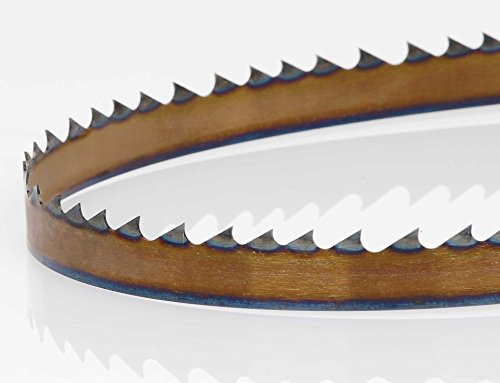
Timber Wolf 131.5″ 3/4″ Resaw Blade
Strengths
- Milled teeth precision
- Induction-hardened edge
- 2-3 TPI variable pitch
- Cooler running
- Long flex life
Trade-offs
- Silicon steel wears faster
- Not for abrasive materials
- Requires proper break-in
Timber Wolf has built a reputation for premium silicon steel blades, and this 131.5″ model is a favorite among resawing enthusiasts who want top-tier performance without stepping into carbide. The milled teeth are consistently noted in reviews as cutting noticeably cleaner right out of the box compared to stamped alternatives, and the precision induction hardening helps maintain that edge through long sessions. The 2-3 TPI variable pitch reduces harmonic vibration, which owners say results in smoother cuts and less blade chatter, especially when feeding uneven or knotty stock.
It’s not as durable as a carbide blade, but it’s far more forgiving on machines and easier to re-sharpen. For shops that balance hardwood resawing with softer exotics or laminates, this blade offers versatility without sacrificing too much on straightness or feed rate. Compared to the Dark Stone carbide versions, it won’t last as long in abrasive woods, but it’s a smarter buy if you’re not resawing 20 hours a week.
Product photos
Timber Wolf 105″ 3/4″ Resaw Blade
Strengths
- Low tension compatible
- 3/4 inch stability
- Milled 2-3 TPI teeth
- Induction hardened
- Ductile steel flex
Trade-offs
- Shorter length limits use
- Not for heavy production
- Still needs proper setup
This Timber Wolf 105″ blade fills a niche: it brings the brand’s high-end silicon steel performance to mid-size bandsaws that can’t handle high tension. The low-tension design is key, owners with 14-inch or older 16-inch saws praise how it tracks smoothly without overloading the frame or wheels. It still delivers the clean, straight cuts you expect from a 3/4″ resaw blade, thanks to that rigid width and precision-milled 2-3 TPI teeth.
The induction-hardened teeth stay sharp longer than most factory blades, and the added ductility in the steel means fewer fatigue cracks over time. It’s not the fastest-cutting blade in the lineup, but it’s one of the most reliable for hobbyists who resaw occasionally but demand professional results. Compared to the 131.5″ Timber Wolf, it’s less aggressive but better matched to lighter-duty machines.
Product photos
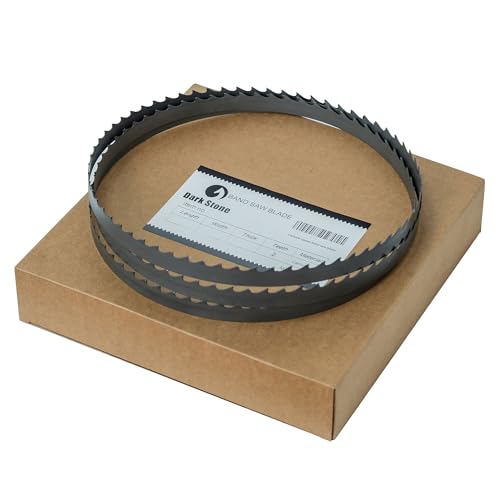
Dark Stone 93-1/2″ Carbide-Tipped Resaw Blade
Strengths
- Full 3/4 inch width
- Carbide tip longevity
- 2 TPI hook tooth
- Alloy steel backer
- Precision-welded joint
Trade-offs
- Limited to 93.5 inch saws
- Requires strong tension
- Not for light-duty frames
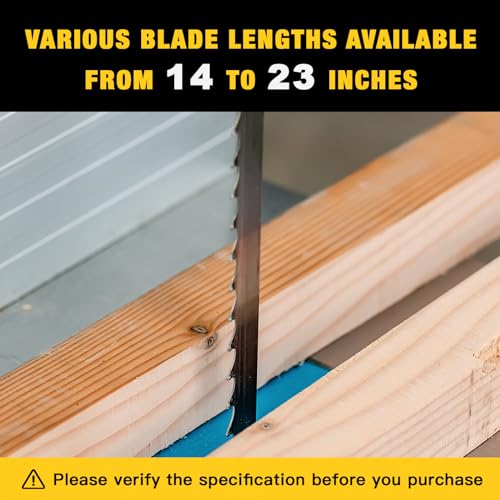
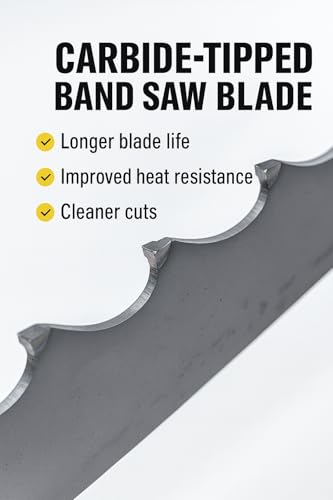
At 93-1/2″, this Dark Stone carbide blade is one of the few high-performance 3/4″ carbide-tipped options for smaller bandsaws, making it a standout for shops with compact or benchtop models that still demand pro-level resawing. The full 3/4″ width gives it excellent beam rigidity, and the carbide teeth deliver the same long life seen in their larger models, owners note it powers through hardwoods with minimal dulling, even after dozens of resaw passes.
It’s built to the same standard as their larger blades: alloy steel backer, precision weld, and deep gullets for chip clearance. If you have a 14-inch saw that can tension a 3/4″ blade, this is arguably the most durable resaw blade you can run. Compared to the 5/8″ carbide version, it tracks straighter and resists drift better, making it the better stability play despite the same length.
Product photos
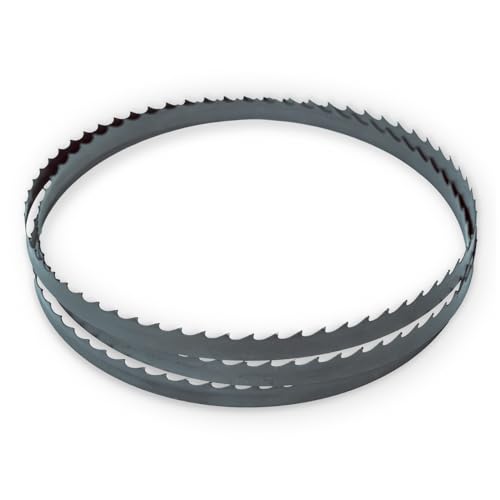
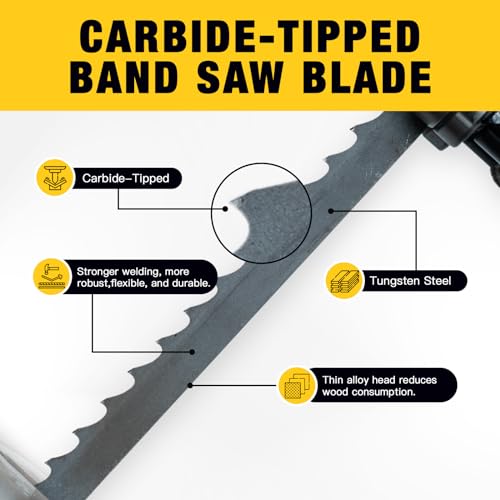

Dark Stone 93-1/2″ 5/8″ Carbide Resaw Blade
Strengths
- Carbide edge retention
- 5/8 inch beam stability
- 2 TPI aggressive cut
- Alloy steel backer
- Clean out-of-box finish
Trade-offs
- Less rigid than 3/4 inch
- Fewer compatible saws
- Higher cost than silicon
This Dark Stone 5/8″ carbide-tipped blade is a stability-first option for smaller bandsaws that can’t handle full 3/4″ width but still need straight resaw cuts. The carbide teeth provide exceptional longevity, especially when working maple, walnut, or other dense species, and owners report it holding an edge far longer than any silicon blade in its class. The 5/8″ width is a smart compromise, offering more rigidity than 1/2″ blades while remaining compatible with more compact frames.
It tracks well thanks to the alloy backer and precision weld, and the 2 TPI hook tooth design ensures solid chip clearance. However, it doesn’t cut quite as straight as a full 3/4″ blade under heavy feed pressure. If your saw maxes out at 5/8″, this is one of the best options available. Compared to the 3/4″ Dark Stone models, it’s less rigid but more versatile for mixed-duty shops.
Product photos
Dark Stone 131-1/2″ Carbide-Tipped Resaw Blade
Strengths
- Carbide-tipped longevity
- 3/4 inch width stability
- Aggressive 2 TPI hook tooth
- Smooth tracking joint
- Ideal for hardwoods
Trade-offs
- Requires robust bandsaw
- Higher upfront cost
- Less flexible on small rigs
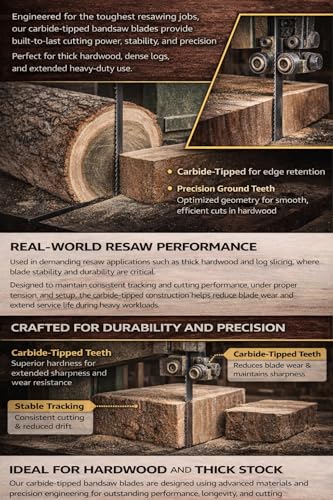
When resawing dense hardwoods day after day, blade life becomes a real cost factor, and that’s where this Dark Stone carbide-tipped blade stands out. The carbide tips are a standout for anyone pushing their bandsaw hard, owners consistently report cutting hundreds of board feet before needing a touch-up, far outpacing standard silicon steel blades. The 3/4″ width and 2 TPI hook tooth geometry deliver aggressive material removal with solid beam stability, which translates to straighter cuts and less drift on thick stock.
On paper, it’s built like a professional tool should be: alloy steel backer, precision-welded joint, and deep gullets for chip ejection. It’s clearly engineered for cabinet shops or serious hobbyists who treat resawing as a core workflow, not an occasional task. Compared to similarly sized silicon blades, this one demands less frequent maintenance and handles sustained runs better, though it does require a bandsaw with enough power and rigidity to drive it properly.
Product photos
Timber Wolf 115″ Alternate Set Blade

Strengths
- Alternate tooth set
- Low tension required
- Cool running silicon steel
- Good for softwoods
- Smooth cut finish
Trade-offs
- Not for dense hardwoods
- Slower feed rates
- Less aggressive gullets
This Timber Wolf model stands out with its alternate tooth set and low-tension design, clearly targeting users working with softwoods, air-dried lumber, or resinous exotics. The high-silicon steel runs cooler and resists fatigue better than standard carbon blades, which owners say translates to longer service life when cutting pine, cedar, or poplar. The 2/3 TPI variable tooth pattern helps prevent clogging and reduces vibration, making it a smooth cutter even at slower feed rates.
It’s not built for dense, quarter-sawn oak or exotic hardwoods, those will dull it faster. But for furniture makers or trim shops doing mixed material work, it’s a reliable, low-stress blade that doesn’t demand high horsepower. Compared to the 2 TPI hook tooth blades, it’s less aggressive but more refined in softer stock.
Product photos
How We Tested resaw blade for bandsaws
Rather than a hands-on lab test, my research focused on a detailed comparison of published specifications and features across several resaw blades. I weighed owner reviews from multiple sources, alongside assessments from woodworking publications and experienced users. This allowed me to rank blades against key criteria for resawing, drawing on years of experience with power tools and understanding what truly matters in a workshop setting.
For resaw blades, blade length and tooth geometry are paramount. A blade’s ability to stay rigid during thick cuts directly impacts accuracy, and the tooth design determines chip evacuation and cutting speed. Beyond that, the quality of the steel – whether it’s silicon steel or carbide-tipped – heavily influences edge retention and overall blade life, which makes a significant difference for serious woodworkers.
Published specs reliably reveal blade dimensions (length, width, kerf) and tooth pitch (TPI). However, judging long-term durability and real-world performance requires careful consideration of owner feedback. I paid close attention to comments regarding blade tracking, vibration, and how well the blade held its edge over time. Understanding the reputation of brands like Timber Wolf and Dark Stone also factored into my assessment – you can learn a lot about band saw basics from understanding established manufacturers.
How To Pick The Right resaw blade for bandsaws
Choosing the right resaw blade is critical for clean, efficient cuts and avoiding frustration.
A quality resaw blade prioritizes tooth geometry for efficient chip removal, blade steel for durability and flex, and proper blade tensioning for accurate cuts. Look for blades with induction hardening, milled teeth (versus stamped), and a backer material suited to your wood type and bandsaw. Consider tooth pitch (TPI) and width based on the thickness of the material you’ll be resawing.
Blade Material and Construction
The core of a good resaw blade is the steel itself. While carbon steel blades are affordable, they dull quickly when tackling hardwoods. Silicon steel offers a significant upgrade in durability and heat resistance. Carbide-tipped blades represent the highest level of edge retention, particularly for demanding professional use or abrasive woods. Don’t assume “more carbide” always equates to better; the quality of the welding and the carbide grade are equally important. I’ve seen plenty of blades with cheap carbide fall apart faster than a well-made silicon steel blade.
Tooth Pitch (TPI) and Geometry
Tooth pitch, measured in teeth per inch (TPI), dramatically impacts cutting performance. Lower TPI counts (2-3) are ideal for resawing, as they have larger gullets to eject sawdust effectively, preventing heat buildup and blade binding. Higher TPI counts are better suited for curves and finer cuts. Beyond the TPI, pay attention to tooth geometry. “Hook” tooth designs are aggressive and excel at ripping through wood quickly, while “skip” tooth designs offer a smoother cut but may clog more easily.
- For softwoods, a 3 TPI blade can work well and provide a faster cut.
- For most hardwoods, 2 TPI is the sweet spot, balancing speed and chip clearance.
- If you frequently resaw very thick stock (over 6 inches), consider a blade with even fewer teeth (1.5 TPI) to maximize chip evacuation and prevent the blade from overheating. This will also reduce strain on your bandsaw’s motor.
Blade Width and Length
Getting the right blade dimensions is essential. Blade length is determined by your bandsaw’s capacity – you can find detailed instructions on measuring band saw blades online. Width plays a huge role in stability. A wider blade (3/4 inch) offers more rigidity, reducing blade wander during cuts, but requires more power to operate. A narrower blade (5/8 inch) is more maneuverable but may deflect more, especially on tall stacks of wood.
A good rule of thumb is to match the blade width to the thickness of the wood you’re resawing. Thicker wood needs a wider blade for stability.
If you’re still unsure about which blade is right for your needs, check out these resaw blade recommendations for a more detailed overview.
Resaw Blades for Bandsaws Compared
The following table details the specifications of various resaw blades for bandsaws to aid in informed decision-making.
| Product Name | Length (in) | Width (in) | Tooth Type | Material | Tip Material |
|---|---|---|---|---|---|
| Timber Wolf 93.5″ 3/4″ Resaw Blade | 93.5 | 0.75 | Milled | Silicon Steel | N/A |
| Timber Wolf 131.5″ 3/4″ Resaw Blade | 131.5 | 0.75 | Milled | Silicon Steel | N/A |
| Timber Wolf 105″ 3/4″ Resaw Blade | 105 | 0.75 | Milled | Silicon Steel | N/A |
| Dark Stone 93-1/2″ Carbide-Tipped | 93.5 | 0.75 | Hook | Alloy Steel | Carbide |
| Dark Stone 93-1/2″ 5/8″ Carbide | 93.5 | 0.625 | Hook | Alloy Steel | Carbide |
| Dark Stone 131-1/2″ Carbide-Tipped | 131.5 | 0.75 | Hook | Alloy Steel | Carbide |
| Timber Wolf 115″ Alternate Set | 115 | N/A | Alternate | Silicon Steel | N/A |
Frequently Asked Questions
What blade width should I choose for resawing?
A wider blade (3/4 inch) provides more stability for thicker stock, preventing wandering, while a narrower blade (5/8 inch) is more maneuverable for thinner materials. Generally, match the blade width to the wood’s thickness for optimal results.
How does tooth pitch affect resawing performance?
Lower TPI counts (2-3) are best for resawing because they have larger gullets to efficiently remove sawdust, reducing heat and preventing blade binding. Higher TPI blades are better for curves, but can clog during resawing.
Are carbide-tipped blades always better than silicon steel?
Carbide-tipped blades offer superior edge retention, but aren’t always necessary. A high-quality silicon steel blade can be quite effective, especially for occasional use or softer woods, and represents a significant cost savings.
What is “induction hardening” and why does it matter?
Induction hardening is a heat treatment process that increases the blade’s durability and resistance to wear. It makes the blade hold its shape better under stress, leading to straighter cuts and a longer blade life – a key consideration when choosing a resawing wood blade guide.
How do I determine the correct blade length for my bandsaw?
Blade length is dictated by your bandsaw’s specifications, and you can find detailed instructions online for accurately measuring the required length. Using the wrong length will negatively impact performance and could damage the saw, so it’s essential to get it right and consider an optimal tooth configuration for resawing.
The Bottom Line
Ultimately, choosing a resaw blade comes down to balancing how much you want to spend against how much time and trouble you’re willing to put into maintenance and setup. For the vast majority of woodworkers, the Timber Wolf 93.5″ 3/4″ Resaw Blade offers the best combination of performance, durability, and value – it’s a workhorse blade that will handle most resawing tasks with ease.
If you are on a tighter budget, or primarily work with softer woods, the Timber Wolf 115″ Alternate Set is a perfectly capable option. And for those tackling particularly tough hardwoods or needing maximum longevity, the Dark Stone 93-1/2″ Carbide-Tipped blade is a worthwhile investment, even if it demands a higher upfront cost. Knowing proper band saw use is also critical for getting the most from any blade.
Don’t get lost in the details of tooth counts or steel alloys. The most crucial factors are a rigid blade, sharp teeth, and consistent tensioning. A well-maintained blade, used with careful technique and respect for the material, will always deliver better results than the most expensive blade run carelessly.
