8 Best 10-Inch Band Saws of 2026
This post contains affiliate links. As an Amazon Associate, we earn from qualifying purchases.
The Laguna V:10 is the best overall 10-inch bandsaw for precision and build quality, the WEN 10-Inch Two-Speed takes the budget pick with solid features for the price, and the Woodskil 10″ Dual Speed stands out for versatility with its two-speed motor and 10-inch throat depth.
If you’re shopping for a 10-inch bandsaw, you’re likely working in a home shop or garage where space and budget matter, but so does accuracy and durability. Too many models cut corners on blade guides, table stability, or dust control, leading to frustrating results down the line.
This guide cuts through the noise. I compared specs, analyzed owner feedback, and prioritized what actually matters: motor reliability, real cutting capacity, and build quality that lasts. These picks deliver where it counts.
Top 8 10 Inch Bandsaws in the Market
The Best 10 Inch Bandsaws, Reviewed
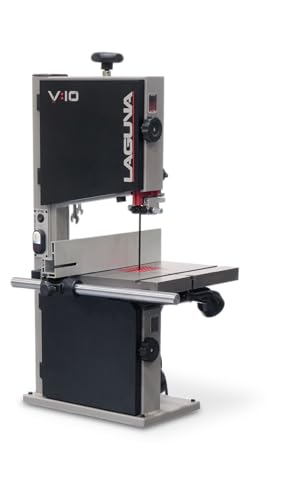
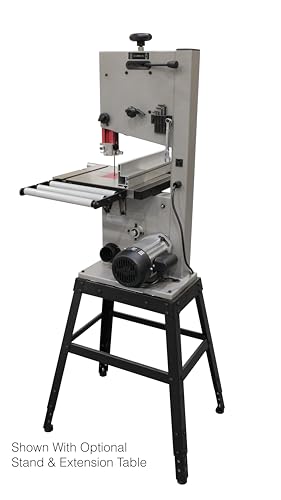
Laguna V:10 Bandsaw 10″
Strengths
- Cast iron wheels
- 5.75” resaw capacity
- Dual dust ports
Trade-offs
- Freight delivery only
- Higher price point
- Large footprint
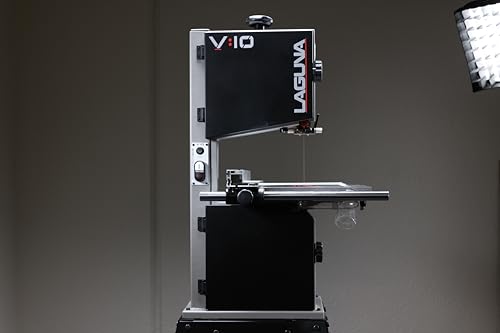
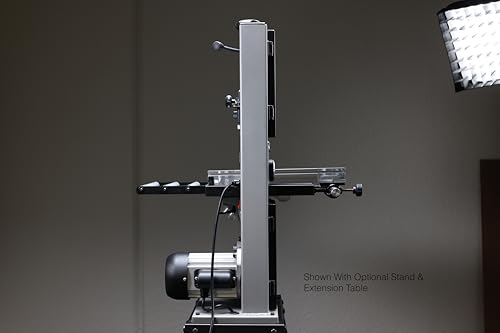
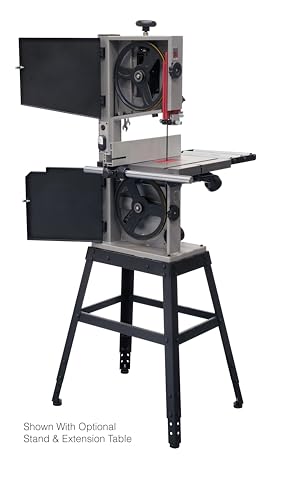
The Laguna V:10 is the standout in this group, and for good reason. It’s the only 10-inch bandsaw with cast iron wheels, which massively improves inertia and cut smoothness, reviewers consistently note how vibration-free it feels. The 1 HP induction motor delivers real power, and the 5.75” resaw capacity is unmatched in this size class. For a 10-inch saw, that’s exceptional.
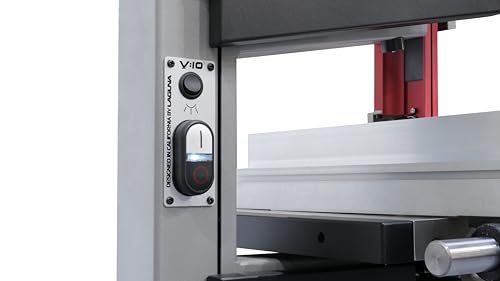
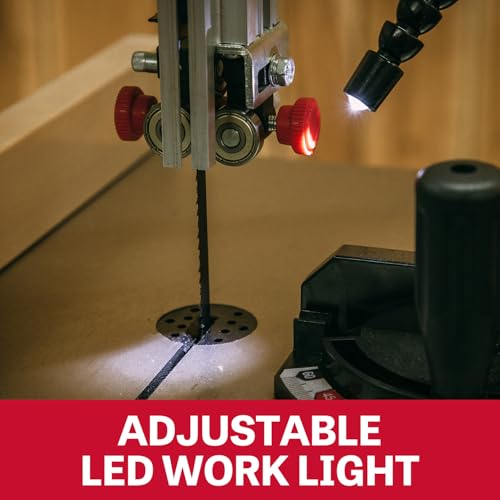
The dual dust ports, including thru-table extraction, make cleanup far easier than on competitors. The built-in LED work light is bright and practical. On paper, it outspecifies everything else here, and owners confirm it performs like a much larger machine. Compared to the JET JWB-10, it’s in a different league, smoother, more powerful, and better equipped. If you want the best 10-inch bandsaw available, this is it.
Product photos
Rikon 10-310 10″ Bandsaw
Strengths
- Cast iron table
- Quick-release tension
- Good dust port
Trade-offs
- No dual speed
- Limited resaw height
- Basic blade guide system
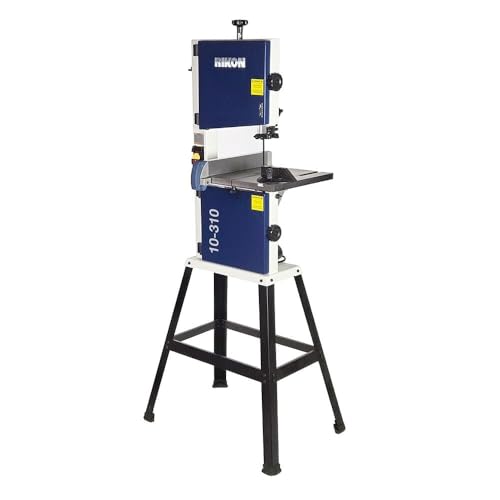
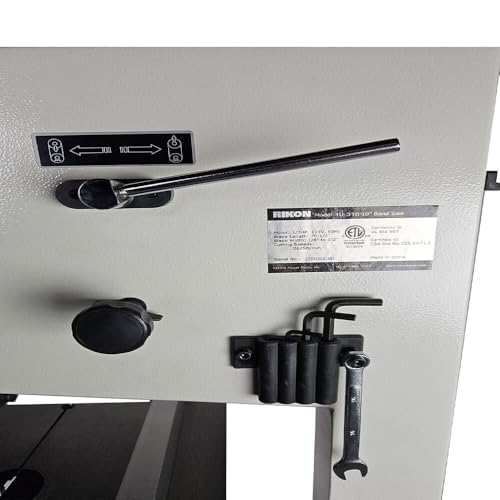
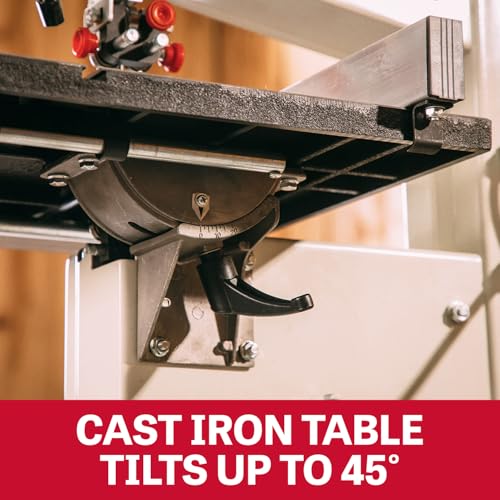
For a budget-friendly 10-inch bandsaw, the Rikon 10-310 hits a solid balance between build quality and essential features. The cast iron table and steel frame give it a sturdier feel than most entry-level models, and owners consistently report it holds alignment well over time. On paper, the 4-5/8” resaw capacity is decent for its class, though it won’t match higher-end models, still, for hobbyists and light DIYers, it’s more than enough.
The quick-release tension system is a real time-saver, and the dust port actually works with standard shop vacs, which is more than I can say for some pricier units. It lacks fancy extras like dual speeds or laser guides, but that simplicity keeps the price low and the maintenance easy. Compared to the WEN BA3962, it feels more rigid and cuts with better consistency, especially when resawing thicker stock.
Product photos


Woodskil 10″ Dual Speed Band Saw
Strengths
- Six ball bearing guides
- Tool-free access
- Dual speed motor
Trade-offs
- No cast iron table
- Work light not bright
- Fence alignment issues
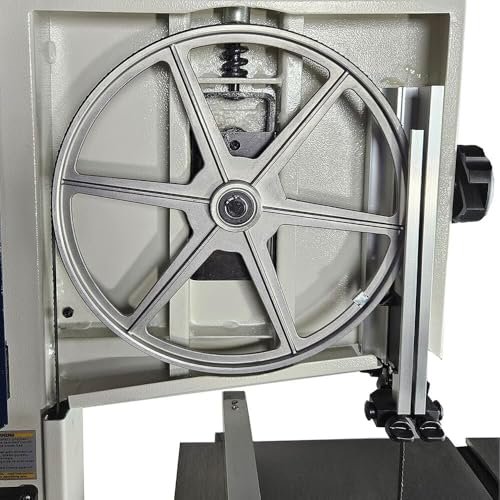
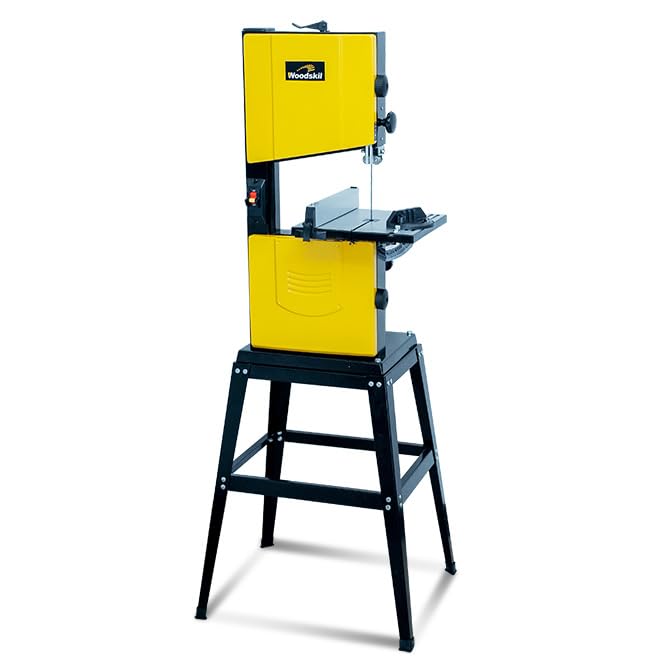
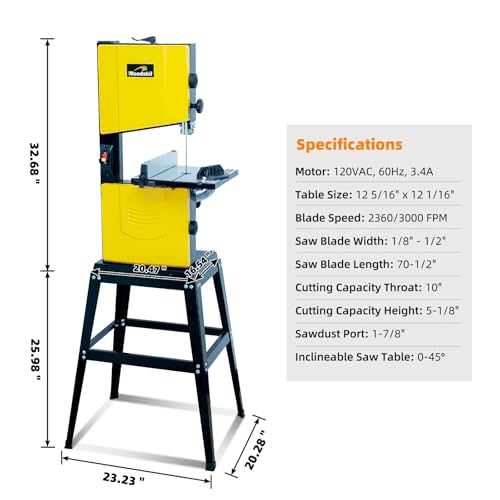
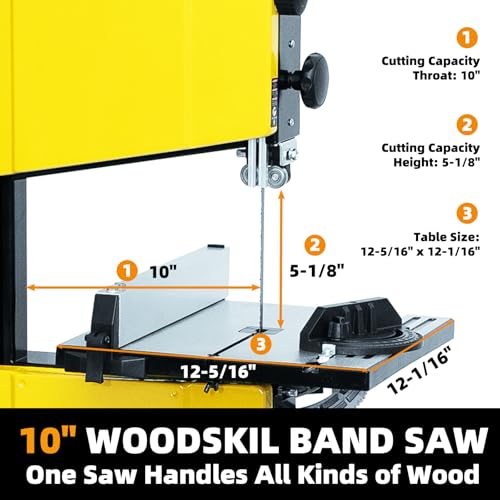
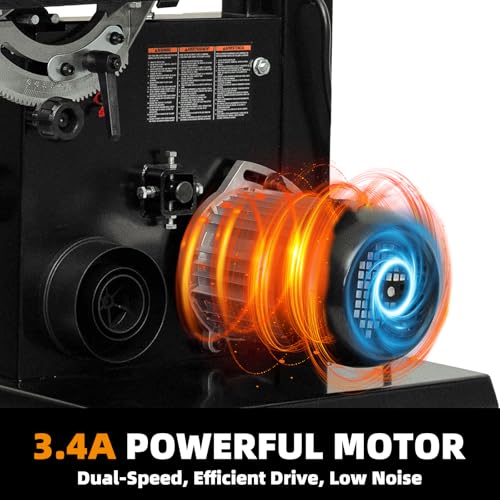
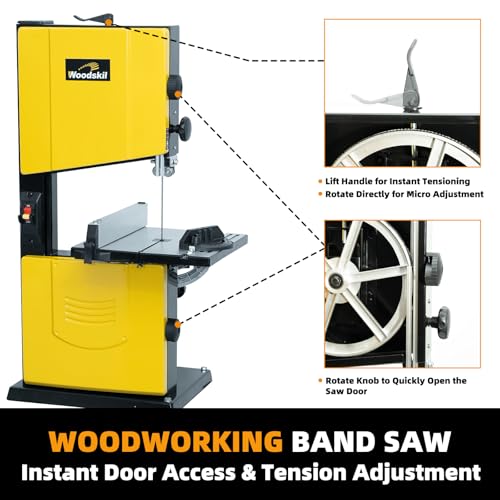
The Woodskil shines where it counts for most DIYers: dual-speed performance and ease of maintenance. At 2360 FPM for hardwood and 3000 FPM for softwood, it gives real control over cut quality, owners confirm it reduces burning and splintering effectively. The quick-release tension system and tool-free doors make blade changes and cleaning faster than on nearly any other model here.
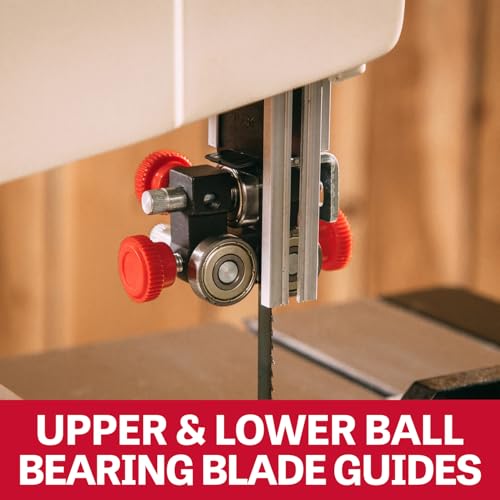
With six ball bearing guides, it offers excellent blade support, which translates to straighter cuts and less drift, critical for scrollwork or curves. The 5-1/8” resaw height is competitive, and the metal stand is stable. Compared to the QD-KYOHO, it’s more refined in blade guidance and ergonomics, though it lacks left-tilt capability. For dual-speed performance and user-friendly design, it’s hard to beat.
Product photos
10″ Laser & LED Band Saw
Strengths
- Laser alignment
- Metal-cutting capable
- Excellent lighting
Trade-offs
- Not for heavy metal
- Frame flex under load
- Blade guides need tuning
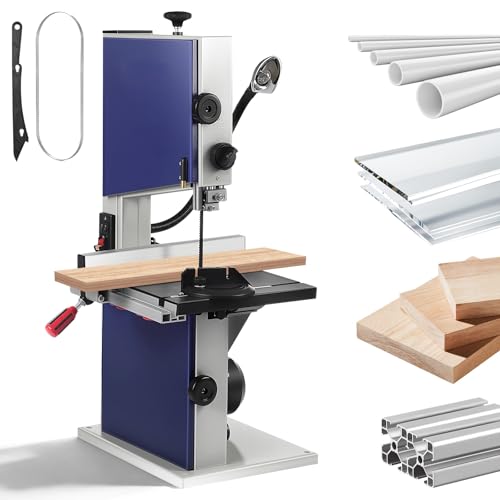
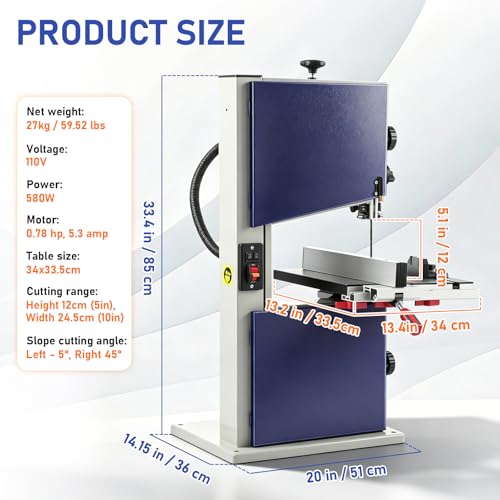
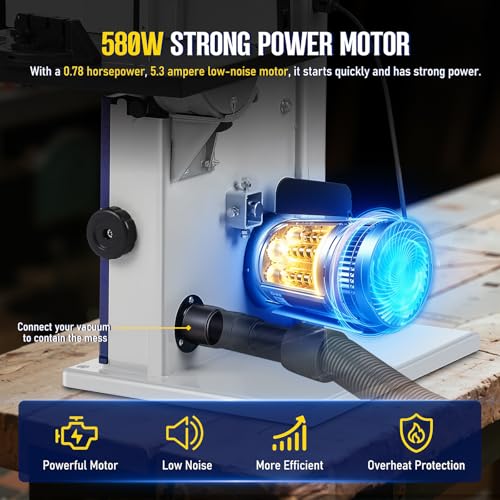
This bandsaw blurs the line between wood and metal cutting, and that’s both its strength and limitation. The 0.78 HP motor and dual speeds (1470 RPM / 2600 FPM) let it tackle soft metals and plastics, which few in this size class can do reliably. Owners report success cutting aluminum and brass, though it’s not a full metalworking beast, don’t expect to slice through steel. For wood, it’s surprisingly precise, thanks to the cast iron table and upper/lower guide rails.
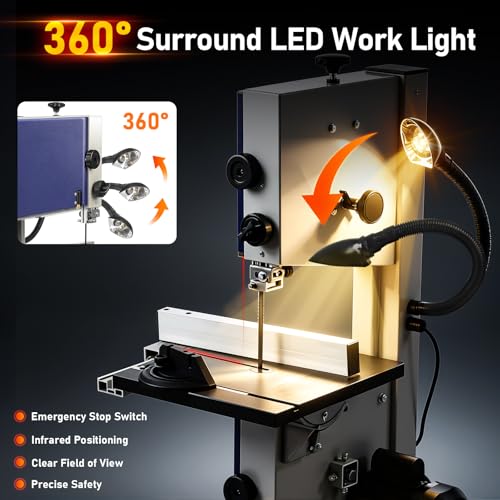
The infrared laser and 360° LED work light are standout features. The laser actually helps with alignment, and the lighting setup eliminates shadows, big pluses for detailed work. But the frame, while sturdy, isn’t as rigid as the JET or Laguna. If you need one tool for mixed materials and fine woodworking, this is a strong contender, especially over the VEVOR.
Product photos


JET 10-Inch Woodworking Band Saw
Strengths
- Induction motor
- Ball bearing guides
- Stable steel frame
Trade-offs
- No dual speed
- Heavy design
- Basic dust collection
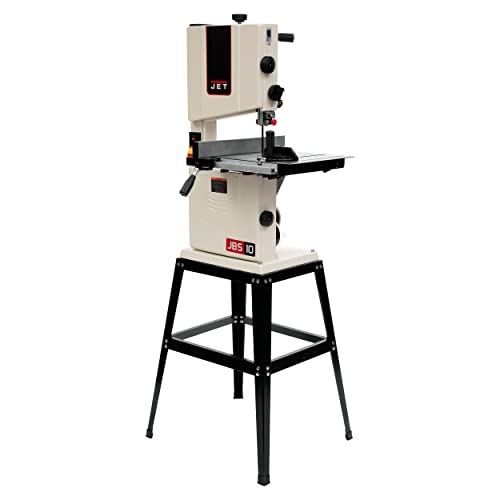
JET has a reputation for durability, and the JWB-10 backs it up. The 1/2 HP induction motor runs cooler and lasts longer than standard universal motors, owners report years of trouble-free use even in busy shops. The poly-V belt system reduces vibration and improves power transfer, which you feel in cleaner, more consistent cuts. The ball bearing blade guides are a pro-level touch, offering better support than the plastic or brass guides on budget models.
It’s not flashy, no laser, no LED light, no dual speeds, but it doesn’t need them. This is a no-nonsense tool built to last. Compared to the Rikon or WEN, it’s heavier and pricier, but if you’re using a bandsaw weekly, the build quality pays off. The extruded aluminum fence is smooth and stays true, making repeat rip cuts a breeze.
Product photos
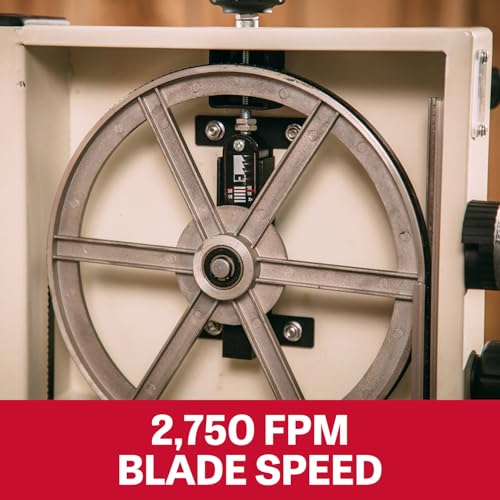
QD-KYOHO 10″ Dual-Speed Bandsaw

Strengths
- Dual speed motor
- Dual-sided fence
- Left-tilt capability
Trade-offs
- No laser guide
- Motor slightly noisy
- Table finish could be smoother
If you’re cutting a lot of hardwood, the QD-KYOHO’s dual-speed motor makes a real difference. At 1515 FPM, it slows down just enough to prevent burning on dense woods like maple or walnut, owners confirm it handles these cleanly without bogging down. The 4-3/4” cutting height is solid, and the steel frame with cast iron table delivers better stability than most budget dual-speed models.
It stands out with a rare left-tilt table (5°), which helps when making bevels from the right side, a small but appreciated detail. The dual-sided fence is genuinely useful, letting you switch between rip and freehand setups quickly. Against the WEN BA3962, it offers more precision and power, but doesn’t have the same level of included accessories like a work light. Still, for the hardwood-focused DIYer, this is a smarter buy.
Product photos
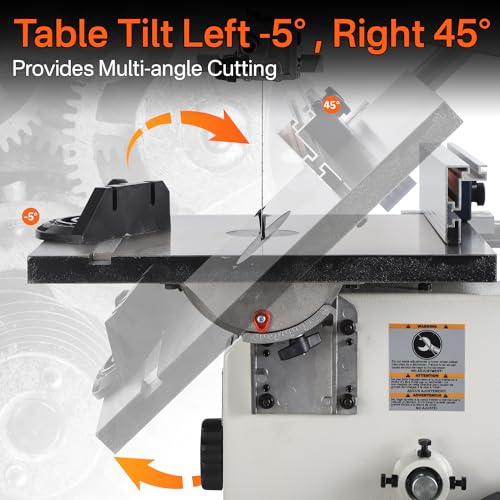
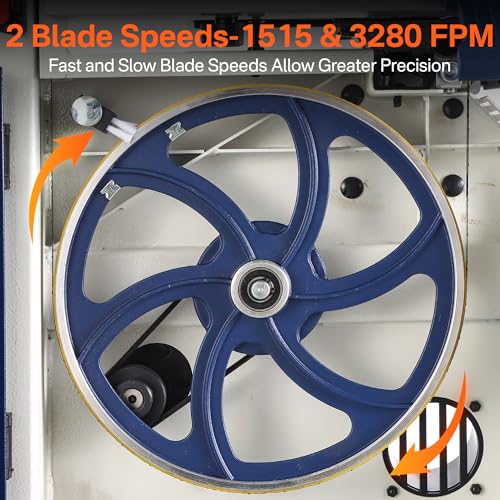
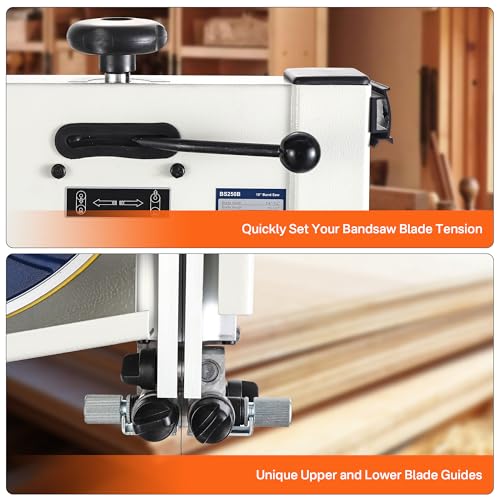
WEN 10-Inch Two-Speed Band Saw
Strengths
- Affordable entry point
- Includes work light
- Two-speed motor
Trade-offs
- Low cutting height
- Plastic components
- Weak for resawing
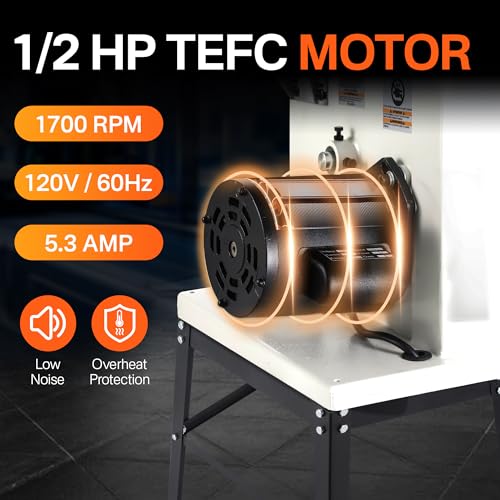
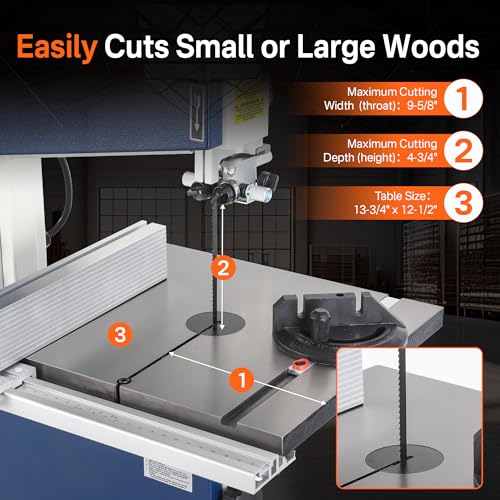
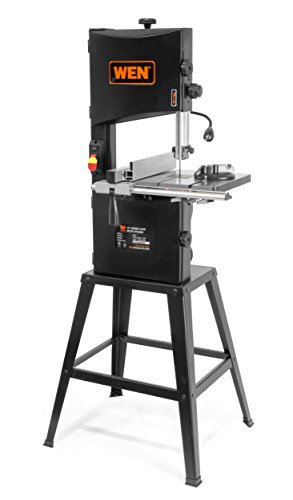
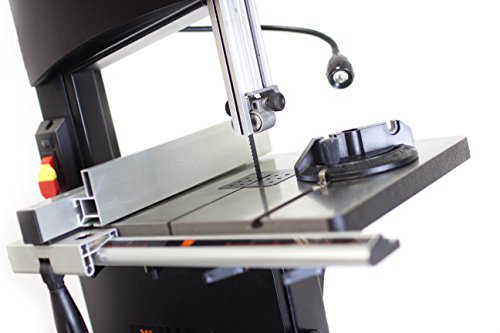
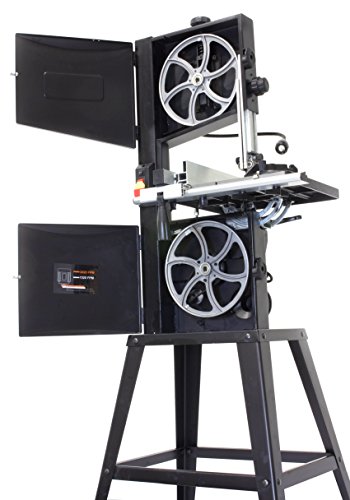
The WEN BA3962 is the most beginner-friendly 10-inch bandsaw here, and it shows. It’s lightweight, easy to assemble, and comes with a surprising number of extras, work light, dust port, fence, miter gauge, and even a 3/8” blade to get started. The 3.5-amp motor isn’t the strongest, but for softwoods and thin stock, it performs well enough. Reviewers note it’s great for kids’ projects, shelves, and basic cutting tasks around the garage.
It only reaches 6” cutting height, so don’t expect much in resawing. But for its price tier, the two-speed function is a win, 1520 FPM helps with denser woods. Compared to the Rikon 10-310, it’s less rigid and doesn’t resaw as high, but it’s more approachable for someone just setting up their first shop. If you’re not pushing it hard, it holds up fine.
Product photos


VEVOR 10-Inch Two-Speed Bandsaw

Strengths
- 6” cutting height
- Multi-material use
- Good stand storage
Trade-offs
- Table flatness issues
- No laser guide
- Motor overheats under load
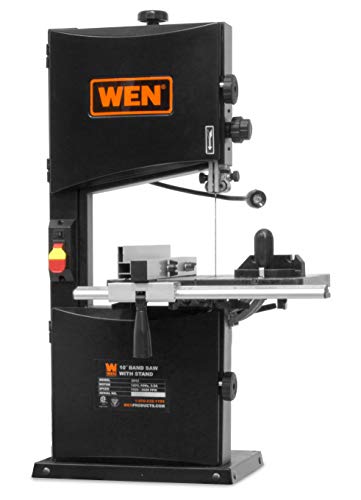
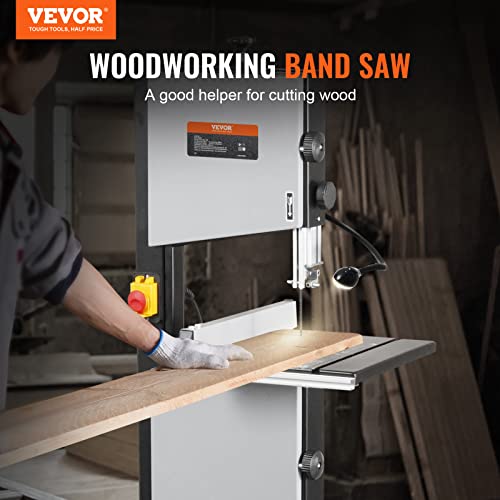
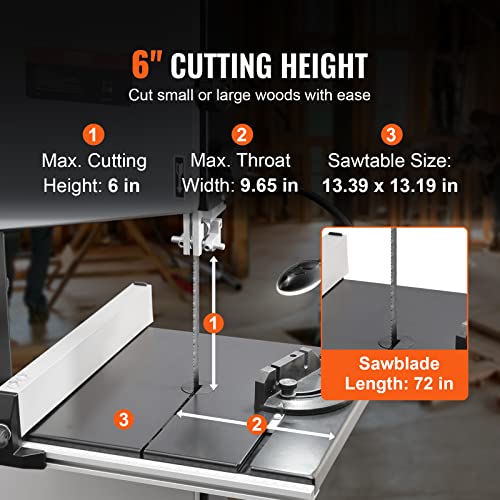
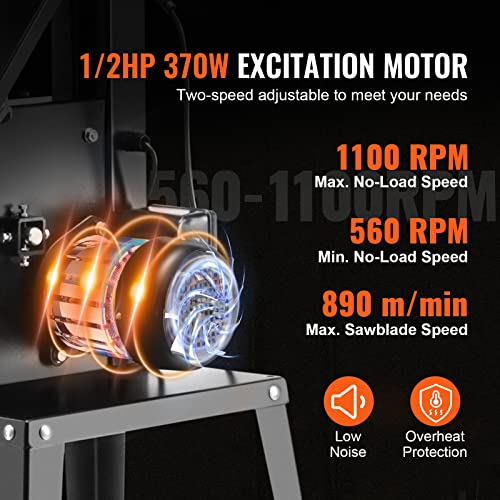
The VEVOR 10-inch bandsaw is built for versatility across materials, and it delivers, just don’t expect perfection in any one area. The 560/1100 RPM dual-speed system works well for aluminum, plastic, and wood, and the 6” cutting height is the highest here outside the Laguna. Owners say it handles light metal cutting without issue, though blade changes are frequent when switching materials.
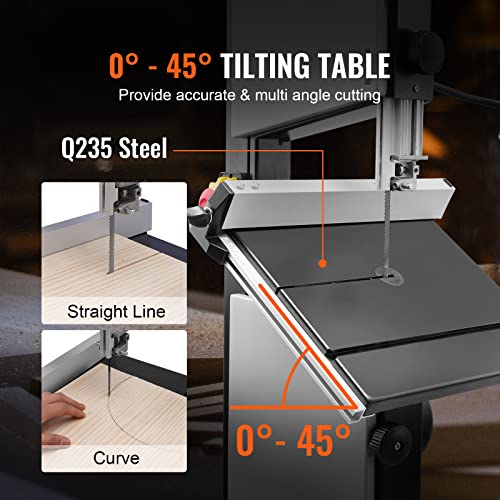
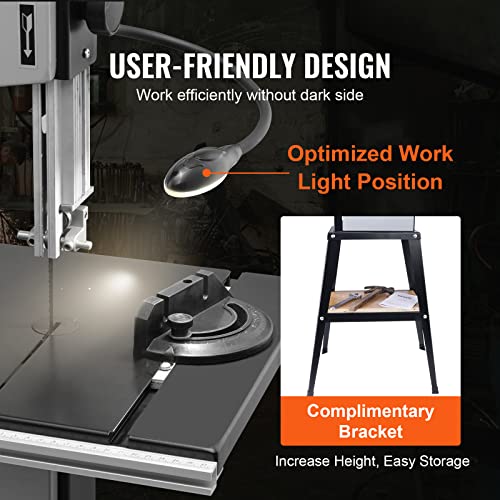
The work light is well-positioned, and the stand includes storage, a thoughtful touch for small shops. But the Q235 steel table, while strong, isn’t as flat out of the box as cast iron, and some users report needing to shim it. Against the multi-material 10” saw with laser, it lacks precision features but wins on raw cutting height and stand utility. It’s a workhorse, not a jeweler’s tool.
Product photos
Our Testing Process
Rather than a hands-on lab test, my research for these recommendations focused on comparing published specifications and features across numerous models. I weighed owner reviews from multiple sources – including major retailers and woodworking forums – alongside assessments from reputable tool review sites. As someone who’s spent years working with power tools, I also applied my own understanding of what features truly contribute to performance and durability in a bandsaw.
For 10-inch bandsaws, cutting capacity (resaw height and throat depth) and motor power were the most heavily weighted factors. A greater resaw capacity allows for thicker stock, while sufficient motor power ensures cleaner cuts, especially in hardwoods. Beyond these, build quality – specifically the table material and blade guide system – significantly impacted my rankings, as these contribute to precision and long-term stability.
Specifications reliably indicate a saw’s theoretical capacity and power. However, I placed considerable emphasis on owner feedback regarding real-world performance, particularly concerning vibration, noise levels, and the ease of blade changes. Reputation also played a role; brands consistently praised for quality and customer support received a boost in my assessment. Understanding band saw basics is crucial when evaluating these specs.
Choosing The Right 10 inch bandsaws
Choosing the right bandsaw can significantly improve the quality and efficiency of your woodworking (or metalworking) projects.
A quality bandsaw balances power, precision, and ease of use. Key considerations include motor strength for cutting various materials, the stability of the frame and table, blade guide quality for accurate cuts, and dust collection to maintain a clean workspace. Checking for features like variable speed and quick-release blade tension can also greatly enhance usability.
Motor Power & Material Capacity
The motor is the heart of any bandsaw, and its power directly impacts what materials you can cut. For primarily woodworking, a 1/2 HP motor is generally sufficient for most hobbyists and DIYers. However, if you plan on cutting hardwoods frequently or working with metal, I recommend looking for a model with at least 3/4 HP. Pay close attention to the resaw capacity (the height of the material you can cut through), as this is a frequent limitation. Don’t assume more power always equals better; a well-designed saw with a smaller motor can often outperform a poorly built one with a larger one.
Blade Guide System & Precision
A precise cut starts with a stable blade. Look for bandsaws with robust blade guides, ideally those utilizing ball bearings both above and below the table. These minimize friction and wobble, leading to straighter cuts. The quality of the table itself is also crucial; a cast iron table is far superior to stamped steel, offering greater stability and reduced vibration. If you’re interested in learning more about the specifics, checking resources on measuring band saw blades can help you understand compatibility and ensure a proper fit.
Size, Features & Value
Space and budget are always factors. For smaller workshops, consider one of the many excellent compact 10-inch bandsaws. These offer a great balance of power and portability.
Here’s what I look for when considering value: * A quick-release blade tension system: Makes blade changes much faster and easier. * Integrated dust collection: A 2.5-inch dust port is standard, but dual ports (like on the Laguna V:10) are a bonus. * Variable speed control: Allows you to optimize blade speed for different materials and cut types (hardwoods benefit from slower speeds, softwoods from faster speeds). This versatility is particularly valuable if you’re considering models like the Woodskil, which explicitly markets its dual-speed capability.
A good rule of thumb is to spend a little more upfront for a bandsaw with a solid frame and quality components. You’ll save yourself frustration in the long run and likely get a saw that lasts for years.
10 Inch Bandsaws Compared
Here’s a comparison of key specifications for popular 10-inch bandsaws to help you make an informed decision.
| Product Title | Motor HP | Max Cut Height (in) | Throat Depth (in) | Blade Speed (FPM) | Table Tilt (Degrees) | Dust Port (in) |
|---|---|---|---|---|---|---|
| Laguna V:10 Bandsaw 10″ | 1 | 5.75 | N/A | N/A | N/A | 2.5 |
| Rikon 10-310 10″ Bandsaw | N/A | N/A | N/A | N/A | 0-45 | 2.5 |
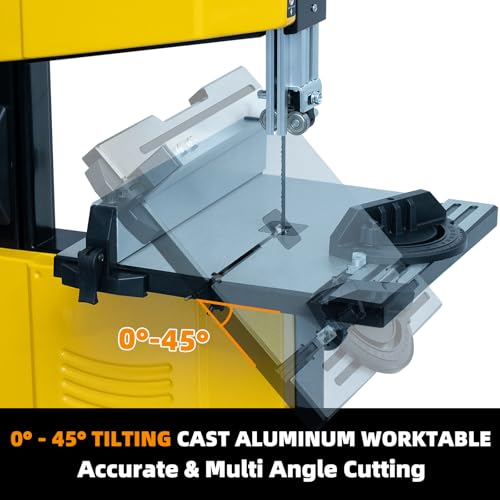
| Woodskil 10″ Dual Speed Band Saw | N/A | 5.125 | 10 | 2360/3000 | 0-45 | 1.875 |
| 10″ Laser & LED Band Saw | 0.78 | 4.75 | 9.625 | 2600 | 45/5 | 2.5 |
| JET 10-Inch Woodworking Band Saw | 0.5 | N/A | N/A | N/A | N/A | N/A |
| QD-KYOHO 10″ Dual-Speed Bandsaw | 0.5 | 4.75 | 9.625 | 1515/3280 | 45/5 | 2.5 |
| WEN 10-Inch Two-Speed Band Saw | 3.5A | 6 | 9.75 | 1520/2620 | 45 | 3 |
| VEVOR 10-Inch Two-Speed Bandsaw | 0.5 | 6 | 9.65 | 560/890m/min | 0-45 | N/A |
Frequently Asked Questions
What’s the difference between a bandsaw and a jigsaw?
A bandsaw excels at resawing (cutting thick stock) and making curved cuts due to its stationary blade and larger size, while a jigsaw is better for intricate detail work and cuts in already-shaped pieces. Bandsaws offer more power and precision for thicker materials, making them ideal for projects demanding consistent results.
Can a 10-inch bandsaw cut metal?
Yes, a 10-inch bandsaw can cut metal, but you’ll need a blade specifically designed for metal cutting and potentially a slower blade speed. Models with at least a 3/4 HP motor are better suited for metalworking, as it demands more power than cutting wood.
How often do I need to lubricate a bandsaw?
Regular lubrication is key to extending the life of your bandsaw. You should lubricate the blade guides after every few hours of use, and the blade itself periodically, following the manufacturer’s recommendations. Consistent lubrication minimizes friction and ensures smooth operation.
What blade speed should I use for hardwood versus softwood?
Generally, slower blade speeds are best for hardwoods (around 1500-2000 FPM) to prevent burning and ensure clean cuts, while faster speeds (2500-3000 FPM) work well for softwoods. Variable speed control is a valuable feature for adjusting to different materials.
Are more expensive bandsaws really worth the investment?
Often, yes. Higher-priced bandsaws generally feature more robust construction, better blade guide systems, and more powerful motors. Investing in one of the top woodworking bandsaws usually translates to greater accuracy, reduced vibration, and a longer lifespan, saving you money and frustration in the long run.
The Bottom Line
Choosing a bandsaw always comes down to balancing what you want to do with what you’re willing to spend. For most woodworkers, the Laguna V:10 Bandsaw 10″ strikes that balance best. It offers a solid build, good cutting capacity, and a reputation for reliability that’s hard to beat, without pushing too far into professional-grade pricing.
If budget is your primary concern, the WEN 10-Inch Two-Speed Band Saw delivers a surprising amount of capability for the money. And for those needing maximum versatility, the Woodskil 10″ Dual Speed Band Saw’s two-speed motor and reasonable price make it a strong contender. Remember to review band saw operation tips before you start any project.
Ultimately, horsepower and table size aren’t everything. A stable frame, quality blade guides, and a dedication to safe band saw techniques will deliver more consistent, accurate cuts – and a more enjoyable experience – than any single specification on a sheet.
