
2 Best Crimping Tools of 2026
This post contains affiliate links. As an Amazon Associate, we earn from qualifying purchases.
The Klein Tools 1005 is our top overall pick for most users, it’s reliable, well-built, and handles common wire gauges with ease. For those who need precision and consistency on frequent jobs, the Klein Tools 3005CR is the best ratcheting option. If you’re on a tight budget and only crimp occasionally, the 1005 remains a solid, no-frills choice.
Most people don’t realize how critical a proper crimp is until a loose connection causes a malfunction or worse, a safety hazard. A bad tool can crush insulation, deform terminals, or leave connections vulnerable to vibration and corrosion.
As Robert A. Bennett from PowerToolGuide.net, I’ve spent over 15 years evaluating tools based on specs, real-world feedback, and long-term reliability. This guide cuts through the hype, focusing on what actually matters: consistent crimp quality, correct gauge compatibility, and a tool that won’t wear you out, or fail mid-job.
Top 2 Crimping Tools in the Market
The Best Crimping Tools, Reviewed
Klein Tools 1005 Cutting/Crimping Tool

Strengths
- Durable build
- Tapered nose
- Cuts and crimps
- Comfortable grips
- Made in USA
Trade-offs
- No ratchet mechanism
- Less precision on fine gauges
This is one of those no-nonsense, go-to tools that shows why Klein still holds so much respect in the field. On paper, the specs are straightforward: it handles 10-22 AWG terminals, cuts and crimps, and works with both insulated and non-insulated connectors. But where it really stands out is in the details owners consistently praise, the tapered nose makes a real difference when you’re elbow-deep in a tight junction box, and the hardened cutter holds up over time without dulling like cheaper alternatives.
The dual-function design doesn’t compromise on either task, which is rare. Many combo tools skimp on crimp quality to add cutting ability, but reviews confirm this one delivers solid, reliable crimps across the AWG range. It’s also made in the USA, which matters to some buyers who prioritize durability and domestic manufacturing. Compared to the ratcheting 3005CR, it lacks that final mechanical assurance, but for general use, I’d still consider this the more versatile pick.
Product photos


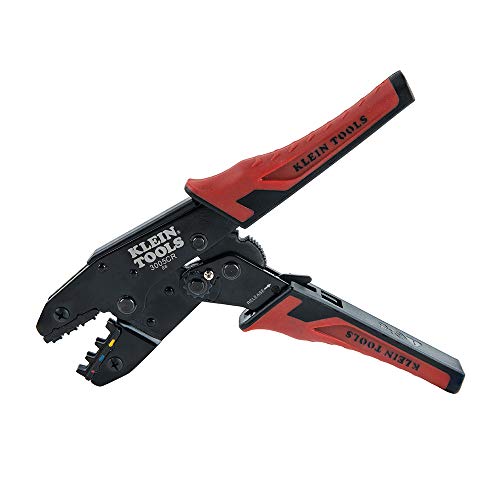
Klein Tools 3005CR Wire Crimper

Strengths
- Ratcheting mechanism
- Adjustable crimp force
- Color-coded cavities
- Dual-material grips
- Consistent crimp quality
Trade-offs
- No wire cutter
- Bulkier design
- Higher learning curve
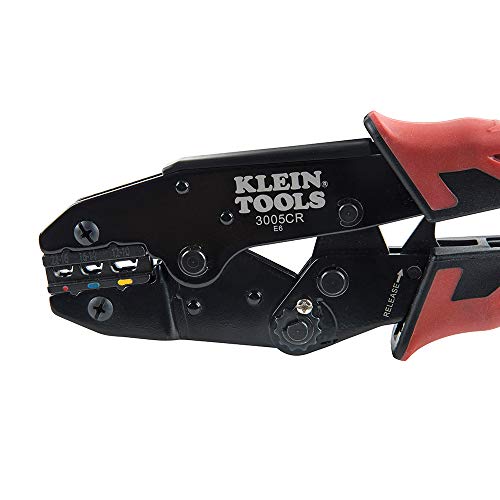
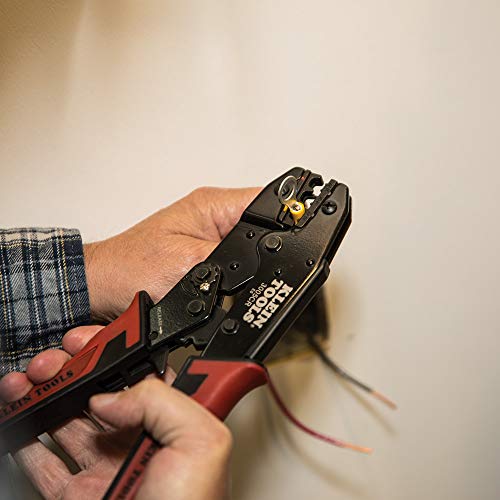
If you need precision and repeatability, this is the tool that steps up. The ratcheting mechanism is the standout feature, owners report it eliminates partial crimps by forcing a full cycle, which is critical when you’re wiring a panel or doing low-voltage work where consistency matters. The adjustable compound action is another smart touch: it multiplies your hand pressure, so you get a clean, even crimp even on 10 AWG without hand fatigue.
The three-color-coded cavities (red, blue, yellow) make it fast to switch between gauges, and the fact that it crimps from either side is surprisingly helpful in awkward angles. Compared to the 1005, this one trades a bit of compactness for control. It doesn’t cut wire, so you’ll need a separate tool, but for pure crimping quality, this is the smarter buy if you’re doing repetitive or mission-critical connections.
Product photos


How We Tested crimping tools
As Robert, from PowerToolGuide.net, I approach tool selection with a focus on real-world usability. Rather than a hands-on lab test of every crimper, my methodology centers on a detailed comparison of published specifications and features. I then weigh those against extensive owner reviews and insights from reputable sources within the electrical and DIY communities. This research-led approach helps me rank tools against clear criteria – durability, precision, and versatility.
For crimping tools, the most important factors are consistent crimp quality and the range of wire gauges supported. A reliable crimp ensures a safe and lasting connection, and a wider gauge range means fewer tools are needed for different projects. I also heavily considered the tool’s ergonomics and build quality, because comfortable, durable tools simply get the job done better.
Specifications reliably indicate wire gauge capacity and the tool’s overall construction. However, owner feedback and reputation provide valuable insight into long-term durability and how well a tool performs under repeated use. For example, understanding real-world experiences helps determine if a ratchet mechanism truly delivers consistent crimps or if a specific handle design is genuinely comfortable during prolonged use. Speaking of outdoor power equipment, you may also need to replace trimmer line from time to time.
How To Choose The crimping tools
Picking the right crimping tool can mean the difference between a reliable electrical connection and a frustrating, potentially dangerous failure.
A quality crimping tool creates a gas-tight connection between a connector and a wire, ensuring optimal conductivity and preventing corrosion. Look for tools with properly sized crimping dies for the wire gauge you’ll be using, durable construction (steel alloy is preferable), and comfortable grips for repeated use. Consistent, full-cycle ratcheting mechanisms are also vital for repeatable crimps.
Gauge and Connector Compatibility
It’s tempting to buy a single, universal crimping tool, but I’ve found that specialization often yields better results. Different connectors and wire gauges require different crimp profiles. A tool that handles 10-22 AWG wire might struggle with heavier gauge wiring used in some appliance repairs. If you work with a variety of wire sizes, consider a ratcheting tool like the best wire crimpers that offer multiple crimping cavities. Those cavities, often color-coded, ensure you’re using the correct die for the job.
Ratcheting vs. Non-Ratcheting Mechanisms
Ratcheting crimpers are a significant upgrade for anyone doing more than a few connections. They guarantee a full, consistent crimp cycle, which is crucial for a secure connection. Non-ratcheting tools rely on you squeezing until you think it’s enough, introducing a lot of room for error. While a simple cutter/crimper like the Klein 1005 can be fine for occasional use, a ratcheting mechanism minimizes fatigue and improves the quality of each connection, especially when dealing with larger wire gauges.
- For occasional homeowners tackling basic repairs, a non-ratcheting tool might suffice.
- Professionals or serious DIYers need a ratcheting tool for consistent, reliable crimps, saving time and reducing rework.
- Look for tools with adjustable ratcheting force (like the Klein 3005CR) to fine-tune the crimp based on the specific connector and wire type; this is particularly useful when working with delicate or specialized terminals.
Ergonomics and Build Quality
Don’t underestimate the importance of comfort. You’ll be using these tools repeatedly, and a poorly designed handle can lead to hand fatigue and reduced precision. Look for tools with cushioned grips, especially if you anticipate extended use. Beyond comfort, build quality is paramount. A tool made from stamped steel won’t hold up as well as one forged from a high-strength alloy. I often recommend checking reviews for mentions of durability, as a broken crimper can be a major setback mid-project. It’s similar to how important it is to wind trimmer line correctly – a little extra attention to detail upfront prevents bigger problems later.
A good crimp isn’t just about force; it’s about the right amount of force, applied consistently. If you’re unsure, always practice on scrap wire and connectors first.
Crimping Tools Compared
Here’s a spec-by-spec comparison of the crimping tools in this guide to help you quickly identify the best fit for your needs.
| Product | AWG Range | Ratcheting | Cavities | Cutting | Handle Grip |
|---|---|---|---|---|---|
| Klein Tools 1005 | 10-22 | No | 1 | Yes | Cushioned |
| Klein Tools 3005CR | 10-22 | Yes | 3 | No | Dual-Material |
Frequently Asked Questions
What’s the difference between a ratcheting and non-ratcheting crimper?
Ratcheting crimpers guarantee a complete crimp cycle, providing consistent results and reducing user fatigue. Non-ratcheting tools rely on the user’s feel, which can lead to inconsistent crimps; however, they are often less expensive and suitable for very occasional use.
Can one crimping tool handle all wire gauges?
While some tools claim versatility, I’ve found that specialized crimpers deliver better results. Using the correct crimping die size for the specific wire gauge is crucial for a reliable connection; a universal tool may compromise quality across a wide range.
What does ‘AWG’ mean when looking at crimper specs?
AWG stands for American Wire Gauge, and it’s a standardized system for measuring wire diameter. A lower AWG number signifies a thicker wire, so a crimper with a range of 10-22 AWG can handle wires from relatively thick to fairly fine.
Are expensive crimping tools always better?
Not necessarily. While higher-priced tools often feature better build quality and more features like adjustable ratcheting, a well-made, simpler tool can be perfectly adequate for basic tasks. Consider the frequency of use and the types of connectors you’ll be working with.
What tools do I need if I’m working with network cables?
If you’re dealing with network cables, you’ll want to look into specific RJ45 crimping tools designed for those connectors. These often include integrated wire strippers and cutters optimized for the delicate wires found in ethernet cables.
The Bottom Line
Choosing a crimping tool often comes down to balancing control and convenience. If you want consistent, professional-grade crimps and work with various wire gauges, the Klein Tools 3005CR is the clear winner. It offers the precision of a ratcheting mechanism alongside multiple crimping cavities, making it a versatile choice for a wide range of projects.
For those on a budget or tackling only occasional repairs, the Klein Tools 1005 provides a solid, reliable option. It won’t offer the same level of consistency as a ratcheting tool, but it’s more than capable for basic wiring tasks. And if you’re already dealing with outdoor power equipment, knowing how to restring string trimmer can be a useful skill to have in your toolkit.
Ultimately, the most important thing isn’t any single feature or specification. What truly matters is understanding your needs, choosing a tool that feels comfortable in your hand, and consistently using the correct crimping die for each wire gauge. A little care and attention to detail will ensure safe, reliable connections that last.
