8 Best Wire Welders of 2026
This post contains affiliate links. As an Amazon Associate, we earn from qualifying purchases.
After comparing the field and weighing specs against owner feedback, the YESWELDER 205A Dual Voltage stands out as the best overall wire welder for its power and multi-process flexibility. For those on a tighter budget, the Futelo 145A Portable delivers solid performance in a lightweight package, while the YESWELDER 135A Synergic Control offers excellent usability for beginners.
Most people don’t realize how quickly a poorly matched welder can turn a simple repair into a frustrating mess, either it can’t handle the material, or the controls are so confusing they slow down progress. As someone who’s helped countless DIYers and hobbyists navigate this space, I focused this guide on real-world usability, process versatility, and reliable performance across skill levels. These picks are based on a deep explore specifications, verified owner experiences, and the kind of practical demands you face in a garage or on a job site.
Top 8 Wire Welders in the Market
The Best Wire Welders, Reviewed
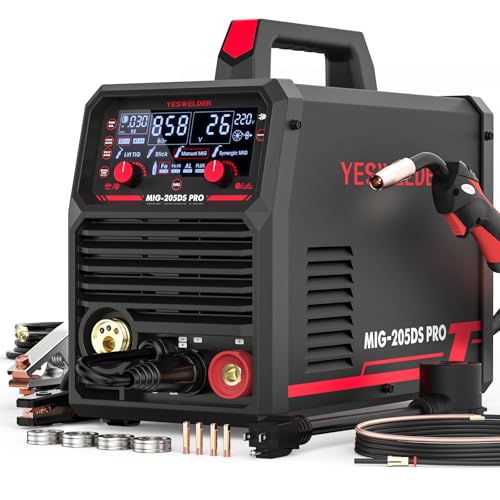
YESWELDER 205A Dual Voltage MIG Welder
Strengths
- Dual voltage support
- 5-in-1 functionality
- Manual and synergic modes
Trade-offs
- Accessories sold separately
- Heavier and larger footprint
The YESWELDER 205A is in a different class, dual voltage (110V/220V) and 5-in-1 capability including spool gun support for aluminum, making it the most versatile unit here. While others are limited to flux-core or basic TIG, this one can handle gas MIG, aluminum, and heavy steel. On paper, the 200A output at 220V means it can weld thicker material than any other on this list, and owners confirm it performs well in fabrication and auto work.
It’s not as beginner-friendly out of the gate, you’ll need to buy the spool gun and TIG torch separately, but for a single machine that can grow with your skills, it’s unmatched. Compared to the 135A models, it’s bulkier and pricier, but the manual and synergic modes give pros and serious hobbyists real control. If you’re serious about welding and want one machine to do it all, this is the one to get.
Product photos


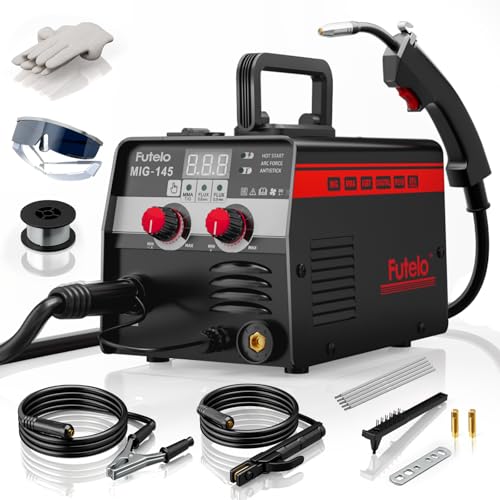
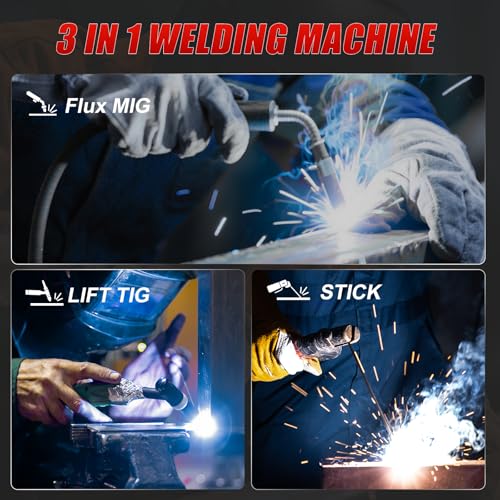
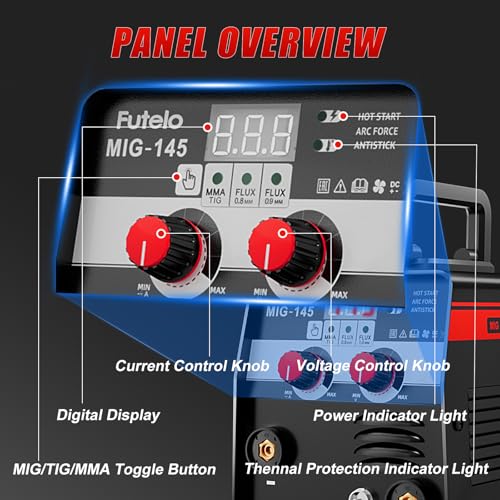
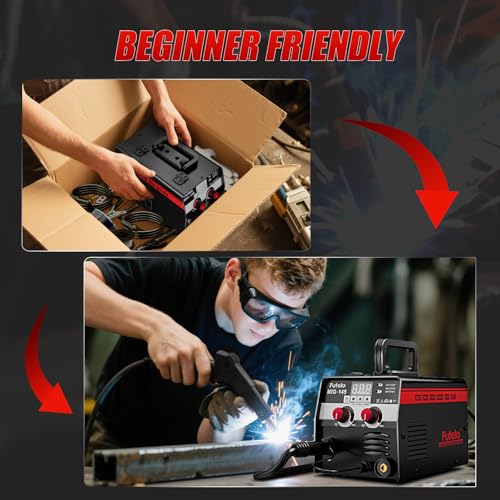
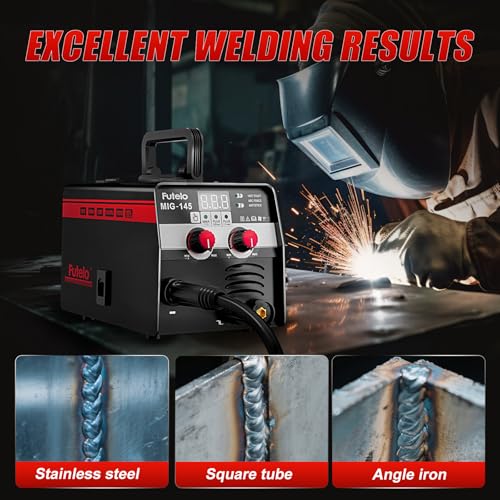
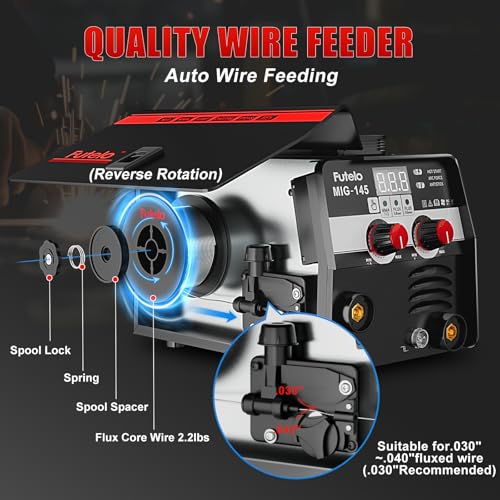
Futelo 145A Portable 3-in-1 Welder
Strengths
- Extremely lightweight
- Thorough starter kit
- Auto-setup with suggestions
Trade-offs
- Amp rating slightly overstated
- No welding helmet included
At just 7.5 lbs, the Futelo 145A is the lightest 3-in-1 welder here, so compact it’s almost pocketable. That makes it a standout for mobility, and the inclusion of a full accessory kit (gloves, goggles, rods, wire, wrench) means it’s genuinely ready to weld out of the box. The synergy system is straightforward: set wire size or amperage, and it suggests voltage and wire speed. For a budget unit, that’s a big plus.
But being lightweight comes with trade-offs. The 145A rating is optimistic under sustained load, owners report it performs closer to a solid 130A in real use. Still, for light-duty home repairs and weekend projects, it holds up. Compared to the BESTMIG 135A, it includes more tools but lacks a helmet. If you’re on a tight budget and want maximum value in a tiny package, this is the pick.
Product photos
Lincoln Electric 90i FC Flux Core

Strengths
- Simple two-knob control
- Durable metal case
- Shoulder strap included
Trade-offs
- Lower output than competitors
- No digital display
The Lincoln Electric 90i FC is the minimalist’s choice, a no-frills, analog welder built for small jobs and quick fixes. With just two knobs for voltage and wire speed, it’s dead simple to use, and Lincoln’s reputation for durability backs it up. The 15 lb weight and shoulder strap make it easy to carry to a fence repair or shed project, and the metal case adds protection on job sites.
It won’t weld thick steel like the 140A models, but for up to 1/4″ on light-duty work, it’s reliable. Owners praise its smooth arc and plug-and-play nature. Compared to the FORNEY 140, it’s less powerful but more polished in build quality. If you only weld occasionally and want something light, tough, and trustworthy, this fits the bill.
Product photos


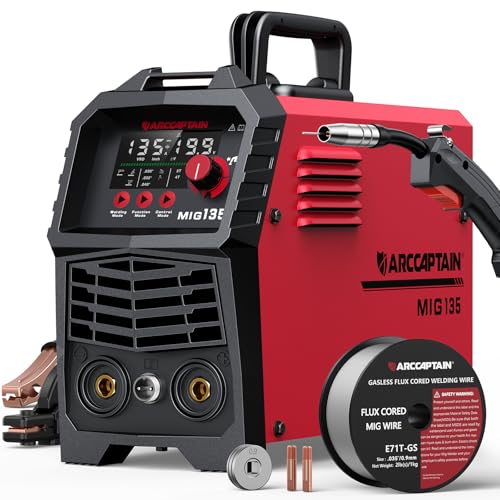
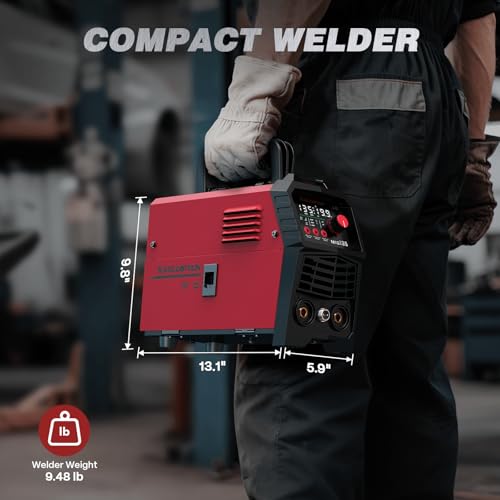
ARCCAPTAIN 135A LED Display Welder
Strengths
- Large LED display
- Lightweight at 9.48 lbs
- Beginner-friendly synergy mode
Trade-offs
- TIG torch sold separately
- No bonus wire or safety gear
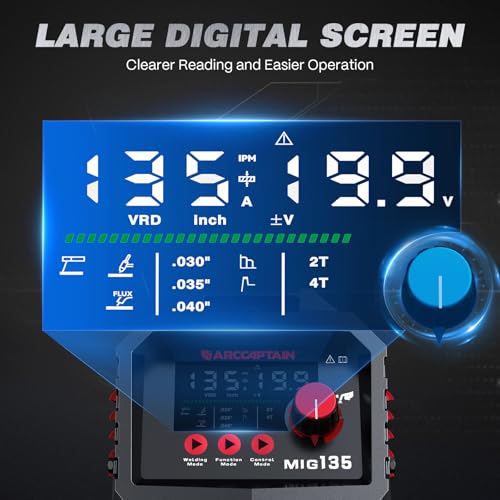
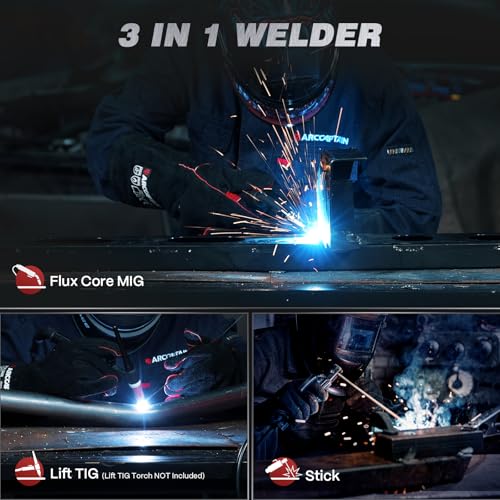
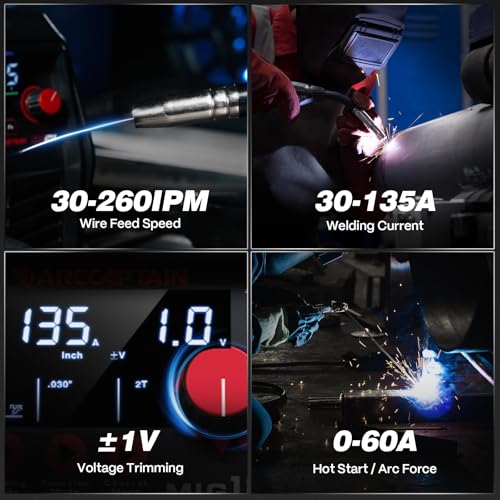
The ARCCAPTAIN 135A stands out in the entry-level 110V welder space with its large LED display, which owners consistently say makes setting and monitoring parameters far easier, especially in dim garage lighting. The synergy mode works well on paper, automatically matching voltage to wire feed speed based on thickness and wire size, which takes the pressure off beginners. I’ve seen this kind of system reduce frustration in early learning curves, and it’s clear ARCCAPTAIN tuned this for accessibility.
That said, while it’s a true 3-in-1 machine on spec, you’ll need to buy the TIG torch separately, which some buyers overlook. The 9.48 lb weight makes it one of the lighter units, and the shoulder strap inclusion is a thoughtful touch for mobility. Compared to the YESWELDER 135A, it’s a bit more refined in interface but lacks included consumables. If you value clear visibility and intuitive setup, this is a solid pick, though not the most beginner-complete out of the box.
Product photos
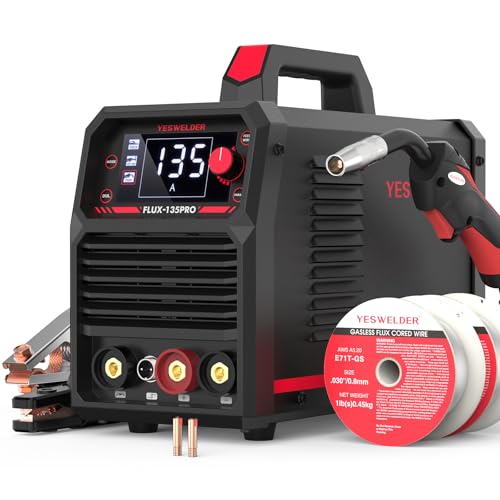
YESWELDER 135A Synergic Control
Strengths
- Includes flux core wire
- Solid synergic control
- Good voltage fine-tuning
Trade-offs
- Display less bright than ARCCAPTAIN
- TIG torch not included
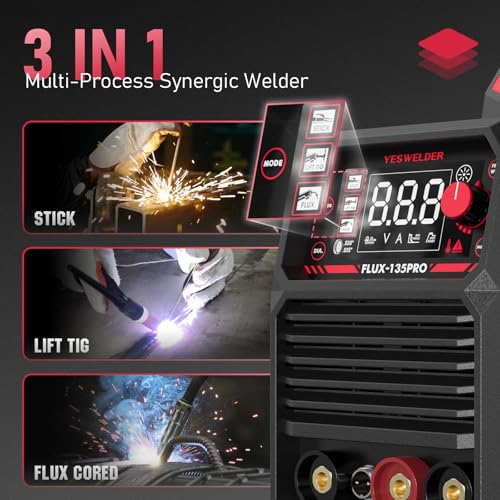
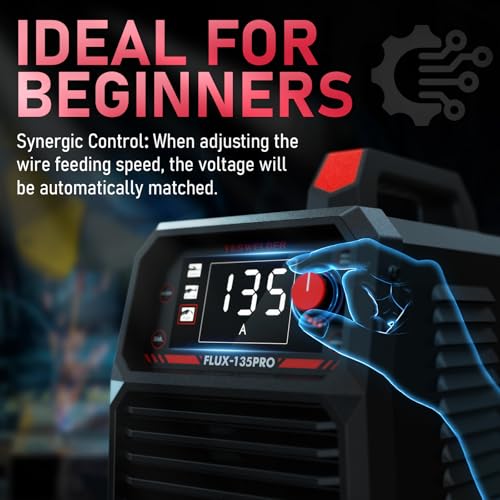
When I look at what makes a welder truly beginner-friendly, it’s not just about simplicity, it’s about what’s included and how forgiving the system is. The YESWELDER 135A earns its ‘Best for Beginners’ label by throwing in a 2LB spool of .030″ flux core wire, so you’re not scrambling to buy your first roll. Owners report this makes a real difference when starting out, and the synergic control system pairs well with it, auto-matching voltage to wire speed with a wide ±3V tuning range for when you want to tweak.
It’s slightly heavier than some competitors at 11.4 lbs, but still highly portable. Compared to the ARCCAPTAIN, it trades a slightly less flashy display for better out-of-box readiness. The digital readout is functional, not dazzling, but it shows real-time current, enough for most new welders. If you’re just getting into metalwork and want something that works without fuss or extra trips to the store, this is the smarter buy.
Product photos


FORNEY Easy Weld 140 FC-i
Strengths
- True 140A output
- All-metal durable case
- Simple infinite controls
Trade-offs
- Heavier than others
- No digital display
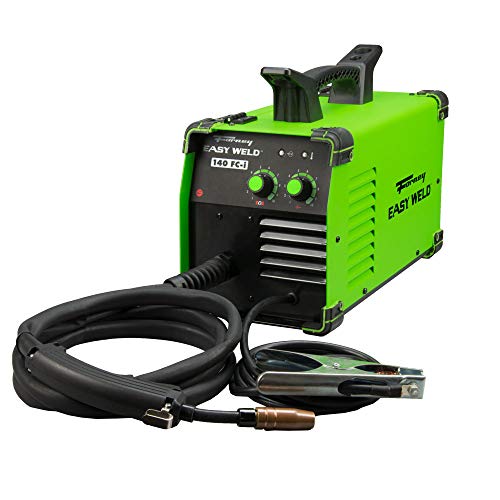
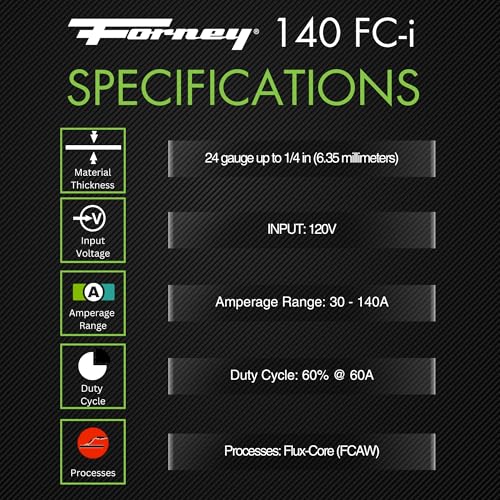
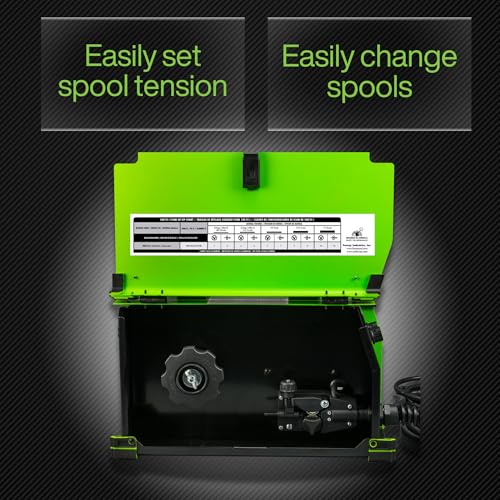
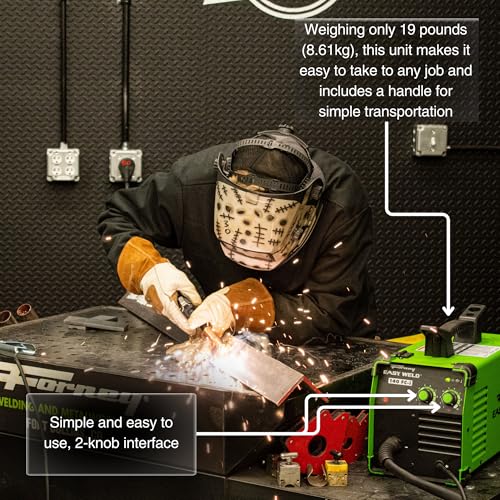
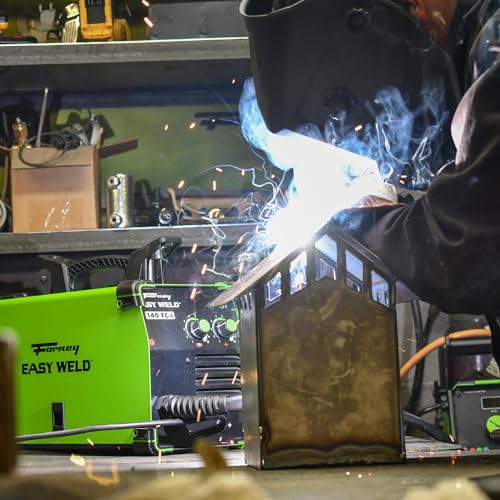
The FORNEY 140 FC-I feels like the anti-frills workhorse of this group, no digital display, no synergy mode, just infinite voltage and wire feed knobs you turn by hand. That simplicity is its strength. In a market flooded with digital gimmicks, this analog approach appeals to purists and those who want to learn the fundamentals without menus. It can handle up to 1/4″ mild steel, which beats most 110V flux-core units, and the all-metal case suggests it’s built to last.
It’s heavier at 19 lbs, so portability takes a hit, but the rugged build makes sense for job site use. Compared to the Futelo 145A, it’s less compact but more durable. The lack of any digital feedback might frustrate some, but owners who value direct control and reliability tend to praise it. If you want a no-nonsense, gasless welder that teaches you how welding really works, this one’s hard to beat.
Product photos

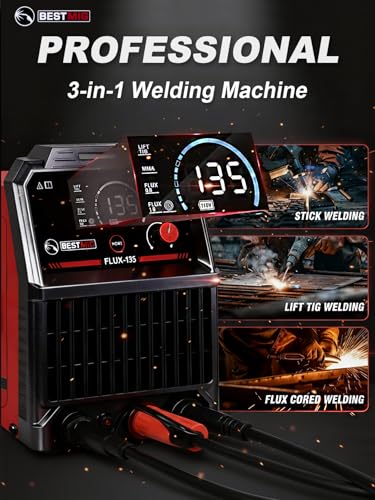
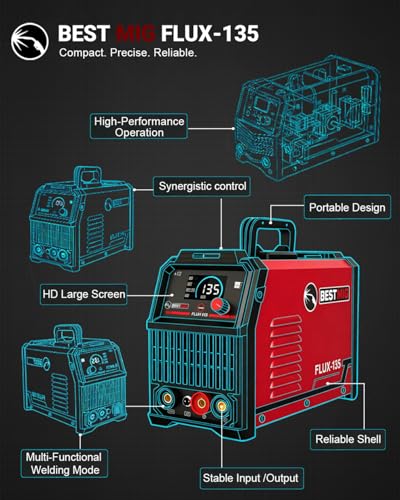
BESTMIG 135A 3-in-1 Welder
Strengths
- Includes auto-darkening helmet
- Full accessory bundle
- Bright full-color display
Trade-offs
- Slightly heavier build
- TIG torch not included
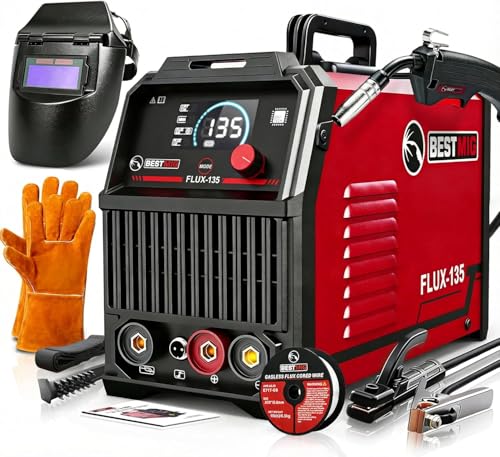
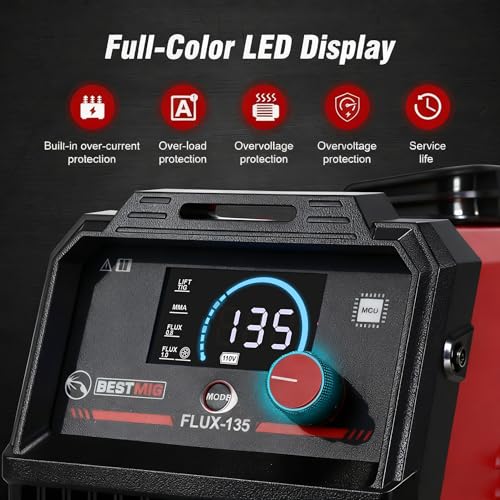
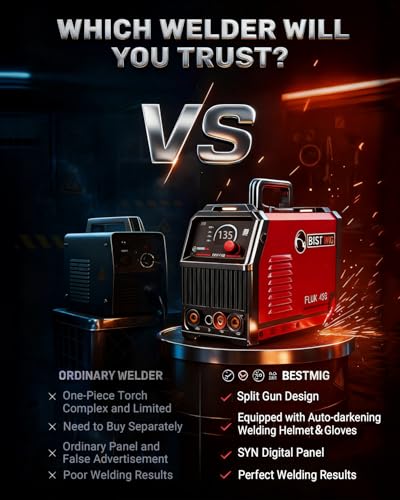
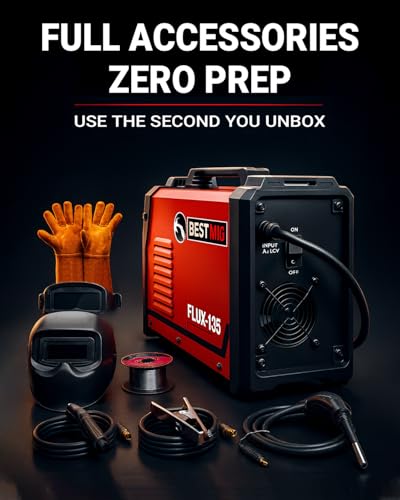
What sets the BESTMIG 135A apart is the inclusion of an auto-darkening welding helmet and gloves, a rare bonus at this price point. That pushes it into “best value with accessories” territory, especially since it also includes the basic welding gun, clamp, and holder. The full-color LED display is brighter than most, and owners appreciate being able to monitor parameters without lifting their mask.
The synergy mode works as expected, auto-adjusting voltage and feed speed, though the fine-tuning range isn’t as wide as on the TOOLIOM. It’s a bit heavier than others, but not enough to hurt portability. Compared to the YESWELDER 135A, it offers more safety gear but a slightly less proven track record in long-term reliability. If your priority is getting the most complete setup for the money, this one delivers.
Product photos
TOOLIOM 135A LCD Display Welder
Strengths
- Precise ±3V adjustment
- Includes gloves and wire
- Clear LCD feedback
Trade-offs
- No auto-darkening helmet included
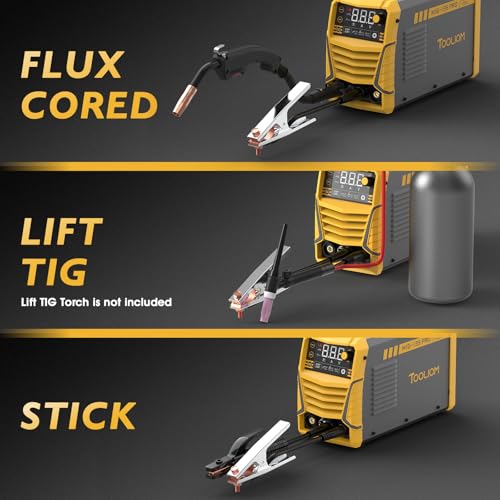
- TIG torch sold separately
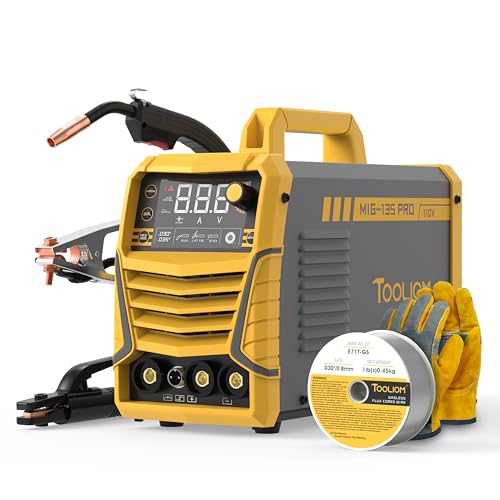
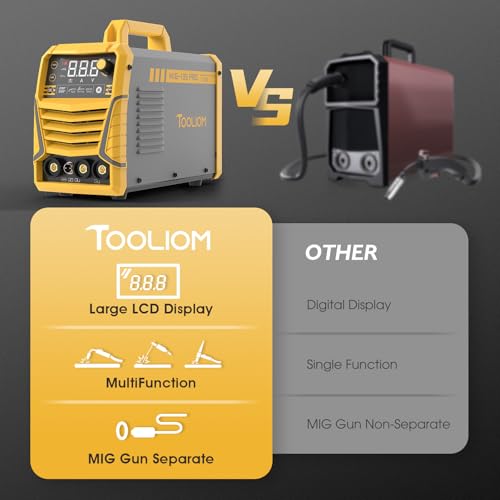
If precision control matters more than flashy extras, the TOOLIOM 135A deserves your attention. Its ±3V fine-tuning range and clearly labeled LCD display give experienced users more room to dial in exact settings, and owners note this makes a difference when switching between thin sheet metal and thicker repairs. The synergic system behaves predictably, and the ability to set wire size and thickness for auto-setup keeps beginners from getting lost.
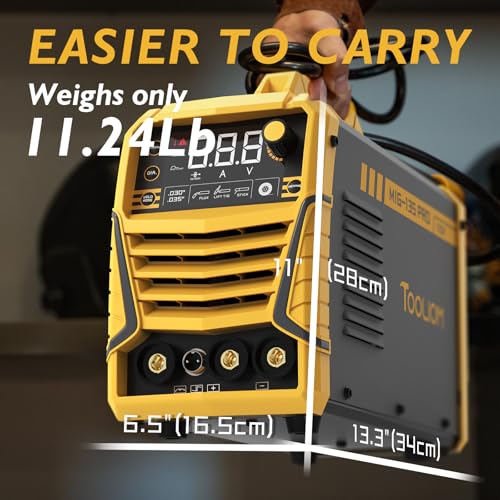
It’s not the lightest, but at 11.24 lbs with a carry handle, it’s still easy to move around a shop. What pushes this ahead for some users is the included welding gloves and wire, which adds value without bloating the price. Compared to the BESTMIG 135A, it lacks a helmet but offers more refined control. For someone who plans to grow into their skills, this balance of automation and manual override is ideal.
Product photos
How We Chose These wire welders
As someone who’s spent years around power tools and workshops, I understand the importance of a reliable welder. Rather than a hands-on lab test of each model, this selection is a research-led comparison of published specifications and features, combined with a careful weighing of owner reviews and insights from reputable expert sources. I focused on identifying units that consistently delivered strong performance and value across a range of needs.
For wire welders, the most impactful factors are welding capacity (measured in amps) and the versatility of the unit – specifically, whether it offers multiple processes like MIG, Stick, and TIG. A higher amperage allows for thicker material welding, while multi-process capability provides flexibility for different projects. Portability and ease of use were also heavily weighted, particularly for DIYers and those who need to move the welder around a jobsite.
Specifications reliably indicate amperage output, duty cycle, and input voltage requirements. However, I paid close attention to owner feedback to understand real-world usability, arc stability, and the quality of included accessories. Reputation and long-term reliability – gleaned from both expert reviews and user experiences – ultimately played a significant role in ranking these models. You can find more details on our top MIG welders guide for a broader overview of the market.
What To Look For In wire welders
Choosing the right wire welder can feel overwhelming, but focusing on a few key features will get you welding confidently. It’s not just about amps; it’s about finding a machine that matches your skill level and project needs.
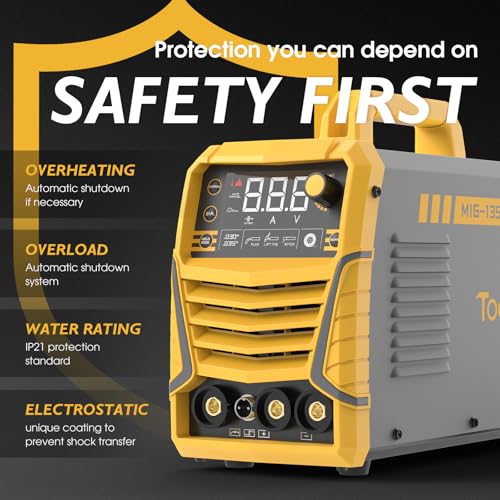
A good wire welder balances power with usability. Key considerations include amperage output for material thickness, the types of welding processes supported (MIG, Stick, TIG), ease of use for beginners, and portability for job-site work. Look for models with synergic control to simplify setup, and robust safety features to protect both the user and the machine.
Amperage and Material Thickness
The amperage of a wire welder dictates the thickness of material it can effectively join. Don’t overestimate your needs, but also don’t undershoot. For thin sheet metal (under 1/8 inch), a 120V welder in the 80-130 amp range will often suffice. If you anticipate working with thicker steel (up to 1/4 inch or slightly more), you’ll want to step up to a 200+ amp model, and likely require a 240V outlet. Remember that different processes, like MIG versus Stick, have different effective ranges, even at the same amperage. I often recommend starting with a slightly higher amperage than you think you’ll need, giving yourself room to grow as your skills develop.
Process Versatility: MIG, Stick, and TIG
Many wire welders now offer multiple processes. MIG (Metal Inert Gas) welding is generally easiest for beginners and ideal for clean, fast welds on thinner materials. Stick welding (SMAW) is more forgiving of dirty or rusty metal and doesn’t require shielding gas. Lift TIG (GTAW) offers the most precise and aesthetically pleasing welds, but has a steeper learning curve. If you’re new to welding, a 3-in-1 machine offering MIG, Stick, and TIG can be a great investment. However, you’ll need to purchase a TIG torch separately for most models. Consider how important each process is to your projects. If you mainly need to repair farm equipment, Stick welding might be your priority. If you’re building artistic metal sculptures, TIG is essential. For a broader overview of options, check out our guide to the top wire feed models.
Ease of Use and Control Features
For beginners, synergic control is a lifesaver. These systems automatically adjust voltage and wire feed speed based on your material thickness and wire diameter, simplifying setup and reducing the risk of poor welds. More experienced welders may prefer manual control for fine-tuning parameters.
Here’s what to look for in usability:
- Digital Display: A clear, easy-to-read digital display is invaluable for monitoring settings.
- Synergic Charts/Presets: Pre-programmed settings for common materials and thicknesses speed up setup.
- Adjustable Controls: Even with synergic control, the ability to fine-tune voltage and wire speed is important for achieving optimal results.
A welder’s controls should be intuitive and responsive. Don’t be afraid to spend a bit more for a machine that simplifies the learning curve and minimizes frustration.
If you anticipate needing to move your welder around a lot, you might also consider checking out our recommendations for portable MIG welders. Sometimes a smaller, more manageable unit is worth the slight trade-off in maximum power.
Wire Welders Compared
Here’s a comparison of key specifications for several wire welders to help you make an informed decision.
| Product | Amperage (Max) | Voltage | Welding Processes | Display Type | Weight (lbs) | Included Accessories |
|---|---|---|---|---|---|---|
| YESWELDER 205A Dual Voltage | 200 | 110V/220V | MIG, Flux Core, TIG, Stick | Digital | N/A | N/A |
| Futelo 145A Portable | 145 | 110V | MIG, Stick, TIG | LED | 7.5 | MIG Torch, Ground Clamp, Electrode Holder, Wire, Tips |
| Lincoln Electric 90i FC | 90 | 120V | Flux Core | N/A | 15 | Welding Gun, Nozzle, Tips, Cable, Clamp |
| ARCCAPTAIN 135A LED Display | 135 | 110V | MIG, TIG, Stick | LED | 9.48 | N/A |
| YESWELDER 135A Synergic Control | 135 | 110V | MIG, Stick, TIG | Digital | 11.4 | Flux Core Wire |
| FORNEY Easy Weld 140 FC-i | 140 | 120V | Flux Core | N/A | 19 | MIG Gun, Ground Clamp, Adapter |
| BESTMIG 135A 3-in-1 | 135 | 110V | MIG, TIG, Stick | LCD | N/A | Ground Clamp, Electrode Holder, Welding Helmet, Gloves |
| TOOLIOM 135A LCD Display | 135 | 110V | MIG, Stick, TIG | LCD | 11.24 | Welding Gloves, Welding Wire |
Frequently Asked Questions
What’s the difference between flux-cored and MIG welding?
MIG welding uses a shielding gas to protect the weld pool, while flux-cored welding uses a flux within the wire itself to provide shielding. Flux-cored is often preferred outdoors or in windy conditions because it doesn’t rely on external gas, though it produces more smoke and slag.
How much does a good wire welder typically cost?
A decent entry-level wire welder capable of handling basic home repairs will generally cost between $300 and $600. More versatile, higher-amperage models with multi-process capabilities can easily exceed $1000, depending on features and brand reputation.
Do I need a 240V outlet for a wire welder?
Not necessarily, but it depends on the thickness of the metal you plan to weld. Many affordable and capable 110V wire welders are available, especially if you’re focused on thinner materials; for heavier work, a 240V outlet is almost essential to avoid tripping breakers and overheating the machine. You can find a selection of best 110V models to suit your needs.
What safety gear is essential when wire welding?
Beyond the welder itself, you absolutely need a welding helmet with the correct shade lens, welding gloves, and fire-resistant clothing. Proper ventilation is also crucial, as welding fumes can be hazardous. Closed-toe shoes and long sleeves are also highly recommended for protection.
What amperage is sufficient for welding a car frame?
Repairing a car frame generally requires a welder with at least 200 amps, and ideally 225 amps or higher, to effectively penetrate the thicker steel. The specific amperage needed will vary based on the frame’s material and the extent of the damage, so a higher-capacity machine offers more flexibility.
The Bottom Line
Choosing a wire welder always comes down to balancing control with convenience, and power with portability. For most DIYers and those starting out, the YESWELDER 205A Dual Voltage offers the best overall combination of features, versatility, and value. It provides sufficient amperage for a wide range of projects, supports multiple processes, and has the digital controls needed for consistent results, all at a reasonable price point.
If budget is a primary concern, the Lincoln Electric 90i FC is a solid choice. It’s limited to flux core welding, but it’s a reliable and easy-to-use machine for basic repairs and light fabrication. For those needing maximum flexibility, the BESTMIG 135A 3-in-1 stands out – it includes a welding helmet and gloves along with MIG, TIG, and Stick capabilities, making it a complete starter kit. If you’re primarily focused on flux core applications, exploring the top flux-core welders is a good idea.
Ultimately, the specs matter less than understanding your own needs and skill level. A high-end machine won’t make you a better welder overnight, but a machine that’s appropriately sized for your projects and easy to learn will set you up for success. Focus on machines with good arc stability, clear controls, and positive owner feedback – those are the hallmarks of a welder you’ll be happy with for years to come.
