
Your Guide to Hybrid Table Saws: Power, Features, and Uses
This post contains affiliate links. As an Amazon Associate, we earn from qualifying purchases.
A hybrid table saw is a stationary workshop saw that merges the enclosed cabinet and internal motor of a cabinet saw with the lighter weight, standard 120V power requirement, and often table-mounted trunnions of a contractor saw. It typically houses a 1.5 to 2 horsepower induction motor, offers better dust collection than a contractor saw, and fits a price and performance point between those two classic categories.
Most people get this wrong because they hear “hybrid” and think it means battery-powered or somehow less capable. They picture a compromised tool. The reality is the opposite. For a serious home workshop or a small professional shop not running eight-hour production days, a hybrid is often the most logical, fully-featured saw you can plug into a standard wall outlet.
This guide breaks down exactly what makes a hybrid table saw tick, where it shines, and where you might want to spend more or less. We’ll look at the guts of the machine, compare it directly to its siblings, and give you the straight talk on setting one up without the marketing fluff.
Key Takeaways
- A hybrid saw needs a 120V outlet, not 240V. Its 1.5-2 HP motor is powerful enough for hardwoods but may bog on deep, continuous cuts in wet lumber.
- The single biggest differentiator is trunnion mounting. Cabinet-mounted trunnions (like on a SawStop PCS31230) allow easier blade-to-table alignment. Most hybrids have table-mounted trunnions, which are harder to adjust.
- Always check the motor type. A Totally Enclosed, Fan Cooled (TEFC) motor will last years longer in a dusty shop than an Open Drip Proof (ODP) motor.
- The enclosed cabinet improves dust collection, but only if you connect a decent vacuum or collector. Without suction, it just becomes a sealed chip box.
- For the price of a high-end hybrid, you can sometimes find a used industrial cabinet saw. The hybrid wins on new features and safety tech; the used cabinet saw wins on pure mass and power.
Anatomy of a Hybrid Table Saw
Forget the label for a minute. When you roll a hybrid saw into your shop, you’re looking at a specific set of physical parts that dictate how it will perform. The magic isn’t in the name, it’s in the arrangement of cast iron, steel, and copper.
The heart is a 1.5 to 2 horsepower induction motor sitting inside the cabinet. This isn’t the universal motor from a jobsite saw. It’s a heavier, slower-spinning workhorse that maintains torque under load.
Because it’s mounted inside, it uses a shorter belt drive to the arbor. Less belt length means less vibration and a smoother cut. You’ll hear the difference immediately, a deeper, steadier hum instead of a high-pitched whine.
Hybrid table saws utilize an induction motor, typically rated between 1.5 and 2 horsepower, mounted internally within a fully enclosed steel cabinet. This configuration allows operation on a standard 15-amp, 120-volt circuit while providing improved power transmission and reduced noise compared to contractor saws with externally hung motors. Common motor specifications include 1725 RPM and a dual V-belt drive system to the arbor assembly.
The cabinet itself is the most visible hybrid feature. It’s a box, usually welded steel, that replaces the open stand of a contractor saw. This does three things. It contains noise.
It provides a solid mounting point for the cast iron wings. And it creates a plenum for dust collection. A proper hybrid will have a 4-inch dust port at the back. The bottom of the cabinet is often hopper-shaped to funnel chips toward that port.
On top, you have a cast iron table, typically 27 inches deep. The fence is almost always a T-square style, a vast improvement over the flimsy rails on old contractor saws. Look for a fence like the Biesemeyer design.
You lock it at the front and the back. A good one has minimal deflection, you shouldn’t be able to move it more than 1/16 inch with firm hand pressure when it’s locked down. If it flexes easily, walk away. That flex translates directly to tapered rip cuts.
Key Differences: Hybrid vs. Contractor vs. Cabinet Saw
The woodworking world loves its categories, and they exist for a reason. Placing the hybrid between the contractor and cabinet saw isn’t just marketing. It’s a map of trade-offs in power, precision, portability, and price. Your choice depends on which compromises you can live with.
A contractor saw is the classic portable workhorse. Its motor hangs off the back on a bracket, driving a long belt. This makes it lighter and the motor easy to service, but that long belt can whip and vibrate.
The stand is open, so dust goes everywhere. It runs on 120V and usually has a 1.5 HP motor. It’s a fantastic saw for a builder moving from site to site or a hobbyist on a tight budget. But for a stationary shop, the dust and noise become real liabilities.
The cabinet saw is the industrial benchmark. The motor is inside a heavy, massive cabinet that acts as a vibration-damping foundation. The trunnions, the assemblies that hold the blade and allow it to tilt, are bolted directly to the cabinet, not the table.
This makes the entire structure incredibly rigid and the blade alignment supremely stable. Cabinet saws often have 3-5 HP motors and usually require a 240V circuit. They are built for all-day, every-day use. They are also heavy, expensive, and demand dedicated wiring.
The hybrid sits squarely in the middle. The table below shows where the lines blur and where they’re crystal clear.
| Feature | Contractor Saw | Hybrid Saw | Cabinet Saw |
|---|---|---|---|
| Motor & Power | 1.5 HP, 120V, external mount | 1.5-2 HP, 120V, internal mount | 3-5 HP, 240V, internal mount |
| Cabinet/Stand | Open steel stand | Fully enclosed steel cabinet | Heavy-gauge enclosed cabinet |
| Trunnion Mount | Bolted to table | Usually bolted to table | Bolted to cabinet |
| Weight | ~200-250 lbs | ~275-325 lbs | 500+ lbs |
| Dust Collection | Poor (open design) | Good (enclosed with port) | Excellent (sealed with port) |
| Primary Use Case | Jobsite mobility, light shop duty | Dedicated home/small pro shop | Industrial production shop |
The hybrid takes the contractor saw’s electrical convenience and merges it with the cabinet saw’s cleaner, quieter operation. The trade-off is in ultimate power and the fiddly trunnion alignment. That last point is critical. Aligning a blade perfectly parallel to the miter slots is a foundational task. On a saw with table-mounted trunnions, you’re adjusting heavy castings that are bolted to the underside of the tabletop.
It’s awkward. On a cabinet saw, you’re adjusting the table itself, which sits on top of the aligned trunnions. It’s a simpler, more stable process. Some hybrids, like the higher-end SawStop models, have adopted cabinet-mounted trunnions. That’s a major upgrade.
Who Should Buy a Hybrid Table Saw?
This isn’t a saw for everyone. It’s a solution to a specific set of problems. If your situation matches the list below, a hybrid is probably your best new-saw investment. If not, you might be better off with a different type of saw or even sharpening your current circular saw blade to extend its life while you save up.
You’re the ideal candidate if:
* Your workshop is in a garage or basement with only standard 120V outlets. Running a 240V line isn’t an option.
* You process a mix of sheet goods (plywood, MDF) and solid hardwoods like maple or oak, but not in high volume.
* Dust management matters because your shop is attached to your house.
* You value a smooth, accurate cut but don’t need to rip 8/4 walnut all day, every day.
* Your budget tops out around $1,500 for the saw itself.
I learned this the hard way with a Delta 36-725T2, a popular hybrid. My shop was a single-car garage with one 120V circuit. The saw ran beautifully for building cabinets and furniture. Then I took on a job milling fifty linear feet of 8/4 white oak for countertop edges.
Ripping those 2-inch-thick boards, one after another, heated the motor to the point where the thermal overload switch kicked in twice an afternoon. The saw could do the work, but it needed breaks. I finished the job, but immediately understood the hybrid’s limit. For that scale of milling, you need the thermal mass of a 3 HP motor. Now I know to break up heavy ripping sessions.
If you plane more than twenty board feet of rough hardwood in a single session, a hybrid saw’s motor will heat up. Let it cool for ten minutes halfway through, or you’ll trip the internal thermal protector and wait longer for it to reset. The smell is a mix of hot enamel and regret.
Critical Features to Evaluate Before You Buy
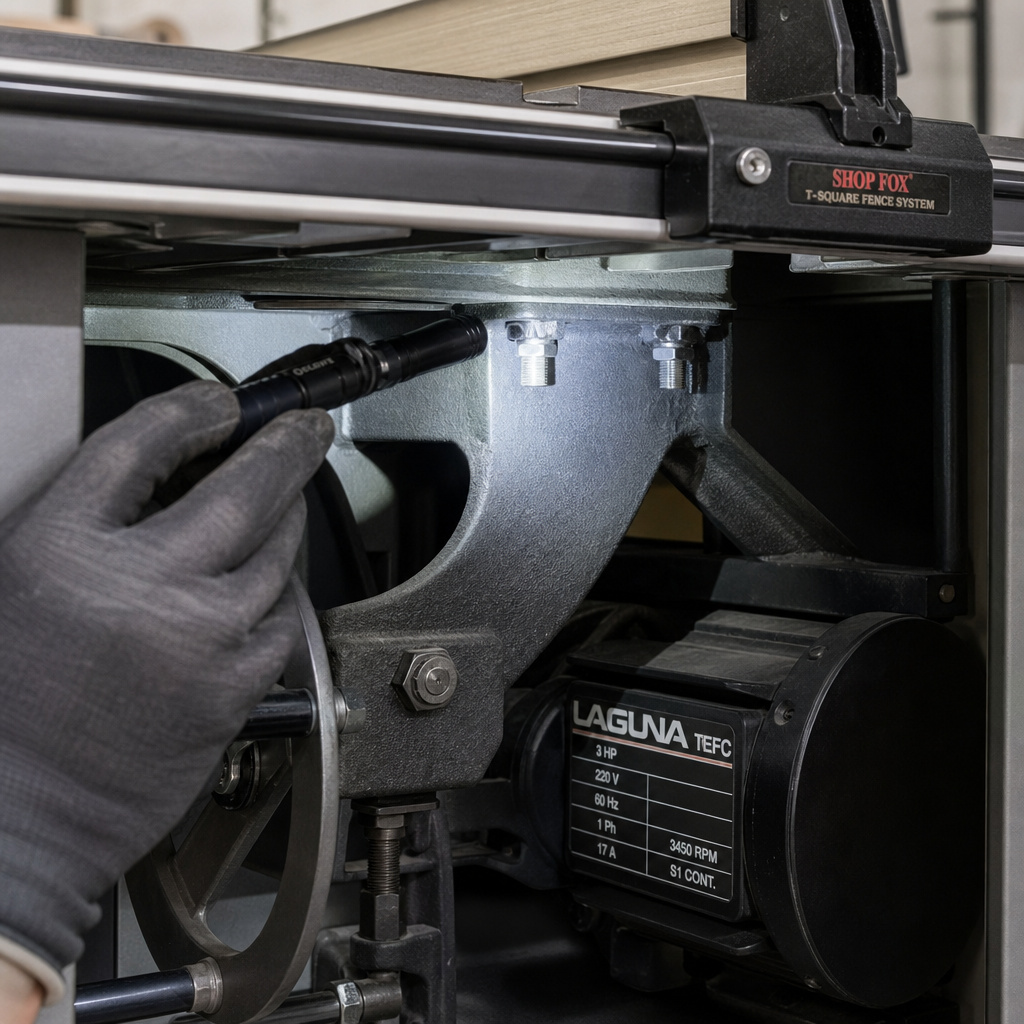
Not all hybrids are created equal. Two saws can look identical on a big-box store floor but have fundamental differences that affect daily use. Look past the paint and the sticker price.
Motor Type: TEFC vs. ODP
This is a deal-maker or breaker. A Totally Enclosed, Fan Cooled (TEFC) motor is sealed against dust and debris. An Open Drip Proof (ODP) motor has ventilation slots that allow cooling air, and every speck of dust in your shop, to be sucked directly through the windings. In a woodshop, an ODP motor is a maintenance headache waiting to happen. You’ll be blowing it out with compressed air monthly. Always choose the TEFC option. It costs a bit more but lasts decades longer.
Trunnion Mounting
Pop off the side panel and look up. Are the massive cast-iron trunnions bolted to the underside of the table? That’s the standard hybrid design. Is there a separate, welded internal frame that the trunnions are attached to, with the table sitting on top? That’s a cabinet-mounted design. The latter is superior for long-term alignment stability. It’s worth seeking out and often separates the budget hybrids from the premium ones.
Fence System
The fence is your most frequent point of contact with the saw. A flimsy fence ruins workpieces. A good hybrid fence has:
* A single locking handle that engages both front and rear points.
* Steel rails that are securely mounted to the table.
* Minimal deflection when locked (test it in the store).
* A smooth, positive micro-adjust mechanism for fine-tuning.
Many brands use a licensed version of the Biesemeyer T-square. It’s a proven design. Just make sure the specific implementation on your chosen model feels solid.
Dust Collection Hookup
A 4-inch port is standard. Some cheaper models might have a 2.5-inch port, which is almost useless for effective chip extraction. Ensure the cabinet has a decent blade shroud that directs chips downward. The best dust collection in the world won’t help if chips just pile up under the blade inside the cabinet.
Common Hybrid Table Saw Models and What They Offer
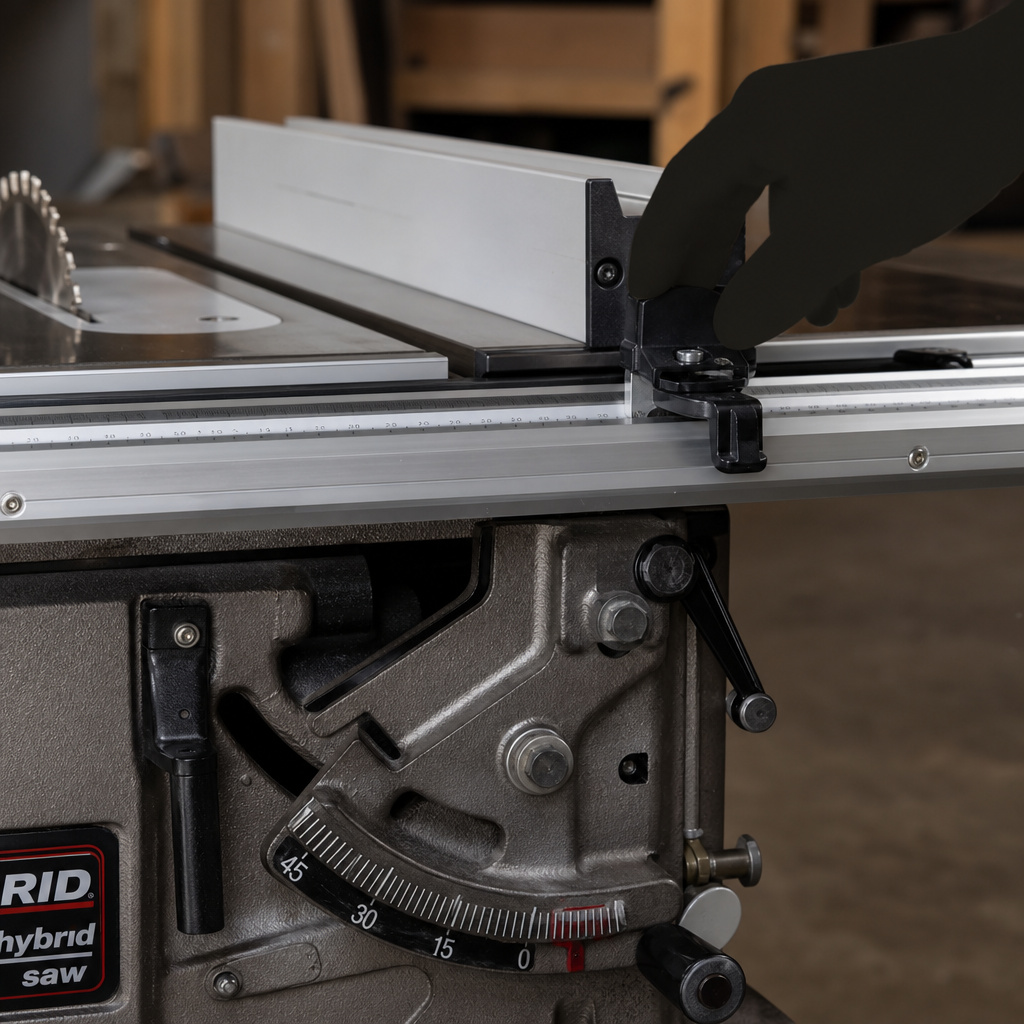
The market has consolidated around a few key players. Each brings a slightly different philosophy to the hybrid category.
Delta 36-725T2 / Delta 36-725T2
This is the saw that defined the modern hybrid for many DIYers. It’s a classic table-mounted trunnion design with a decent T-square fence and a 1.75 HP motor. It’s often the benchmark for value. The motor is ODP, so be prepared for dust cleanouts. The alignment procedure is finicky but well-documented online by a community of owners.
Grizzly G0771Z
Grizzly imports heavy machinery, and their hybrid leans into that ethos. It’s often heavier than competitors, with a more substantial feel. It frequently includes a TEFC motor as standard, a major plus. The fence is robust. The trade-off can be in fit and finish, you might spend your first weekend tuning it up, but you get a lot of saw for the money.
SawStop PCS31230
SawStop revolutionized safety with their blade-braking system. Their “Professional Cabinet Saw” (PCS) in the 1.75 HP, 120V configuration is technically a hybrid with cabinet-mounted trunnions. It’s at the top of the hybrid price range, but you get unparalleled safety, excellent build quality, and that crucial cabinet-mounted alignment. It’s the hybrid that acts like a cabinet saw.
Powermatic PM1000
Powermatic’s entry is another premium hybrid with cabinet-mounted trunnions. It boasts superb fit and finish, a great fence, and the iconic gold powder coating. Like the SawStop, it commands a premium price, positioning itself as a lifetime tool for the serious amateur.
Setting Up and Maintaining Your Hybrid Saw
Getting the saw off the pallet is just the beginning. How you set it up dictates its accuracy for the next decade.
- Assemble on a perfectly flat floor. Use a long level across the table. Shim the cabinet feet until the table is flat in all directions. An unlevel cabinet twists the frame and throws off all future adjustments.
- Align the blade to the miter slot first. This is the foundational step. Use a dial indicator or a reliable combination square. Adjust the trunnions (consult your manual) until the blade is parallel to the slot along its full height. If you have table-mounted trunnions, this will involve loosening several large bolts underneath and tapping things into place. It’s a two-person job.
- Square the fence to the table. Once the blade is parallel to the miter slot, set the fence to lock parallel to that same slot. Most fences have adjustment screws at the front and rear locking points.
- Set the riving knife. This splitter-alike sits just behind the blade to prevent kickback. It must be perfectly aligned with the blade, not touching it, and just slightly lower than the top of the blade’s teeth.
- Connect dust collection. Use a 4-inch hose. If you only have a shop vac, get a 4-inch to 2.5-inch reducer, but know that performance will be limited. The cabinet needs airflow.
Maintenance is straightforward but non-negotiable. Every six months:
* Check belt tension. They should deflect about 1/4 inch with moderate thumb pressure.
* Lubricate the raising and tilting gears with a dry lubricant like powdered graphite.
* Vacuum out the cabinet, especially if you have an ODP motor.
* Check the arbor nut for tightness (unplug the saw first).
Neglect the belts and they’ll glaze over, slipping under load and burning. Skip the cabinet cleanout with an ODP motor, and you’ll eventually hear a concerning buzz before the magic smoke escapes.
Frequently Asked Questions
Can a hybrid table saw run a dado stack?
Most can, but you must check the arbor length. A standard arbor is long enough for a single blade and a washer. For a dado stack, you need about an extra inch of thread. Many hybrids have a short arbor that only accepts a thin-kerf blade. The manual will specify the maximum dado width. Never force a stack onto a short arbor.
Is a hybrid saw safe for a beginner?
It can be, provided you respect it. Its power demands respect. Always use the blade guard and riving knife. Never make freehand cuts. Use push sticks for any rip cut under 12 inches wide. The safety features are there, but they don’t replace focused, deliberate technique. Start by practicing circular saw basics on scrap wood to build good habits first.
How does dust collection really work on these saws?
The enclosed cabinet captures chips that fall off the back and bottom of the blade. A shroud around the blade’s underside directs them toward the port. It’s effective for maybe 70-80% of the dust. The fine, airborne particles (the kind that are worst for your lungs) still escape from the top of the blade unless you have an overhead blade guard with its own vacuum port. Connect a collector for the cabinet port.
What’s the actual cut capacity?
Typically, with the fence, you can rip a sheet of plywood (about 24 inches to the right of the blade). The maximum cutting height at 90 degrees is usually between 3 and 3.25 inches. That’s enough for most hardwoods. At a 45-degree bevel, that capacity drops by about 30%.
Hybrid vs. a high-end contractor saw: which wins?
It depends on your shop’s layout. If you need to occasionally wheel the saw out of the way, a contractor saw on a mobile base is lighter and easier. If the saw has a permanent station, the hybrid’s enclosed cabinet wins on noise and dust every time. Compare the specific models. A premium contractor saw with a TEFC motor and a great fence might beat a budget hybrid with an ODP motor and a wobbly fence.
Can you add cast iron extension wings later?
Usually, yes. Most hybrids have bolt patterns to accept standard cast iron wings. This adds significant weight and stability. Avoid the lighter granite composite wings if you can. They don’t dampen vibration as well as cast iron and can develop a sag over many years if not fully supported.
The Bottom Line
A hybrid table saw isn’t a compromise. It’s a targeted solution for the woodworker who has graduated from portable tools but isn’t running a commercial shop. It brings cabinet-saw cleanliness and contractor-saw convenience into a single package that plugs into the outlet you already have. Your focus should be on the motor type and the trunnion mounting. Get a TEFC motor if you can. Seek out cabinet-mounted trunnions if your budget allows. Everything else, the fence, the dust port, the table size, flows from those two core decisions. Set it up with patience, maintain it with discipline, and it will handle 95% of what any advanced DIYer or small pro throws at it for the next twenty years.
