
What Does an Edger Do For Your Lawn? Tool Purpose & Uses
This post contains affiliate links. As an Amazon Associate, we earn from qualifying purchases.
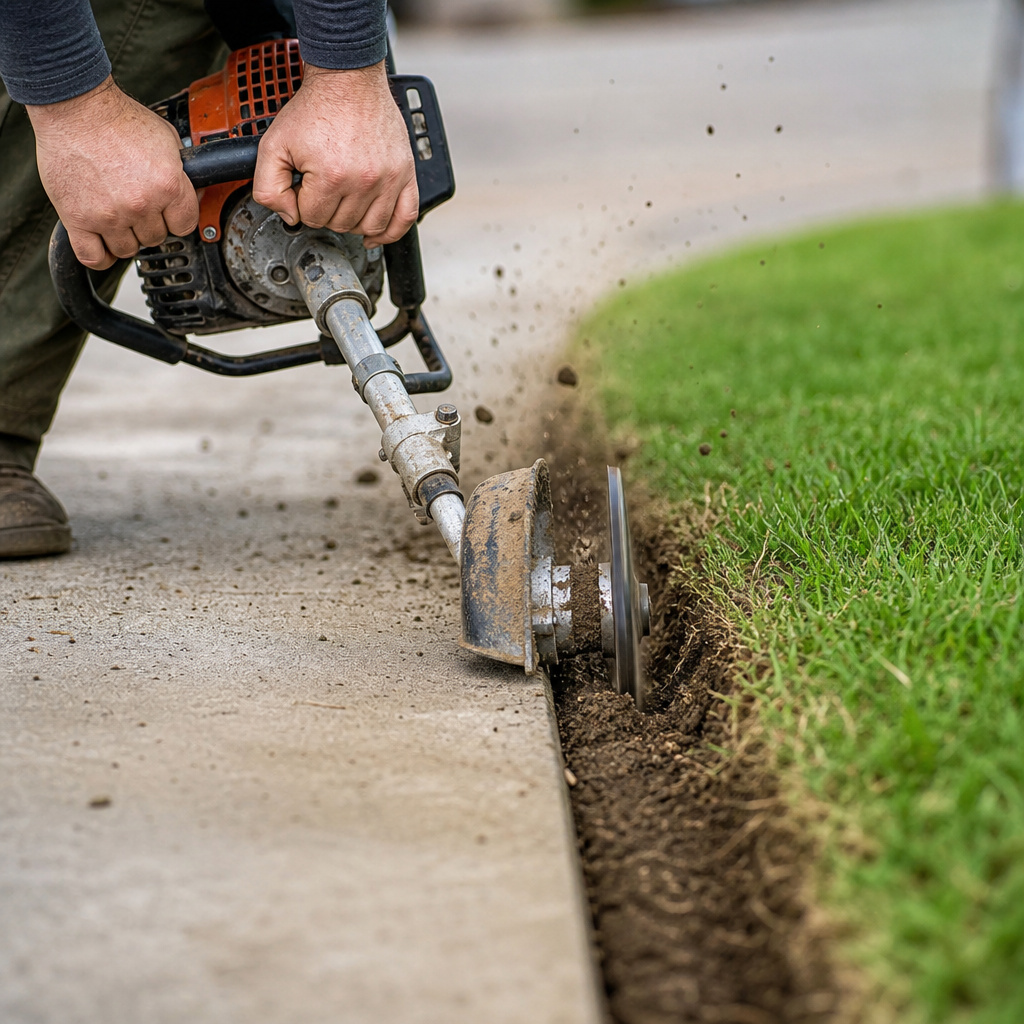
A lawn edger is a power tool designed to cut a clean, vertical edge between a lawn and an adjacent surface like a sidewalk, driveway, or garden bed. It uses a steel blade that spins perpendicular to the ground to slice through grass roots and soil, creating a distinct trench that defines the lawn’s border and prevents grass from spreading. Unlike a string trimmer, which cuts horizontally, an edger is built for a single, precise task: making that sharp, professional-looking line.
Most people think a string trimmer is enough to keep their lawn looking neat. They spend ten minutes whipping the line along the sidewalk, then wonder why the edge looks ragged and the grass creeps back onto the concrete within a week. The trimmer just cuts the top growth. The edger goes for the roots.
This guide breaks down exactly what an edger does, why it’s a different tool from a trimmer, and how to pick the right one for your yard. We’ll cover the mechanics, the types, and the real-world choices that separate a quick job from a lasting one.
Key Takeaways
- An edger’s primary job is to cut a vertical trench, not just trim grass. The blade slices through soil and roots to create a long-lasting physical barrier.
- Using a string trimmer for edging is a compromise. It can’t achieve the same depth or clean line as a dedicated edger, and it wears out line faster on hard surfaces.
- Gas-powered stick edgers offer the most power for large properties, while battery models are ideal for typical suburban yards. Manual edgers work for small, simple borders.
- The single most common mistake is not cleaning out the trench after cutting. Leaving the spoil (grass and soil clippings) on the hardscape kills the grass edge and looks sloppy.
- Edging should be part of your regular mowing routine, not a once-a-season chore. A quick touch-up every other mow keeps the line sharp with minimal effort.
How Does an Edger Work?
The core of an edger is a steel blade, typically 8 to 10 inches in diameter, mounted on a rotating shaft. When you start the engine or motor, this blade spins at high speed, perpendicular to the ground. You guide the machine along the boundary you want to define. The blade’s leading edge contacts the soil and grass, slicing a narrow, vertical channel.
The cutting action is a shear, not a tear. A sharp steel blade rotating at 2,000 to 3,000 RPM cleanly severs grass stems and roots, leaving a smooth wall of soil. A worn or dull blade, or one spinning too slowly, will rip and fray the grass, leaving a brown, damaged edge that takes weeks to recover.
The machine’s design forces this vertical cut. Most have a guide wheel that runs along the hard surface (sidewalk, driveway), maintaining a consistent distance and depth. You set the cutting depth with a lever, usually between 1 and 3 inches. The deeper the cut, the longer it takes for grass to grow back across the gap.
The physics are simple. The blade’s kinetic energy transfers directly into cutting soil and root mass. A string trimmer’s monofilament line, by contrast, whips horizontally and relies on abrasion. It beats the grass back but doesn’t create a defined separation in the soil. That’s why a trimmer edge disappears in a rainstorm, while a proper edged trench holds its shape for a month or more.
Edger vs. String Trimmer: The Critical Difference
This is where most DIYers get it wrong. They are not interchangeable tools, though a trimmer can sometimes do a poor imitation of an edger’s job.
| Feature | Lawn Edger | String Trimmer (Weed Eater) |
|---|---|---|
| Primary Cutting Action | Vertical, perpendicular to ground | Horizontal, parallel to ground |
| Cutting Tool | Rigid steel blade | Flexible monofilament nylon line |
| Primary Purpose | Create a defined border/trench | Cut grass/weeds in tight spaces |
| Result on Lawn Edge | Clean, vertical soil wall | Beveled, torn grass edge |
| Best For | Defining borders along hardscapes | Trimming around trees, fences, walls |
| Damage to Hard Surfaces | Minimal (if wheel is used) | Can scar concrete/wood with line |
A string trimmer held vertically can edge. It’s a common technique, and our guide on converting string trimmer to edger covers the method. But it’s a workaround. The line wears down rapidly on concrete, the cut is uneven, and you have no depth control. You’re essentially using a tool for a job it wasn’t optimized for.
The edger is the specialist. Its whole design, the blade orientation, the guide wheel, the depth adjustment, is built for one outcome: a crisp, straight line that makes your lawn look professionally maintained. For the foundational proper edging techniques, you start with the right tool.
Types of Lawn Edgers: From Manual to Gas-Powered
Your choice here dictates the effort required and the quality of the result. There are three main categories, each with a clear place.
Manual Edgers
These are your basic, no-power options. The classic is the half-moon edger, a curved steel blade on a long handle. You drive it into the soil with your foot and lever it forward. It’s cheap, quiet, and gets the job done on small, simple edges. The downside is labor. After 20 feet of compacted soil, your back and shoulders will know it. Roller edgers and long-handled shears fall into this category, too. They’re fine for touching up a flower bed border once a season but aren’t viable for a full property perimeter.
Electric Edgers
These split into corded and cordless (battery) models.
* Corded Electric: Plugs into an outlet. They’re lighter than gas, start instantly, and are relatively low-maintenance. The cord is the obvious limitation. For a typical suburban lot, you’ll need multiple extension cords and constant awareness to avoid cutting your own power source. They also lack the torque for dense, dry soil.
* Cordless/Battery Electric: This is the sweet spot for most homeowners. Brands like Ryobi, EGO, and DeWalt make powerful 18V to 80V models. They’re quiet, emission-free, and start with a trigger pull. The runtime is the constraint. A 5.0Ah battery might last 30-45 minutes of continuous edging, which is enough for most yards. If you have a large property, you’ll need a spare battery. For setup, our guide on Ryobi 18V trimmer edger setup walks through the common steps.
Gas-Powered Edgers
These are the heavy-duty machines. They’re typically “stick edgers” with a two-stroke or four-stroke engine mounted on a single pole. Models like the Stihl FC 90 or RedMax EG2600 are common. They offer unlimited runtime (just refuel), immense power for tough soil, and are built for professional or large-property use. The trade-offs are noise, vibration, fumes, and maintenance (fuel mixing, spark plugs, air filters). For consistent, large-scale work, they’re unmatched. If you go this route, understanding Stihl edger operation is key to a long engine life.
Choosing the Right Edger for Your Yard
Don’t buy based on brand loyalty alone. Match the tool to the task. This table lays out the decision matrix.
| Yard Size & Use Case | Recommended Edger Type | Key Considerations |
|---|---|---|
| Small urban lot (< 1/4 acre), occasional use | Manual half-moon or cordless battery | Low cost, low noise, minimal storage. Battery runtime is less of an issue. |
| Typical suburban yard (1/4 – 1/2 acre), regular maintenance | Cordless battery-powered edger | Balance of power and convenience. Buy into a battery ecosystem you already own (e.g., Ryobi, DeWalt). |
| Large property (> 1/2 acre), frequent edging | Gas-powered stick edger | Power and runtime are critical. Accept the noise, fuel, and maintenance for performance. |
| Professional landscaping service | Commercial gas-powered edger | Durability, serviceability, and all-day power are non-negotiable. |
My own mistake was buying a mid-range corded electric edger for a three-quarter-acre lot with a long, winding driveway. The first 50 feet were easy. Then I spent more time untangling and repositioning 150 feet of extension cords than I did actually edging.
I sold it after one season and bought a used gas Stihl. The difference in job completion time was over an hour. The gas model was louder and smelled of two-stroke oil, but it finished the work.
For most people, a quality cordless model from a major brand is the right call. The technology has caught up. The 40V and 80V platforms have enough torque to handle established lawns, and you can often share batteries with your other tools.
The Real Cost of Not Edging (And How Often to Do It)
Skip edging and your lawn slowly loses its definition. Grass rhizomes creep under the sidewalk and pop up on the other side. Soil and mulch spill over onto walkways. The clean line between garden bed and turf disappears, making everything look unkempt even if the grass is freshly mowed.
Edge every time you mow during the peak growing season (spring/early summer). In the heat of summer or early fall, you can stretch it to every other mow. Letting it go longer means fighting through overgrowth, which strains the tool and yields a rougher cut.
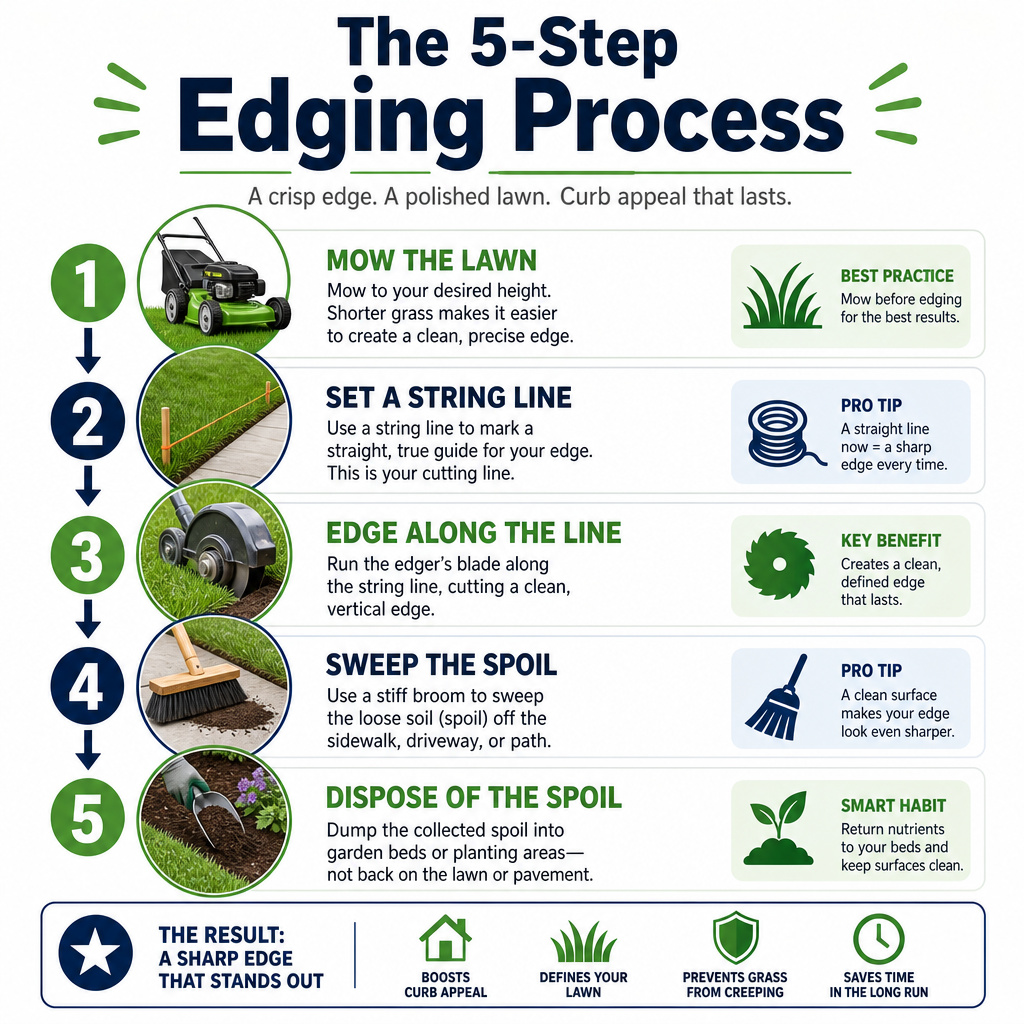
The process is simple but has one non-negotiable step most people skip. Here’s the right sequence:
- Mow First. Always mow your lawn before you edge. This removes the long grass that can flop over and obscure your cutting line. Trying to edge through uncut grass is like cutting fabric with a pattern you can’t see.
- Define Your Line. For a straight edge, use a garden hose or a string line as a guide. For curved beds, just eyeball it. The wheel on the edger will follow the existing hardscape.
- Make the Cut. Start the edger, lower the blade to your desired depth (start with 2 inches), and walk at a steady, moderate pace. Let the tool do the work, don’t force it. If the engine bogs down, you’re going too fast or the soil is too dry. A light spray with a hose 30 minutes prior can help in hard clay.
- Remove the Spoil. This is the step everyone misses. The edger throws cut grass and soil, the “spoil”, up onto the sidewalk or driveway. You must clean this up. Use a stiff broom, a leaf blower, or a flat shovel. Leaving it there smothers the grass edge, kills it, and creates a brown, dead line. It also looks terrible. Clean spoil reveals the sharp edge you just created.
- Dispose of Debris. Toss the spoil into a compost pile or garden bed, or bag it with your grass clippings.
That’s it. The whole perimeter of an average yard should take 20-30 minutes with a power edger. The manual version will take longer and work up a sweat.
Safety, Maintenance, and Common Problems
Before you start: Wear safety glasses, the blade throws rocks and debris sideways with enough force to chip concrete. Use hearing protection with gas models; they run at 85-90 decibels. Always wear long pants and sturdy closed-toe shoes. Never operate the tool with the blade guard removed.
Maintenance is straightforward but non-optional. For battery and corded electric models, just keep the blade sharp and the air vents clear of grass clippings. For gas models, you have a longer checklist:
- Blade Sharpness: A dull blade tears grass instead of cutting it. You’ll see brown, frayed edges within a day. Sharpen the blade with a file every 2-3 uses, or replace it when nicked. Our guide on edger blade replacement covers the safe way to do this.
- Air Filter: Check and clean the foam filter every 5-10 hours of use. A clogged filter starves the engine of air, causing it to run rich, lose power, and eventually foul the spark plug.
- Fuel: For 2-stroke engines, use fresh fuel mixed with the correct 2-stroke oil ratio (usually 50:1). Stale fuel is the number one cause of starting problems. Never store a gas edger with fuel in the tank over winter.
Common problems you’ll encounter:
- Edger won’t start (Gas): 90% of the time, it’s old fuel. Drain the tank and carburetor, add fresh mix. Next, check the spark plug.
- Uneven depth or wandering cut: The guide wheel is likely set unevenly or is worn. Adjust the depth-of-cut lever on both sides, or replace a bald tire.
- Excessive vibration: The blade is either damaged, loose, or out of balance. Stop immediately and check the blade nut and blade condition.
Frequently Asked Questions
Can I use my string trimmer as an edger?
You can, but it’s not ideal. By rotating the head 90 degrees, you can use the spinning line to cut a vertical edge. It works for quick touch-ups but won’t create the deep, clean trench a dedicated edger blade makes. The line also wears down quickly on concrete.
How deep should I edge my lawn?
Aim for 2 to 3 inches deep. This is deep enough to sever the majority of grass roots at the border, creating a lasting barrier. Shallower cuts need redoing every few weeks. Deeper cuts are unnecessary and put more strain on the tool.
Is a dedicated edger worth it for a small yard?
If you value a crisp, professional-looking lawn edge, yes. A manual half-moon edger is a low-cost investment. For even more convenience, a cordless multi-tool that converts from a trimmer to an edger (like many Ryobi or DeWalt models) is a great space-saving option.
What’s the difference between edging and trimming?
Edging creates the vertical border along hardscapes. Trimming cuts the grass around objects like trees, fences, and walls where a mower can’t reach. They are complementary tasks for a finished look.
Can I edge when the ground is wet?
It’s not recommended. Wet soil is heavy, clogs the blade and wheel, and tears instead of cutting cleanly. It also compacts the trench walls, which can hinder grass recovery. Edge when the soil is slightly moist or dry.
The Bottom Line
An edger isn’t just another lawn tool, it’s the finisher. It’s what transforms a mowed lawn into a landscaped one. A string trimmer manages overgrowth; an edger defines the space. For a small yard, a manual tool or a cordless multi-tool attachment gets the job done. For anything larger, a dedicated power edger saves your back and your time.
The real secret isn’t in buying the most expensive model. It’s in using it consistently and cleaning out the trench afterward. Do that, and your lawn will hold that sharp line with minimal effort, season after season. That’s the difference between a yard that’s simply cut and one that looks deliberately cared for.
