What Is a Good Weed Eater? 5 Key Factors and Top Picks
This post contains affiliate links. As an Amazon Associate, we earn from qualifying purchases.
A good weed eater matches three things to your property: the power source (gas, battery, or corded), the cutting width (14 to 16 inches for most yards), and the ergonomics (shaft type and balance) that fit your height and stamina. Ignore any one of those and you’ll fight the tool every time you use it.
Most people walk into a store and buy the one with the biggest engine or the shiniest battery. They get home, use it for twenty minutes, and their shoulder aches. The line snaps constantly. It either feels like a toy or a boat anchor. That frustration comes from picking a trimmer built for a different yard, or a different person, entirely.
This guide walks through the five factors that separate a good weed eater from a bad fit. We’ll cover power, specs, handling, and the specific models that get the job done without the drama.
Key Takeaways
- Match power to property size: Corded or 18V-40V battery for under 1/4 acre; 56V+ battery or gas for 1/2 acre and up, especially with tough weeds.
- Cutting width dictates efficiency: A 14-inch swath is the minimum for adult-sized work; 16-inch is the sweet spot for balancing power and maneuverability.
- Ergonomics are non-negotiable: A curved shaft benefits users under 5’8″; a straight shaft is better for taller users and accepts universal attachments.
- Line feed systems fail predictably: Bump-feed is reliable if you tap, don’t slam. Automatic feed systems often waste line and jam on startup.
- Battery lifespan has a cost: A quality 40V-56V battery lasts 3-5 years with weekly use; factor a $100-$150 replacement into your long-term budget.
The 3 Power Sources: Gas, Battery, and Corded
Your first and most permanent choice is how the trimmer gets its energy. This decision locks in your maintenance routine, noise tolerance, and upfront cost.
Gas-powered trimmers use a 2-cycle engine (25-30cc typical) that requires a fuel mix of gasoline and oil. They deliver the highest power-to-weight ratio and unlimited runtime, but produce exhaust, require seasonal carburetor maintenance, and operate between 95-105 decibels, comparable to a motorcycle at close range.
Gas is for large properties, professional use, or yards with persistent, woody weeds. The Echo SRM-225 is the benchmark here for a reason. It’s a 21.2cc engine that starts on the third pull if you follow the choke sequence, and it’ll run for years with basic upkeep.
The trade-off is the smell, the noise, and the ritual of mixing fuel. Leave mixed gas in the tank over winter and you’ll be cleaning the carburetor jet with a fine wire come spring. Every time.
Battery-powered trimmers have closed the power gap. A 56V or 80V model like the EGO Power+ ST1521S now rivals a 25cc gas trimmer in cutting torque. They start instantly, run around 75-85 decibels (like a vacuum cleaner), and need almost no maintenance beyond cleaning grass clippings off the head.
The constraint is runtime. A 5.0Ah battery gets you 30-45 minutes of continuous trigger time in thick grass. For a half-acre, that means buying a second battery or taking a break to recharge.
Corded electric trimmers are the budget entry. They’re light, quiet (65-75 dB), and have infinite runtime. Your limit is a 100-foot extension cord and the patience to manage it around trees and fences.
They top out at about 12-13 amps, which is fine for suburban lawn edges but bogs down in foot-tall weeds. I keep a corded model for quick touch-ups around the driveway because it’s always ready. It’s a terrible primary tool for anything over a quarter acre.
| Power Source | Best For | Runtime / Fuel | Noise Level | Long-Term Cost |
|---|---|---|---|---|
| Gas (2-cycle) | Large properties (1/2+ acre), tough brush, commercial use | Unlimited (refill tank) | 95–105 dB (Very Loud) | Moderate (fuel, spark plugs, carb kits) |
| Battery (40V-80V) | Medium yards (1/4–1/2 acre), noise-sensitive areas, DIYers | 30–45 min per 5.0Ah charge | 75–85 dB (Moderate) | High (battery replacement every 3–5 years) |
| Corded Electric | Small yards (<1/4 acre), light trimming, tight budgets | Unlimited (with outlet) | 65–75 dB (Quiet) | Low (electricity only) |
What Size Yard Do You Actually Have?
Measure it. A “medium” yard is a useless term. Walk the perimeter and do the math, or use a satellite map tool. This number dictates your power source and battery voltage.
- Under 1/4 Acre (10,000 sq ft): This is a typical suburban lot. A corded trimmer is viable if you don’t mind the cord. A 40V battery system is the comfortable choice here. You can likely edge and trim the whole property on a single 4.0Ah or 5.0Ah charge if you work efficiently.
- 1/4 to 1/2 Acre: You’ve entered battery or gas territory. A 56V or 80V battery system is strong enough, but you’ll want a second battery charged and ready. This is also where a lightweight gas model like the Stihl FS 56 RC-E shines, you can refill and go without waiting.
- Over 1/2 Acre: Prioritize power and runtime. This is gas country, or a premium 80V battery system with multiple batteries. The physical work of walking a property this size is enough without also fighting an underpowered tool.
Here’s the mistake I made on my first acre lot: I bought a 40V trimmer because the box said “up to 1/2 acre.” It died at the 40-minute mark, halfway through the back fence line. I spent the next two summers buying a second battery, then a third, before finally selling the kit and buying a Stihl. The upfront cost of gas was higher, but the total cost of three batteries over two years was more.
Key Specs That Actually Matter
Once you’ve narrowed the power type, these are the numbers on the box that will affect your experience every time you use the tool.
Cutting Swath (Width): This is the diameter of the circle the spinning line cuts. A 14-inch swath is the minimum for an adult to use efficiently. Sixteen inches is the sweet spot for most, it removes more grass per pass without being so wide it becomes unwieldy. Eighteen-inch swaths exist on commercial gas units and are overkill for 90% of homeowners. The cutting width directly determines how many passes you’ll make along a fence line.
Line Diameter and Type: The trimmer head will specify a line size, like .080″ or .095″. Use that size. Going thicker can overload the motor and stall it; going thinner snaps constantly. Line shape matters more than people think.
* Round .080-inch: General purpose for grass. It’s cheap and fine for weekly maintenance.
* Twisted or Square .095-inch: This is for weeds and overgrown areas. The edges bite through thicker stems. It also wears down slower.
* Avoid “Dual-Line” or “Multi-Sided” marketing: It’s usually just round line with a fancy name. Focus on the diameter number.
Shaft Type:
- Curved Shaft: The motor is at an angle to the shaft. This brings the cutting head closer to your body, giving better balance and control for users around 5’8″ and under. It’s the go-to for most residential curved-shaft trimmers.
- Straight Shaft: The motor is in line with the shaft. It’s easier for taller users (over 5’10”) because you stand more upright. The big advantage is attachment compatibility, straight shafts accept universal attachments like brush cutter blades, pole saws, and edgers. If you think you might want to use a string trimmer as an edger or tackle light brush, get a straight shaft.
Ergonomics and Handling: The Feel Test
You can’t always test a trimmer before you buy, but you can read the right reviews. Weight is a number, but balance is a feeling.
A 10-pound trimmer that balances over the handle feels lighter than an 8-pound trimmer that’s head-heavy. Look for mentions of “well-balanced” or “front-heavy.” An adjustable auxiliary handle lets you set the distance for your arm length, which reduces fatigue faster than any weight saving.
The harness matters. A basic strap digs into your shoulder. A dual-strap harness, like the one on the DeWalt DCST972X1, distributes weight across both shoulders and your back.
For a 30-minute job, it’s a luxury. For an hour, it’s a necessity. Your lower back will tell you the difference the next morning.
I learned the harness lesson the hard way with an early Ryobi 18V model. The single strap cut into my collarbone after twenty minutes. By the end of the season, I had a permanent callus. I retrofitted a $30 universal harness and the tool became usable. Now I won’t consider a trimmer without a decent harness system included.
Line Feed Systems: Bump, Auto, and Headache
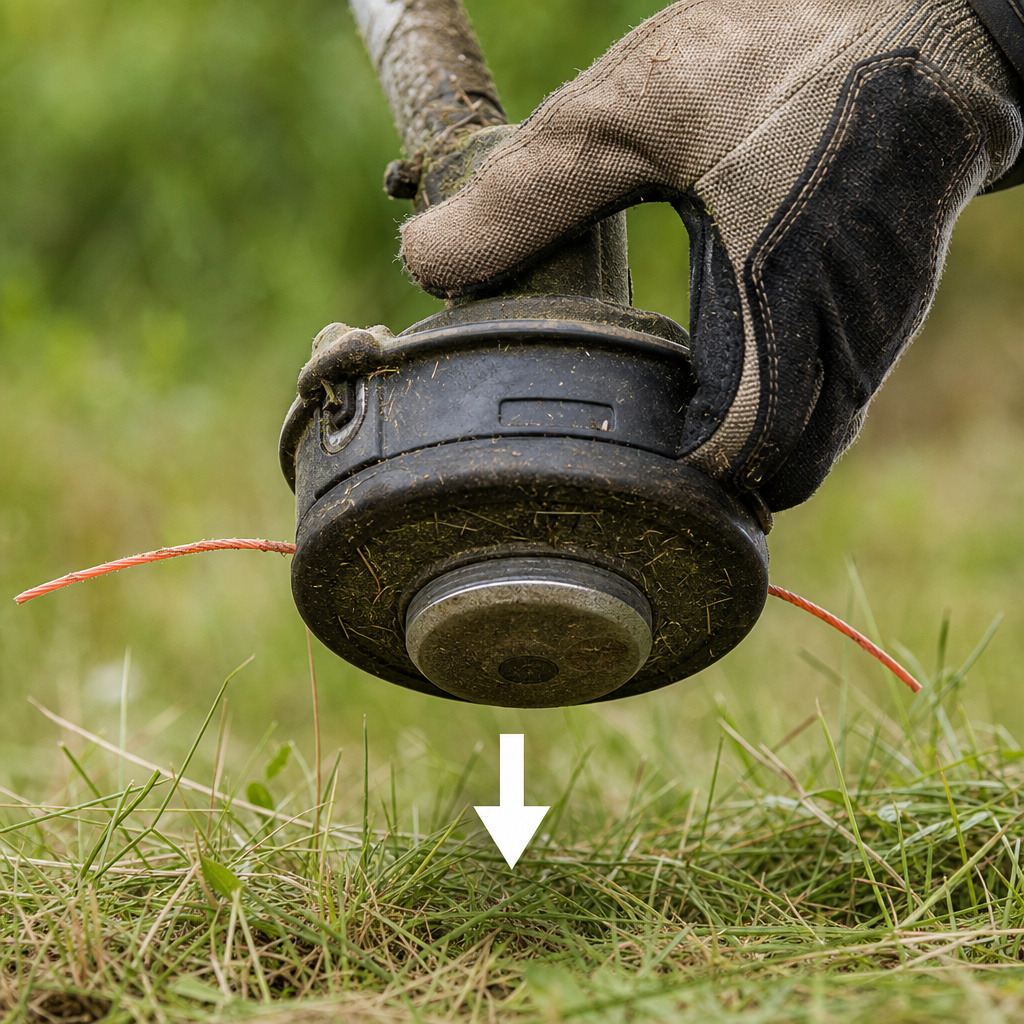
How the trimmer feeds new line is its most common point of failure. There are three types, and one is clearly better.
- Bump-Feed (The Standard): You tap the head on the ground while the motor is running. A spring mechanism releases a short length of line. A good bump head feels firm and precise. You tap, it feeds. A bad one requires slamming it, which can damage the internal spool mechanism over time.
- Automatic Feed: The trimmer feeds line automatically when it senses the motor speed change (like when you release the throttle). In theory, it’s hands-free. In practice, it often feeds line when you don’t need it, like at startup, wasting spool and leading to tangles. I avoid them.
- Manual Feed: You stop the trimmer, pull the line out by hand, and restart. It’s reliable because there are no moving parts to break, but it’s inconvenient. You’ll see this on some low-end corded models.
The bump-feed system on something like an Echo or Stihl is refined. The tap is satisfyingly mechanical. On cheaper trimmers, the mechanism is plastic and wears into a sloppy mess after a season, requiring you to replace the trimmer head. When you’re learning proper string trimmer use, a predictable bump head is one less thing to fight.
Top Picks Across Categories
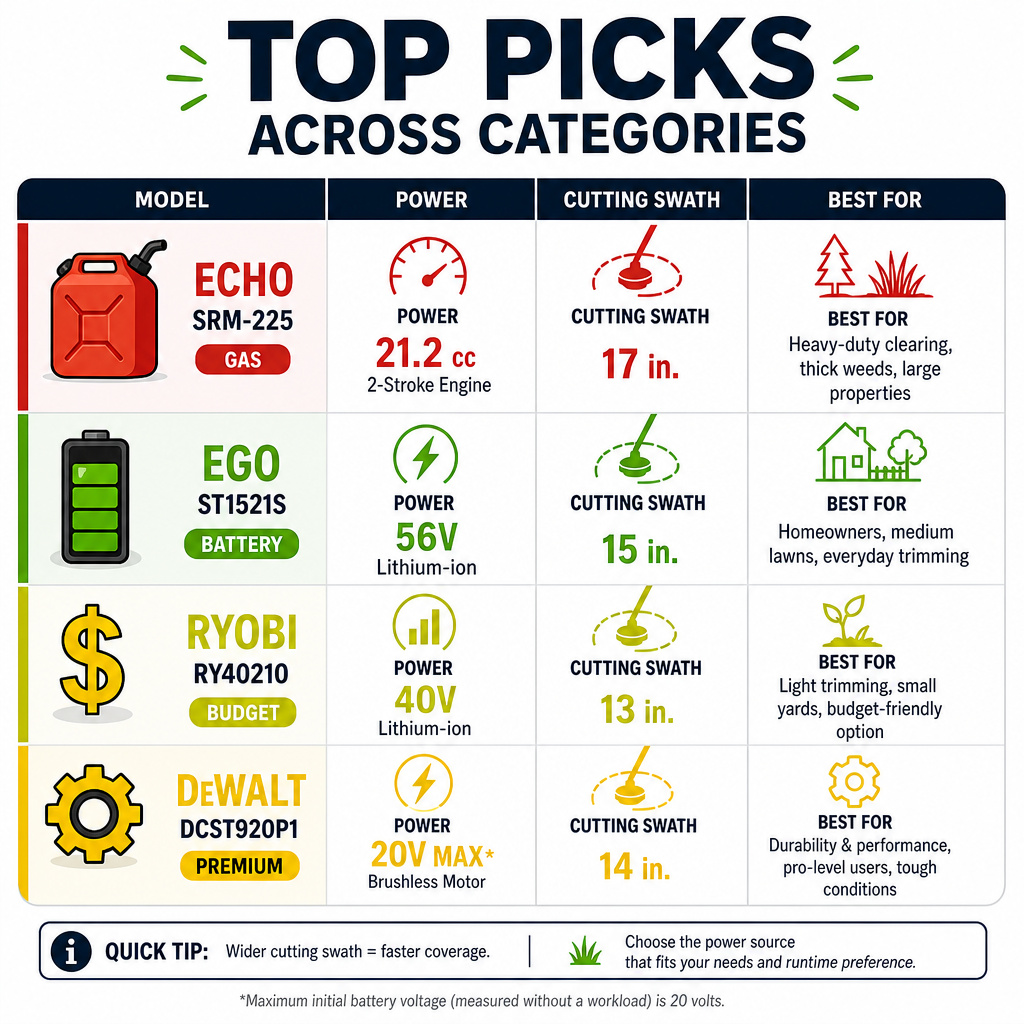
These models consistently perform where it counts. They balance power, reliability, and ergonomics without glaring flaws.
Best Gas: Echo SRM-225
A 21.2cc engine that’s been the homeowner benchmark for a decade. It starts reliably, has a commercial-grade drive shaft, and uses a simple, repairable bump-feed head. It’s louder and requires fuel mixing, but for pure, untethered power on a large property, it’s the default choice. The straight shaft version (SRM-225) accepts attachments.
Best Battery: EGO Power+ ST1521S
The 56V ARC lithium system delivers gas-like power. The 15-inch cutting swath is effective, and the automatic line advance actually works well on this model. It’s part of a huge tool ecosystem, so the battery investment spreads across blowers, mowers, and chainsaws. The battery and charger are included, which isn’t always the case.
Best Value Battery: Ryobi 40V HP Brushless
For a typical suburban yard, this trimmer hits the price-performance sweet spot. The brushless motor is efficient, and it uses Ryobi’s “HP” high-performance batteries for extra output. It’s light, well-balanced, and shares batteries with Ryobi’s 40V mowers. The bump feed is adequate, not great. It’s a solid workhorse.
Best for Attachments: DeWalt DCST972X1 60V FlexVolt
This is a straight-shaft, brushless beast. It’s powerful enough to run a brush cutter blade attachment. The real win is the harness system, it’s the most comfortable in its class. It uses DeWalt’s 60V/20V FlexVolt batteries, so if you’re already in that tool family, it’s a seamless add. It’s overkill for a postage-stamp lawn.
| Model | Power | Cutting Swath | Key Strength | Best For |
|---|---|---|---|---|
| Echo SRM-225 | Gas (21.2cc) | 15 in. | Legendary reliability, repairable | Large properties, users who don’t mind maintenance |
| EGO Power+ ST1521S | Battery (56V) | 15 in. | Gas-like power, quiet, great ecosystem | Medium-large yards, noise-sensitive areas |
| Ryobi 40V HP Brushless | Battery (40V) | 15 in. | Excellent value, good balance | Typical suburban 1/4-acre lots |
| DeWalt DCST972X1 | Battery (60V) | 16 in. | Professional harness, attachment-ready | Large yards, users wanting edger/brush cutter attachments |
Before You Buy: The Final Checklist
Walk through this list with your specific property in mind. If you answer “no” to more than one, reconsider the model.
- Runtime Match: Will a single battery charge (or tank of gas) cover my entire property on the heaviest trim day of the year? If not, what’s the cost of a second battery?
- Weight & Balance: Have I read reviews specifically about balance and fatigue? Does it include a harness that distributes weight?
- Shaft Type: Am I under 5’8″ and just trimming (curved shaft)? Am I over 5’10” or interested in attachments (straight shaft)?
- Line System: Is it a bump-feed with a reputation for working? Have I ruled out problematic automatic feed systems?
- Future-Proofing: Is this tool part of a battery ecosystem I already own or plan to invest in? Does the brand have a history of supporting its tools long-term?
Spend ten minutes with this checklist. It saves the frustration of owning a tool that’s almost right, which is somehow worse than one that’s completely wrong.
Frequently Asked Questions
What’s more powerful, gas or battery?
Today, the highest-end battery trimmers (80V systems) match the cutting power of a mid-range 25cc gas trimmer. Gas still wins for sustained, heavy-duty work because you can refuel in 30 seconds. For 95% of homeowners, a 56V battery trimmer is more than powerful enough and eliminates the noise, fumes, and fuel mixing.
How long does a weed eater battery last?
quality 40V-56V lithium-ion battery will last 3-5 years with regular weekly use before you notice a significant drop in runtime. Storage matters: never leave it fully depleted or on the charger in a hot garage. A replacement battery typically costs between $100 and $150.
Can I use any trimmer line in my weed eater?
No. You must use the line diameter specified for your trimmer head (e.g., .080″, .095″). Using thicker line can overload and damage the motor. You can use a different shape (round, twisted) of the correct diameter. For tough weeds, a twisted .095-inch line cuts more aggressively than round line.
Is a straight shaft or curved shaft better?
It depends on your height and goals. A curved shaft is lighter and better balanced for users of average height (around 5’8″) doing basic trimming. A straight shaft is better for taller users, provides longer reach, and is required if you want to use attachments like edgers or brush cutters.
Why does my new trimmer line keep breaking?
Three common reasons: 1) You’re using line thinner than the trimmer head is designed for. 2) You’re hitting rocks, pavement, or metal fencing, line is for vegetation only. 3) The line is old and brittle. Fresh line from a sealed package is more flexible. Also, don’t soak nylon line in water; it doesn’t strengthen it and can introduce grit that wears the head.
How important is the harness?
For sessions under 20 minutes, a basic strap is okay. For anything longer, a dual-strap harness that distributes weight across your back is a game-changer for comfort and reducing fatigue. It’s a sign the manufacturer considered extended use, not just the sale.
The Bottom Line
A good weed eater disappears into the job. You don’t think about the battery dying, the line jamming, or your shoulder aching. That comes from matching the tool’s core specs, power source, cutting width, shaft type, to the reality of your yard and your body. Ignore the marketing about “maximum power” and focus on balanced performance. For most, that means a 40V or 56V battery trimmer with a 15-inch swath and a decent harness. For large, weedy properties, accept the maintenance and get a proven gas model like the Echo. Measure your space, hold the tool if you can, and buy for the hardest trim day of the year, not the easiest. The right choice lasts a decade. The wrong one feels like a lifetime.
