
What Is a Grass Edger? The Core Tool for Clean Lawn Lines
This post contains affiliate links. As an Amazon Associate, we earn from qualifying purchases.
A grass edger is a dedicated lawn-care tool, either manual or motorized, designed to cut a vertical trench along the edge of a lawn where it meets a hard surface like a sidewalk, driveway, or garden bed. Its purpose is to create a definitive, clean border that physically separates grass roots from encroaching onto other areas, which is a different job than the horizontal trimming done by a string trimmer.
Most people think a string trimmer turned on its side is good enough for edging. It creates a sloped, ragged cut that lasts about a week before the grass grows back over the line. A real edger digs in.
This guide breaks down exactly what an edger is, why the tool exists, and how to pick the right one for your property without wasting money on the wrong machine.
Key Takeaways
- A grass edger cuts a vertical trench. A string trimmer cuts horizontal overgrowth. Confusing the two tools gives you a messy, temporary edge.
- The metal blade on a stick edger spins parallel to the ground, shearing roots and soil. A string trimmer’s line spins perpendicular, which is why it melts against concrete.
- Gas-powered edgers like the Stihl FSA 57 deliver consistent torque for long, overgrown edges but require two-stroke fuel mix maintenance. Battery models are quieter and need less upkeep but can bog down in thick Bermuda or zoysia grass.
- Manual edgers work for small, defined beds. For more than 30 linear feet of edging along pavement, your lower back will vote for a motorized option by the second season.
- Always edge after mowing. Mowing first removes the bulk material, so the edger only has to define the line, which reduces clogging and gives you a visible guide to follow.
What Does a Grass Edger Do?
It carves a boundary. Think of it as a trencher for your lawn’s perimeter. The primary function isn’t to cut grass blades you missed with the mower. It’s to slice through the thatch and soil at the lawn’s edge, creating a small gap that grass stems cannot easily cross.
A motorized lawn edger uses a steel cutting blade, typically 7 to 9 inches in diameter, mounted on a rotating shaft. The blade spins parallel to the ground surface at 2,000 to 3,000 RPM. When the guide wheel is rolled along a sidewalk or driveway, the blade cuts a vertical face into the soil and grass roots, producing a trench 1 to 3 inches deep and about 0.25 inches wide.
This trench has a practical purpose. It acts as a physical barrier that slows lateral grass growth. It also provides a clear guide for your mower’s wheel, allowing you to mow right up to the edge without scalping the lawn. The visual effect is immediate and significant. A lawn with a crisp edge looks professionally maintained, even if the grass itself is just average.
If you skip this step and only use a mower and string trimmer, the lawn’s edge becomes a gradually sloping ramp. Grass grows over the curb. The line between yard and pavement blurs within two weeks. Edging resets that boundary to zero.
String Trimmer vs. Edger: The Critical Difference
This is the most common point of confusion. You can use a string trimmer to edge, but it is not an edger. The difference is in the cutting plane and the tool’s design intent.
A string trimmer, or weed eater, is built for horizontal cutting. The head rotates so the nylon line spins in a vertical plane, parallel to the user’s body. This is perfect for slicing off tall grass and weeds. When you tilt the whole machine 90 degrees to run along a sidewalk, you’re asking the tool to do a job it wasn’t engineered for. The line now strikes the soil and concrete at an inefficient angle.
| Aspect | String Trimmer (for Edging) | Dedicated Grass Edger |
|---|---|---|
| Cutting Element | Rotating nylon line (e.g., 0.095-inch diameter) | Solid steel or carbide-tipped blade |
| Cutting Action | Abrasive wear against soil and concrete | Shearing through roots and soil |
| Resulting Edge | Shallow, sloped, and often wavy | Deep, vertical, and crisp |
| Line/Blade Wear | Extremely high; line depletes rapidly | Minimal; blade stays sharp for seasons |
| Best For | Quick touch-ups on already-defined edges | Establishing new edges or restoring overgrown borders |
The physical consequence is rapid line wear. Nylon line abrades against concrete and stone. You’ll hear it buzzing and see plastic dust flying.
You might burn through a full spool of line on a single long driveway edge. The cut is also shallow. You’re only trimming grass blades, not severing the advancing root mass at the border.
I used a high-quality 0.095-inch commercial line on my trimmer for edging one summer. The 200-foot spool was gone in three weekends. The edge looked okay from the street, but up close it was a rounded, uneven mess. Switching to a used ECHO PE-225 gas edger changed the game. The blade lasted two seasons before needing a sharpen, and the edge it cut was a definitive trench that stayed clean for a month.
Types of Grass Edgers: Manual and Motorized
Your choice here dictates the effort level and the finish quality. It’s not just about power; it’s about matching the tool to the scale and frequency of your work.
Manual Edgers
These are muscle-powered. They fall into two main categories, and your soil type decides which one works.
Half-Moon Edgers (Edging Irons):
This is the classic tool: a curved, flat blade on a long handle. You position the blade on your line, press the top with your foot, and rock it back and forth to slice through the sod. It’s precise, quiet, and cheap. The limitation is force. In heavy clay or soil packed with roots, the rocking motion turns into a brutal jumping session. It works beautifully for defining new flower beds or curving paths.
Roller/Wheel Edgers:
These look like a small wheelbarrow with a cutting disc. You push them along, and the rotating wheel drives a cutting blade. There are two mechanisms here. Cheap models use a single solid steel disc that scrapes a line. Better versions use two counter-rotating, star-spoked discs that create a shearing scissor action for a cleaner cut. They’re easier on your back than a half-moon for straight lines but struggle with curves.
For a short stretch of garden border, learning proper manual lawn edging techniques is a solid skill. For anything longer, you’ll start eyeing the motorized aisle.
Motorized Edgers
These do the work for you. The category splits by power source, which dictates your maintenance routine.
1. Gas-Powered Stick Edgers:
The professional’s choice. Models like the Stihl FSA 57 or the ECHO PE-225 run on a two-stroke engine mix (gas and oil). They deliver relentless power for tackling overgrown edges, thick roots, and long runs. The downside is the engine upkeep. You must use fresh fuel mix, clean the air filter, and deal with winterization. If you neglect the fuel system, the carburetor will gum up by next spring. The vibration and noise are significant.
2. Battery-Powered Edgers:
The modern homeowner’s favorite. Brands like EGO, Milwaukee, and DeWalt offer these. They start instantly, are much quieter, and have almost zero routine maintenance beyond keeping the battery charged. The power is usually sufficient for most residential tasks. The catch is runtime and torque. On a large property, you might need a second battery. When you hit a section of dense, dry soil, a battery edger can stall where a gas model would dig through.
3. Electric Corded Edgers:
These are the budget plug-in option. They offer consistent power but are hamstrung by the cord. Managing 100 feet of extension cord while trying to edge a precise line is a frustrating dance. They’re a viable choice only if your edge is very close to an outlet.
How Does a Grass Edger Work?
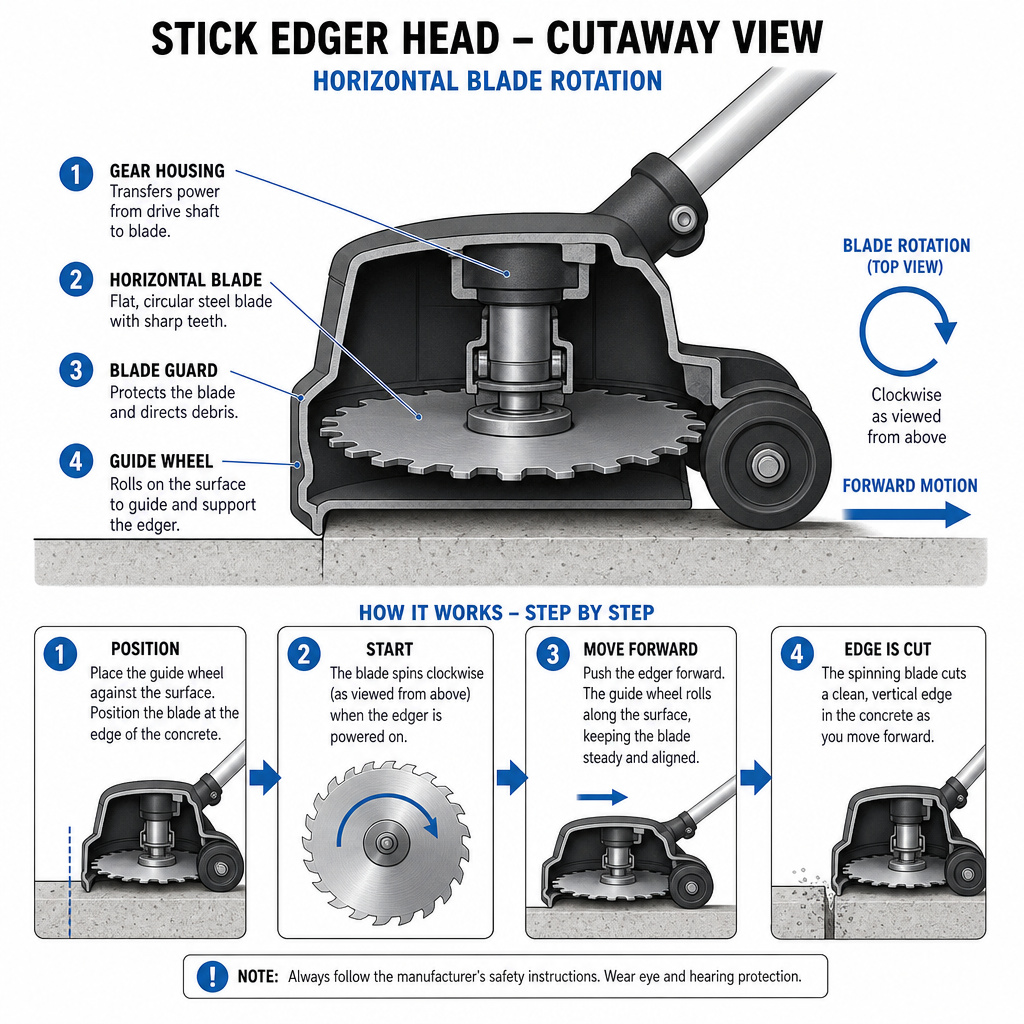
The magic is in the blade orientation. Open up the guard on a stick edger. You’ll see a steel blade mounted flat, like a circular saw blade laid on its side. When the engine or motor spins the shaft, this blade rotates in a horizontal plane. A small guide wheel, positioned next to the blade, rides on the hard surface (sidewalk, driveway) to control the cutting depth.
As you push the edger forward, the spinning blade encounters the vertical face of grass and soil at the lawn’s edge. The teeth don’t chop; they shear. The blade’s high rotational speed and the forward momentum combine to slice a narrow strip of material away. The cut material is ejected out the back of the guard, usually onto the lawn side for easy cleanup.
The depth is adjustable. On most models, you loosen a knob or lever to raise or lower the entire blade assembly relative to the guide wheel. A deeper cut (2-3 inches) is for establishing a new edge or fighting aggressive grass types. A maintenance cut (1 inch) is for monthly upkeep of an existing clean edge.
Before you start: The blade is exposed and spins at high speed. It can throw rocks, debris, or cut material with enough force to cause serious injury. Always wear ANSI-rated safety glasses, long pants, and sturdy closed-toe shoes. Clear the work area of sticks, stones, and irrigation flags. Never operate the tool without the guard properly installed.
When to Use a Grass Edger (And When Not To)
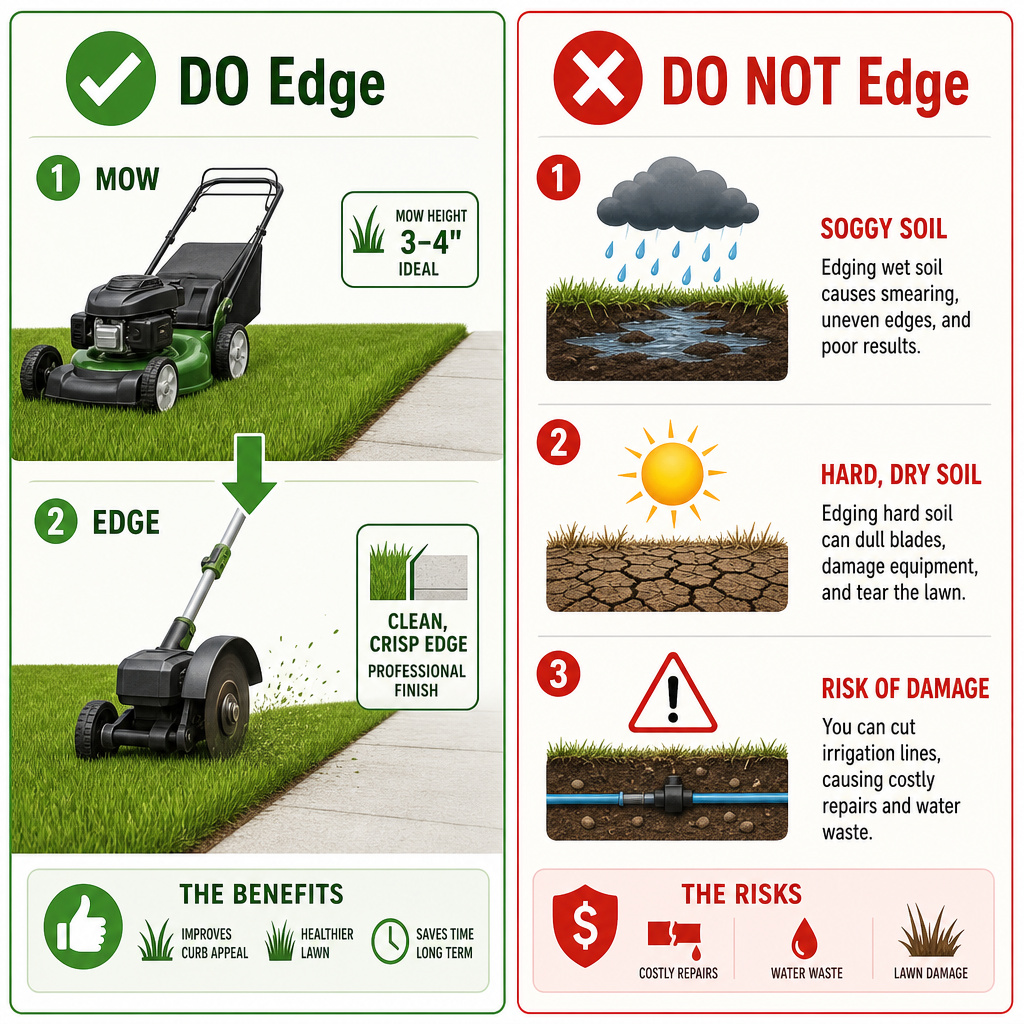
Timing matters. The best practice is to edge your lawn immediately after mowing. Here’s why that sequence works:
1. The mower has already cut the grass to a uniform height, giving you a clear visual field.
2. The edger isn’t bogged down by long grass, which reduces clogging and strain.
3. You can blow or rake the edgings from the trench directly onto the freshly cut lawn for easy collection.
Aim to edge as often as you mow during the peak growing season. For a typical cool-season lawn, that might be every 1-2 weeks in spring and fall.
Do not edge under these conditions:
- When the soil is soggy wet. You’ll tear the lawn edge instead of cutting it, creating a ragged, muddy lip that dries into an uneven mess.
- During a drought with rock-hard soil. You’ll stress the engine or motor, dull the blade prematurely, and likely skid the tool instead of cutting. Water the edge area lightly the day before if needed.
- If you have shallow irrigation lines or landscape lighting wire right at the border. Know what’s underground. That steel blade cuts through PVC and low-voltage wire as easily as it cuts roots.
For those situations, or if you simply don’t own an edger, there are alternative lawn edging methods that use a shovel or a trimmer. They’re more work and less perfect, but they get the job done.
Essential Maintenance for Longevity
An edger is a simple machine, but neglect shortens its life fast. The maintenance checklist depends entirely on the power source.
For All Edgers:
- Clean after every use. Hose off mud and grass clippings from the blade, guard, and underside. Let it dry completely before storage.
- Check the blade. Look for nicks, bends, or severe dulling. A sharp blade cuts cleanly; a dull one tears grass and vibrates excessively.
- Inspect for loose nuts and bolts, especially around the blade assembly and handle.
Gas-Powered Specifics:
This is where most failures happen. The fuel system is the enemy.
* Never leave old fuel in the tank. For storage longer than 30 days, either run the engine dry or add a fuel stabilizer (like Sta-Bil) to a fresh tank, run it for 5 minutes to circulate, then store.
* Use the correct two-stroke oil mix ratio (e.g., 50:1). Check your manual. The wrong ratio causes engine seizure or fouled spark plugs.
* Replace the air filter annually, or more often in dusty conditions.
Battery-Powered Specifics:
- Store batteries indoors, away from temperature extremes. Don’t leave them on the charger indefinitely.
- Keep the motor intake vents clear of debris to prevent overheating.
A quick sharpen can restore a blade. Use a flat file, following the original angle of each tooth. For badly damaged blades, replacement is safer and often cheaper than your time. An OEM blade ensures proper balance, which is critical at 3000 RPM.
Frequently Asked Questions
Can’t I just use my string trimmer as an edger?
You can, but you’ll compromise on quality and efficiency. The nylon line is designed to cut flexible plant material, not to dig into soil. It wears down rapidly against hard surfaces, produces a shallower, angled edge, and takes more time and skill to keep straight. For a true, lasting vertical edge, a dedicated edger is the right tool.
How deep should I edge my lawn?
For a new edge or an overgrown one, cut 2 to 3 inches deep. This creates a substantial barrier. For regular maintenance of an established edge, 1 to 1.5 inches is sufficient to keep the line clean. Cutting deeper than 3 inches is rarely necessary and can undermine paved surfaces over time.
Is a gas or battery edger better?
Gas edgers offer more consistent power for heavy-duty, prolonged use and aren’t limited by battery life. Battery edgers are quieter, have fewer maintenance demands (no fuel, oil, or spark plugs), and start instantly. For most residential properties under half an acre, a quality battery-powered model from a major tool ecosystem is often the more convenient choice.
What safety gear do I need?
Non-negotiable items include safety glasses or goggles to protect from flying debris, sturdy work gloves, long pants, and closed-toe shoes with good grip. Hearing protection is recommended for gas-powered models. Never operate the tool with the safety guard removed.
How do I edge a curved border?
For gentle curves, a stick edger can be guided carefully. For tight curves around garden beds or trees, a manual half-moon edger offers the best control. Alternatively, you can use a string trimmer with a precise string trimmer edging technique, accepting that it will be a more frequent maintenance task.
The Bottom Line
A grass edger isn’t a luxury lawn tool. It’s the defining instrument that separates a cut lawn from a manicured landscape. It works by doing one specific job a string trimmer can’t: cutting a vertical trench. Choosing between manual, gas, and battery models comes down to the scale of your property and your tolerance for engine maintenance versus runtime limits.
Remember the sequence. Mow first, then edge. Keep the blade sharp and the tool clean. If you’ve been wrestling with a string trimmer to get a straight line, trying a real edger feels like discovering a cheat code. The crisp line it leaves behind is proof the right tool makes the job not just easier, but fundamentally better.
