How to Edge with a String Trimmer for Perfect Lawn Borders
This post contains affiliate links. As an Amazon Associate, we earn from qualifying purchases.
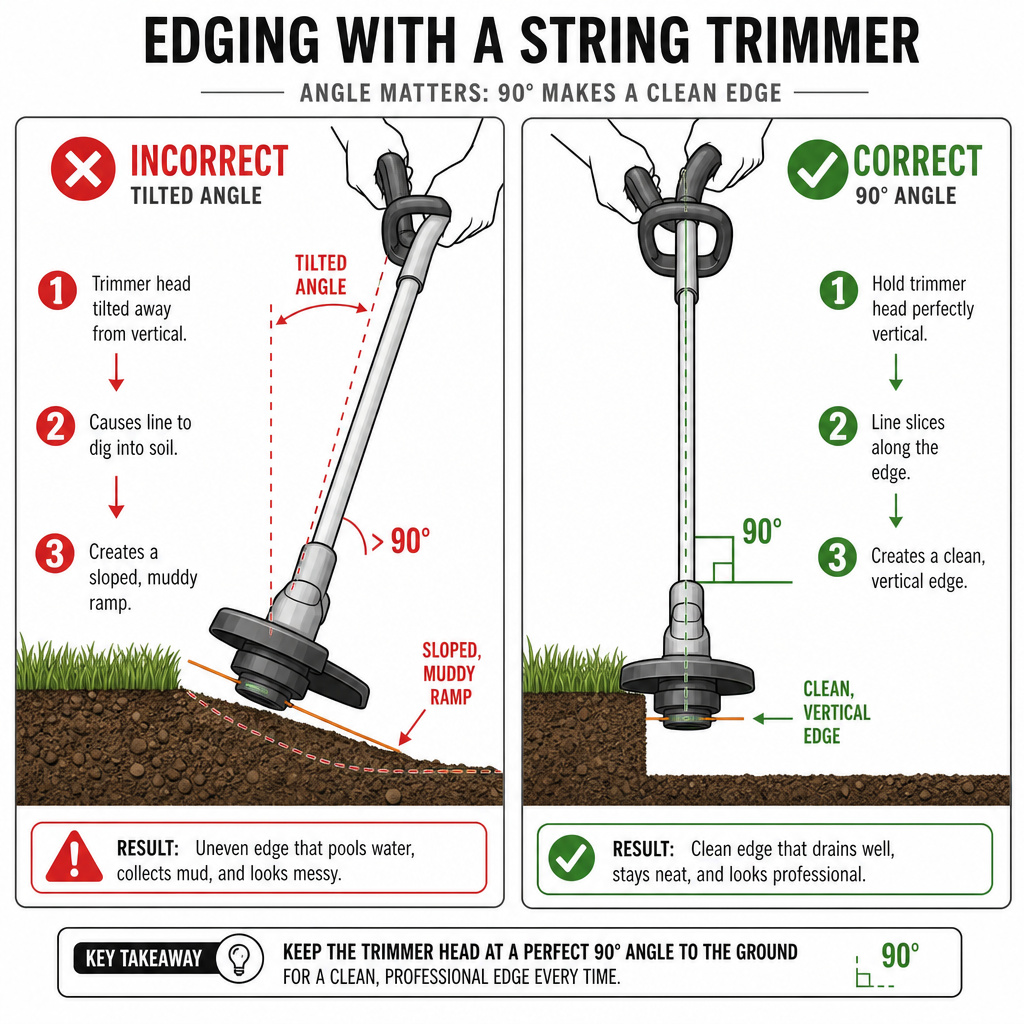
Edging with a string trimmer means holding the tool vertically so the spinning line cuts a sharp, 90-degree boundary between your grass and a hard surface like a sidewalk. You move slowly, letting the tool’s weight and the line’s speed do the cutting, not your arms.
The goal is a clean trench that defines the lawn’s edge, not a ragged tear through the turf.
Most people hold the trimmer at the wrong angle. They tilt it slightly, or they swing it like a golf club. The result is a scalloped, uneven line that looks worse than no edge at all. It’s a subtle mistake that ruins the whole effect.
This guide walks through the prep work, the exact grip and motion, and the maintenance that keeps your trimmer cutting clean. We’ll cover gas, electric, and battery models, straight lines and curves, and what to do when the line keeps breaking.
Key Takeaways
- Hold the trimmer completely vertical, with the guard parallel to the edge you’re cutting. Any tilt creates a sloped, messy cut.
- Walk in the opposite direction of the line’s spin to blow debris away from your fresh edge. For a clockwise-spinning trimmer, move left to right.
- Use the correct line diameter printed on your trimmer head. Thicker line (.095″ or .105″) resists breaking on tough edges but requires more power.
- Mow your lawn first, setting the blade to leave grass about 2.5 inches tall. Edging tall grass wraps it around the spindle and bogs down the motor.
- Clear the edge of all debris, rocks, sticks, irrigation heads. A .095″ line snaps on a half-buried pebble in under a second.
Before You Start: Gear Up and Clear Out
Before you start: A spinning .095″ nylon line travels at over 200 mph. It will throw a stone or piece of metal like a bullet. Wear safety glasses that wrap around the sides. Wear long pants, closed-toe shoes with a stiff sole, and hearing protection. Gas trimmers run around 95 decibels, loud enough to cause hearing damage in 30 minutes.
Your first job isn’t cutting. It’s inspecting. Walk the perimeter you plan to edge and pick up every stick, pinecone, and toy.
Check for sprinkler heads and landscape lighting wires that sit flush with the soil. Mark them with a small flag or a dab of spray paint. I learned this the hard way after shearing the top off a pop-up sprinkler. The repair cost more than a good pair of safety glasses.
Mow the lawn first. Set your mower deck to cut the grass to about 2.5 inches. Edging after mowing gives you a uniform height to work against and prevents long grass from wrapping around the trimmer’s drive shaft. If the grass is damp, wait. Wet clippings stick to the trimmer head and guard, forming a dense, damp plug that’s a hassle to scrape off.
The Right Trimmer and Line for the Job
Not all string trimmers are created equal for edging. A dedicated stick edger has a metal blade and a wheel for guidance. A string trimmer is a multitasker. You need to know its limits.
Corded electric trimmers are light and quiet, perfect for small yards with accessible outlets. The EGO Power+ ST1511T is a cordless beast that handles most suburban edges on a single charge. Gas models like the Stihl FS 56 RC-E have the torque for overgrown beds and thick, woody stems.
The head matters. A fixed-line head is simple but you stop to manually pull out more line. A bump-feed head lets you tap the head on the ground to advance fresh line, crucial for edging because you’re wearing down the line on abrasive concrete. An automatic feed head is convenient but can be finicky and waste line.
| Trimmer Type | Best For Edging | Watch Out For |
|---|---|---|
| Corded Electric | Small, flat yards with nearby outlet. | Cord management. Running over the cord severs it instantly. |
| Cordless/Battery | Medium yards, quiet operation. | Battery life. An 18V model may struggle with 200+ feet of concrete edge. |
| Gas-Powered | Large properties, tough overgrowth. | Weight and noise. They’re heavier and require fuel mix. |
The line is your cutting tool. The diameter is stamped on the trimmer head or in the manual. Using a line that’s too thin for your tool’s power (like .065″ on a heavy-duty trimmer) causes it to snap constantly. Using a line that’s too thick (like .130″ on a lightweight electric) bogs down the motor. For most homeowner edging, .080″ to .095″ is the sweet spot.
A bump-feed trimmer head works best for edging because you can advance fresh line without stopping. The constant abrasion against concrete and brick wears down the nylon filaments faster than trimming grass. You’ll tap the head every 15–20 feet on a concrete sidewalk, less often on soil.
I keep a spool of .095″ commercial-grade line in my shed. The cheap stuff melts and fuses inside the head after a long edging session. The commercial line holds its diameter and cuts cleanly until it’s gone.
How Do You Hold a String Trimmer for Edging?
This is the make-or-break moment. The difference between a professional curb appeal and a hack job is about eight degrees of tilt.
Stand with your feet shoulder-width apart, the trimmer’s shaft across your body. Rotate the entire tool so the head is vertical, with the guard parallel to the edge you’re cutting. The string should be spinning in a plane that’s exactly 90 degrees to the ground. Your goal is to lower the spinning line so it just kisses the soil at the grass line.
Don’t choke up on the shaft. Hold it near the end with your dominant hand, and use your other hand on the auxiliary handle for control and stability. Let the tool’s weight do the work. If you’re forcing it down, you’re either cutting too deep or the line is too short.
Grip and Posture for Edging
- Dominant Hand: Holds the rear handle, controls the trigger.
- Support Hand: Holds the front auxiliary handle, guides the head vertically.
- Stance: Stand sideways to the edge, feet planted. Don’t reach.
- Head Position: Rotate the head so the guard is facing you, the string is parallel to the edge.
If your trimmer has a pivoting head or an edging wheel attachment, lock it into the edging position according to the manual. For a standard straight-shaft trimmer, you’re just rotating your wrists.
The Step-by-Step Edging Technique
You have your gear on, the area is clear, and the trimmer is vertical. Now you move.
Start the trimmer and let it reach full operating speed. With the head off the ground, walk to the starting point. Lower the spinning line slowly until you hear the pitch change, that’s the sound of it cutting soil and grass roots. You only need to cut about a half-inch deep. Any deeper and you’re wasting energy and creating a trench that will erode.
Move steadily along the edge. Don’t swing your arms. Keep your arms relatively steady and move the tool by walking your feet. Your pace should be slow enough that you don’t see individual divots, but fast enough that the motor doesn’t bog down.
Which way do you walk? Look at the head. Most trimmers spin the line clockwise (when viewed from above). That means the line is throwing debris to the left. So, you walk from left to right. This pushes the thrown grass and dirt away from the clean edge you just cut, onto the lawn or sidewalk where you can blow it away later. If you walk right to left, you’re throwing debris back into your fresh cut, clogging it.
For a curved garden bed, the technique changes slightly. You still hold the trimmer vertical, but you’ll need to take smaller steps and pivot your body to follow the curve. Think of tracing the edge with the tip of your shoe, and let the trimmer head follow. Trying to steer the head independently with your arms leads to a wobbly line.
The 3 Most Common Edging Mistakes (And How to Fix Them)
You can have the right tool and the right line and still get a bad result. These are the errors I see every weekend.
Mistake 1: Tilting the Head. This is the big one. Even a slight angle means the line is hitting the soil at less than 90 degrees. Instead of slicing a clean vertical wall, it gouges a sloping ramp. The edge loses definition immediately. The fix is simple but requires constant awareness: glance at the guard. It should look like a wall facing you, not a ramp.
Mistake 2: “Trimming” Instead of Edging. People use a sideways sweeping motion, like they’re trimming along a fence. That cuts the grass blades along the edge but doesn’t define the soil line. Edging is a vertical, downward-cutting action. If you’re not creating a slight trench, you’re not edging. For a deeper dive on the fundamental differences, check out our guide on string trimmer basics.
Mistake 3: Letting the Line Get Too Short. As the line wears, the effective cutting diameter shrinks. You subconsciously tilt the head forward to reach the edge, or you press down harder. Both ruin your technique and strain the motor. The instant you find yourself leaning the tool forward, stop and bump out more line. A good rule is to never let the line shorter than the diameter of the guard.
I edged my entire driveway with a trimmer set to .065″ line because it was what I had on hand. By the end, my forearms were vibrating from the constant micro-impacts of the thin line hitting the concrete curb. Switching to .095″ line the next time felt like the tool was gliding. The thicker filament absorbed the shock and lasted three times longer.
Troubleshooting: When Edging Goes Wrong
Your line keeps breaking. You’re getting an uneven, ragged cut. The trimmer is bogging down. Here’s what’s happening.
Frequent Line Breakage: You’re hitting something hard, or the line is old and brittle. Clear the edge more thoroughly. Soaking nylon line in water for 24 hours before use can reduce brittleness in older line, but it’s a temporary fix. Fresh line is better. Also, check that you’re using the correct diameter. For tough edging against concrete, a reinforced .095″ line like Oregon Magnum Gatorline resists snapping.
Uneven, Ragged Cut: This is almost always an angle problem. You’re tilting the head, or you’re moving too fast and bouncing. Slow down. Focus on keeping the guard perfectly vertical. If the problem persists, your trimmer head might be wobbling due to a worn spindle or bent shaft. Time for maintenance or a trimmer spool replacement.
Trimmer Bogs Down or Stalls: You’re cutting too deep, the grass is too tall/wet, or the line is too long. Only cut a half-inch deep. Mow first. For bump-feed heads, if you’ve advanced too much line, it creates drag. Tap the head gently, don’t slam it, to release the correct amount.
| Symptom | Likely Cause | Immediate Fix |
|---|---|---|
| Line breaks every few feet | Hitting debris; line too thin for task | Clear area; switch to thicker line (.095″ or .105″) |
| Cut is scalloped, not straight | Head is tilted; walking too fast | Check guard is vertical; slow your pace |
| Motor bogs down, smells hot | Cutting too deep; wet grass; line too long | Raise head slightly; let grass dry; bump head to shorten line |
| Line won’t advance (bump-feed) | Spool is tangled or empty | Stop, disassemble head, and re-wind spool properly |
Maintaining Your Trimmer for Edging Duty
Edging is harder on a trimmer than regular trimming. You’re running it at full throttle, pressing the line against an abrasive surface. Maintenance isn’t optional.
After each use, especially edging, clean the head and guard. Grass and soil packed under the guard throws off balance and causes vibration. Use a stiff brush and a blast of compressed air if you have it. For a thorough clean, follow our guide on cleaning your trimmer.
Check the air filter on gas models more often if you edge frequently. The higher, sustained RPMs suck in more dust. A clogged filter makes the engine run hot and lose power.
Inspect the cutting line itself. If it’s frayed, melted, or has lost its original diameter near the tips, it’s time for a full replacing trimmer line. Don’t just bump out more of the bad line, it cuts poorly and strains the engine.
For battery trimmers, let the battery cool down for 20 minutes before charging it after an edging session. Pushing a hot battery straight onto a charger shortens its lifespan.
Gas vs. Electric for Edging: A Quick Comparison
The choice here affects your experience more than you might think.
A gas trimmer (like a Stihl or Echo) has unlimited runtime and serious power for tough, overgrown edges. The downside is the noise, the smell, the maintenance (fuel mix, spark plugs), and the weight. You feel it after 30 minutes of holding it vertical.
A cordless electric trimmer (Ryobi 40V, EGO) is lighter, instantly quiet when you stop, and has zero emissions. The limitation is battery life. A 2.5Ah battery might get you through 30 minutes of heavy edging. For a large yard, you need a second battery or a higher-capacity one (5.0Ah+).
Corded electric is the lightest and cheapest, but you are tethered. For edging a typical suburban front yard, a 100-foot extension cord is manageable. For a full perimeter, it becomes a tangling hazard.
My preference for a typical homeowner is a mid-range cordless model. The Ryobi 40V Expand-It system is a workhorse. The weight is manageable, the power is ample for edging against concrete, and you can swap in other attachments. The noise reduction alone is worth it.
Frequently Asked Questions
Can you edge with any string trimmer?
Technically, yes. But trimmers designed for edging often have a pivoting head that locks vertically or a second handle for better control. A standard straight-shaft trimmer works fine; you just have to manually rotate it to the correct position and maintain it.
How often should I edge my lawn?
Once a month during the growing season is standard. If you have aggressive spreading grass like Bermuda or St. Augustine, you might need to edge every 2-3 weeks to keep a crisp line. In the fall and winter, you can scale back.
Why does my string trimmer leave a ragged edge?
You’re either moving too fast, holding the head at an angle, or using worn-out line. Slow down, check that the guard is perfectly parallel to the edge, and bump out fresh line. If the line is old and brittle, replace the entire spool.
Is it better to edge before or after mowing?
Always after mowing. Mowing first gives you a uniform grass height to edge against. If you edge first, the mower wheels can crush your fresh edge and blow clippings into the clean trench you just made.
How do I edge a curved flower bed?
The principle is the same: keep the head vertical. Take smaller steps, pivot your body to follow the curve, and let the trimmer head follow your feet. Don’t try to steer the head with your arms, you’ll overcorrect and create a wobbly line. For severe curves, you might consider manual edging techniques with a half-moon edger for more precision.
My line keeps breaking on concrete. What should I do?
Concrete is highly abrasive. First, make sure you’re using the thickest line your trimmer can handle (check the manual). Second, don’t force the line into the concrete. Let it kiss the surface. Third, consider a reinforced line designed for abrasive surfaces. Finally, bump the head more frequently to always have fresh, sharp line exposed.
The Bottom Line
Edging with a string trimmer isn’t about muscle. It’s about precision and patience. Get the angle right, move at a steady pace, and let the tool do its job. The difference between a sloppy hack and a crisp, professional edge is just a few degrees of tilt and a slow, consistent walk.
Clear the path first. Mow the lawn. Wear your safety gear. Hold the trimmer like a plumb line, not a baseball bat.
And when you’re done, take five minutes to clean the head and check the line. That routine keeps the tool ready for next time and extends its life by years. A clean edge makes the whole lawn look deliberate. It’s the finishing touch that separates a cared-for yard from a neglected one.
