
How to Start a STIHL Weed Trimmer: The Complete Guide
This post contains affiliate links. As an Amazon Associate, we earn from qualifying purchases.
Starting a gas-powered STIHL trimmer requires matching three things: the correct choke position for the engine’s temperature, a proper priming sequence, and identifying which of the two standard starting systems your model uses. Press the fuel pump bulb five times, set the choke to the top position for a cold start, and pull the starter cord with a controlled technique. The engine will start within a few pulls if everything is set and the fuel is fresh.
Most people get this wrong because they treat every startup the same. They prime a warm engine and flood it. They pull the starter cord like they’re starting a lawnmower from the 1980s. They ignore the subtle difference between the choke symbols on the side of the engine cowling. That’s why a trimmer that ran fine yesterday sputters and dies today.
This guide walks through the exact sequence, from pre-start safety to the difference between a cold and warm start. It covers how to identify your trimmer’s starting system, what to do when you’ve flooded it, and the one maintenance habit that guarantees a first-pull start next season.
Key Takeaways
- STIHL trimmers use either a Traditional Starting System (hold the throttle trigger while pulling) or a Simplified Starting System (throttle stays at idle). Identifying yours is the first step to a correct start.
- Always press the fuel pump bulb five times before a cold start. Pressing it on a warm engine is the fastest way to flood the carburetor.
- Move the choke lever down from the full cold start position immediately after the engine first “pops” or fires. Waiting more than three seconds lets the engine die from fuel starvation.
- A flooded engine smells strongly of gasoline. Clear it by moving the choke to RUN, holding the throttle wide open, and pulling the starter cord 6-10 times without priming.
- Use only fresh, high-quality 50:1 2-stroke engine oil mixed with ethanol-free gasoline. Fuel older than 30 days is the most common cause of hard starting and will eventually clog the carburetor jets.
Before You Pull the Cord: The 3-Minute Setup
You can’t start the tool correctly if it’s not positioned correctly. This isn’t a lawn mower you yank upright. The trimmer head must be clear of the ground, grass, gravel, and any other debris. Place it on a flat surface, resting on the cutting guard and the engine support bracket. That orientation keeps fuel from pooling in the wrong part of the carburetor and gives you a stable platform to pull from.
Before you start: The cutting line or blade spins at over 7,000 RPM. Clear a 15-meter radius of other people and pets. Wear wrap-around safety glasses — not just readers. Debris flies sideways. Wear hearing protection, long pants, and sturdy boots. The exhaust manifold reaches 200°C within a minute; don’t touch it after starting.
Your personal protective equipment is non-negotiable. I learned that the hard way twenty years ago. A small piece of gravel, kicked up by a neighbor’s trimmer, hit me square in the lens of my safety glasses.
It left a permanent scratch and a healthy respect for what a spinning line can throw. The glasses were $15. An ER visit is not. Put them on.
Now, check the fuel. The tank should have the proper 50:1 gasoline-to-oil mixture. Shake the trimmer gently side-to-side. If you don’t hear a definite sloshing, you’re out of gas.
It sounds obvious, but it’s the first thing to rule out. If the fuel is from last season, drain it. Old fuel loses volatility and gums up the carburetor. That’s a repair, not a start.
Which STIHL Starting System Do You Have?
This is the pivot point. STIHL uses two primary starting systems across its gas trimmer line, and using the wrong procedure guarantees frustration. You need to look at your throttle trigger and the choke lever.
The Traditional Starting System is common on older models and some current ones like the FS 38 and FS 56. The choke lever has three distinct positions: a top position (cold start symbol, often a snowflake), a middle position (half-choke or warm start), and a bottom position (run symbol). With this system, you must manually hold the throttle trigger lockout and open the throttle while pulling the starter cord.
The Simplified Starting System (often called Easy2Start or ErgoStart on newer models like the FS 91 and FS 131) automates part of the process. The choke lever typically only has two positions: up for start and down for run. The throttle trigger stays at the idle position. A single pull starts the engine, and a quick blip of the throttle after it’s running automatically moves the internal choke to the run position.
| STIHL Model | Typical Starting System | Key Identifier |
|---|---|---|
| FS 38, FS 45 | Traditional | 3-position choke lever, hold throttle to start |
| FS 56 RC-E, FS 70 | Traditional or Simplified (varies by year) | Check for “Easy2Start” label on engine cowl |
| FS 91, FS 111, FS 131 | Simplified (ErgoStart) | 2-position choke, throttle at idle during start |
| FS 240, FS 260 | Traditional (professional series) | Manual choke, manual throttle |
If you’re unsure, your specific model’s Stihl trimmer restringing guide or the official STIHL manual will state the system. Taking thirty seconds to confirm this saves ten minutes of yanking on a cord that won’t start.
The Simplified Starting System (ErgoStart) uses a spring-loaded mechanism that partially compresses the engine on the pull cord’s return stroke. This reduces peak pulling force by about 30 percent. Pull with a smooth, consistent motion—jerk it, and you defeat the assist.
How to Start a STIHL Trimmer (Cold Engine)
A cold start means the engine is at ambient temperature. It hasn’t been run in the last hour. This is the most involved procedure, but it’s perfectly reliable if you follow the order.
- Press the primer bulb five times. Look for the small, translucent rubber bulb on the side of the engine. Press it firmly until you see fuel (not air bubbles) moving through the fuel lines toward the carburetor. Five presses is the standard. Fewer, and the carburetor bowl isn’t full. More, and you risk flooding before the first pull. You’ll feel the bulb get firmer as it fills.
- Set the choke to the full cold start position. On traditional systems, push the lever all the way up to the symbol that looks like a closed circle or a snowflake. On simplified systems, this is usually the only “up” position.
- Set the stop switch to “I” (On). On traditional systems, you’ll often have a physical switch. On many simplified systems, the switch is omitted and the unit is always “on.”
- Engage the throttle. For traditional systems, press the throttle trigger lockout (usually a lever under the handle) and squeeze the throttle trigger fully. Hold it there. For simplified systems, leave the throttle at idle. Do not touch it.
- Pull the starter cord. Place your foot on the rear handle for stability. Pull the starter grip slowly until you feel firm resistance—this is the engine’s compression stroke. Then, pull quickly and forcefully straight back in a smooth motion. Do not yank it at an angle. Guide the cord back in; never let it snap back into the housing.
- Listen for the “pop”. The engine will fire once but not stay running. This usually happens on the first or second pull. This is your cue.
- Immediately move the choke lever. On a traditional system, as soon as you hear the pop, move the choke lever down ONE notch to the half-choke (warm start) position. You have about three seconds. Then pull again. The engine should start and run. After it runs for 5-7 seconds, blip the throttle to move the choke lever automatically down to the run position. On a simplified system, after the pop and start, simply blip the throttle trigger. The internal mechanism will move the choke to run.
If the engine doesn’t pop after 3-4 pulls, move the choke to half-choke and try 2 more pulls. If it still doesn’t start, move to full RUN and try again. You may have slightly flooded it.
How to Start a STIHL Trimmer (Warm Engine)
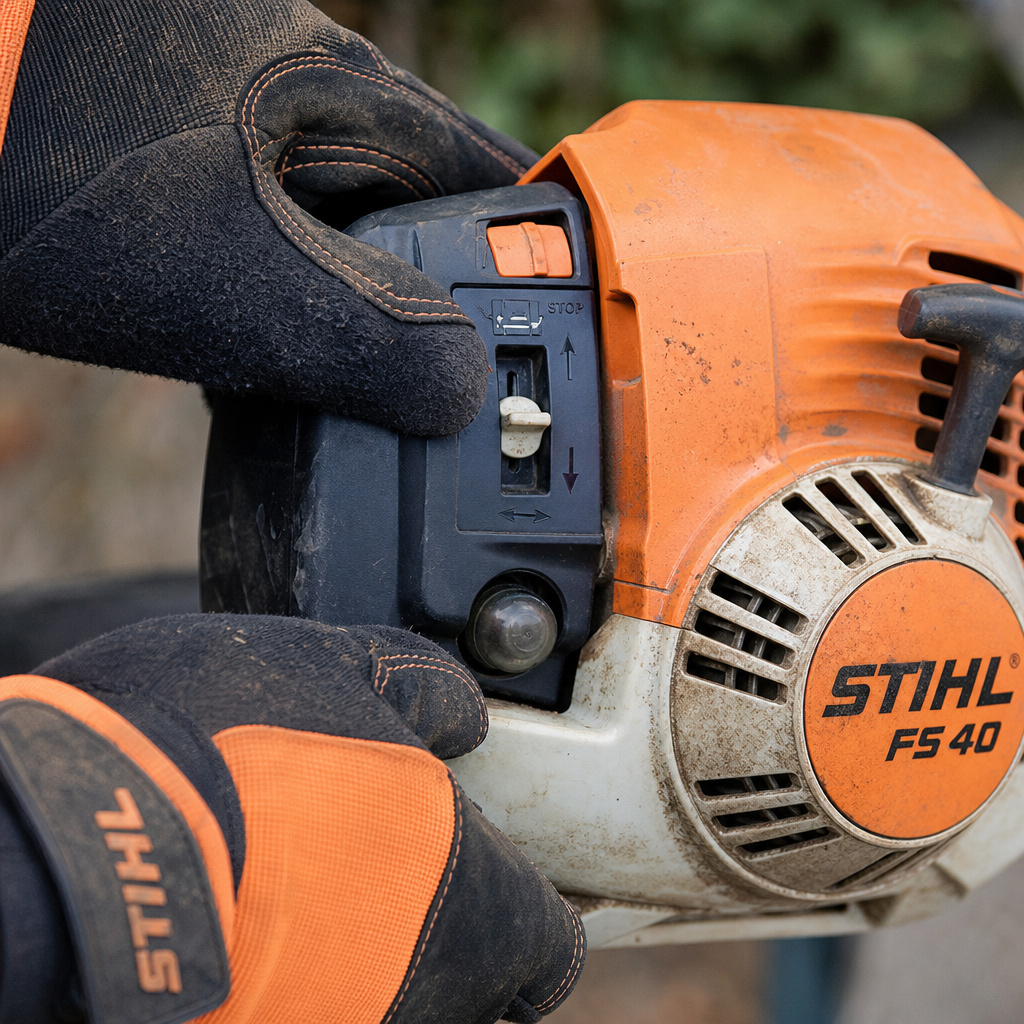
A warm start is for an engine that has been run and shut off within the last hour. The metal is still hot, and fuel vapors are present in the carburetor. The procedure is simpler, but the margin for error is smaller.
Do not press the primer bulb. This is the critical rule. Priming a warm engine almost always forces liquid fuel into the intake, flooding it. The strong smell of raw gasoline at the muffler is the telltale sign you’ve done this.
For a traditional system, set the choke lever to the half-choke (middle) position. No priming. Set the stop switch to “I”, press the throttle trigger lockout and open the throttle fully.
Pull the starter cord. It should start within 1-2 pulls. If it doesn’t, move the choke lever to RUN and pull again.
For a simplified system, the choke lever should already be in the RUN (down) position from when you shut it off. No choke, no priming. Simply pull the starter cord with the throttle at idle. It should start on the first pull.
A warm engine that refuses to start is almost always flooded. The corrective action is the same for both systems, which we’ll cover next. This shared Stihl power tool startup logic applies across their gas-powered lineup, from trimmers to brushcutters.
What to Do If You Flood the Engine
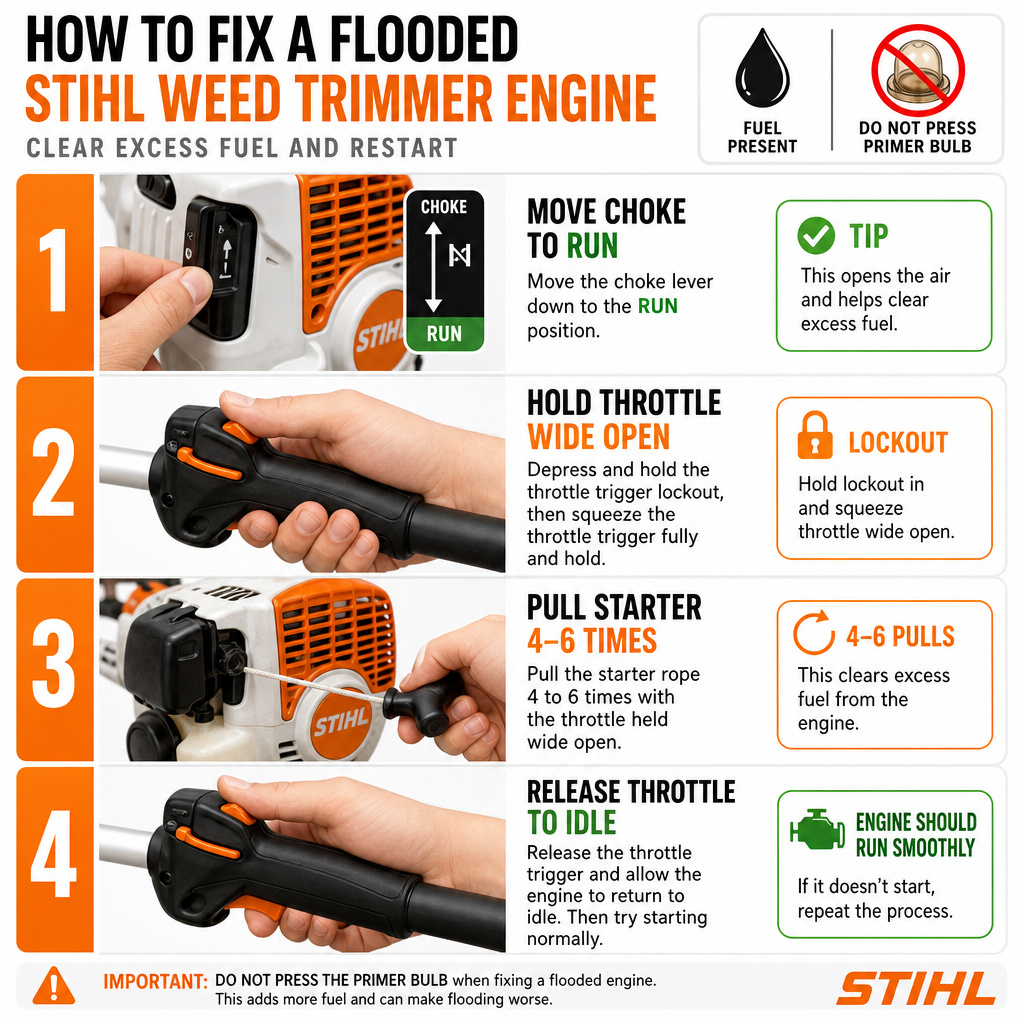
You’ll know. The smell of gasoline around the muffler is overwhelming. The engine may sputter wetly but not catch. This happens when too much liquid fuel is in the combustion chamber, drowning the spark plug.
The fix is straightforward but requires a specific sequence:
1. Move the choke lever to the RUN position (all the way down).
2. Press and hold the throttle trigger lockout, and open the throttle to its maximum position. Hold it wide open.
3. Pull the starter cord 6 to 10 times in smooth, full strokes. You are using the piston to pump raw fuel and air out of the exhaust. Do not prime. Do not change the throttle position.
4. After the 6-10 pulls, return the throttle to idle. Now, attempt a normal warm start (choke in RUN, no prime, pull the cord).
The engine should start within a pull or two. If it doesn’t, wait five minutes for residual fuel to evaporate and try the warm start procedure again. Persistent flooding can wet the spark plug so thoroughly it won’t spark. In that case, you’d need to remove and dry the plug—a topic covered in our guide to weed trimmer repair.
A spark plug fouled by repeated flooding develops a black, wet, sooty coating. The carbon deposits create a conductive path that shorts out the spark. Cleaning it with a wire brush and regapping it to 0.020 inches often works, but a new NGK BPMR7A plug is a more reliable fix for under $5.
Why Won’t My STIHL Trimmer Start?
Sometimes it’s not the procedure. If you’re certain you’re following the correct steps for your system and the engine still won’t pop, you’re facing a mechanical or maintenance issue. Work through this diagnostic order.
First, confirm spark. Remove the spark plug, reconnect it to the ignition wire, and rest the metal body of the plug against the engine’s metal cylinder. Pull the starter cord and look for a bright blue spark jumping the plug’s gap. No spark points to a faulty ignition module, a disconnected kill switch wire, or a failed spark plug.
Second, confirm fuel delivery. Is the fuel fresh (less than 30 days old)? Is the fuel filter in the tank clogged?
Is the carburetor diaphragm stiff? Old fuel is the most common culprit. It forms a varnish that clogs the tiny jets inside the carburetor. The engine will get fuel to start but not to run.
Third, check compression. While not common on newer tools, a worn piston ring or cylinder can cause low compression, making the engine impossible to start. You’ll feel almost no resistance on the starter cord.
| Symptom | Most Likely Cause | Immediate Action |
|---|---|---|
| No “pop,” no resistance on cord | No compression or sheared flywheel key | Inspect spark plug hole for damage; check flywheel woodruff key |
| “Pops” but won’t run | Clogged carburetor jet or stale fuel | Drain fuel, replace with fresh 50:1 mix; consider carb cleaner |
| Strong gas smell, won’t start | Flooded engine | Follow flooded engine procedure above |
| Starts then dies immediately | Clogged fuel filter or air filter | Replace fuel filter in tank; clean/replace air filter |
| Intermittent spark | Faulty ignition coil or bad spark plug | Replace spark plug first; if problem persists, test/replace coil |
Regular cleaning your trimmer and using fresh fuel prevents 90% of these issues. The other 10% are usually solved with a $5 spark plug.
The Right Way to Shut Down and Store
How you stop the engine matters for the next start. Never just run it out of fuel. Move the stop switch to the “0” position. The engine will shut off immediately. The switch will usually spring back to “I” when you release it. This is normal.
After use, let the engine cool for a few minutes. Then, wipe down the exterior with a dry cloth to remove grass clippings and dirt, especially from the cooling fins on the cylinder head. This is part of good trimmer maintenance that extends the tool’s life.
For storage longer than a month, you must stabilize the fuel system. The best practice is to run the engine until the carburetor is completely dry. Here’s the method:
1. Turn the fuel valve to OFF (if equipped).
2. Start the engine and let it run at idle until it stalls from fuel starvation. This takes about 60-90 seconds.
3. Once stalled, pull the starter cord 2-3 more times with the choke in RUN to eject any final fuel droplets from the carburetor.
Now the carburetor bowl and fuel lines are empty. Varnish cannot form. When you’re ready to use it again, turn the fuel valve ON, prime five times, and do a cold start. It will fire right up. For long-term winter storage, follow a full guide on storing a weed trimmer to protect the engine and battery.
Frequently Asked Questions
How many times should I press the primer bulb?
Press it five times for a cold engine. You should see fuel, not air bubbles, moving through the lines. For a warm engine, do not press it at all. Pressing it on a warm engine is the most common cause of flooding.
Why does my STIHL trimmer start but then immediately die?
This is almost always a fuel delivery issue. The carburetor’s idle jet or main jet is partially clogged with stale fuel residue. The engine uses the fuel in the float bowl to start, but then the clogged jet can’t supply enough fuel to keep it running. Drain the old fuel, add fresh 50:1 mix, and consider using a fuel system cleaner like Sea Foam. If that doesn’t work, the carburetor may need a rebuild.
What’s the difference between the choke positions?
The top position (often marked with a snowflake or dot) is full choke for a cold start. It restricts air to create a very rich fuel mixture. The middle position is half-choke for a warm start or after the engine first “pops.” It allows more air. The bottom position is RUN, for normal operation after the engine is started and warmed up.
My starter cord is hard to pull. What’s wrong?
few things. First, ensure the cutting tool isn’t jammed against something. Second, the engine could be hydro-locked from severe flooding—remove the spark plug and pull the cord to eject fuel. Third, the recoil starter assembly itself could be dirty or damaged. A lack of lubrication on the starter rope pulley creates immense friction. A drop of light oil on the pulley spindle often fixes it.
The Bottom Line
Starting a STIHL weed trimmer isn’t about strength. It’s about sequence and identification. Prime five times for cold, never for warm. Know your system—traditional requires throttle, simplified does not. Move the choke the moment the engine pops. And always, always use fresh fuel. That last point is the single biggest factor in reliable starting season after season.
When the procedure becomes habit, the tool becomes dependable. You’ll spend your time cutting grass, not pulling a cord. For the next steps after starting, learn proper using a string trimmer techniques for edging and trimming efficiently.
