What Type of Drill Bit for Stainless Steel: Cobalt or Carbide?
This post contains affiliate links. As an Amazon Associate, we earn from qualifying purchases.
Use a 5% cobalt high-speed steel (HSS-E5) drill bit or a solid carbide drill bit for stainless steel. The cobalt bit is the practical choice for most hand drills and occasional use; the solid carbide bit is for production runs and CNC machines. Both must have a 135° split point, a thicker web, and a coating like TiAlN to handle the heat and prevent the steel from work-hardening into an un-drillable surface.
That choice is the first of three. The second is matching the drill’s length to the job, a 3xD stub drill resists deflection better than a 12xD aircraft bit. The third is setting your machine to the correct surface speed and feed. Get any one of those three wrong, and you’ll burn through bits without making a hole.
What follows is the spec sheet you need: material (cobalt or carbide), geometry (point angle, flute, coating), and the exact speeds and feeds for austenitic grades like 304 and 316. We’ll walk through the settings that keep the steel cutting instead of hardening, and the two named bits that deliver on the promise.
Key Takeaways
- The 135° split point is non-negotiable for stainless steel; a standard 118° point will skate and work-harden the surface before it bites.
- For holes deeper than 3 times the diameter, you must reduce speed and feed progressively. At 6xD depth, cut speed by 35% and feed by 20% (per BSSA data) or the chips will jam and snap the bit.
- Solid carbide drills like the Gühring RT 100 InoxPro are rated for 55 m/min in sub-900 N/mm² stainless; a 3mm bit at that speed requires ~5,800 RPM. Most hand drills can’t control that, which is why 5% cobalt HSS is the default for portable tools.
- Work hardening happens when the drill rubs instead of cuts. The fix is constant pressure, cutting fluid, and never letting the bit dwell in the hole. Back out frequently to clear chips.
- If your hole wall is rough, increase speed and decrease feed. If the bit is chipping, decrease speed. The wrong correction makes both problems worse.
The Two Drill Bits That Actually Work
Forget the general-purpose black oxide bit in your drill index. It will dull on contact, glaze the surface, and leave you with a hardened dimple. Stainless steel demands a dedicated tool, and you have two proven paths.
A 5% cobalt high-speed steel (HSS-E5) drill bit with a TiAlN coating and a 135° split point geometry is the baseline for hand drills and drill presses. A solid carbide bit with through-coolant and a 140° point is for production machines. The cobalt bit is tougher and more forgiving of vibration; the carbide bit is harder and holds an edge longer but is brittle in a handheld tool.
The Tivoly TBX metal drill bit is the archetype of the first path. It’s a 5% cobalt HSS bit with a BLADE coating (TiAlN+TiCN), a 135° tip, and a four-sided grind derived from carbide tooling. That cobalt content lets the steel retain its hardness at the 500–700°C heat generated at the cutting edge. The coating reduces friction and acts as a thermal barrier. This is the bit you buy for a weekend project or a handful of holes.
The second path is something like the Gühring RT 100 InoxPro or the HOLEX Pro Inox. These are solid carbide drills compliant with DIN 6537K, with a 140° point angle and an AlTiN coating. Their flute geometry is engineered for chip evacuation in gummy materials. They are not forgiving. In a hand drill, a slight wobble will snap a 3mm carbide bit. In a rigid CNC machine or a mill with through-spindle coolant, they can run at 50% higher feed rates and last 60% longer than HSS, according to Gühring’s testing.
The part nobody mentions: cobalt HSS is the default for a reason. It’s the bridge between the impossible hardness of carbide and the flexibility needed in a tool that isn’t bolted to a $10,000 machine. If you’re drilling by hand or with a drill press, start with cobalt.
Cobalt HSS vs. Solid Carbide: When to Switch
| Feature | 5% Cobalt HSS (e.g., Tivoly TBX, Bosch PRO Stainless) | Solid Carbide (e.g., Gühring RT 100 InoxPro, HOLEX Pro Inox) |
|---|---|---|
| Best For | Hand drills, drill presses, occasional use, holes under 10mm. | CNC machines, milling machines, production runs, deep holes (up to 7xD). |
| Point Angle | 130°–135° split point for reduced walking and thrust. | 140° point for stability and heat dissipation at high speeds. |
| Key Strength | Toughness — withstands vibration and slight misalignment. | Hardness & Wear Resistance — holds an edge far longer. |
| Critical Weakness | Wears faster, especially in abrasive stainless alloys. | Brittle — lateral force or chatter will snap it. |
| When It Fails | Dulls quickly if speed is too high or coolant is absent. | Snaps at the shank if the setup isn’t perfectly rigid. |
The HOLEX Pro Inox spec sheet gives the numbers: for a 3mm bit in stainless under 900 N/mm², it calls for a cutting speed (Vc) of 55 m/min and a feed (f) of 0.05 mm per revolution. That translates to roughly 5,800 RPM on a drill press. Try that with a hand drill and you’ll lose control. The cobalt bit runs slower, around 15–20 m/min (1,600–2,100 RPM for 3mm), which is manageable with a variable-speed trigger.
Geometry Is Everything: Point, Flute, and Coating
The material is half the battle. The shape of the bit is the other half. A bit designed for soft steel or wood has the wrong angles for stainless and will fail instantly.
A 135° split point is the minimum. The sharper 118° point on a standard bit has less web support and a tendency to “walk” or skate on stainless’s hard surface. That skating work-hardens the spot before the cutting lips engage. The 135° angle is stronger and penetrates with less downward force. The split point, a self-centering tip ground into the web, eliminates the need for a center punch, which itself can create a work-hardened dimple.
The flute helix should be a standard or “slow” spiral (around 35°). A high-speed spiral for aluminum would pack the gummy stainless chips into the flutes, causing immediate binding and heat buildup. The web, the central column of the bit, should be thicker than on a standard bit for rigidity. However, a web that’s too thick impedes chip flow. This is why premium bits feature “web thinning” near the point, a detail specified in standards like DIN 1897 VA h8 for stub drills.
Finally, the coating. Titanium Aluminum Nitride (TiAlN) or similar (like Tivoly’s BLADE coating) is not just for show. It provides a surface hardness over 3000 HV and reduces the coefficient of friction. This keeps heat in the chip and out of the workpiece and the tool, directly combating the work-hardening tendency of austenitic stainless.
Where this goes sideways: Using a standard 118° wood/metal bit. The tip skates, generates instant heat, and hardens the stainless surface. Your next attempt with the correct bit will now hit that hardened spot and dull immediately. You’ve created your own worst enemy.
The 3-Step Method to Avoid Work Hardening
Work hardening is the process where austenitic stainless steel (304, 316) becomes harder and tougher when deformed at room temperature. In drilling, this happens when the bit rubs instead of cuts. The method to beat it is a triad: pressure, lubrication, and chip clearance.
1. Start with a Dimple (But Not a Punch).
Forget the center punch. Its sharp impact can locally harden the steel. Instead, use a center drill or a spotting drill to create a shallow, precise conical starter hole. This guides the main drill bit and prevents walking. If you must punch, use a spring-loaded automatic center punch with very light pressure.
2. Apply Constant, Firm Pressure with Lubricant.
Stainless needs to be cut, not rubbed. The moment you ease up, the cutting edges rub and generate heat. Use a cutting fluid or paste formulated for stainless or hard metals. Tap Magic, Rapid Tap, or even a heavy-weight synthetic oil works. Apply it to the hole, not just the bit. The lubricant reduces heat and helps break the chip.
3. Peck Drill and Clear Chips Aggressively.
This is non-negotiable for holes deeper than the bit’s diameter. Drill no more than one diameter deep, then retract the bit fully to clear chips. Let the flutes come clean. For a 3xD deep hole, you’ll peck three times. For a 6xD hole, plan on six pecks. Clogged flutes are the fastest route to a broken bit and a hardened hole.
The British Stainless Steel Association’s training notes are explicit: “During drilling it is essential to maintain the feed to cut through the work hardened layer generated as the metal is cut. Dwell or rubbing must be avoided. Entry and re-entry after backing out should be done at full speed and feed rate.”
Speed, Feed, and the Deep-Hole Penalty
Getting the material and geometry right but botching the machine settings will still ruin your day. Speed (RPM) and feed (pressure/advance rate) are a locked system.
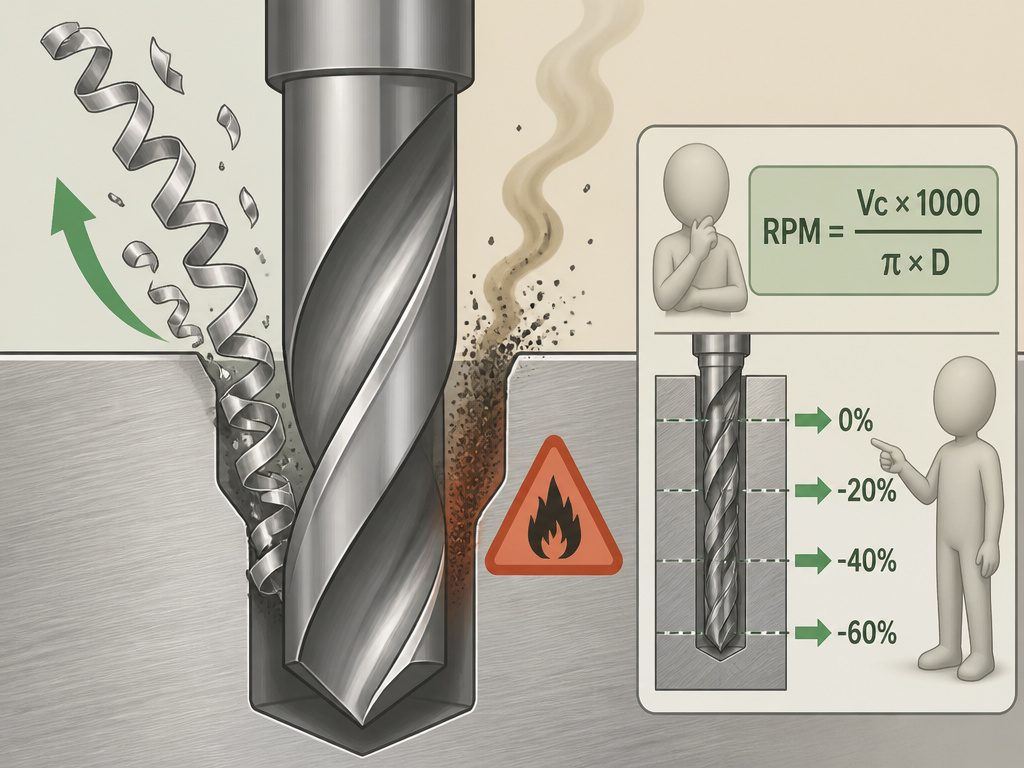
For 5% cobalt HSS, a safe starting surface speed is 15–20 meters per minute. For solid carbide, you can run at 45–55 m/min for stainless under 900 N/mm² tensile strength. Use this formula to find your RPM:
RPM = (Cutting Speed in m/min × 1000) / (π × Drill Diameter in mm)
So, a 5mm solid carbide bit at 50 m/min: (50 × 1000) / (3.1416 × 5) = ~3,180 RPM. A 5mm cobalt HSS bit at 18 m/min: (18 × 1000) / (3.1416 × 5) = ~1,145 RPM.
Feed is trickier without a machine feed rate. By hand, you’re aiming for a steady, firm pressure that produces a continuous, tight chip. A curly chip means good cutting; dust or a burning smell means you’re rubbing.
The BSSA Stainless Steel Specialist Course provides the definitive deep-hole correction table. For a hole depth of 3 times the diameter, reduce speed and feed by 10%. At 4xD, reduce speed by 20% and feed by 10%. At 5xD, reduce speed by 30% and feed by 20%. At 6xD, reduce speed by 35% and feed by 20%. This progressive reduction counteracts chip evacuation problems and heat buildup.
| Hole Depth (Multiple of Diameter) | Speed Reduction | Feed Reduction |
|---|---|---|
| Up to 3xD | 0% | 0% |
| 3xD | -10% | -10% |
| 4xD | -20% | -10% |
| 5xD | -30% | -20% |
| 6xD | -35% | -20% |
Why does this matter? In a drilling stainless steel test by Nastrojecz.cz, each bit drilled 42 holes into austenitic stainless steel 1.4301 to a depth of 5×D before evaluation. The winner was an uncoated bit with optimized cooling grooves, proving that managing heat and chip removal is more critical than just having a fancy coating. Your settings must actively manage those two factors.
What To Do When the Drill Stops Cutting
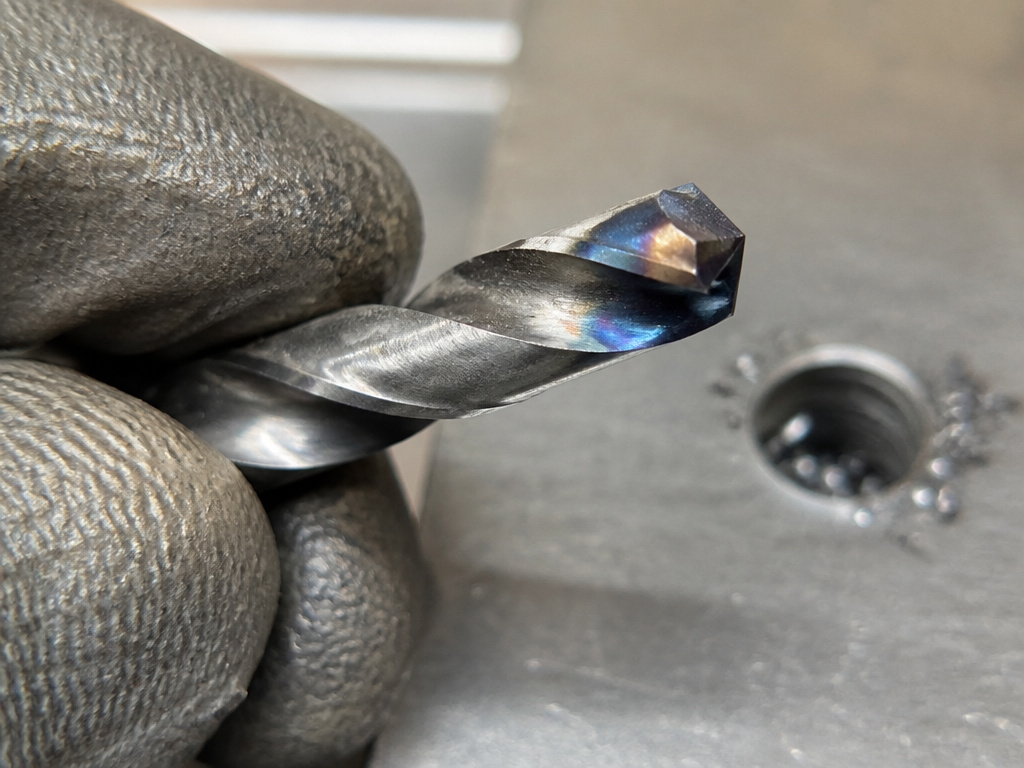
You’ll feel it. The bit stops advancing, the motor whines higher, and you smell that hot, metallic scent. Stop immediately. Do not push harder.
First, retract the bit and inspect the flutes. Are they packed with a long, stringy chip? Clear it with pliers. The gummy chip of stainless can weld itself to the flute if it gets hot enough. Second, check the cutting edges. If they are glazed or have a blue/tan temper color, the bit is dull and has been rubbing. For a cobalt bit, this is often the end. For carbide, it might be salvageable with a specialized diamond wheel sharpener, but that’s a job for a pro.
If the hole is partially drilled and the bit is still sharp, the problem is work hardening. The bottom of the hole has turned into a glassy, hardened cap. Your options are narrow: use a solid carbide bit, which is harder than the hardened steel, and attempt to drill through it with fresh coolant and very slow, steady pressure. Sometimes a drill bit for hardened steel with a different geometry can power through. Often, you must move the hole location and start over, applying the constant-pressure-and-lube rule from the first second.
This is why the initial setup matters more than the recovery. A proper drill bit for steel might work on mild steel, but stainless is a different animal. The margin for error is smaller, and the cost of a mistake is a ruined workpiece and a collection of broken tools.
Frequently Asked Questions
Can I use a titanium nitride coated bit on stainless steel?
No. Titanium Nitride (TiN) is a great general-purpose coating for wood and soft steel, but it breaks down around 500°F. Drilling stainless generates heat well above that. The coating fails, the underlying HSS softens, and the bit dulls in seconds. You need a high-temperature coating like TiAlN (Titanium Aluminum Nitride) or AlTiN.
What’s the difference between 118-degree and 135-degree drill bits?
The 118-degree drill bit has a sharper, more acute point. It requires less thrust to start cutting in soft materials like wood and mild steel, but it’s prone to walking on hard, curved surfaces. The 135-degree drill bit has a blunter, stronger point. It withstands more axial force without deforming, which is essential for penetrating hard materials like stainless steel without deflecting. The split-point variant of the 135° bit is self-centering.
Why does my drill bit keep snapping in stainless steel?
The two most common causes are side load and chip clogging. If you’re not drilling perfectly perpendicular, or if your workpiece or drill chuck has play, the bit experiences lateral force. Cobalt HSS can handle some flex; solid carbide bits are brittle and will snap. The second cause is letting chips jam in the flutes. The bit binds, torque spikes, and the shank shears. Always peck drill and clear chips.
Is a pilot hole necessary for stainless steel?
Not a pilot hole in the traditional sense of using a smaller bit first. That can work-harden the material twice. However, using a center drill or spotting drill to create a precise, shallow starting cone is highly recommended. It guarantees your main bit starts exactly on location and reduces the walking that leads to immediate work hardening.
Can I drill stainless steel with a cordless drill?
Yes, but you must respect its limits. Use a 5% cobalt HSS bit, not carbide. Set the clutch to the drill setting (not screw driving). Use slow speed (often the “1” setting on a two-speed drill) and high torque. Apply firm, steady pressure and peck every few seconds. A cordless drill lacks the rigidity and RPM control of a drill press, so your margin for error is smaller. Let the tool and bit cool frequently.
Before You Go
For a home shop or a maintenance kit, buy a set of Bosch PRO Stainless Steel HSS-Co Twist Drill Bits. They’re 5% cobalt, have the 135° split point, and are available in the useful sizes. They will handle 95% of the stainless jobs you encounter.
For a machine shop or repetitive production, the Gühring RT 100 InoxPro solid carbide drills are the benchmark. Pair them with a rigid machine, through-coolant, and the speed/feed chart from the manufacturer.
The drill bit is only one variable. The machine’s rigidity, your feed pressure, and the constant stream of cutting fluid are the other two. Get all three right, and stainless steel becomes just another material to drill. Get one wrong, and it feels like trying to drill through a file.
