What Type of Drill Bit for Steel | The Point Angle That Decides
This post contains affiliate links. As an Amazon Associate, we earn from qualifying purchases.
For steel, you need a twist drill bit made from High-Speed Steel (HSS) or a cobalt alloy (HSS-Co). The exact type is decided by the steel’s hardness and your drill’s stability. Mild steel (under 36 HRC) works with standard HSS and a 118° point angle. Harder steels (stainless, tool steel) demand HSS with 5% or 8% cobalt and a 135° split point. For the hardest wear plates like Hardox® Extreme, only solid cemented carbide drills cut it.
That split between 118 and 135 degrees is where most DIY projects go wrong. It’s not a minor spec. It’s the difference between a clean hole and a bit that smokes, walks, and snaps inside three uses.
What follows is a breakdown of the three specs that actually matter: the steel alloy in the bit (HSS, HSS-Co, carbide), the point angle ground into its tip (118° or 135°), and the flute geometry that clears chips. We’ll match each to the steel you’re likely to face, from sheet metal to hardened plate.
Key Takeaways
- Point angle drives the cut. A 118° point is for softer steels and stable drill presses; it requires a pilot hole to prevent walking. A 135° split point self-centers, needs less pressure, and is mandatory for handheld drills and harder alloys.
- Cobalt content fights heat. Standard HSS bits lose their edge around 600°F. Adding 5% cobalt (HSS-Co5) raises that threshold; 8% cobalt (HSS-Co8) is for production drilling in tough steels like 4140. For a homeowner, HSS-Co5 covers 95% of needs.
- Coatings are for life, not performance. Titanium Nitride (TiN) adds surface hardness and can extend bit life sixfold, but it doesn’t change the bit’s core ability to cut hard steel. A coated HSS bit is still HSS.
- Carbide is a last resort. Solid cemented carbide bits are brittle and expensive. They are the only option for materials like Hardox® Extreme, but they demand a rigid, coolant-fed machine setup. They will snap in a hand drill.
- Thin steel needs support. Drilling sheet metal or plate under 8mm thick requires a backup board underneath. Without it, the material deflects, the drill catches, and you get a triangular, mangled hole.
The 118° vs 135° Trade-Off That Burns Bits
The number stamped on a drill bit’s shank is its diameter. The number you can’t see, but that decides everything, is the point angle. Get this wrong and the bit will fail in one of three ways: it will skate across the steel, overheat and turn blue, or snap at the flute.
A 118-degree point is the traditional geometry. Think of it as a sharper, more aggressive wedge. It cuts fast in softer materials but has a tendency to “walk” or skate on hard, smooth surfaces. That’s why it’s best suited for mild steel, aluminum, and brass, and it assumes you’re using a drill press or have drilled a pilot hole. The concentrated force can generate excessive heat if the feed rate is too slow.
A 135-degree split point is a flatter, more robust angle. The tip is ground with a self-centering split (often to the DIN 1412 C standard), which eliminates walking. This design requires less downward pressure and dissipates heat more effectively across a wider cutting edge. This makes it the only sensible choice for stainless steel, tool steel, and any handheld drilling operation. The Bosch PRO Metal HSS-G twist drill bit uses this geometry.
Common mistake: Using a 118° bit in a cordless drill on stainless steel. The bit skates, you push harder, the tip overheats and loses its hardness within seconds. The hole work-hardens, and now nothing will cut it.
The choice isn’t about brand loyalty. It’s about physics. If your drill isn’t bolted to a bench, default to 135°.
HSS, Cobalt, or Carbide? The Steel-Alloy Hierarchy
Drill bits are a cutting tool, and cutting tools are about heat management. The material they’re made from determines how much heat they can absorb before they soften and fail.
| Bit Type | Key Material | Max Hardness (HRC) it can drill | Best For | Will Fail On |
|---|---|---|---|---|
| HSS (High-Speed Steel) | Tungsten, Molybdenum Steel | Up to ~36 HRC (Mild Steel) | General fabrication, thin sheet metal, aluminum. The baseline. | Stainless steel, hardened tool steel. Dulls quickly. |
| HSS-Co5 (5% Cobalt) | HSS with 5% Cobalt alloy | Up to ~50 HRC (Hardened Tool Steel) | Stainless steel, high-tensile steel, production work. The DIY sweet spot. | Extremely hard wear plate (e.g., Hardox 600+). |
| HSS-Co8 (8% Cobalt) | HSS with 8% Cobalt alloy | Up to ~55 HRC (Very Hard Steels) | Rational production drilling in tough alloys (4140, 4340). Professional use. | Not suitable for unstable machines. Brittle. |
| Solid Cemented Carbide | Tungsten Carbide grains in a binder | 60+ HRC (Hardox® Extreme) | Machining centers with high rigidity, internal coolant, and no vibration. | Any handheld application. Will snap from lateral shock. |
High-Speed Steel (HSS) is the default. It’s tough, relatively inexpensive, and can be re-sharpened. For drilling mild steel or drilling steel in a home shop, a quality HSS bit with a 135° split point is often enough. The Ruko Jobber Length drill specs call for a 118° point on HSS bits, but that’s for ideal, stable conditions.
Cobalt (HSS-Co) bits aren’t made of cobalt. They are HSS with cobalt alloyed into the steel matrix. The cobalt doesn’t make the bit harder; it gives the steel hot hardness—the ability to retain its cutting edge at the high temperatures generated by drilling tough metals. The difference between 5% and 8% cobalt is about longevity under sustained production load. For a weekend project involving stainless steel, HSS-Co5 is the ticket.
Solid Cemented Carbide is in another league. It’s extremely hard but also extremely brittle. As the SSAB machining guide states, it’s “the only type of drill suitable for drilling Hardox® Extreme.” This is a non-negotiable rule for hardened metal. However, it mandates a perfect setup: a rock-solid machine, internal coolant, and precise feeds/speeds. In a hand drill, carbide is a very expensive way to make kindling.
Coatings: TiN, TiAlN, and Oxide – What They Actually Do
You’ll see gold (Titanium Nitride), bronze (Titanium Aluminum Nitride), or black oxide coatings. Their job is often misunderstood.
A coating does not make a soft bit able to cut hard material. A Titanium Nitride-coated HSS bit is still an HSS bit at its core. The coating’s real functions are: 1. Reduce friction: The coating creates a slicker surface, so chips flow up the flutes more easily and heat transfers into the chips instead of the bit. 2. Increase surface hardness: TiN can boost surface hardness to around 2300 HV, making the bit more resistant to abrasion. 3. Extend tool life: By reducing friction and abrasion, coatings can dramatically increase the number of holes a bit can drill. Irwin claims its TiN coating extends life by “up to six times.”
Where this goes sideways: Assuming a “Titanium” drill bit is made of titanium. It’s not. It’s a steel bit with a microns-thin ceramic coating. It will still fail if the point angle and base material are wrong for the steel.
Think of a coating like a non-stick pan. It makes the cooking process cleaner and the pan easier to maintain, but it doesn’t change the fact that you’re cooking on an aluminum or steel core. Choose the core material (HSS vs. Cobalt) for the job, and consider the coating a durability bonus.
The 4-Step Matchmaker: Choosing Your Bit
Forget generic advice. Follow this sequence to lock in the right bit.
- Identify Your Steel. Is it mild steel (magnetic, files easily), stainless steel (still magnetic, but tougher), or a known hard grade (like a bucket’s wear edge)? If unsure, assume it’s harder than you think.
- Select the Base Material. Use the table above. For unknown or harder steels, jump straight to HSS-Co5. It’s the cost-effective safety net. Keep a set of HSS drill bits for softer materials.
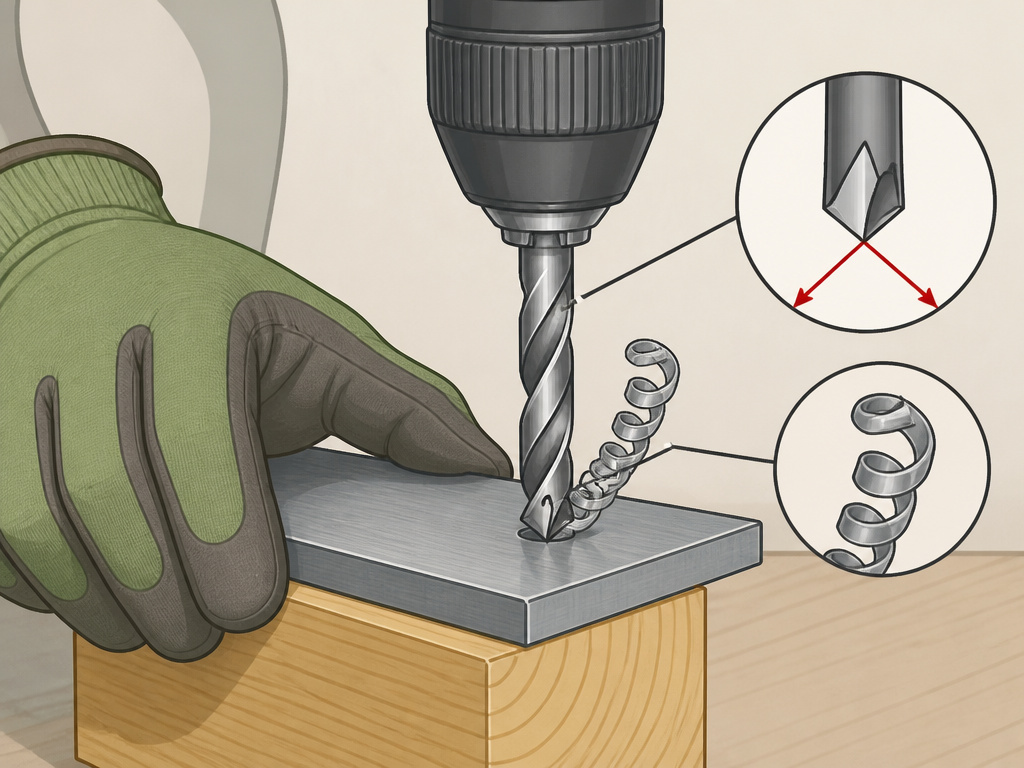
- Impose the Point Angle Rule. Are you using a hand drill? → 135° split point. Are you using a drill press on mild steel? → 118° is acceptable. Drilling hardened steel? → 135° is mandatory.
- Add Support for Thin Material. If the steel is less than 1/4″ (6mm) thick, clamp it to a sacrificial wood block. This prevents blow-out, reduces chatter, and gives the drill tip a clean exit path.
The part nobody mentions: The drill’s RPM matters, but feed pressure matters more. Push hard enough to make steady, curly chips, not dust. Dust means you’re rubbing, not cutting, and you’re overheating the bit. If the chips are turning blue, you’ve already lost the edge.
Special Cases: When the Standard Playbook Fails
Some steels change the rules entirely.
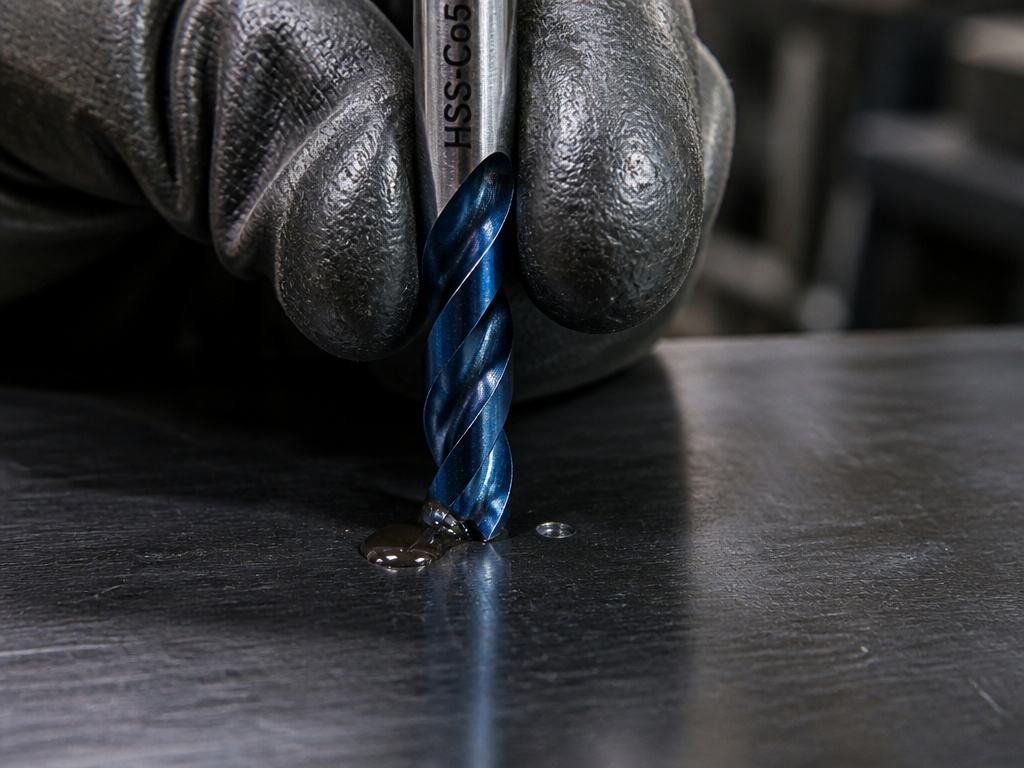
Spring Steel: This is high-carbon steel that’s been hardened and tempered. It’s tough and elastic. Standard HSS will skate and burn. Use a HSS-Co5 bit with a 135° split point, low RPM, high feed pressure, and plenty of cutting oil. The goal is to get under the hard surface before work-hardening occurs. Specific techniques for spring steel often involve a punch mark to prevent walking.
Hardox® and Other Abrasive Wear Plate: This is the domain of professional machining. For grades like Hardox 500 and below, HSS-Co8 drills with a robust core and small helix angle are recommended for “rational production.” For the hardest, like Hardox® Extreme, the SSAB guide is absolute: only solid cemented carbide drills are suitable, and only with internal coolant. Attempting this with a cobalt bit will result in immediate, catastrophic failure.
Unstable Machines: This is a fascinating edge case from the SSAB guide. If your drill press has play or you’re using a handheld tool, they actually recommend HSS drills over carbide for drilling Hardox up to 500 Brinell. The reason? HSS can flex and absorb vibration without shattering. Carbide cannot. So, the “best” material isn’t always best for the real-world context.
Speed, Feed, and Coolant: The Forgotten Third of the Equation
You can have the perfect bit and still ruin it in ten seconds. The machine settings are that important.
- Speed (RPM): Harder steel = slower speed. A good starting point for HSS-Co5 in 1/4″ steel is around 850 RPM. For carbide, it might be 2000 RPM or higher. When in doubt, start slow.
- Feed Pressure: This is the human element. You must push. The bit should be making a continuous, audible cutting sound. No sound means you’re polishing, and polishing makes heat.
- Coolant: It’s not just for cooling. It lubricates and helps break chips. For the home shop, a pump bottle of cutting oil or even a consistent drip of 3-in-1 oil is a game-changer. The Bosch guide notes coolant can extend bit life by a factor of six. Without it, you’re leaving performance on the bench.
The short version: Slow the spindle, push with purpose, and use oil. Those three things will do more for bit life than any coating.
Frequently Asked Questions
Can I use a masonry drill bit on steel?
No. Masonry bits have a carbide tip brazed onto a soft steel body. They are for hammering and crushing brittle material. The cutting geometry is wrong for metal, and the steel shank will flex and overheat. You’ll destroy the bit and likely ruin the workpiece.
What’s the difference between titanium and cobalt drill bits?
This is a common point of confusion. “Titanium” bits are almost always HSS bits with a Titanium Nitride (TiN) coating. “Cobalt” bits are HSS with cobalt alloyed into the steel. The cobalt bit is fundamentally better for hard steel because it resists heat better. The titanium vs carbide debate is about coatings versus solid material.
Why does my drill bit keep walking on steel?
The point angle is too sharp (118°) and/or it lacks a self-centering split point. Switch to a 135° split-point bit. Also, use a center punch to make a small dimple for the bit to seat into. This is a non-negotiable first step for accurate drilling into steel.
How do I know if my drill bit is dull?
Dull bits require excessive pressure, produce squealing or squeaking sounds, and make fine dust instead of chips. The cutting edges will look rounded under magnification. If you see a polished, mirrored edge on the tip’s cutting lips, it’s done.
Is there a “universal” drill bit for all metals?
No. The closest you’ll get is a HSS-Co5 bit with a 135° split point. It will handle aluminum, mild steel, and stainless steel reasonably well. But for optimal performance and bit life, matching the bit to the specific metal is always better. The quest for one perfect bit is a fast track to mediocre results.
The Bottom Line
Stop looking for a single magic bit. Start matching three things: the bit’s alloy to the steel’s hardness, the point angle to your drill’s stability, and your technique to the heat the cut generates.
For most home workshops drilling a mix of materials, a set of HSS-Co5 bits with 135° split points is the default answer. They cost a bit more than plain HSS, but they save the frustration of burned-up bits and ruined work. Keep a separate set of cheaper HSS bits for wood and plastic.
When the steel is unknown or looks tough, assume it’s harder than your bit. Step up the alloy, slow down the speed, and add oil. That sequence works more often than not. And remember, the hole is only as good as the first chip. If you’re not making chips, you’re making mistakes.
