Defining the Jobber Drill Bit: The Common Standard Length
This post contains affiliate links. As an Amazon Associate, we earn from qualifying purchases.
A jobber drill bit is a standard-length twist drill bit, defined by its flute length being 8 to 14 times its diameter. This specific proportion, standardized in ANSI/ASME B94.11M-1993 and DIN 338, makes it the default general-purpose bit for drilling into metal, wood, and plastic where hole depth isn’t extreme.
That length-to-diameter ratio is the entire game. It’s not a special material or a magic coating. Every other characteristic, point angle, helix, coating, gets built on top of that foundational jobber length. Get the length wrong, and you’re either fighting a bit that’s too short to reach or one that’s too long and deflects on contact.
What follows is the breakdown of that standard: the official specs, the two other length categories you need to know (mechanics and screw machine bits), and the single decision that tells you which one to grab.
Key Takeaways
- The term “jobber” specifies a standardized flute length of 8–14 times the bit’s diameter, not the bit’s material or purpose.
- For deep holes over an inch in soft materials, a jobber bit’s length is necessary; for hard metals or shallow work, a shorter mechanics bit resists breakage.
- The common 118° point angle suits general steel and wood; switch to a 135° split point jobber bit for harder steels or stainless to reduce “walking.”
- HSS (High-Speed Steel) jobber bits are the baseline; HSS-TiN (Titanium Nitride) coating adds heat resistance and lifespan; HSS-Co5 (5% Cobalt) alloy handles tough materials like stainless steel.
- Always match the drill bit’s length to your needed hole depth, using a jobber bit for a 1/4-inch deep hole is overkill and increases the risk of deflection and breakage.
The Definition: Length Over Everything
Forget any vague ideas about a jobber bit being a “general-purpose drill.” That’s a side effect. The core definition is a numeric standard: a twist drill bit with a flute length measuring between 8 and 14 times its diameter.
The ANSI/ASME B94.11M-1993 standard formalizes this “jobber length” specification. For a 1/4-inch diameter bit, that means a flute length of 2 to 3.5 inches, with a typical example being 2 3/4 inches (11 times the diameter).
This ratio creates the bit’s most important physical trait: reach. The flute is the spiraled portion that channels chips out of the hole. A longer flute lets you drill deeper before you need to retract and clear debris. That’s the jobber’s reason for existing, it’s the standard drill bit length that balances reach for common tasks with reasonable rigidity.
Flute length is not overall length. The overall length includes the shank (the smooth part that goes in your drill chuck). When you’re checking if a bit can reach the bottom of a hole, you care about flute length. When you’re checking if it will fit in your drill’s chuck, you care about overall length.
Why Is It Called a “Jobber”?
The name is a historical artifact. From the mid-1800s to mid-1900s, a “jobber” was a middleman who bought from manufacturers and sold to retailers. These distributors commonly stocked this medium-length, do-most-things drill bit. The name stuck to the product itself. Today, “jobber” solely describes the length standard. A HSS jobber bit and a cobalt jobber bit are the same length; one just uses a harder alloy.
Jobber Drill Bit Specs: The Numbers You Can Trust
Once you know the length, the other specs determine performance in specific materials. These aren’t marketing fluff, they’re ground into the tool.
| Specification | Common Standard | What It Means for Your Work |
|---|---|---|
| Point Angle | 118° or 135° | 118° is the universal default for steel, wood, plastic. 135° is a flatter, split point design that bites faster with less pressure, ideal for hard metals and preventing “walking” on curved surfaces. |
| Helix Angle | 20° to 30° | A steeper helix (closer to 30°) moves chips out of deep holes more aggressively. A shallower helix (closer to 20°) provides more strength for interrupted cuts or harder materials. |
| Shank Type | Straight Cylindrical | The standard round shank that fits in any 3-jaw drill chuck. Some high-precision bits have a ground shank for minimal runout. |
| Material | HSS, HSS-TiN, HSS-Co5 | HSS (High-Speed Steel) is the economic workhorse. HSS-TiN has a gold titanium nitride coating that reduces friction and withstands 600°C. HSS-Co5 has 5% cobalt alloyed into the steel for hot hardness on stainless steel or cast iron. |
The point angle is your first material check. Grabbing a 118° bit for a piece of mild steel plate is fine. Drilling into hardened steel or stainless with that same bit will work-harden the material and dull the tip almost immediately. That’s when you reach for the 135° split point drill bit.
Where this goes sideways: Using a 118° point on stainless steel without cutting fluid. The bit will skate, generate intense heat, and create a hardened spot that no bit will penetrate without a pre-punch. You’ll ruin the workpiece and the bit in under 30 seconds.
The Ruko DIN 338 Standard Type jobber bit (common in industrial supply) locks these specs down: 118° point, cylindrical shank, HSS material. The AutomationDirect 214214RO 19-piece metric set follows the same pattern. These are the baseline.
The Other Lengths: Mechanics vs. Screw Machine Bits
A jobber bit isn’t your only length option. It sits in the middle of a strength-versus-reach spectrum. Your choice here has a bigger impact on breakage rates than any coating.
| Bit Type | Flute Length (x diameter) | Strength & Purpose | When You’d Use It |
|---|---|---|---|
| Screw Machine (Stub) | 4–7x | Maximum rigidity. Minimal flex. | Drilling hard metals (tool steel), shallow holes, or on a drill press where reach isn’t needed. The go-to for picking the right bit in a machining vise. |
| Mechanics | 7–10x | Shorter than jobber, stronger, but with less reach. | A compromise for harder materials where you still need a bit of depth. General metal fabrication. |
| Jobber | 8–14x | Standard reach for general-purpose work. | The default for 90% of DIY and repair tasks in wood, plastic, soft metal, and steel when hole depth is >1/2 inch. |
| Long/Extra-Long | 14x+ | Extended reach for deep holes. | Drilling through thick timber, deep structural steel, or plumbing where a standard bit can’t reach. |
The shorter the bit, the straighter it drills. A screw machine bit has almost no flute to twist or bend. It transmits all the drill’s torque directly to the cutting lips. A jobber bit’s longer flute acts like a lever, any side pressure or uneven material causes it to deflect. That’s why they’re “bound to twist and break” in deep or hard materials.
I once tried to drill a 1-inch deep hole in a piece of axle steel with a 1/8-inch jobber bit. The bit deflected, snapped at the flute, and left a hardened, off-center dimple that required annealing to fix. A 1/8-inch screw machine bit drilled the same hole cleanly in ten seconds.
The rule is simple: use the shortest bit that can reach the bottom of your hole. Needing a jobber’s length for a 1/4-inch deep hole in aluminum is a waste of the bit’s potential and introduces unnecessary risk.
How to Choose the Right Jobber Bit for the Task
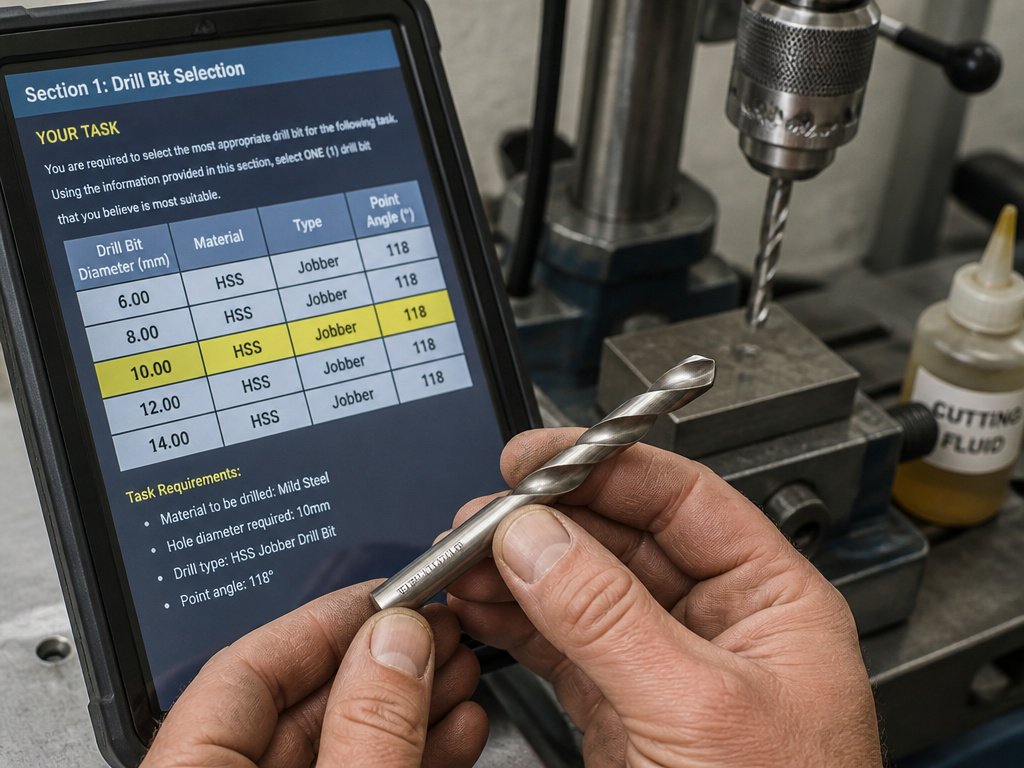
You need three pieces of information: material, hole depth, and desired finish. The chart below turns those into a spec.
| Your Task | Material | Recommended Jobber Bit Specs | Reason & Pro Tip |
|---|---|---|---|
| General DIY & Wood | Pine, Plywood, Softwood | HSS, 118° point, standard helix. | A basic HSS jobber bit is perfect. For cleaner holes in wood, a brad point drill bit is better, but a jobber will work. |
| Metal Fabrication | Mild Steel, Aluminum | HSS or HSS-TiN, 118° or 135° split point. | Use cutting fluid. For aluminum, a higher helix helps clear stringy chips. The TiN coating on an HSS-TiN bit dramatically increases life in steel. |
| Hard Metals & Stainless | Stainless Steel, Cast Iron | HSS-Co5, 135° split point. | The cobalt alloy retains hardness at the high temperatures generated. Slow speed, high pressure, and oil are mandatory. |
| Deep Holes in Soft Material | Plastic, Softwood | HSS, 118° point, higher helix (25-30°). | The steep helix pulls long chips out efficiently. Peck drill (drill a little, pull out to clear) to prevent melting plastic. |
For most home workshops, a quality HSS jobber bit set covers the bases. The AutomationDirect 214850RO 21-piece fractional set is a solid industrial-grade example. If you drill metal often, a separate set of HSS-TiN bits is worth the investment, they last three to five times longer.
What most people get wrong: They buy a “cobalt” bit thinking it’s always better. HSS-Co5 bits are brittle. Using them on soft materials or in a hand drill with side-to-side wobble can cause the cutting lips to chip. Save the cobalt for the drill press and hard metals.
What a Jobber Drill Bit Is Not Good For
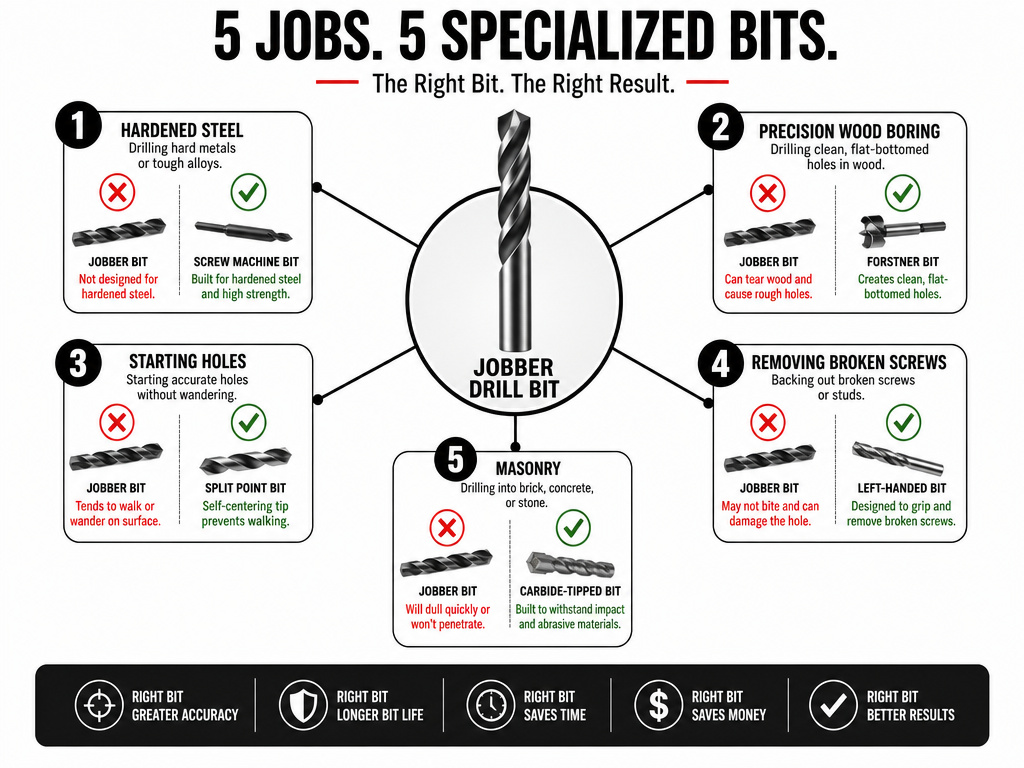
Knowing the limits saves bits, workpieces, and your patience. A jobber bit is a compromise, and some jobs demand a specialist.
- Hardened Steel or Spring Steel: The long flute will flex, work-harden the surface, and snap. Use a short screw machine bit or a solid carbide bit.
- Precision Wood Boring: For clean, flat-bottomed holes for hinges, a Forstner drill bit is the only correct tool. A jobber bit will tear out grain and leave a conical bottom.
- Starting Holes Without a Pilot Punch: The standard 118° point will “walk” across curved or hard surfaces. A split point drill bit or a center punch is required.
- Removing Broken Screws or Extractors: This is a job for a left-handed drill bit. Running in reverse, it often bites and spins the broken fastener out before an extractor is needed.
- Masonry or Concrete: The HSS material and cutting geometry are wrong. You need a carbide-tipped masonry bit.
Think of your drill bit purpose. Is it to make a deep, rough hole in a common material? The jobber is your friend. Is it for precision, extreme hardness, or a unique shape? There’s a dedicated bit for that, and forcing a jobber to do it will end badly.
Frequently Asked Questions
Are all jobber drill bits the same quality?
No. Quality is determined by the precision of the grinding (how concentric the flute is), the consistency of the heat treatment, and the quality of the steel or coating. A budget bin HSS bit and a premium-brand HSS bit may look identical but will have vastly different lifespans and cutting performance.
How do I identify a jobber drill bit?
Look at the ratio of the twisted flute length to the diameter. If the flute is roughly 10 times longer than the bit is wide, it’s a jobber length. You can also check packaging or manufacturer spec sheets, which often list “jobber length” or reference ANSI B94.11M.
Can I use a jobber bit in a hand drill vs. A drill press?
Yes, but performance differs. A drill press provides perfect vertical alignment and steady pressure, minimizing the jobber bit’s tendency to deflect. In a hand drill, you must be meticulous about starting perpendicularly and applying steady, straight pressure to avoid breaking smaller diameters.
What’s the best way to store jobber drill bits?
Keep them organized in a labeled index case or a drill bit stand. Loose bits in a toolbox will rub against each other, dulling the cutting edges and points. Protecting the precise grind is the easiest way to extend their useful life.
When should I sharpen or replace a jobber bit?
Sharpen a bit when it requires excessive pressure to cut, produces burnished or discolored chips, or makes a squealing sound. Small HSS bits are often cheaper to replace than to sharpen a drill bit correctly. For larger or cobalt bits, learning to resharpen on a bench grinder is a valuable skill.
The Bottom Line
A jobber drill bit is the default for a reason. Its standardized 8-14x flute length delivers the reach needed for most common drilling tasks without being overly fragile. Your decision starts with confirming you need that reach. If your hole is shallow or the material is brutally hard, step down to a stronger, shorter mechanics or screw machine bit. If you need a clean, flat-bottomed hole in wood or are drilling masonry, step sideways to a dedicated bit type.
For the toolbox, a basic set of HSS jobber bits handles the majority of work. For the bench, adding a set of HSS-TiN bits for metal and understanding the 135° split point for hard materials turns the jobber from a compromise into a precision instrument. Start with the length, then match the point, material, and helix to your project. That’s how you stop breaking bits and start drilling perfect holes.
