SDS Drill vs Hammer Drill | The Mechanism That Decides
This post contains affiliate links. As an Amazon Associate, we earn from qualifying purchases.
An SDS drill is a specialized rotary hammer that uses a pneumatic piston mechanism to deliver high-impact energy, making it the tool for drilling holes larger than 1/2-inch in concrete or for frequent masonry work. A standard hammer drill uses a mechanical cam-action hammer that is better suited for occasional smaller holes in brick or block.
The distinction isn’t about power or brand. It’s about the hammer mechanism inside the tool, cam versus piston, and what that mechanism can physically do to a carbide bit. A cam hammer bounces the bit; a piston hammer slams it. That single difference dictates which materials you can work, how fast you can drill, and how long your arms will feel afterward.
What follows is a breakdown of the two hammer systems, a side-by-side spec comparison, and the one question that decides which tool you should buy.
Key Takeaways
- The cam-action hammer in a standard hammer drill is for holes up to 1/2-inch in brick or block. The pneumatic piston in an SDS drill (rotary hammer) is for holes from 1/4-inch to over 1-inch in concrete.
- Impact Energy, measured in Joules (J), is the critical spec. A hammer drill delivers 1-3 J; an SDS rotary hammer starts around 1.5J and goes up to 6J or more.
- Using a hammer drill on concrete larger than 1/2-inch will burn out the motor or strip the gears within 30 minutes of continuous use.
- SDS stands for Slotted Drive System, a specific chuck that allows the bit to slide back and forth. You cannot put a standard round-shank masonry bit in an SDS chuck.
- For a one-time project like hanging a curtain rod, rent an SDS rotary hammer. For a deck with dozens of concrete anchors, buy one.
The Core Difference: It’s All in the Hammer
You feel it in your hands before you see the hole. A hammer drill rattles. An SDS rotary hammer thumps. That thump is a pneumatic piston driving the bit forward, while the rattle is two metal cams clashing together. One is a precise punch; the other is a violent shake.
A standard hammer drill uses a mechanical cam-action system. Two ribbed metal discs (cams) clash together as the motor spins, creating a rapid, jarring vibration that is transferred to the bit. An SDS rotary hammer uses an electric motor to drive a piston inside a cylinder, compressing air that then slams a striker into the bit. The piston delivers more force per blow with less vibration to the user.
The cam system in a tool like the Bosch GSB18V-755CB25 or the RIDGID R86115B is effective for brick, block, and soft stone. It’s essentially a standard drill with an extra gear. When you need to understand the fundamentals of this more common tool, our guide on how a hammer drill works breaks down the cam mechanism in detail. But when that spinning, rattling bit meets dense concrete, the cam’s energy gets absorbed by the material, and your elbows. The drill works harder, you work harder, and progress slows to a gritty crawl.
The pneumatic piston in an SDS tool, like the SKIL 1770 GA or the ROKTOR AB743, separates the hammering action from the rotation. The piston hits the striker, which hits the bit, in a straight line. All the reactive force is absorbed by the tool’s mass and handle, not your wrist. This is why a 5.4kg rotary hammer is less fatiguing to use for ten minutes than a 2.3kg hammer drill. The tool does the pounding, not you.
Specs That Matter: Joules, BPM, and Chuck Type
Forget voltage and amp-hours for a minute. When comparing these tools, three numbers tell you everything.
Impact Energy (Joules): This is the force of each hammer blow. It’s the single most important number. A Black+Decker BEHS01-GB SDS drill lists 1.4 Joules. A ROKTOR 1500W rotary hammer lists 6.0 Joules. More Joules means it can drill larger holes in harder material, faster. A standard hammer drill might not even list Joules because the cam mechanism’s output is comparatively low and inconsistent.
Blows Per Minute (BPM): How many times the hammer hits per minute. A higher BPM with lower Joules (like a hammer drill’s 0-31,500 BPM) creates a rapid tapping. A lower BPM with high Joules (like a rotary hammer’s 4,200 BPM) is a slower, heavier pounding. For concrete, the heavier blows of a rotary hammer are far more effective.
Chuck Type: This is the physical divide. A hammer drill uses a standard keyed or keyless chuck that grips the smooth, round shank of a masonry bit. An SDS drill uses an SDS+ chuck (or the larger SDS-Max). The bit has grooves that lock into the chuck, allowing it to slide back and forth freely while being driven rotationally. This sliding action is mandatory for the piston mechanism to work. You can use an SDS bit in a standard hammer drill with a special adapter, but you lose the sliding action and thus most of the benefit.
| Specification | Standard Hammer Drill | SDS Rotary Hammer |
|---|---|---|
| Primary Mechanism | Mechanical Cam-Action | Pneumatic Piston |
| Impact Energy | 1-3 Joules (often unlisted) | 1.5J – 6J+ (explicitly listed) |
| Typical BPM | 0 – 30,000+ | 0 – 5,000 |
| Chuck Type | Standard Keyed/Keyless | SDS+ or SDS-Max |
| Best For Material | Brick, Block, Soft Stone | Concrete, Reinforced Concrete, Hard Stone |
| Max Hole Size (Concrete) | 1/2-inch (13mm) | 1-inch to 1-1/4-inch (32mm+) |
| User Fatigue | High (vibration in hands/arms) | Low (vibration absorbed by tool) |
SDS vs Hammer Drill: Which One Should You Buy?
The choice comes down to two questions: What are you drilling, and how often are you doing it?
Buy a Standard Hammer Drill if:
- You are drilling into brick, cinder block, or soft stone.
- Your holes are for plastic anchors, screws, or bolts no larger than 1/2-inch.
- This is an occasional task, hanging shelves, mounting a TV on a brick wall, installing a mailbox.
- You already own a quality cordless drill/driver and want a versatile, all-in-one tool. Many modern kits bundle a hammer drill function for this exact scenario.
A tool like the DEWALT DCD805B is a perfect example. It’s a capable drill/driver with a hammer function for light masonry duty. For a deeper dive into the most capable tools in this category, see our roundup of the best hammer drills available today.
Buy an SDS Rotary Hammer if:
- You are drilling into poured concrete, concrete block, or hard stone.
- Your holes are for wedge anchors, sleeve anchors, or lag shields larger than 1/2-inch.
- You have more than 5-10 holes to drill in a session, or you do masonry work regularly.
- The project involves chiseling, light demolition, or tile removal.
For the DIYer tackling a concrete patio cover or a basement renovation, a model like the Black+Decker SDS65 is a capable entry point. For serious, frequent work, you step up to professional-grade rotary hammers. Our guide to the best rotary hammer drills covers that heavy-duty territory.
Where this goes sideways: Using a hammer drill with a masonry bit on concrete for a hole bigger than 3/8-inch. The cam mechanism can’t deliver enough force, so the bit spins without biting, generating extreme heat. The bit’s carbide tip glazes over and becomes useless in under a minute, and the drill’s gears wear out prematurely.
When You Absolutely Need an SDS Drill
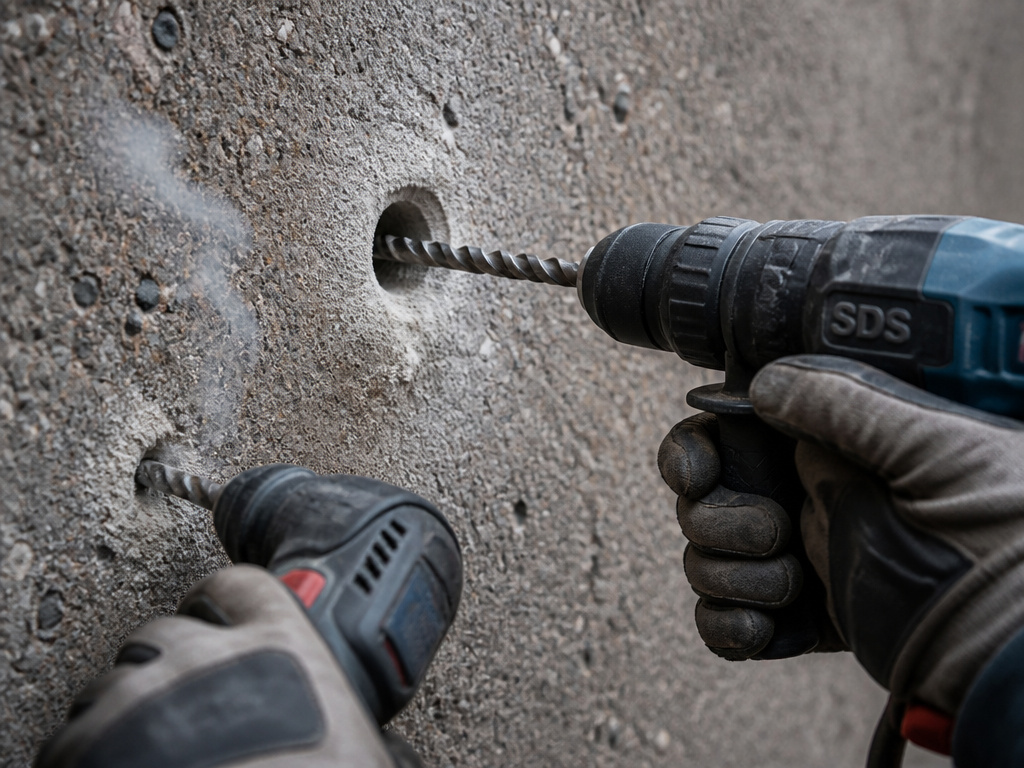
The line is concrete. Not concrete block, but poured, aggregate-filled concrete. A hammer drill will eventually get a 1/4-inch hole in it, but you’ll smell the motor heating up before you’re halfway through. An SDS rotary hammer will punch through in seconds.
The other clear signal is hole diameter. The moment your project calls for a 5/8-inch or 3/4-inch hole in masonry, you’ve left hammer drill territory. The physical limit of a cam-action mechanism is torque and impact force. It simply cannot efficiently transfer enough energy to a larger bit surface area. This is the core of the rotary hammer vs hammer drill debate, it’s not about preference, but mechanical capability.
Chiseling is the final sign. If your project involves removing tile, breaking up a small concrete step, or chipping out mortar, you need the “rotation stop” function found on SDS rotary hammers. A hammer drill cannot chisel.
Can You Use an SDS Bit in a Regular Hammer Drill?
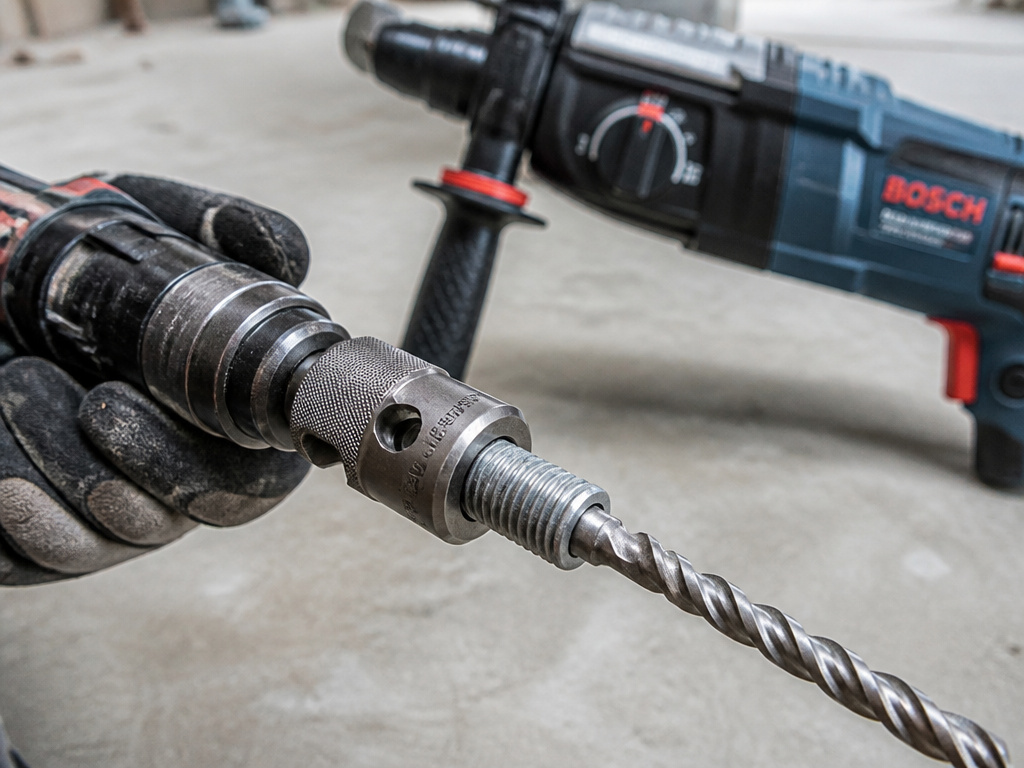
Yes, with a $15 adapter. And you will be disappointed.
The adapter screws into your standard chuck and has an SDS+ socket on the other end. It lets you physically attach the bit, but it completely defeats the purpose. The SDS bit cannot slide back and forth inside the adapter, so the pneumatic hammer mechanism of the rotary hammer is irrelevant. You’re just using a more expensive bit in a less effective tool. All you gain is the convenience of not buying a separate set of standard masonry bits.
The 4 Tools That Replace a $200 Service Visit
For most homeowners, buying a dedicated SDS rotary hammer for a single project is hard to justify. Renting is the smart move. But if you own a home and anticipate multiple projects over the years, the investment pays off. Here’s what you need beyond the tool itself.
- SDS-Plus Drill Bits: Buy a set that includes the sizes you need (often 1/4″, 3/8″, 1/2″, 5/8″). Quality matters, a cheap bit will dull fast in concrete.
- Auxiliary Handle: Use it. Every time. It gives you the leverage to control the tool and prevents the torque from twisting your wrist when the bit binds.
- Dust Extraction: A shop-vac attachment or a built-in dust collection shroud. Concrete dust is fine and abrasive, and you don’t want it in your lungs or your garage.
- Hearing and Eye Protection: A rotary hammer is loud (often over 96 dB) and produces flying chips. This isn’t a suggestion.
Frequently Asked Questions
Can a hammer drill be used as a regular drill?
Yes. Every hammer drill has a switch to turn the hammer function off. In “drill only” mode, it functions identically to a standard drill for drilling wood, metal, or plastic, and for driving screws. This dual functionality is what makes a hammer drill vs regular drill comparison so relevant for the average DIYer.
Is SDS better than a hammer drill?
For drilling in concrete, absolutely. The SDS mechanism delivers more power with less user fatigue. For everything else, wood, metal, brick, driving screws, a standard drill or hammer drill is more versatile and cost-effective. “Better” depends entirely on the material.
What does SDS stand for?
SDS stands for Slotted Drive System (from the German “Steck-Dreh-Sitz”). It refers to the special chuck and bit design that allows the bit to slide back and forth while being locked rotationally. This sliding action is what enables the efficient pneumatic hammer mechanism. For a full breakdown of the design, read our article on what is an SDS drill.
Can I use a hammer drill for concrete?
You can, for small holes (under 3/8-inch) and very few of them. It will be slow, hard on the tool, and exhausting. For any hole larger than 1/2-inch or more than a handful of holes, you need the impact energy of an SDS hammer drill or rotary hammer.
What is the main advantage of an SDS drill?
Reduced user fatigue and faster drilling in hard masonry. The pneumatic system absorbs the recoil, so your arms aren’t taking the beating. The higher impact energy also drills faster, turning a 10-minute struggle into a 30-second job.
Before You Go
If your project list has “drill into brick” once, get a hammer drill. If it has “drill into concrete” more than once, get an SDS rotary hammer. The cost difference is real, but so is the difference in results and how your body feels the next day. For the majority of homeowners, a quality combi-drill with a hammer function covers 95% of tasks. That last 5%, setting a deck into a concrete footing, mounting a safe to a basement floor, is where the SDS tool earns its keep. Don’t fight concrete with a rattling cam. Rent the piston.
