
How Long Does a Drill Battery Take to Charge? (Key Factors)
This post contains affiliate links. As an Amazon Associate, we earn from qualifying purchases.
Most 18V/20V drill batteries take between 25 minutes and 2 hours to reach a full charge. The exact time depends on three things: the battery’s capacity (measured in Amp-hours, or Ah), the charger’s output current (measured in Amps), and the battery’s temperature when you plug it in. A small 2.0Ah battery on a standard charger might hit full in 35 minutes, while a large 12.0Ah pack can take over 2 hours.
That 2-hour spread is the difference between finishing a job today and waiting until tomorrow. The numbers in your manual are for a battery that starts at room temperature—drop it on a cold garage floor in winter, and the charger’s safety circuit will delay the start until the pack warms up, adding another 30 minutes you didn’t plan for.
What follows: the OEM charge tables for Milwaukee, Bosch, and Ryobi, what the blinking lights on your charger actually mean, and the one mistake that cuts a battery’s life in half.
Key Takeaways
- Charge time is set by battery capacity (Ah) and charger output (A). A 4.0Ah battery charges twice as fast on a 8A charger as it does on a 4A unit.
- Temperature is a hard gate. Bosch and Milwaukee chargers will not start a charge if the battery is below 32°F (0°C) or above 104°F (40°C)—the light just blinks.
- The “first charge” myth is real for nickel-cadmium, but not for modern lithium-ion. Li-ion packs charge fully on the first plug-in, but may need a few discharge cycles to reach peak runtime.
- A battery that feels only slightly warm during charging is normal. One that’s hot to the touch after 10 minutes is failing.
- Leaving a battery on the charger after the green light comes on does not “trickle charge” it. It stresses the cells and is the single biggest cause of premature capacity loss.
The 3 Factors That Control Charge Time
You can’t change a battery’s chemistry. You can control the three variables that decide how long it sits on the bench.
Charge time depends on the capacity of the battery pack. Heavily cycled batteries may take longer to charge completely. Milwaukee 48-59-2401 Charger Manual
1. Battery Capacity (Amp-hours – Ah)
This is the gas tank size. A 2.0Ah battery holds less energy than a 6.0Ah battery. It will also fill faster.
The relationship isn’t perfectly linear because of charging inefficiencies, but it’s close. Doubling the capacity roughly doubles the charge time on the same charger. This is why a Milwaukee M18 2.0Ah battery charges in 35 minutes on a standard charger, while their M18 12.0Ah High Output pack needs 130 minutes.
| Battery Capacity (Ah) | Typical Full Charge Time (Standard Charger) | Best For |
|---|---|---|
| 1.5Ah – 2.0Ah | 25 – 40 minutes | Light-duty tasks, overhead work, compact drills |
| 3.0Ah – 4.0Ah | 45 – 60 minutes | General drilling, driving screws, most homeowner projects |
| 5.0Ah – 6.0Ah | 60 – 90 minutes | Continuous use, saws, hammer drills, larger projects |
| 8.0Ah+ | 90 minutes – 2+ hours | High-demand tools, all-day runtime, professional sites |
2. Charger Output (Amps – A)
This is the size of the hose filling the tank. A charger’s output current, measured in Amps (A), is the single biggest spec most people miss.
A standard charger might output 4A. A rapid charger like the Bosch GAL18V-160 pushes 16.0A. That higher amperage forces energy into the battery cells faster, cutting charge times dramatically.
Where this goes sideways: Assuming all chargers are equal. Plugging a 6.0Ah battery into a 2A charger can take over 3 hours. The same battery on a 8A charger finishes in under an hour.
Check your charger’s label or manual for its output rating. It’s often printed near the input voltage. More Amps means faster charging, but also generates more heat, which is why rapid chargers have fans.
3. Battery Temperature
Lithium-ion cells charge efficiently only within a specific window. Go outside it, and the charger’s protection circuit stops everything.
- Too Cold (Below 32°F / 0°C): Charging a frozen battery can cause permanent internal damage. The Bosch GAL12V/18V-80 and Milwaukee 48-59-1808 manuals explicitly state their chargers will not initiate a charge below this threshold. The red light will flash until the pack warms up.
- Too Hot (Above 104°F / 40°C): A battery hot from use needs to cool. Ryobi and RIDGID manuals advise letting a hot pack cool for about 30 minutes before recharging. Forcing a charge on a hot battery accelerates cell degradation.
The sweet spot is room temperature, between 60°F and 80°F (15°C – 27°C). This is where the published charge times are measured.
Manufacturer Charge Times: Milwaukee, Bosch, Ryobi
Generic advice is useless. You need the numbers for your brand.
Milwaukee M18 & M12 Times
Milwaukee publishes a detailed charging chart. Times vary by charger type: Standard, Rapid, and Super Charger.
| Battery Model | Capacity | Standard Charger | Rapid Charger | Super Charger |
|---|---|---|---|---|
| M18 CP2.0 | 2.0Ah | 35 min | 21 min | – |
| M18 XC4.0 | 4.0Ah | 60 min | 48 min | 30 min |
| M18 XC6.0 (High Output) | 6.0Ah | 105 min | 76 min | 46 min |
| M18 HD12.0 (High Output) | 12.0Ah | 241 min | 162 min | 115 min |
| M12 CP2.0 | 2.0Ah | 30 min | 22 min | – |
The jump from a Standard to a Rapid charger can cut time by 25-35%. The Super Charger, available for M18 batteries, slashes it by over 50%. If you’re running a cordless tool system with multiple high-capacity packs, the charger upgrade pays for itself in downtime saved.
Bosch 18V & 12V Times
Bosch provides times for specific charger models. The GAL18V-160 rapid charger is a game-changer.
| Battery Model | Capacity | GAL12V/18V-80 Charger | GAL18V-160 Charger (PowerBoost) |
|---|---|---|---|
| Standard 18V 2.0Ah | 2.0Ah | 25 min | – |
| CORE18V 4.0Ah | 4.0Ah | 47 min | 35 min to full |
| CORE18V 6.0Ah | 6.0Ah | 46 min | 35 min to full |
| CORE18V 8.0Ah | 8.0Ah | 65 min | 44 min to full |
Note the CORE18V 6.0Ah charges faster than the 4.0Ah on the older charger—a quirk of cell configuration. The GAL18V-160’s “PowerBoost” mode can deliver a 50% charge in as little as 9 minutes for a 4.0Ah pack.
Ryobi & 20V MAX Platform Times
These platforms often use more universal chargers with slower output.
- Ryobi HP1441M: The manual states 1 hour for a normal recharge, and 1 to 1.5 hours for a completely discharged tool.
- 20V MAX 1/2″ Drill (Battery 5350-023): The replacement 2.5Ah battery takes up to 75 minutes for a full charge.
- RIDGID R8411511: After normal use, it needs 20 minutes to be fully charged.
These times assume you’re using the OEM charger that came in the kit. Using a different charger, even from the same brand family, can alter these times or not work at all.
What Those Charger Lights Really Mean (And What to Do)
The LED lights function as a diagnostic tool.
- Solid Red: Fast charging in progress. This is the normal state. The battery will feel slightly warm.
- Solid Green: Charging is complete. Remove the battery. Leaving it on the charger after this point does not “top it off”—it slowly stresses the cells.
- Flashing Red (Fast): The battery is too hot or too cold. Unplug it, let it reach room temperature, and try again. This is the charger protecting your investment.
- Flashing Red (Slow) or Red/Green: Communication error. The charger and battery aren’t talking. Remove the battery, clean the metal contacts on both with a dry cloth, and re-seat it firmly.
- Yellow/Green (Ryobi/Bosch) or No Light: This often indicates a control charge mode or a possible faulty battery. As the Ryobi manual says, if this light combination persists for more than 15 minutes after re-seating the pack, the “battery pack is damaged and will not accept charge.”
Easy to miss: A blinking red light isn’t always a bad battery. Check the temperature first. A pack left in a truck overnight in January will blink red on the charger until it thaws.
Why Your “New” Battery Isn’t Fully Charged (And Other Myths)
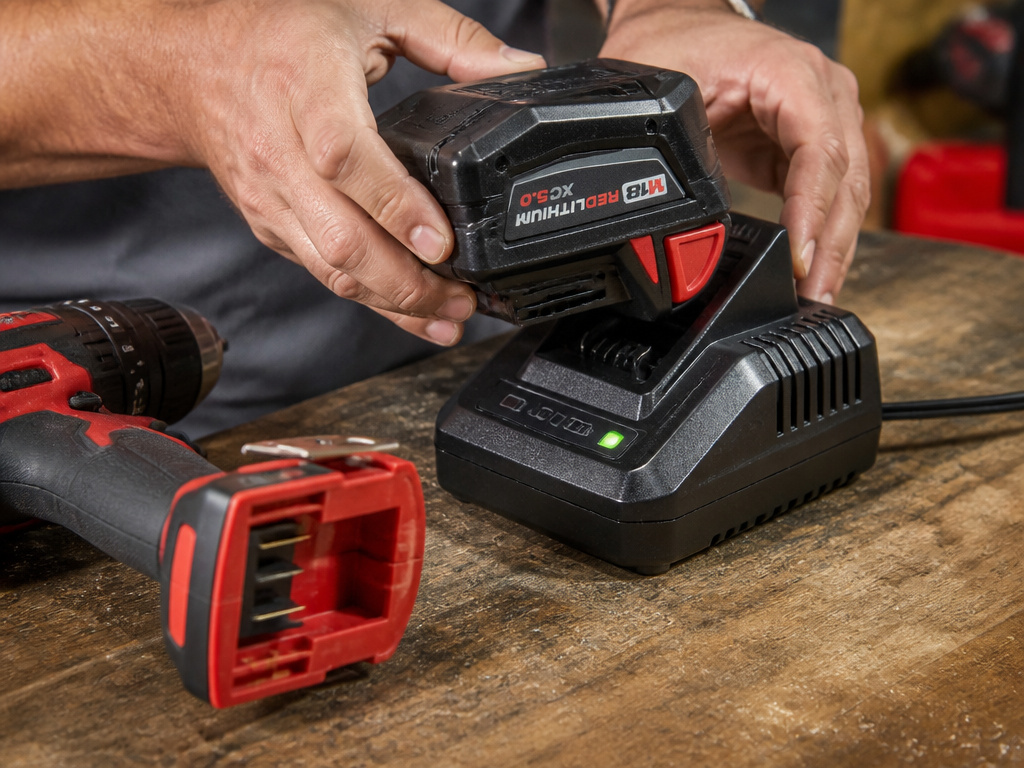
You followed the instructions. The green light is on. But your brand-new drill dies in 10 minutes. What gives?
The Ryobi and RIDGID manuals contain a critical note many miss: “Batteries will not reach full charge the first time they are charged. Allow several cycles (operation followed by recharging) for them to fully charge.”
This is specifically true for older nickel-cadmium (Ni-Cd) chemistry, which is what the RIDGID manual references. Modern lithium-ion batteries don’t have a “memory effect,” but their initial cycle might still calibrate the internal fuel gauge. Run it down and charge it 2-3 times before judging its runtime.
Other persistent myths: * Myth: You must drain the battery completely before charging. * Truth: Lithium-ion batteries have no memory. “Topping off” from 50% is better for cell longevity than deep discharges. * Myth: Leaving it on the charger keeps it at 100%. * Truth: Once green, the charger stops. The battery then slowly self-discharges. When it drops a few percent, the charger kicks in for a brief top-up. This micro-cycling creates heat and degrades cells over time. * Myth: A third-party “fast charger” is always better. * Truth: It might be faster, but if it doesn’t match the brand’s communication protocol, it can overcharge or overheat the pack. This is a common path to a drill battery that won’t charge permanently.
How to Make Any Battery Charge Faster
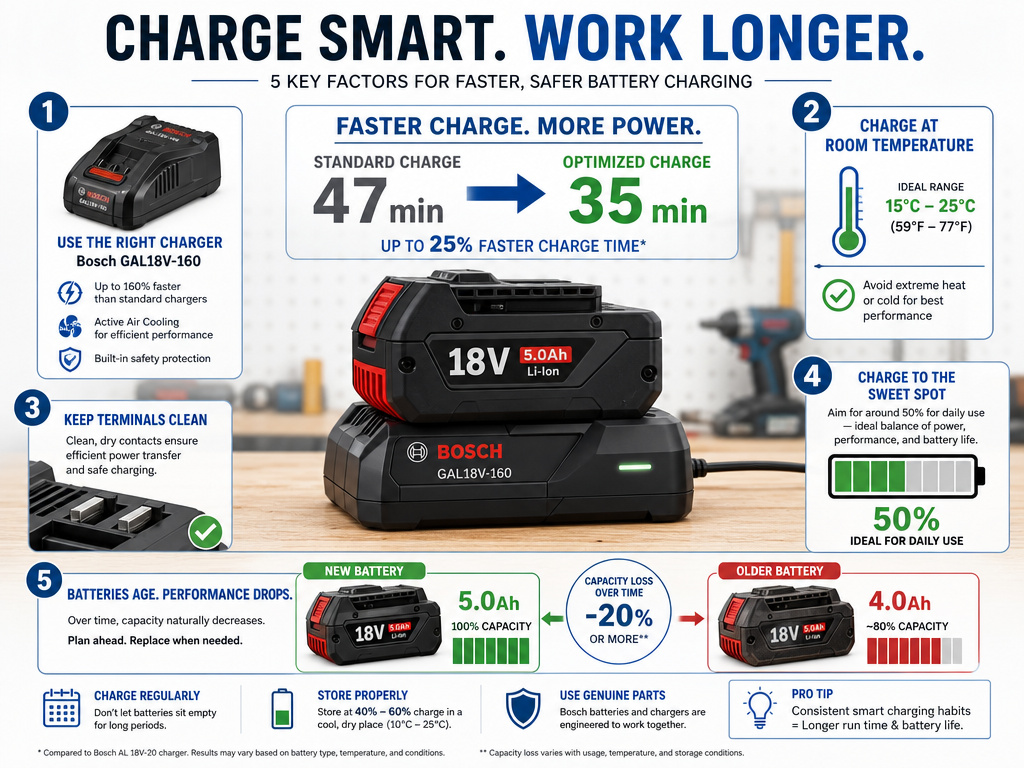
You can’t change the physics, but you can optimize the conditions.
- Use the Right Charger. If speed matters, buy your brand’s rapid charger. The Bosch GAL18V-160 cuts a 4.0Ah charge from 47 minutes to 35. That adds up.
- Charge at Room Temperature. Bring cold batteries inside for an hour before charging. Don’t charge on a sun-baked workbench.
- Keep Contacts Clean. Dirty terminals increase resistance, creating heat and slowing charge acceptance. A pencil eraser or contact cleaner works.
- Store Partially Charged. If storing a battery for weeks, charge it to about 40-60%. A fully charged or fully dead battery stored long-term loses capacity faster.
- Replace When It’s Time. The Bosch manual is blunt: “Replace battery pack if a substantial drop in operating time per charge is observed. Battery pack may be nearing the end of its life.” Holding onto a dying 4.0Ah battery that now acts like a 1.5Ah wastes more time than buying a new one.
Frequently Asked Questions
Why does my drill battery take so long to charge?
Three likely culprits: a low-amperage charger, a high-capacity battery, or an extreme temperature. A 6.0Ah battery on a 2A charger will take 3+ hours. Check your charger’s output rating (in Amps) and the battery’s Ah rating. Also, feel the battery when you plug it in. If it’s very hot or cold, that’s your answer.
Can I use a fast charger on any battery?
Only if it’s from the same brand and listed as compatible. Battery and charger have a communication chip. A mismatched fast charger might not “handshake,” or worse, could deliver too much current. Stick with your OEM’s recommended rapid charger models.
Is it bad to leave a drill battery on the charger overnight?
Yes, routinely. While modern chargers have cut-off circuits, the repeated micro-cycling (charge, tiny discharge, recharge) that happens after the green light comes on creates heat and stress. For maximum lifespan, take it off when it’s green. This is the simplest habit that prevents a dead battery scenario.
How do I know if my drill battery is bad?
The first sign is a substantial drop in runtime. If a battery that used to last an hour now dies in 15 minutes, it’s failing. Physical signs include swelling, not charging fully (green light never comes on), getting excessively hot during use or charge, or the tool cutting out under mild load.
What’s the difference between 18V and 20V Max batteries?
It’s marketing, not mechanics. They are the same nominal voltage. A “20V Max” battery measures 20 volts when fully charged with no load, but its nominal, working voltage is 18V. An 18V drill and a 20V Max drill from the same brand use the same cells and are often cross-compatible. The choice between a cordless drill vs corded drill is about portability versus constant power, not this voltage label.
Before You Go
Charge time is determined by battery capacity divided by charger output, with temperature holding the veto. A Milwaukee M18 2.0Ah charges in 35 minutes.A Bosch CORE18V 8.0Ah needs 65. Your Ryobi wants an hour.
The charger’s lights tell you what’s happening—a flashing red means wait, not worry. And the single best thing you can do for battery life is to pull it off the charger the moment it turns green. That simple move adds more cycles than any other tip.
For most home shops, a standard charger and a couple of mid-size batteries are enough. If you’re running a battery-powered tool all day, the math changes. Then, investing in a rapid charger and larger capacity packs isn’t a luxury; it’s how you finish before dark.
