
What Size Hole Saw for 2 Inch PVC Pipe? The Correct Answer
This post contains affiliate links. As an Amazon Associate, we earn from qualifying purchases.
The correct hole saw size for a 2-inch PVC pipe is 2-1/2 inches for a standard pass-through hole. If you need the hole to accommodate a PVC fitting like a coupling or elbow, you likely need a 3-inch hole saw. This is because a ‘2-inch’ PVC pipe has a nominal size, not an actual outer diameter of 2 inches.
Everyone gets this wrong at least once. You grab a 2-inch hole saw because the pipe says 2-inch on the side. The pipe won’t fit.
You check the math, curse a little, and realize the tool aisle doesn’t stock a 2-3/8 inch saw. Now you’re making a second trip or forcing a pipe through a ragged, undersized hole. The mistake is assuming the label on the pipe matches its physical size. It doesn’t.
This guide will walk you through the three things you must match: the pipe’s real outer diameter, the type of hole you’re drilling (pipe pass-through vs. fitting installation), and the right technique to cut PVC without melting it or destroying your saw. We’ll cover the exact sizes, the best hole saw types, and the step-by-step process to get it right the first time.
Key Takeaways
- A “2-inch” PVC pipe has an actual outer diameter (OD) of 2-3/8 inches (2.375″). The nominal size is for flow capacity, not physical measurement.
- For a hole that a bare pipe slides through, use a 2-1/2 inch hole saw. For a hole that must accept a glued fitting (coupling, elbow, tee), use a 3-inch hole saw, measure the fitting’s hub to be sure.
- Drill PVC at low RPMs. High speed generates heat that melts the plastic, gums up the saw teeth, and creates a rough, fused edge that’s hard to clean.
- Always use a pilot bit and clamp your workpiece. A wandering hole saw will oval the hole and weaken the support, especially in wall studs.
- A carbide-tipped hole saw (like Diablo’s or Milwaukee’s Big Hawg) will last significantly longer on PVC than a standard bi-metal saw and produce a cleaner cut.
The First Rule: Nominal vs. Actual Size
Forget the number printed on the pipe. In plumbing, “2-inch” is the Nominal Pipe Size (NPS), a holdover from iron pipe standards that refers to approximate inner diameter for flow. The actual outer diameter is standardized and larger.
For Schedule 40 and Schedule 80 PVC pipe, the two most common types in residential work, the outside diameter is 2.375 inches. That’s 2-3/8 inches on your tape measure. The wall thickness is what changes between schedules, not the OD. This means your hole must be at least 2-3/8 inches wide just for the pipe body to fit.
PVC pipe sizing follows the Nominal Pipe Size (NPS) system, where the labeled size does not match the physical dimensions. For NPS 2-inch PVC, the standardized outer diameter is 2.375 inches (60.3 mm) regardless of schedule. The inside diameter decreases with thicker walls (Schedule 80 vs. 40), but the outside diameter remains constant for compatibility with standard fittings.
You won’t find a 2-3/8 inch hole saw on the shelf at most hardware stores. They jump from 2-1/4 inch to 2-1/2 inch. That’s why the 2-1/2 inch size is the practical choice. It gives you about 1/8 inch of clearance all around, which is enough for the pipe to slide through without binding on minor imperfections in the wood or the hole itself.
What Size Hole Saw Do You Need for a 2-Inch PVC Fitting?
This is where people get surprised. If you’re running a drain line from a sink and need to poke a 2-inch PVC elbow through a wall, the hole size changes completely. The fitting’s hub, the bell-shaped end that accepts the pipe, is much larger in diameter than the pipe itself.
A standard 2-inch PVC coupling has an outer hub diameter around 2.875 inches. Some elbows can be over 3 inches across at their widest point. If you drill a 2-1/2 inch hole for the pipe, the fitting won’t pass through. You’ll be chopping out wood with a chisel or, worse, trying to force it and cracking the fitting’s socket.
| Application | Target Object | Recommended Hole Saw Size | What Happens If You Go Smaller |
|---|---|---|---|
| Pipe Pass-Through | Bare PVC pipe (OD 2-3/8″) | 2-1/2 inches | Pipe binds, requires hammering; risks scraping off primer/glue during installation. |
| Fitting Installation | PVC coupling, elbow, tee | 3 inches | Fitting will not fit; you must enlarge hole with a rasp or jigsaw, compromising structural support in the stud. |
| Drain Line with Air Gap | Pipe with insulation or sleeve | 3 inches | Insulation compresses, creating a cold bridge or moisture trap; sleeve gets damaged during forced install. |
The rule is simple: measure the fitting, not the pipe. Use a caliper or a flexible tape measure around the hub’s widest point. Round up to the next common hole saw size. For most 2-inch fittings, that’s a 3-inch hole saw.
I learned this the hard way on a garage sink install. I drilled a perfect 2-1/2 inch hole through the double top plate for my 2-inch drain pipe. Then I dry-fit the assembly and realized the 90-degree elbow at the bottom wouldn’t go through. I had to bore a second, overlapping 3-inch hole from underneath, splintering the wood and weakening the header. Now I dry-fit the entire assembly and measure the largest component before I ever touch the drill.
Choosing the Right Hole Saw for PVC
Not all hole saws are equal for plastic. The wrong choice leads to melted edges, clogged teeth, and a frustrating experience.
Bi-Metal Hole Saws (General Purpose)
These are the most common and affordable. They have high-speed steel teeth welded to a spring steel body. They’ll cut PVC, but they dull faster against abrasive plastic and are more prone to loading up with melted material. Brands like Irwin Speedbor or Milwaukee’s standard line work fine for a one-off project.
Carbide-Tipped Hole Saws (Best for PVC)
The teeth have carbide inserts that stay sharper longer and resist heat better. They cut cleaner with less melting. Milwaukee’s “Big Hawg” and Diablo’s carbide-tipped hole saws are top choices. They cost more, but if you’re drilling more than a few holes or working with Schedule 80 (thicker wall) PVC, they’re worth it. The cut is smoother, requiring less deburring.
“Pilot Bit” is Non-Negotiable
Every hole saw needs a pilot bit, the small drill bit in the center that guides the cut. For PVC, use a standard 1/4-inch twist bit. Make sure it’s sharp. A dull pilot bit will wander, especially on curved surfaces like an existing pipe (which you shouldn’t drill into, but sometimes you have to). For advanced hole saw techniques, like cutting through layered materials, a sharp pilot is your best friend.
Before you start: Wear safety glasses. PVC chips can fly. Secure the workpiece with a clamp; a spinning hole saw can grab and spin a loose board or pipe with surprising force. If drilling overhead, wear a dust mask; PVC dust is not something you want to inhale.
Step-by-Step: Drilling the Hole in PVC (Without Melting It)
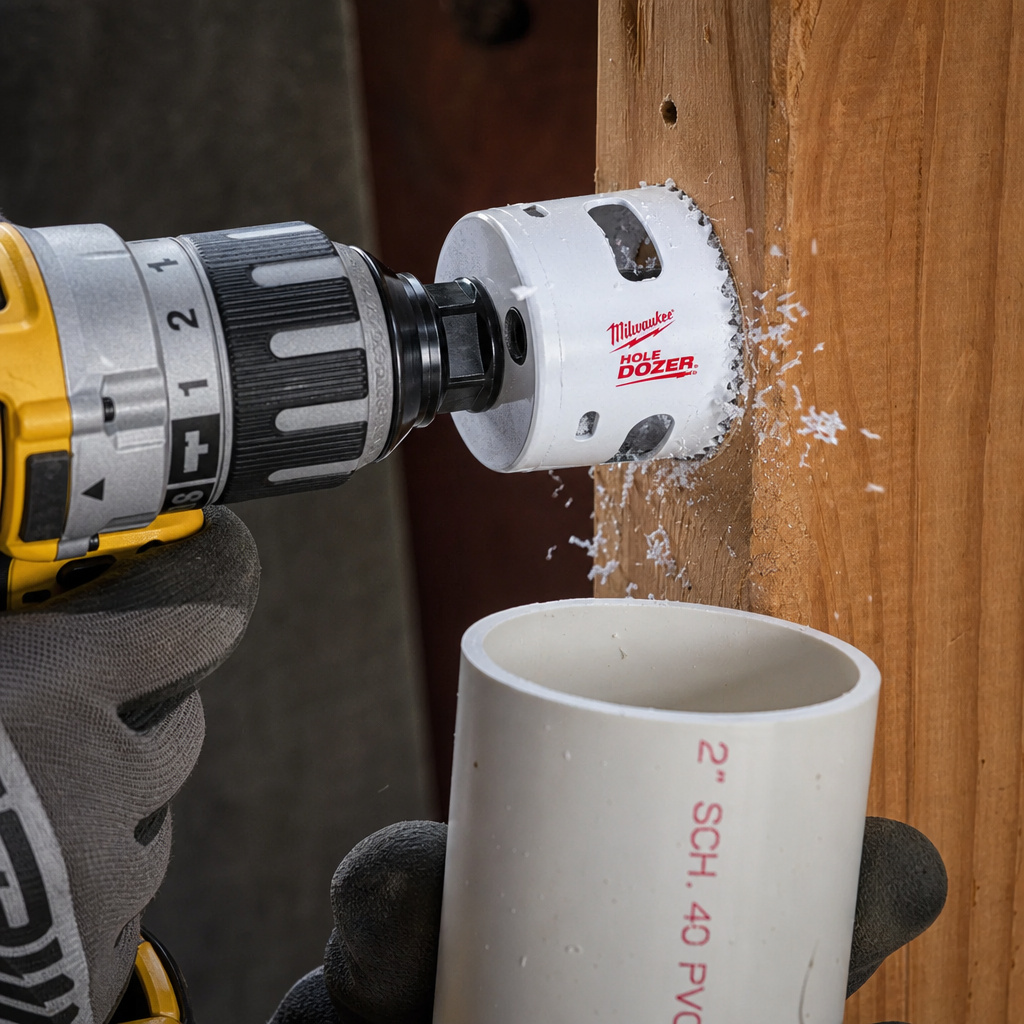
PVC is thermoplastic. Friction heat from the drill turns it gummy, not powdery. Your goal is to cut chips, not melt a groove.
-
Mark and Pilot. Clamp your material (wood stud, plywood, etc.). Mark the hole center. Using your drill with just the pilot bit installed, drill a clean, straight pilot hole all the way through. This gives the hole saw’s arbor a guided path. If you skip this, the hole saw will skate across the surface and mar your workpiece before it bites.
-
Set Low Speed. Attach the hole saw. Set your drill to its lowest speed setting. If it’s a variable speed trigger, feather it gently. For a cordless drill, start around 300-500 RPM. For a corded drill, use the low-gear setting if it has one, around 800-1000 RPM. High speed is the enemy.
-
Cut with Steady Pressure. Align the pilot bit into your pre-drilled hole. Apply firm, steady pressure. Let the teeth do the work. You’ll feel and hear a rhythmic chunk-chunk-chunk as they take bites. If the sound becomes a high-pitched whine and you smell a sweet, plastic-burning odor, you’re going too fast. Stop.
-
Clear Chips Frequently. After every 1/4 inch of depth, back the hole saw completely out of the cut to clear the plastic chips from the gullets (the spaces between teeth). If you don’t, the chips pack in, create more friction, melt, and eventually stall the saw. This is the most skipped step. Do it.
-
Finish from the Back Side (For Thick Material). If you’re drilling through a 2×4 stud (1.5 inches thick) or thicker, cut until the pilot bit just pokes through the back. Then stop, flip the workpiece, and finish the cut from the opposite side using the pilot bit hole as a guide. This prevents the wood from splintering out as the hole saw breaks through, giving you a cleaner hole on both faces.
-
Deburr. The hole will have a slight plastic lip or rough wood edges. Use a deburring tool, a half-round file, or coarse sandpaper to smooth it. A smooth hole prevents the PVC from snagging during installation and protects the pipe’s surface.
What If My Hole is Too Small or Too Rough?
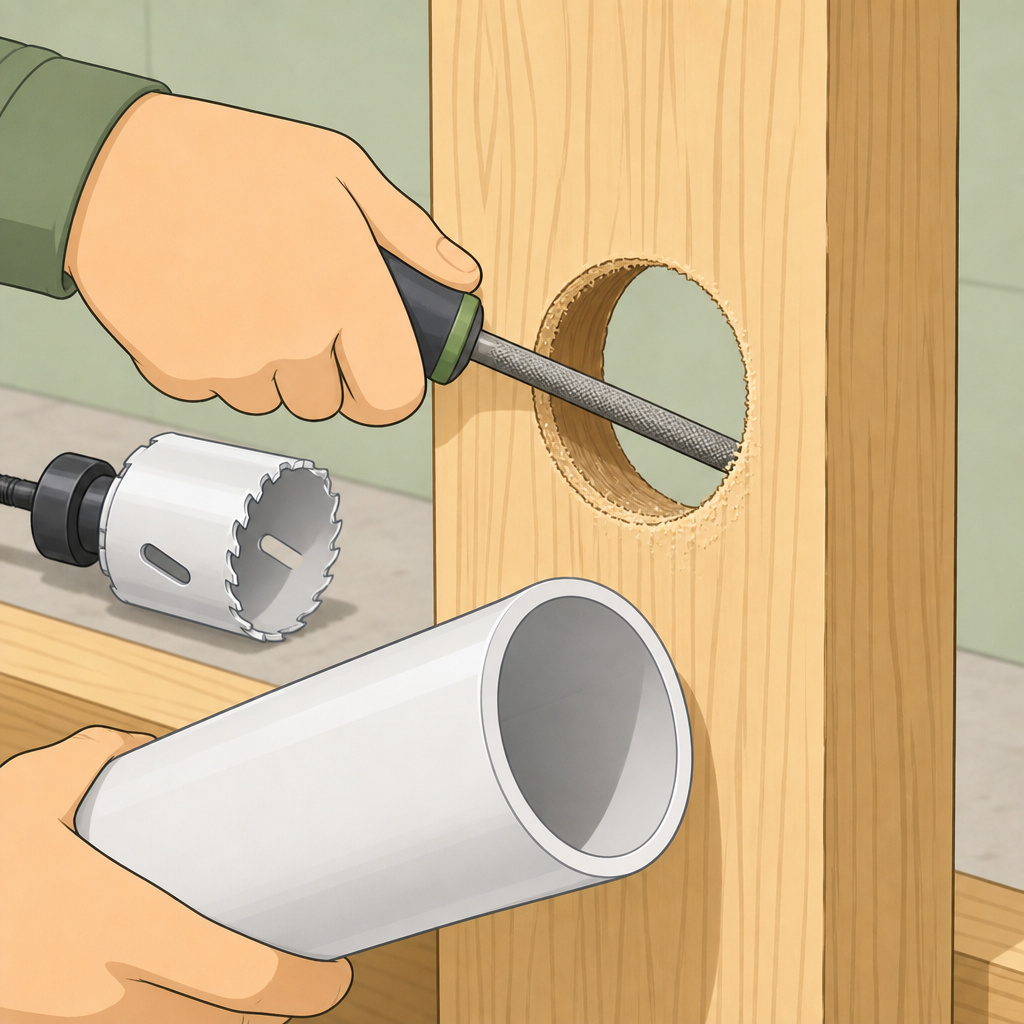
Mistakes happen. Here’s how to recover without starting over.
The Hole is Slightly Too Small (Pipe Won’t Fit)
If you used a 2-1/4 inch saw and the 2-3/8 inch pipe is just stuck, don’t hammer it. Remove the pipe. Use a round file or a coarse sandpaper wrapped around a dowel to evenly enlarge the hole. Work from both sides to keep it round. Check the fit often. Forcing it can crack the pipe, especially in cold weather.
The Hole is Rough and Melted (Gummy Plastic Edges)
You drilled too fast. The plastic re-fused inside the cut. Let the hole saw and plastic cool completely. Use a utility knife to carefully slice away the melted burrs from the inside of the hole. Then, use a file or sandpaper to smooth it. Consider sharpening a hole saw before your next cut; dull teeth exacerbate melting.
The Hole is Oval or Wandering
The pilot bit wandered, or the workpiece moved. The hole is now egg-shaped, which weakens a stud. Your best fix is to use a hole saw one size larger (e.g., go from 2-1/2 to 2-3/4 inch) to recenter and cut a new, clean hole. The oval hole will be partially consumed by the larger cut. If the stud is too compromised, sister a new stud alongside it.
Frequently Asked Questions
Can I use a spade bit instead of a hole saw for 2-inch PVC?
You can, but you shouldn’t for a clean pass-through hole. A 2-1/2 inch spade bit will tear out the back of the wood and leave a rougher hole. It’s also harder to control for a perfectly round cut. A hole saw is the right tool for this job.
What about a 2-inch PVC pipe through metal stud?
The process is the same, but use a carbide-tipped hole saw designed for metal. Drill at an even slower speed with steady pressure. You’ll need cutting oil or lubricant to keep the saw cool. The clearance is even more critical here, as the sharp edges of the metal can scrape the PVC.
How do I drill a hole in an existing PVC pipe?
This is a specialty repair task, not for standard installation. You must use a dedicated PVC hole saw or a step drill bit designed for plastics, at very low speed, with the pipe firmly supported and filled with water to prevent heat buildup. It’s easy to crack the pipe. I avoid it unless absolutely necessary.
My hole saw gets stuck in the cut. What now?
It’s bound because of heat buildup and packed chips. Stop drilling. Reverse the drill slowly while applying gentle outward pressure. If it’s truly jammed, you may need to use a pry bar or second drill to back out the pilot bit, then work the saw loose. Next time, clear chips more often and use less pressure.
Is there a chart for other PVC pipe sizes?
Yes. The pattern holds: a 1-1/2 inch PVC pipe has a 1.900-inch OD, so use a 2-inch hole saw. A 3-inch pipe (3.500-inch OD) needs a 3-1/2 or 3-3/4 inch hole saw. Always measure the actual OD or fitting.
Before You Go
Drilling for PVC isn’t about brute force. It’s about matching three numbers: the pipe’s real outer diameter (2-3/8 inches), the common tool size that gives you clearance (2-1/2 inches), and the drill’s RPMs (keep them low). When fittings are involved, measure the hub, not the pipe, that usually means a 3-inch hole.
Use a carbide-tipped hole saw if you can. It pays off in cleaner cuts and less headache. Clamp your work, pilot first, and clear those plastic chips every few seconds.
That rhythm prevents melting and binding. If the hole ends up wrong, fix it with a file or the next size saw, don’t force the pipe. Forcing breaks things.
{
“@context”: “https://schema.org”,
“@type”: “FAQPage”,
“mainEntity”: [
{
“@type”: “Question”,
“name”: “Can I use a spade bit instead of a hole saw for 2-inch PVC?”,
“acceptedAnswer”: {
“@type”: “Answer”,
“text”: “You can, but you shouldn’t for a clean pass-through hole. A 2-1/2 inch spade bit will tear out the back of the wood and leave a rougher hole. It’s also harder to control for a perfectly round cut. A hole saw is the right tool for this job.”
}
},
{
“@type”: “Question”,
“name”: “What about a 2-inch PVC pipe through metal stud?”,
“acceptedAnswer”: {
“@type”: “Answer”,
“text”: “The process is the same, but use a carbide-tipped hole saw designed for metal. Drill at an even slower speed with steady pressure. You’ll need cutting oil or lubricant to keep the saw cool. The clearance is even more critical here, as the sharp edges of the metal can scrape the PVC.”
}
},
{
“@type”: “Question”,
“name”: “How do I drill a hole in an existing PVC pipe?”,
“acceptedAnswer”: {
“@type”: “Answer”,
“text”: “This is a specialty repair task, not for standard installation. You must use a dedicated PVC hole saw or a step drill bit designed for plastics, at very low speed, with the pipe firmly supported and filled with water to prevent heat buildup. It’s easy to crack the pipe. I avoid it unless absolutely necessary.”
}
},
{
“@type”: “Question”,
“name”: “My hole saw gets stuck in the cut. What now?”,
“acceptedAnswer”: {
“@type”: “Answer”,
“text”: “It’s bound because of heat buildup and packed chips. Stop drilling. Reverse the drill slowly while applying gentle outward pressure. If it’s truly jammed, you may need to use a pry bar or second drill to back out the pilot bit, then work the saw loose. Next time, clear chips more often and use less pressure.”
}
},
{
“@type”: “Question”,
“name”: “Is there a chart for other PVC pipe sizes?”,
“acceptedAnswer”: {
“@type”: “Answer”,
“text”: “Yes. The pattern holds: a 1-1/2 inch PVC pipe has a 1.900-inch OD, so use a 2-inch hole saw. A 3-inch pipe (3.500-inch OD) needs a 3-1/2 or 3-3/4 inch hole saw. Always measure the actual OD or fitting.”
}
}
]
}
