What Is A Table Saw Used For
This post contains affiliate links. As an Amazon Associate, we earn from qualifying purchases.
What Is a Table Saw Used For?
A table saw is a woodworking tool with a circular blade protruding through a flat table surface. It is primarily used for making precise and controlled cuts in materials, typically wood. The blade’s position can be adjusted for depth and angle, allowing for a wide range of cuts essential for construction, cabinetry, furniture making, and general DIY projects.
Key Takeaways
- A table saw’s primary function is ripping: cutting wood along the grain to reduce its width. This is its most common and efficient use.
- It excels at crosscutting: cutting wood across the grain to shorten its length, especially when used with a miter gauge or sled.
- Beyond basic cuts, it can handle specialized tasks: like making angled miter and bevel cuts, cutting dados and rabbets for joinery, and breaking down large sheet goods.
- Safety is paramount. Always use push sticks, blade guards, and anti-kickback pawls. Never cut freehand.
The 5 Primary Uses of a Table Saw
While versatile, a table saw’s design makes it exceptionally good at a few key operations.
1. Ripping Lumber (Its Main Job)
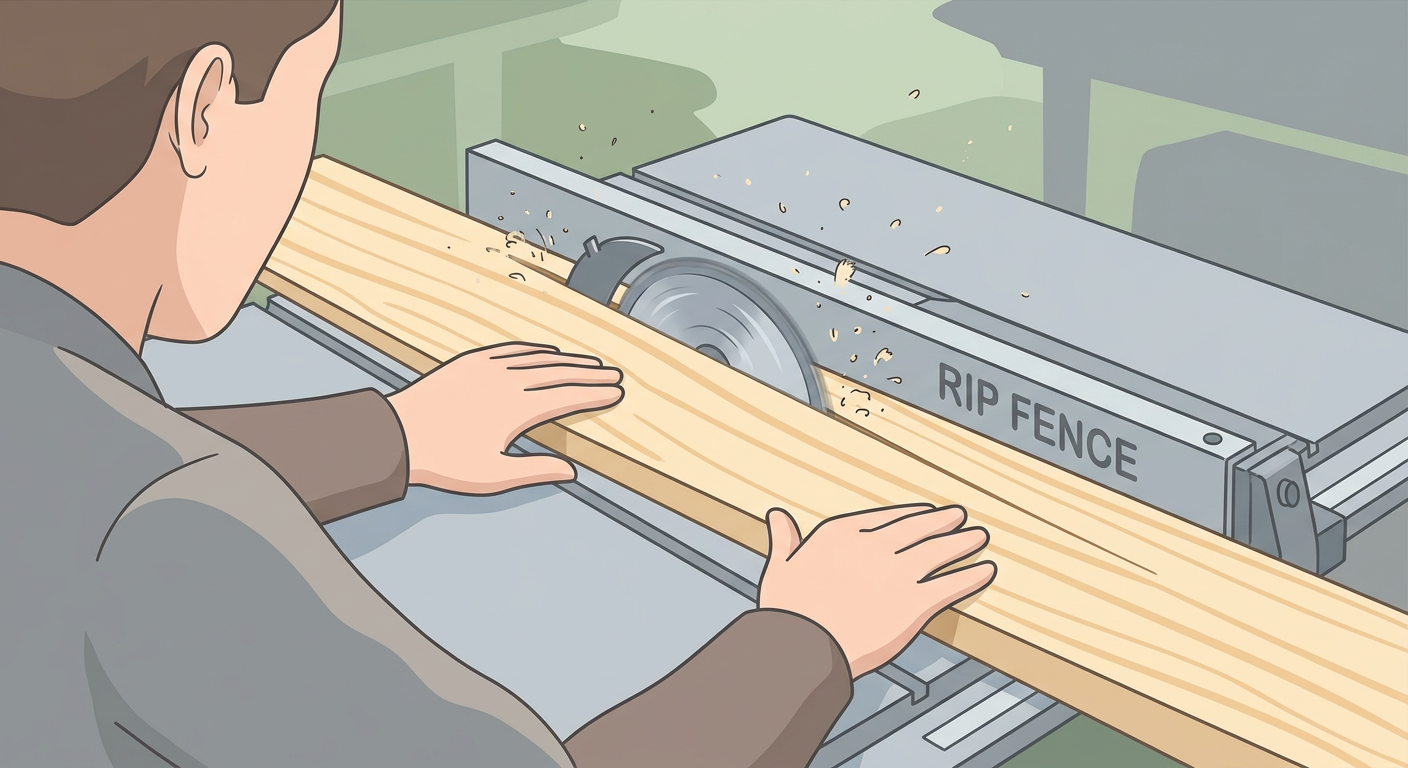
Ripping is cutting a board lengthwise, parallel to the wood grain, to make it narrower. You use the table saw’s rip fence—the adjustable guide that locks parallel to the blade—to ensure straight, consistent cuts.
Before you rip: Always ensure the rip fence is parallel to the blade. A misaligned fence forces the wood against the blade, which is a major cause of dangerous kickback.
Good For: Reducing wide boards to needed widths, creating strips for trim, preparing stock for other projects.
Tool Needed: Rip fence.
2. Crosscutting Lumber
Crosscutting is cutting a board across the grain to cut it to length. For this, you use a miter gauge that slides in the table’s slots, guiding the wood at a 90-degree angle (or other angles) to the blade.
I never use the rip fence as a crosscut stop. That’s a classic beginner mistake. When the cutoff piece gets trapped between the blade and the fence, it can be violently thrown back toward you in a kickback.
Good For: Cutting boards to final length, trimming pieces to size.
Tool Needed: Miter gauge or crosscut sled.
3. Making Angled Cuts: Miter & Bevels
- Miter Cut: An angled cut made across the face of the wood. You set the angle on the miter gauge (common for picture frames).
- Bevel Cut: An angled cut made through the thickness of the wood, tilting the blade itself (common for edge details).
- Compound Miter Cut: A combination of both—the blade is tilted, and the wood is angled on the miter gauge (essential for crown molding).
4. Cutting Dados, Rabbets, and Grooves
These are joint-making cuts that remove a section of wood to create a channel or ledge.
* Dado: A square-walled, flat-bottomed groove cut across the wood grain. Requires a special dado blade set.
* Rabbet: An L-shaped cut along the edge of a board.
* Groove: Similar to a dado but runs with the grain.
Good For: Shelving, cabinet construction, drawer assembly, and strong box joints.
5. Breaking Down Sheet Goods
Large panels of plywood, MDF, or particleboard are cumbersome to cut with a circular saw. A table saw, especially with a large table or outfeed support, makes breaking them down safer and more accurate. Some saws even have a scoring blade that scores the veneer first to prevent splintering.
Types of Table Saws and Their Typical Uses
The saw you choose dictates its best applications.
| Type of Table Saw | Best Used For | Key Features & Limitations |
|---|---|---|
| Benchtop | Light DIY projects, hobbyists, portability. | Lightweight, direct-drive motor, affordable. Limited power and table size. |
| Jobsite | Contractors needing portable power. | Folding stand, powerful universal motor, good dust port. Less precise than stationary saws. |
| Contractor | Serious hobbyists with space constraints. | Open-stand design, often a 1–2 HP induction motor. Heavier than benchtops. |
| Hybrid | Hobbyists wanting cabinet-saw capability without professional price. | Enclosed cabinet for dust, 1.5–2 HP motor, heavier than contractor saws. |
| Cabinet | Professional shops, fine woodworking, high-volume work. | Heavy, stable, 3–5 HP induction motor, superior dust collection, maximum precision. |
| Sliding Table Saw | Cutting large panels and sheet goods with extreme precision. | Sliding table handles the workpiece weight; some have scoring blades. |
Essential Table Saw Safety Practices
Caveats
A table saw is one of the most useful and dangerous tools in a workshop. Complacency causes accidents.
- Use Safety Gear Every Time: Safety glasses, hearing protection, a dust mask are non-negotiable. Avoid loose clothing and jewelry. Never wear gloves—they can get caught and pull your hand into the blade.
- Set the Correct Blades Height: The blade should extend no more than 1/8 to 1/4 inch above the material being cut. This minimizes exposed teeth and reduces kickback risk.
- Use the Right Guide: Never rip without the rip fence. Never crosscut using just the fence as a stop. Use a miter gauge or sled.
- Use Push Sticks & Blocks: When your hands come within 6 inches of the blade, use a push stick or block. Your fingers are worth less than a scrap of wood.
- Maintain Kickback Prevention: Always use the riving knife and blade guard. Ensure the wood is flat against the table and fence. Never start the saw with the material touching the blade.
- Unplug for Adjustments: Always unplug the saw before changing blades or making fence adjustments.
I learned the hard way. My first saw was a used benchtop model. I was ripping a narrow piece of oak for a shelf, thinking I could quickly push it through with my fingers. I slipped. The piece shot back, slamming into my push stick so hard it left a dent in my palm. The saw was unplugged for the rest of the day while my hands stopped shaking. That push stick is still in my shop, dent and all, as a reminder. Respect the blade every single time.
Frequently Asked Questions
What’s the difference between a table saw and a miter saw?
table saw is for ripping and cutting large panels, where the workpiece moves through a stationary blade. A miter saw is for crosscutting and angle cutting stationary workpieces against a moving blade. They complement each other.
Can a table saw cut metal or plastic?
Yes, with the right blade. A fine-toothed carbide blade works for non-ferrous metals like aluminum and plastics. Always go slow, wear full face protection. For steel, a specialized metal-cutting blade in a bandsaw or chop saw is safer and better.
How do I prevent kickback?
Use the riving knife and blade guard. Keep the blade height low. Ensure the fence is parallel. Use a push stick. Never let cutoffs get trapped between the fence এবং blade.
What maintenance does a table saw need?
Regularly clean the tabletop and undercarriage of debris. Check the blade এবং fence for square. Lubricate the elevation gears. Inspect the motor brushes on older saws. A clean saw is a safe saw.
What size blade do I need?
For general woodworking, a 40-tooth combination blade works well. For fine crosscutting, a higher-tooth (80-tooth) blade gives cleaner edges. For ripping hardwoods, a 24-tooth ripping blade is faster and smoother.
The Bottom Line
A table saw is the cornerstone of a woodworking shop because it masters the rip cut—a task no other stationary saw does as efficiently. Its flat table and array of guides make it the go-to tool for dimensioning lumber, breaking down sheet goods, and cutting precise joinery. Whether you’re a DIYer building a deck or a craftsman fitting dovetails, understanding its primary uses—and respecting its power—is the first step to unlocking its potential.
