What is a Single Bevel Miter Saw? A Straight-Talking Guide
This post contains affiliate links. As an Amazon Associate, we earn from qualifying purchases.
A single bevel miter saw is a power tool that makes precise angled cuts in two planes: it swivels left and right for miter (horizontal) angles, and it tilts in only one direction (almost always left) for bevel (vertical/tilted) angles. This limitation defines it, making it simpler, lighter, and cheaper than a dual bevel model, but requiring you to flip the workpiece to create a matching bevel cut in the opposite direction.
Most people see the lower price tag and think they’re getting a bargain without missing much. They don’t account for the physical choreography that limitation introduces on a real project. You’ll be lifting, flipping, and re-aligning long pieces of crown molding or baseboard more times than you can count, and each flip is a chance to mark the wood wrong or knock your setup out of square.
This guide breaks down exactly what a single bevel miter saw is, when it’s the perfect tool, and when that “bargain” becomes a frustrating bottleneck. We’ll cover the mechanics, the real-world workflow, and how to decide if it’s the right saw for your shop.
Key Takeaways
- The “single bevel” means the saw blade only tilts left. To cut a matching right-hand bevel, you must physically flip the workpiece, which adds steps and potential for error.
- These saws excel at straightforward trim work, picture frames, and projects where all bevel cuts face the same direction. They struggle with efficiency on complex crown molding or anything requiring frequent opposite-side bevels.
- You trade capability for cost and portability. A single bevel saw is typically lighter, less expensive, and has fewer mechanical parts to maintain or calibrate than a dual bevel model.
- The most common mistake isn’t using the wrong angle, it’s forgetting to flip the workpiece correctly for the second cut, resulting in two pieces that don’t mate.
- For most homeowners and weekend warriors tackling basic projects, a 10-inch or 12-inch single bevel compound miter saw is a rational, cost-effective starting point.
What Does “Single Bevel” Actually Mean?
It’s a mechanical restriction, not a suggestion. The saw’s head, which holds the motor and blade, is mounted on a hinge that allows it to pivot to the side. On a single bevel model, that hinge is fixed so the blade can only tilt in one direction.
Industry standard is a left tilt. This isn’t arbitrary. When the blade tilts left, the bulk of the motor housing swings away from the fence and the material you have clamped against it. That gives you a clearer view of your cut line and keeps the motor from bumping into your workpiece on deeper cuts.
A single bevel miter saw can tilt its blade along the vertical axis in one direction only, creating a slanted cut through the thickness of the material. This is distinct from the miter function, which rotates the saw’s base horizontally to cut angles across the material’s width. The bevel range is typically 0 to 45 degrees, calibrated for common angles like 22.5 and 33.9 degrees used in trim work.
The immediate consequence is workflow. If your project calls for two pieces with bevels that slope toward each other, like the two sides of a door frame or a peaked roof detail on a birdhouse, you can’t just adjust the saw and cut the second piece. You have to take the first piece off the saw, turn it around, figure out the new orientation so the bevel faces the other way, re-clamp, and then cut.
It breaks your rhythm. On a long, eight-foot piece of baseboard, that flip is awkward. You’ll likely need to re-measure from the other end, which doubles your chances of a measuring mistake.
That’s the single bevel experience. It’s a series of pauses and repositionings that a dual bevel saw user doesn’t face. For some projects, it’s a minor nuisance. For others, it’s the dominant activity.
Single Bevel vs. Dual Bevel: The Real Trade-Off
This isn’t about good versus bad. It’s about matching the tool’s inherent workflow to the work you actually do. The choice between single and dual bevel dictates how you move around the saw.
A dual bevel miter saw tilts both left and right. You set an angle, cut your piece, then simply swing the blade to the mirrored angle on the other side to cut the mating piece. The workpiece never moves.
This is a linear, efficient process for complex trim. The cost is more weight from the dual-tilt mechanism, a higher price tag, and more potential calibration points that can drift out of square. You’re buying time and reducing error potential.
The table below lays out the practical differences you’ll feel in the shop.
| Aspect | Single Bevel Miter Saw | Dual Bevel Miter Saw |
|---|---|---|
| Bevel Direction | Tilts left only. | Tilts both left and right. |
| Workflow for Paired Cuts | Must flip workpiece for opposite bevel. More steps, more handling. | Cut first piece, swing saw head, cut second piece. Workpiece stays put. |
| Best For | Projects with same-direction bevels; basic trim; first-time buyers. | Complex trim (crown molding), production work, any project with frequent opposite bevels. |
| Weight & Portability | Generally lighter and more compact. | Heavier due to dual-tilt mechanism. |
| Cost | Lower upfront cost. | Higher initial investment. |
| Maintenance | Simpler mechanics, fewer adjustments to check. | More complex, requires periodic checks of both bevel calibrations. |
The upgrade decision often comes down to a simple question: how often will you cut crown molding? If the answer is “once every few years,” a single bevel saw with a sharp blade will get you through it, albeit with extra steps. If you’re doing a whole house or plan to tackle built-in cabinetry, the dual bevel’s efficiency pays for itself in saved time and frustration. It’s the difference between using a saw and working for the saw.
Anatomy and Key Features to Look For
Knowing the parts helps you buy smarter and use the tool correctly. Every single bevel miter saw has the same core components, but their quality varies wildly.
The fence is the vertical surface at the back of the table that your material rests against. A good fence is solid, perfectly perpendicular to the table, and often has extendable wings for supporting longer stock. A flimsy fence will flex under pressure, throwing your cut out of square.
The miter scale and lock control the horizontal rotation. You’ll feel the difference between a cheap saw and a good one here. A DeWalt DWS715 has a positive detent at common angles (0, 15, 22.5, 31.6, 45 degrees) with a solid click, and the lock lever cinches down without slippage. A bargain-bin model might have a vague scale and a lock that creeps during the cut.
The bevel assembly is the heart of the matter. Look for a robust lock knob or lever and a clear, easy-to-read scale. The bevel should move smoothly without gritty resistance and lock down rock-solid. There’s no play allowed here. If the bevel setting shifts even half a degree during a cut, your project is ruined.
Other critical features:
* Blade Size: 10-inch blades are the sweet spot for portability and capacity, handling a 2×6 at 90 degrees. A 12-inch blade, like on the DeWalt DWS715, can crosscut a 2×8, which is useful for deck work.
* Dust Collection Port: It’s never perfect, but a standard-sized port that accepts a shop vacuum hose is non-negotiable for indoor use. Without it, you’ll be breathing fine sawdust and cleaning up a cloud.
* Electric Brake: This feature stops the blade within seconds of releasing the trigger. It’s a major safety benefit and speeds up workflow. Not all budget models have it.
* Slide vs. No Slide: A sliding single bevel miter saw has rails that allow the head to move forward and back, dramatically increasing crosscut capacity. It’s heavier and more expensive, but it lets you cut wider boards. For most trim work, a non-sliding compound miter saw is sufficient.
My first “good” saw was a 10-inch Metabo HPT C10FCGS. I chose it for the weight, just over 30 pounds, because I was constantly carrying it from my garage to a truck. The bevel lock was a simple knob, but it never slipped.
I built shelves, picture frames, and a dozen sets of basic window trim with it before the motor brushes wore out. That’s the trade. It was light and trustworthy for its class, but not built for a thousand cuts a week.
Common Projects and Where It Shines (And Where It Doesn’t)
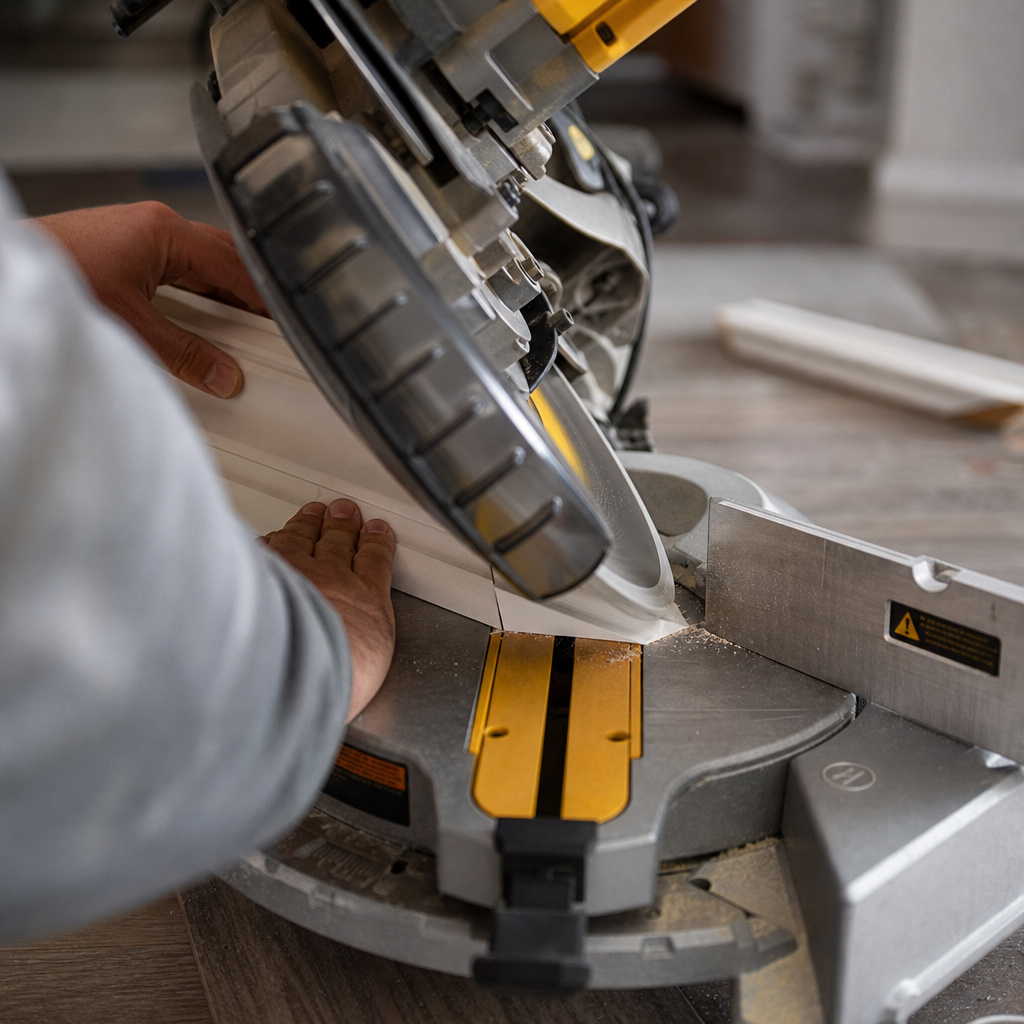
The tool’s design makes it ideal for certain tasks and a poor fit for others. Let’s be specific.
Where a Single Bevel Miter Saw Excels:
- Picture Frames and Basic Boxes: All cuts are simple miters (no bevels) or bevels in the same direction. The saw’s precision is the only requirement.
- Straightforward Trim: Baseboards, window casings, and door trim where corners are simple 90-degree miters or coped joints. Even when a slight back-bevel is needed for coping, you only tilt the blade one way.
- Framing and Decking: Cutting 2x4s, 2x6s, and deck boards to length, often with a square (90-degree) cut. The bevel function is rarely used here; you’re buying a portable, powerful chop saw.
- Projects with Consistent Bevels: If you’re making a series of shelves with a 15-degree bevel on the front edge only, you set the saw once and cut all day.
Where It Becomes a Hindrance:
- Complex Crown Molding: This is the classic example. Crown molding sits at an angle between the wall and ceiling, requiring a compound cut, both a miter and a bevel. To cut the left-hand and right-hand pieces for a corner, the bevels are mirror images. With a single bevel saw, you must flip the long, awkward molding stock for the second cut. It’s tedious and error-prone.
- Any Project with Frequent Opposite Bevels: Hexagonal planter boxes, multi-faceted lamp bases, or decorative wall panels with alternating bevels will have you flipping stock constantly. The project time can double.
- Production Work: If you’re making ten identical window frames, the cumulative time spent flipping and re-measuring becomes significant. A dual bevel saw pays for itself in saved labor.
The gap is in the handling, not the cutting. The saw makes a perfect cut every time. The inefficiency is in the human movement required between perfect cuts. For a DIYer doing one room of baseboard, that’s fine. For a contractor doing a whole house, it’s wasted profit.
How to Get Accurate Cuts Every Time
Precision isn’t magic. It’s a short checklist of setup and habit. The saw can only be as accurate as you make it.
Before Your First Cut:
- Square the Saw: Out of the box, the blade is probably not perfectly perpendicular to the table and fence. Use a reliable combination square or a dedicated miter saw calibration square. Check it at 0 degrees miter and 0 degrees bevel. Adjust the stops according to the manual. Do this twice a year.
- Use a Sharp, Appropriate Blade: The stock blade is usually mediocre. Invest in a high-tooth-count finishing blade (60-tooth or more) for trim and a general-purpose 40-tooth blade for framing. A dull blade tears wood and forces you to push, deflecting the cut.
- Clamp Everything: Your hand is not a clamp. Even a slight shift during the cut ruins the angle. A quick-action bar clamp mounted to the saw’s table is the best ten dollars you’ll spend.
The Cutting Sequence:
- Measure and Mark Clearly: Use a sharp pencil or a knife mark for critical joints. Mark the waste side of your cut line, the side that will become sawdust.
- Set the Angles in Order: Set your miter angle first and lock it. Then set your bevel angle and lock it. Trying to set a bevel with the miter unlocked can throw off the miter setting.
- Test on Scrap: Always make your first cut on a piece of scrap of the same thickness. Check the angle with your square. This catches errors before they hit your good material.
- Make the Cut: Hold the workpiece firmly against the fence with the clamp. Start the saw, let it reach full speed, then lower the blade smoothly and steadily through the wood. Let the blade stop completely before lifting it back up.
- Flip for the Match: If you need the mirrored bevel, this is the critical step. Flip the workpiece end-for-end, not face-for-face. Re-clamp, ensuring your measurement is now taken from the opposite end. Double-check the orientation before pulling the trigger. This is where 80% of single-bevel mistakes happen.
I once rushed a batch of six picture frames, all with 30-degree bevels on the inside edges. I cut the first four sides perfectly. On the fifth, my mind was on the next project. I flipped the board but didn’t re-clamp it tightly against the fence. The cut was off by maybe two degrees. It looked fine until I tried to assemble the frame. The gap was hairline but obvious across the glossy maple. I had to recut two new pieces from fresh stock. The lesson was physical: your hands must follow the ritual even when your brain checks out. Now I touch the clamp lever and the fence with two fingers before every cut, a forced habit.
Essential Accessories for the Single Bevel User
The right accessories don’t change the saw’s limitation, but they make working within it safer, faster, and more accurate. These are force multipliers.
- Digital Angle Gauge: This is the single biggest accuracy upgrade. Stick the magnetic base to your saw’s blade (power off!), zero it on the table, and then tilt the bevel. You’ll get a digital readout to 0.1 degrees, bypassing the often-imprecise stamped metal scale on the saw. It removes guesswork.
- Long Material Supports: Flipping an eight-foot piece of trim is dangerous if the unsupported end is flopping on the floor. A set of collapsible roller stands or even a simple DIY support table at the same height as your saw table is essential.
- Zero-Clearance Insert: The gap around the blade in the saw’s throat plate can cause thin trim or delicate molding to chip and splinter. A zero-clearance insert, which you can buy or make from hardboard, supports the wood fibers right up to the blade edge for cleaner cuts.
- Dedicated Sharp Blades: Have at least two: a high-tooth-count finish blade (like a Freud Diablo 80-tooth) for trim and a general-purpose blade for lumber. Label them. A sharp blade produces less heat and vibration, which helps keep your bevel and miter locks from creeping.
- Good Clamps: The clamp that comes with the saw is often an afterthought. Replace it with a sturdy, quick-release F-style clamp or a dedicated miter saw clamp that mounts permanently. Your hands should be nowhere near the blade during the cut.
You can manage without these, but you’ll be fighting the tool. The digital gauge alone saves more time on setup than any other accessory, especially when you’re constantly switching between bevel angles and need to trust the setting absolutely.
Who Should Buy a Single Bevel Miter Saw?
This tool isn’t for everyone, but it’s perfect for a specific user profile. It’s a strategic choice, not just a cheap one.
Buy a Single Bevel Miter Saw If:
- You’re a homeowner or new DIYer tackling occasional projects like shelves, basic trim, or simple furniture.
- Your primary need is a precise, portable saw for cutting lumber to length (a “chop saw plus”).
- Your budget is tight, and you’d rather spend the price difference on a better blade, a good stand, and clamps.
- Your workshop space is limited, and the lighter weight and smaller footprint matter.
- You value mechanical simplicity and lower long-term maintenance.
Skip It and Consider a Dual Bevel If:
- You plan to install crown molding, wainscoting, or any complex interior trim as a primary project.
- You do repetitive production work where time-per-cut directly impacts your productivity.
- You find the idea of constantly flipping and re-measuring long boards fundamentally annoying.
- Your projects frequently involve compound angles with mirrored bevels.
For context, choosing the right miter saw size is a related and critical decision. A 10-inch single bevel saw is a fantastic starter tool. A model like the Ryobi TSS103R offers a solid balance of price and performance for a weekend warrior.
It will handle 90% of what you throw at it. The other 10% will just take you a bit longer and require more focus. That’s the honest trade.
Frequently Asked Questions
Can a single bevel miter saw cut crown molding?
Yes, it can. The process just involves more steps. You’ll have to flip the crown molding stock to cut the mirrored bevel for the opposite side of a corner. It requires careful marking and handling, but it’s absolutely doable for a one-off room. For whole-house crown installation, the flipping becomes a significant slowdown.
Is a single bevel miter saw good for beginners?
Generally, yes. It has fewer controls to learn and calibrate than a dual bevel model, which reduces initial complexity. The lower cost also lowers the barrier to entry. The need to flip workpieces does add a learning step, but it reinforces careful measurement and setup, valuable habits for any woodworker.
What’s the main disadvantage of a single bevel saw?
The singular disadvantage is workflow interruption. The inability to tilt the blade to the right means you cannot cut matching left and right bevels without physically repositioning the workpiece. This increases handling time, measurement complexity, and the potential for errors on projects requiring paired bevel cuts.
Can you convert a single bevel miter saw to dual bevel?
No. The dual bevel function requires a different internal hinge mechanism and structural support in the saw’s arm and base. It is a fundamental design difference that cannot be added or modified after purchase. You must buy a saw designed as dual bevel from the start.
Which brands make reliable single bevel miter saws?
DeWalt, Makita, and Metabo HPT are known for durable, accurate contractor-grade saws in both single and dual bevel configurations. For budget-conscious DIYers, Ryobi and Skil offer capable single bevel models that are well-reviewed for home shop use. Always prioritize a model with a good fence system and a solid bevel lock.
The Bottom Line
A single bevel miter saw is a capable, precise tool with one deliberate limitation. It forces a specific, methodical workflow. For cutting lumber to length, building simple frames, or installing basic trim, it’s often the most rational choice, lighter on your wallet, your bench, and your back.
The moment your projects demand efficiency in cutting mirrored angles, that limitation becomes the loudest part of the job. Understand that trade-off before you buy. For most people in their first few years of DIY, starting with a solid 10-inch single bevel model is the right move. You’ll learn what you really need, and when the day comes that you’re sick of flipping crown molding, you’ll know exactly why you’re upgrading.
