
How to Hang a Shelf Without a Drill | Easy No-Tool Methods
This post contains affiliate links. As an Amazon Associate, we earn from qualifying purchases.
Hang a shelf without a drill by matching three things: your shelf’s weight, your wall’s material, and the correct no-drill fastener. For a 5-pound decorative shelf, use adhesive strips. For 10 to 60 pounds, use a construction adhesive like Bostik No More Nails applied in a continuous 4–6mm bead. For 60 to 80 pounds on a hollow wall, use a shelf clip system installed with a 3/16-inch toggle bolt.
That weight-to-fastener match is the whole game. Get it wrong and the shelf drops, sometimes in an hour, sometimes in six months when humidity hits.
What follows breaks down the three proven no-drill methods, with the exact load numbers from manufacturer spec sheets, the timelines each adhesive needs to cure, and the wall conditions that void every guarantee.
Key Takeaways
- Adhesive strips fail first in humid rooms; the bond weakens as moisture penetrates the adhesive layer over weeks.
- Construction adhesives need a full 72 hours to reach maximum strength on a cool, dry wall; loading the shelf at 24 hours can shear the bond.
- A shelf clip system mounted with a toggle bolt on a hollow wall holds 60 pounds, but you must find the wall’s studs to hit the 80-pound rating.
- Never use a no-drill method on a shelf made of solid oak or steel; the fastener will fail before the shelf even feels loaded.
- For a rental, adhesive strips are removable; construction glue and toggle bolts are permanent and will damage the wall upon removal.
The Real Load Numbers Your Hardware Store Doesn’t Print
You see “holds up to 20 pounds” on a package. That number is a best-case scenario on a perfect, cool, dry sheetrock wall. Real walls have texture, old paint, and humidity.
The published specs from shelf and fastener manufacturers tell a more specific story. A Knape & Vogt 24-inch floating shelf is rated for 50 pounds, but only when its backplate is screwed directly into wall studs. Their 36-inch model drops to 30 pounds on studs. Use drywall anchors and those numbers fall again.
A C.R. Laurence 88SC shelf clip holds 80 pounds when screwed into a stud with a pre-drilled 1/8-inch hole. On a hollow wall with a 3/16-inch toggle bolt, the capacity drops to 60 pounds. The clip itself doesn’t change; the wall’s holding power does.
Your shelf’s weight includes everything you put on it. A 5-pound shelf holding 10 pounds of books is a 15-pound load. Choose your fastener for the total weight, not the shelf’s empty weight.
| Fastener Type | Best For Total Load | Wall Type | Permanence |
|---|---|---|---|
| Adhesive Strips | 5–16 lbs | Dry, painted drywall | Removable |
| Construction Adhesive | 10–60+ lbs | Most interior surfaces | Permanent/Destructive |
| Shelf Clip + Toggle Bolt | 60–80 lbs | Hollow drywall or stud | Permanent/Destructive |
The 3-Step Process for Adhesive Strips
Adhesive strips, like Command Strips, are hook-and-loop pads with sticky backs. They work through surface adhesion, not penetration. That’s their strength for rentals and their weakness for heavy loads.
First, clean the wall and the back of the shelf with isopropyl alcohol. Any dust or grease breaks the bond at a molecular level. Let both surfaces dry for five full minutes.
Second, press the strips’ Velcro sides together to make pairs. Remove one liner and stick the pair to your shelf. Follow the package spacing, usually one near each end and one in the middle for a 3-foot shelf. Remove the remaining liners.
Common mistake: Not pushing the strip firmly into the wall for 30 seconds. Handyman Jason Phillip notes that a partial bond pulls away from the wall under load, starting a slow peel that finishes at 2 a.m. With a crash.
Third, press the shelf onto the wall, align it, and hold it firmly for 30 seconds. Separate the strips so one side stays on the wall and the other on the shelf. Wait one hour before re-attaching the shelf to the wall-mounted strips. This wait lets the adhesive’s initial grab strengthen.
Only place light, durable objects on the shelf. This is for photos, small trinkets, or a single lightweight speaker. It is not for books, kitchen canisters, or tools.
Where Adhesive Strips Fail (And It’s Not Weight)
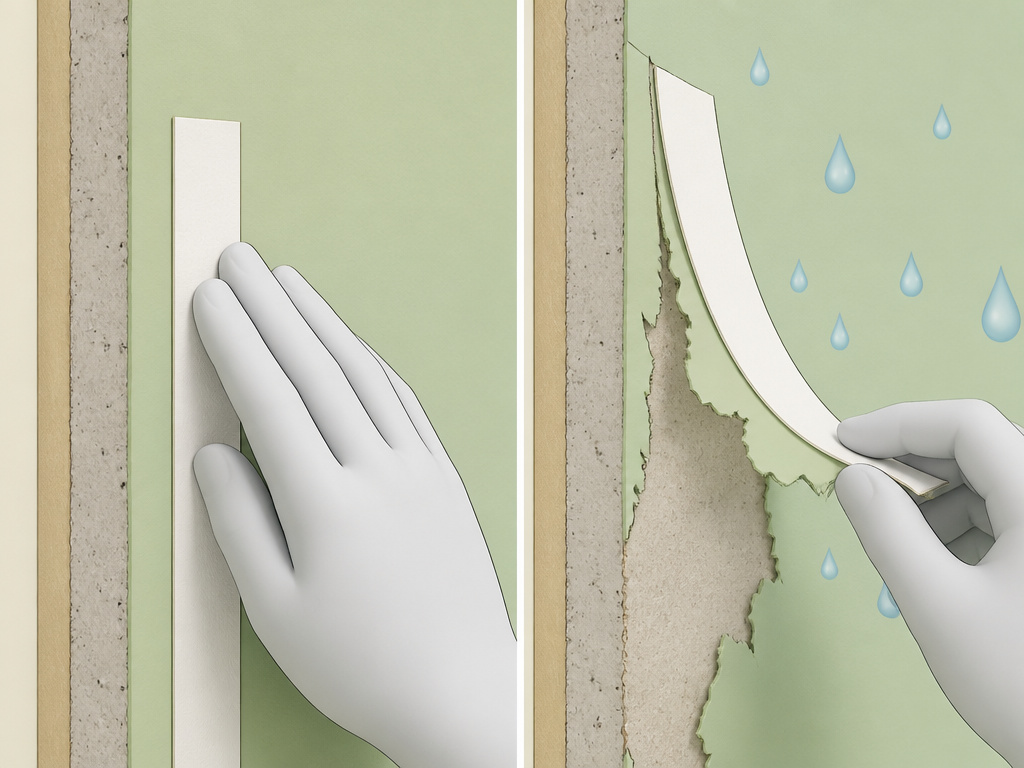 Weight gets the blame, but environment kills more strip-mounted shelves. The manufacturer’s weight rating assumes a clean, climate-controlled room.
In a bathroom or kitchen, humidity is the enemy. Moisture in the air slowly migrates into the adhesive layer. It plasticizes the glue, making it softer and less able to hold. The shelf doesn’t fall on day one. It starts to sag after a few weeks of showers, then pulls free one night.
A wall with loose or flaking paint is another failure point. The strip bonds tightly to the paint, but the paint’s bond to the drywall is weaker. When load is applied, the paint layer shears off the wall, taking your shelf with it. You must scrape and sand any flaky spots before sticking anything.
If you need to hang something heavier than a few pounds in a humid room, skip the strips. Move to a method that doesn’t rely on surface adhesion alone.
The Heavy-Duty Option: Construction Adhesive
 For shelves between 10 and 60 pounds, a multi-purpose construction adhesive like Bostik No More Nails is the default. This is a synthetic rubber-based glue that cures into a flexible, water-resistant bond. It sticks to wood, drywall, plaster, and even tile.
The process is deceptively simple, which is why people mess it up. Clean the wall and shelf back thoroughly, sand any glossy paint to give the glue tooth. The wall surface temperature should be between 50°F and 85°F for proper curing.
Apply a continuous 4–6mm bead of adhesive along the back of the shelf. Keep each bead no more than 45cm apart. Do not apply globs or zigzags; an even bead spreads pressure and cures uniformly.
Press the shelf firmly against the wall, then pull it away for 3 to 5 minutes. This “open time” lets solvents flash off and the adhesive become tacky. Then press the shelf back into position for good, applying even pressure across its entire back.
You must support the shelf while the glue cures. Use painter’s tape and a prop like a stack of books underneath. This is non-negotiable. The bond reaches handling strength in about 12 hours, but full maximum strength takes between 12 and 72 hours depending on temperature and glue thickness.
Do not place anything on the shelf for at least 24 hours. Loading it early can cause the shelf to slide down the wall or create a weak, sheared bond that fails later. This adhesive creates a permanent, destructive bond. Removing the shelf will rip the drywall paper or plaster face off the wall.
Shelf Clip Systems: The Hidden No-Drill Heavyweight
When you need to hold more than a construction adhesive can reliably manage, a shelf clip system is the answer. Brands like EZ Shelf or C.R. Laurence make metal brackets and clips that mount to the wall, and the shelf simply slides or snaps onto them. The trick is mounting the hardware without a drill.
For hollow drywall, you use a toggle bolt. The C.R. Laurence 88SC clip instructions specify a 3/16-inch x 3-inch toggle bolt for a 60-pound capacity. You hand-drive a screwdriver or use an awl to make a pilot hole in the drywall, then insert the toggle bolt through the clip and into the wall. As you tighten, the toggle flips behind the drywall and pulls the clip tight.
If you happen to hit a wood stud behind the drywall, your capacity jumps to 80 pounds. You can drive a screw directly into the stud through the clip’s hole. Finding a stud without a drill means using a stud finder or tapping the wall to listen for a solid sound.
These systems are fantastic for modular shelving in garages or closets. The shelf thickness is critical, the 88SC clips come set for 5/8-inch to 3/4-inch shelves. A thinner shelf requires inserting a small plastic tab so the clip grips it tightly. Forget the tab and the shelf wobbles.
The short version: For hollow walls, a toggle bolt and clip holds 60 pounds. For studs, a screw holds 80. It’s the strongest no-drill method you can buy, but it’s as permanent as drilling a hole.
The One Wall Type That Breaks Every Rule
Most no-drill methods assume you’re working on standard drywall or plaster. Concrete, brick, and cinder block walls change the equation entirely.
You cannot use adhesive strips or construction adhesive on bare, porous masonry. The surface absorbs the adhesive, preventing a proper bond. Painting the masonry helps, but the fundamental roughness still compromises strength.
For concrete, your only real no-drill option is a heavy-duty adhesive like a two-part epoxy rated for masonry. Even then, the weight capacity is a fraction of what it would be on drywall. The EZ Shelf instructions state concrete walls require a pilot hole and concrete anchors, which, of course, requires a drill.
If your wall is masonry and you absolutely cannot drill, your shelf will be light-duty and decorative. Plan accordingly, and double-check the adhesive’s specifications for concrete bonding.
Frequently Asked Questions
Can you hang a shelf with just glue?
Yes, a construction adhesive like Bostik No More Nails can hang a shelf. It must be applied in a continuous 4–6mm bead across the shelf’s back, and the shelf needs support while the glue cures for 24-72 hours. This method is permanent and will damage the wall upon removal.
How much weight can Command Strips hold on a shelf?
Command Strips and similar adhesive strips can hold a shelf with a total load of 5 to 16 pounds, depending on the number and size of strips used. This weight includes the shelf itself and anything you place on it. Exceeding this limit or using them in humid environments leads to failure.
What is the strongest way to hang a shelf without drilling?
The strongest no-drill method is a metal shelf clip system installed with a toggle bolt on hollow drywall, rated for 60 pounds. If the clip’s mounting screw hits a wooden wall stud, the capacity increases to 80 pounds. This is a permanent installation.
How long does no-drill adhesive take to dry?
Construction adhesive reaches handling strength in about 12 hours, but it needs a full 24 hours before you can lightly load the shelf. Maximum bond strength is achieved between 12 and 72 hours after application, depending on room temperature and adhesive thickness.
Will no more nails damage the wall?
Yes, Bostik No More Nails and similar construction adhesives create a destructive bond. Removing the shelf will almost certainly tear the drywall paper or the surface layer of plaster off the wall, requiring repair.
Before You Go
Pick your method by the total weight first. For picture frames and light decor, adhesive strips work if the wall is dry. For books and kitchen items, construction adhesive is the default, just wait the full 72 hours. For garage storage or heavy displays, get a shelf clip and a pack of 3/16-inch toggle bolts.
Ignore the “up to” marketing. Trust the OEM load ratings that specify wall type. And never skip the surface prep. A clean, solid wall is the only foundation a no-drill shelf has.
