
How to Drill a Hole in a Rock | A Complete DIY & Pro Guide
This post contains affiliate links. As an Amazon Associate, we earn from qualifying purchases.
To drill a hole in a rock, you control three interdependent parameters: Rate of Penetration (ROP), Weight on Bit (WOB), and water flow. The goal is to find the optimum ROP for your specific rock and bit, which balances speed with bit life. This is achieved by adjusting WOB and rotation speed while maintaining a water flow high enough to cool the bit and clear cuttings, but not so high it polishes the diamonds in hard rock.
That optimum point is where the bit self-sharpens. The matrix wears at a controlled rate, exposing fresh diamonds to keep cutting. Stray from it and you either burn through bits or stall completely.
What follows is the operational framework used in mineral exploration, adapted for the serious DIYer. We’ll cover the two main methods, diamond core drilling for precise samples and top hammer percussion for speed, along with the critical specs, common failure modes, and the one adjustment that saves a polished bit.
Key Takeaways
- The published Mohs hardness of your rock dictates the diamond bit matrix you need; a scratch test with a pocket knife (hardness ~6.5) gives a field estimate.
- Start a new diamond bit several centimeters above the bottom and spin it in without weight; going to full pressure immediately glazes the cutting face.
- In very hard, competent rock, reduce water flow to enable cutting and prevent polishing; in soft or fractured rock, use maximum flow to clear debris and cool the bit.
- Rod joints must be pre-loaded manually with the correct wrench; they will not tighten themselves during drilling, and a loose joint destroys threads and causes deviation.
- For a broken drill bit stuck in a hole, stop rotation, use a left-handed drill bit or an extraction tool, and apply steady backward pressure, never hammer or jerk.
The Three Drilling Parameters You Control
Drilling rock isn’t about forcing a tool through it. It’s about managing a balance between three variables. Get one wrong and the whole process fails.
ROP, WOB, and water flow are your direct levers. The ROP is the key parameter, once you find the optimum speed for your rock and bit, you maintain it by adjusting the WOB and RPM. A high water flow across the bit face should always be maintained at high rates of penetration. (Epiroc Diamond Driller’s Technical Book)
Rate of Penetration (ROP) is your speedometer, measured in inches per minute or meters per hour. It’s not a target to maximize blindly. The bit manufacturer provides a recommended starting ROP on the label. Your job is to find the optimum ROP, where the bit wears evenly and stays sharp. An excessive ROP burns the matrix away too fast, throwing out sharp diamonds and killing bit economy. Too slow, and the bit can polish and stop cutting altogether.
Weight on Bit (WOB) is the downforce. It’s the adjustment you make to hold your target ROP as rock conditions change. The Epiroc manual provides a crucial maximum WOB table to prevent mechanical failure:
| Bit Size | Max WOB |
|---|---|
| AQ / AWL | 22 kN (≈ 5,000 lbf) |
| BQ / BWL | 30 kN (≈ 6,400 lbf) |
| NQ / NWL | 40 kN (≈ 9,000 lbf) |
| HQ / HWL | 50 kN (≈ 11,000 lbf) |
| PQ / PWL | 60 kN (≈ 13,500 lbf) |
Exceed these limits and you risk bit damage, hole deviation, or broken rods. The rule is simple: if ROP falls, increase WOB slightly. If ROP spikes, decrease it.
Water flow cools the bit and flushes cuttings. The general rule is “as high as possible,” but it has a critical, counterintuitive exception straight from the OEM guide.
The Water-Flow Exception That Saves Your Bit
In soft or fractured rock, you need high flow to clear the hole fast. But in very hard and competent rock, where penetration speed is low, the water flow must be reduced. Why? Excessive water in a slow-moving hole cools the bit so effectively that the diamonds polish against the rock instead of cutting it. The matrix doesn’t wear, no new diamonds are exposed, and the bit simply stops penetrating.
The Epiroc Guide to Diamond Tools provides a chart, but the principle is what matters: match flow to cutting speed. High speed needs high flow; low speed needs restrained flow.
Choosing Your Method: Core Sample or Blast Hole?
Your goal dictates your tools. The two professional pathways are diamond core drilling and top hammer percussion.
Diamond Core Drilling (For Core Samples)
This method uses a hollow, diamond-impregnated bit to cut a cylindrical core. It’s for mineral exploration, geotechnical surveys, or any job where you need to see the intact rock layers. The system is defined by standardized sizes.
The “Q” series (AQ, BQ, NQ, HQ, PQ) is the global standard for exploration. The letter defines the hole and core diameter. According to the TU Freiberg overview, an NQ bit produces a 75.7 mm (2.98 in) hole and retrieves a 47.6 mm (1.87 in) core. You choose the size based on the core sample you need and the depth you’re drilling, smaller rods for deeper holes.
The bit matrix is graded by hardness. You match it to your rock using the Mohs scale. A scratch test with a pocket knife (hardness ~6.5) tells you if the rock is harder or softer than the blade. Softer rock needs a harder matrix (lower number) to resist abrasion; harder rock needs a softer matrix (higher number) to wear and expose diamonds. Brands like Epiroc offer series like HERO or T-Xtreme for different conditions.
Top Hammer Percussion (For Speed & Volume)
This is for making holes fast, typically for blasting, anchoring, or demolition. A pneumatic or hydraulic hammer delivers thousands of impacts per minute to a solid button bit, crushing the rock. It’s brutally effective in hard formations where rotary drilling would stall.
Common mistake: Using standard air flushing in deep or abrasive holes. Beyond 15 meters, air can’t clear cuttings effectively, leading to bit binding and overheating. Switch to water flushing for cooling and dust control.
Operating parameters are a different world: 2,000–5,000 strikes per minute, 60–200 RPM rotation, and air pressure of at least 6 bar. The thread system (R32, T38, T45, T51) must match your hammer and your desired hole diameter.
Step-by-Step: Drilling a Core Hole
This sequence assumes a skid-mounted or trailer-based diamond drill rig. Missing a step costs you a bit or a rod.
1. Select and Inspect the Bit. Match the matrix to your rock hardness. Check the bit for damage and ensure the reaming shell (the ring above the bit that keeps the hole to gauge) is in good shape. A worn shell lets the bit wallow and oversize the hole.
2. Assemble the String with Pre-Loaded Joints. This is the step everyone rushes. Rod joints must be pre-loaded manually with adequate wrench sizes. The joint will not make itself up during normal drilling. Finger-tight is a guaranteed leak and a thread destroyer. Use the correct spanner and apply firm torque.
3. Start Circulation and Lower to Bottom. Start water flow before the bit touches anything. Lower the string until the bit is several centimeters above the hole bottom.
4. Break In the New Bit. Start a new bit several centimeters above the bottom and spin into the formation. Do not go to full ROP until you have drilled 10-20 centimeters (4-8 inches). This gentle break-in seats the bit and prevents immediate polishing. It’s in the manual because skipping it glazes the face on the first contact.
5. Find and Hold Optimum ROP. Start with the manufacturer’s recommended RPM and WOB. Monitor ROP. Adjust WOB in small increments to find the speed where the bit sounds consistent and cuttings are uniform. Lock in that ROP and use WOB to maintain it as you drill.
6. Respond to Changes. If ROP drops and increasing WOB doesn’t help, you may have hit a harder layer or the bit may be polishing. If vibration starts, stop. Vibration shatters core and damages equipment.
What To Do When the Bit Stops Cutting (Sharpening In-Hole)
A polished bit hasn’t failed; it’s dormant. The diamonds are worn flat but still embedded. You can sharpen it in the hole.
To sharpen the bit, momentarily increase the WOB by 15 to 20 percent, while at the same time reducing the water flow to near the minimum indicated on the bit label. (Epiroc Diamond Driller’s Technical Book)
This duo of actions forces the bit matrix to abrade against the rock. The reduced water flow allows heat to build, softening the matrix slightly. The increased pressure grinds it away. The moment the bit starts cutting again, you’ll feel and hear it, immediately revert to normal parameters. You’ve just saved a bit and hours of tripping time.
A DIY Approach for Smaller Projects
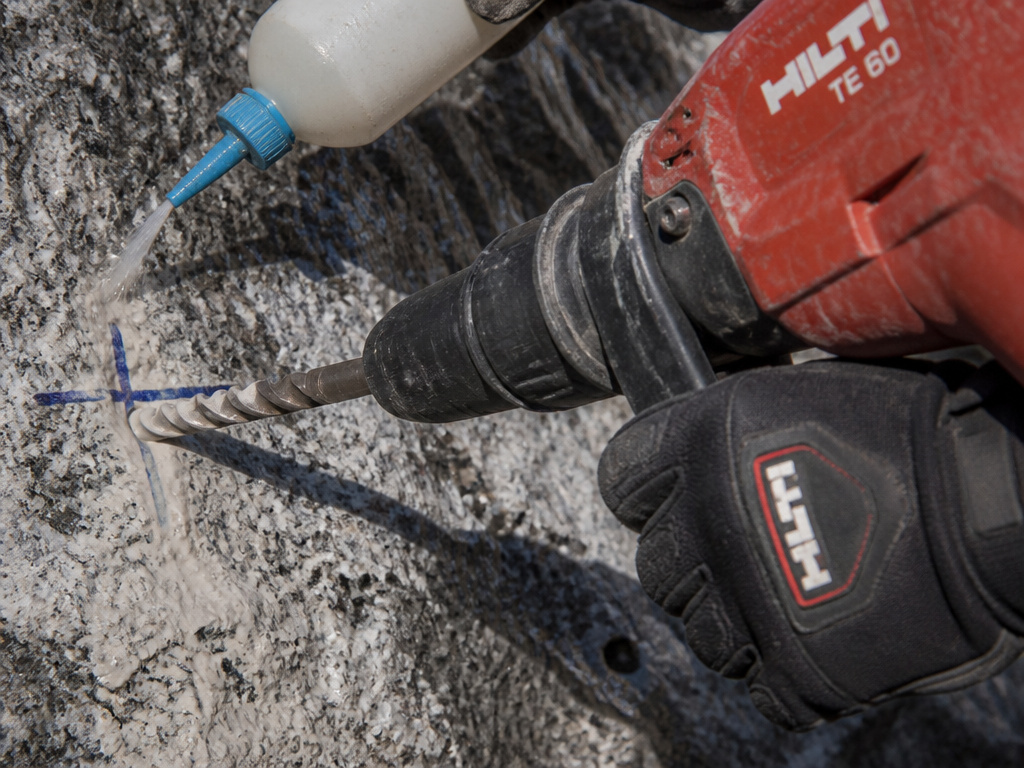 You’re not drilling a 300-meter mineral hole. You need an anchor hole in a boulder or a drainage hole through a ledge. The principles scale down.
Tool Choice: A heavy-duty rotary hammer drill (SDS-Max or Spline) is the minimum for holes up to about 1 inch in diameter in moderate rock. For anything larger or harder, a dedicated rock drill (like an Epiroc or Sandvik pneumatic jackleg) or a core drill with a diamond hole saw is required. For drilling granite or other hard stone, a diamond-tipped hole saw and a drill press with water feed is often the only way.
Bit Choice: Use a solid carbide masonry bit for small, shallow holes. For holes larger than 1/2 inch or in very hard rock, a diamond hole saw is the only tool that will last. Always use water as a coolant, a spray bottle or a helper with a hose, to suppress dust and prevent bit death.
Technique: Mark your spot. Start at a low speed with very light pressure to create a pilot dimple. Increase speed and apply steady, firm pressure. Let the tool do the work; don’t lean on it. Back the bit out frequently to clear cuttings. If you hit a sudden stop, you may have encountered a seam of harder mineral or a fractured zone. Try a fresh bit or consider moving the hole.
Problem → Cause → Fix
 Drilling rarely goes perfectly. Here’s how to diagnose the common issues.
| Problem | Likely Cause | Immediate Fix |
|---|---|---|
| ROP suddenly drops, bit sounds smooth | Bit polish in hard rock | Sharpen in-hole: Increase WOB 15-20%, reduce water flow momentarily. |
| Water isn’t returning to surface | Rod joint leak or blocked bit waterways | Stop. Check and tighten all joints. Clear bit face. |
| Severe vibration, erratic ROP | Core barrel jam or broken inner tube | Pull the string. Inspect and replace the core barrel. |
| Hole deviation, bent rods | Excessive WOB or drilling in fractured zone | Reduce WOB. Use a stabilizer in the string. |
| Broken drill bit stuck in hole | Bit jammed in fracture, then snapped | Stop rotation. Use a left-handed drill bit or extraction tool. |
A broken drill bit is a specific headache. Forcing it or hammering on it usually makes it worse. The best method is to switch to a left-handed drill bit and slow reverse; sometimes it will catch and back the remnant out. Failing that, a dedicated screw extractor sized for the bit shank is the next step.
Frequently Asked Questions
Can I use my regular drill to drill into rock?
For very soft rock like sandstone or shale, a powerful hammer drill with a good masonry bit might make a shallow hole. For any hard rock (granite, basalt, quartzite) or for holes deeper than an inch, no. You need a rotary hammer (SDS-Plus or SDS-Max) at a minimum, and likely a dedicated rock drill or core rig.
How do I know what kind of rock I’m drilling?
Perform a scratch test. Try to scratch it with your pocket knife (~6.5 Mohs). If it scratches easily, it’s softer than 6.5. If the knife skates and leaves a metal mark, it’s harder. For a more precise measure, use a dedicated Mohs hardness pick set. Also, look at the cuttings: sandy cuttings indicate abrasive, sedimentary rock; fine, glassy powder suggests hard, competent rock like chert or quartzite.
Why does my bit keep getting stuck?
The two main reasons are inadequate clearing of cuttings (too low water or air flow) and drilling into a fractured zone where rock pieces wedge around the bit. Increase flushing pressure and try to maintain a steady penetration rate. If you’re in known fractured ground, use a bit with a more open waterway configuration.
What’s the difference between drilling rock and drilling concrete?
Concrete is a composite, you’re drilling through aggregate (rock) held in a cement matrix. It’s generally more abrasive but less hard than solid rock. Drilling concrete often uses carbide-tipped hammer bits that crush and chip. Solid rock drilling, especially for core samples, relies on grinding and cutting with diamonds. The equipment and parameters are different.
How do I drill a hole in granite or quartz countertop material?
The process is a specialized subset of rock drilling. You must use a diamond hole saw (often in an electroplated style), constant water cooling, and a drill press or a very steady hand. The key is to prevent heat buildup, which delaminates the diamond coating. Start at an angle to create a groove, then slowly straighten the drill.
Before You Go
Drilling rock is a negotiation between force, speed, and cooling. The professional driller’s mantra is “find the optimum ROP and hold it.” That’s the difference between a productive hole and a costly pile of broken bits.
For the DIYer, that translates to choosing the right tool for the rock’s hardness, using plenty of coolant, and applying steady, never brutal, pressure. Whether you’re anchoring a retaining wall, sampling for a geology project, or installing a fountain, let the tool and the bit do the work. Your job is to read the signs and adjust.
