
8 Best Small Air Compressors of 2026
This post contains affiliate links. As an Amazon Associate, we earn from qualifying purchases.
The MZB 2.4 Gallon air compressor stands out as the best overall small air compressor for its strong CFM output and reliable performance across common tasks, while the California Air Tools 1 Gallon model is our top budget pick thanks to its ultra-quiet operation and solid build. For those who need dual power options, the AstroAI Dual Power unit offers unmatched versatility.
Most people shopping for a small air compressor want something that’s easy to move, simple to use, and actually works when you need it, whether you’re filling tires, running a finish nailer, or tackling small inflating jobs around the garage. Too many models either underperform, fail quickly, or are so loud they disturb the whole neighborhood.
This guide cuts through the noise. I researched the field, compared specs, and analyzed owner feedback to find compressors that deliver real-world reliability, balanced performance, and smart features, so you can pick one with confidence.
Top 8 Small Air Compressors in the Market
The Best Small Air Compressors, Reviewed
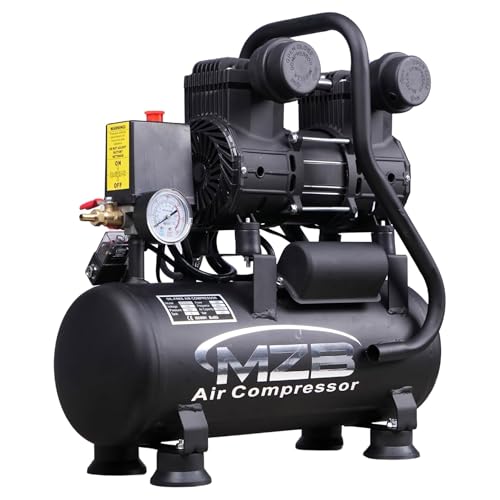
MZB 2.4 Gallon Ultra Quiet Air Compressor
Strengths
- High CFM output
- Fast recovery time
- Durable, rust-resistant build
Trade-offs
- Slightly louder than premium quiet models
- Heavier than compact units
- No pressure gauge backlight
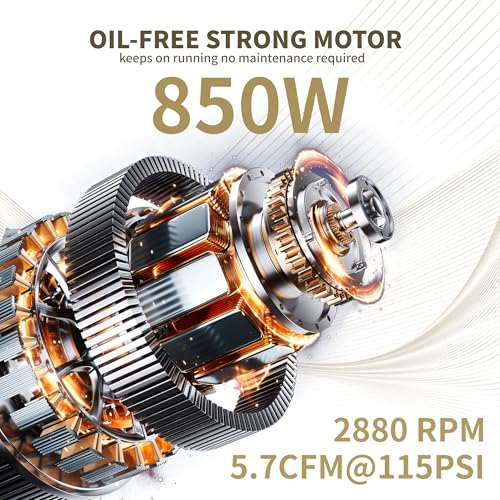
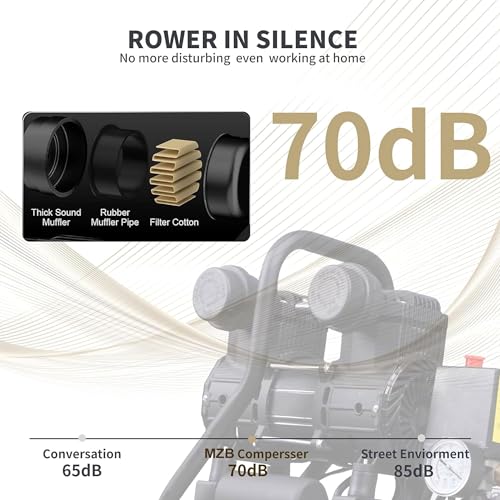
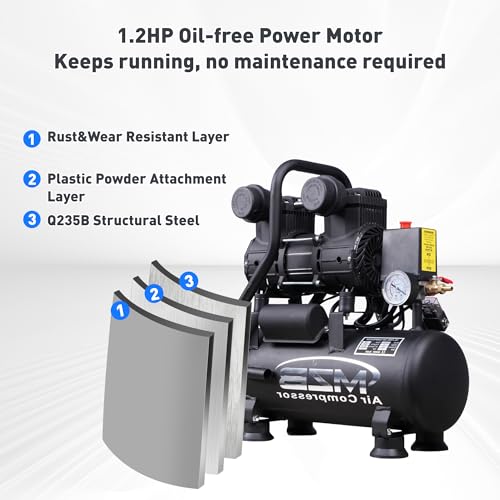
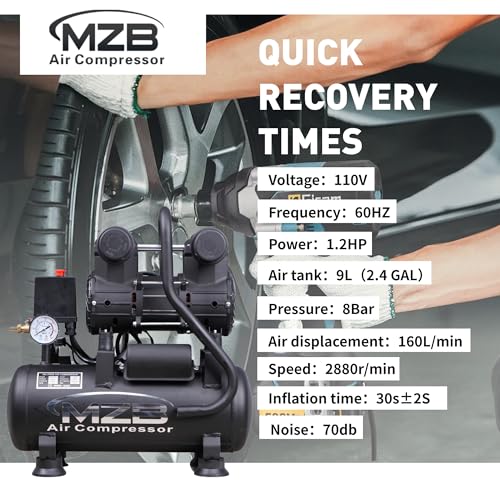
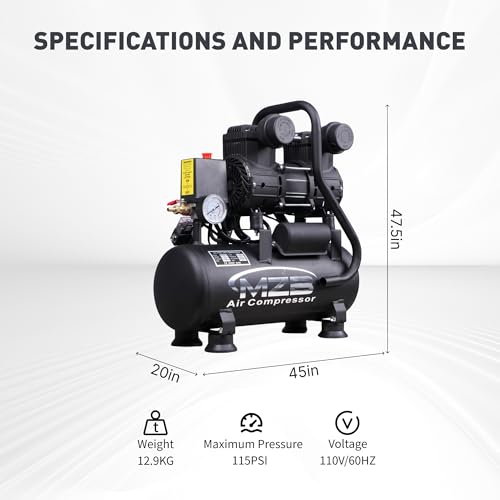
The MZB 2.4-gallon compressor makes a strong case as the most balanced all-around performer here. With 5.65 CFM @ 115 PSI and a robust 1.2 HP motor, it powers through spray painting, framing, and auto repair tasks without lag. The 70 dB noise level is quiet for its class, and the dual silencers plus dust-filtering design keep it running clean. Reviewers highlight how quickly it refills, under 30 seconds, which keeps workflow smooth.
It’s also built to last, with a three-layer anti-rust casing and seamless tank welding that minimize long-term failure risks. The wheels make it easy to move, and the oil-free motor means no maintenance. Compared to others, it’s not the quietest or the cheapest, but it hits the sweet spot between power, durability, and usability.
Product photos
California Air Tools 1 Gallon Ultra Quiet Compressor

Strengths
- Extremely quiet
- Oil-free maintenance-free pump
- Long motor life
Trade-offs
- Lower CFM output
- Not for heavy tools
- Slower recovery time
If noise is a dealbreaker, the California Air Tools CAT-1P1060S is the gold standard. At just 56 dBA, it’s quieter than a library whisper, perfect for indoor use, apartments, or early-morning projects where disturbing others isn’t an option. The oil-free pump and low-RPM motor (1680 RPM) aren’t just quiet, they’re built to last, with reviewer feedback suggesting minimal wear even after years of light-duty use.
It’s not the most powerful, 1.2 CFM @ 90 PSI limits it to smaller tools like brad nailers and airbrushes, but that’s by design. This isn’t a jobsite beast; it’s a precision tool for finish work, tire inflation, and cleaning. For woodworkers or DIYers with a home garage, the combination of quiet operation and clean air output makes it a top-tier choice.
Product photos


CRAFTSMAN 2 Gallon Portable Air Compressor
Strengths
- Lightweight and portable
- Good accessory kit
- Reliable brand
Trade-offs
- Low power output
- No CFM specs listed
- Not for continuous use
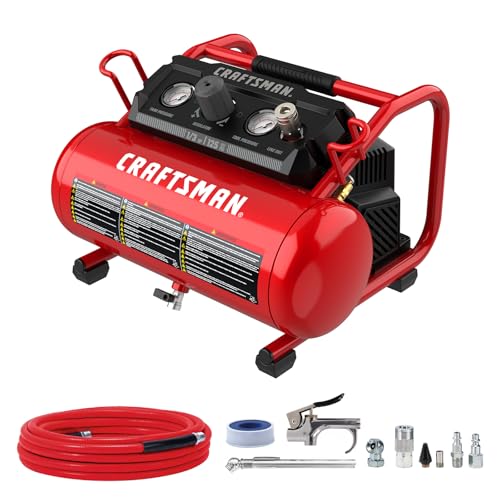
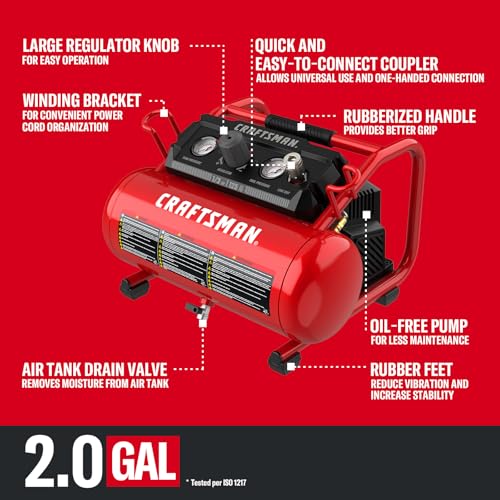
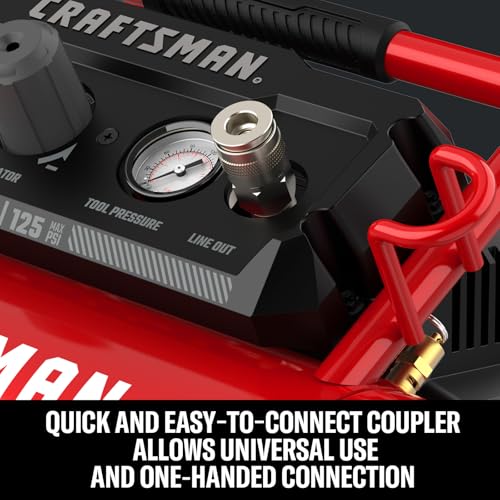
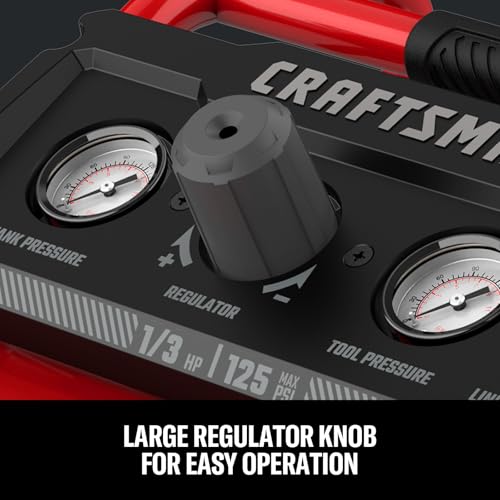
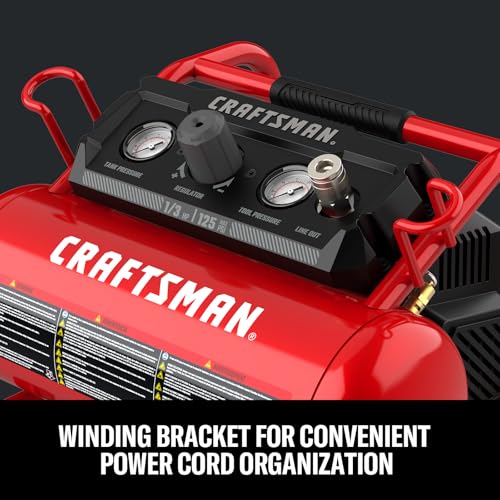
The CRAFTSMAN 2-gallon model is a textbook example of sensible budget engineering. At just 19 lbs with a comfortable handle, it’s one of the lightest in its class, and the included 10-piece accessory kit adds real value right out of the box. The 1/3 HP motor and 125 PSI max pressure are modest, but enough for tire inflation, light nailing, and occasional spray work. Owners appreciate the oil-free pump and solid heat dissipation, which help it last longer than expected for the price.
It won’t keep up with constant demand, and the CFM isn’t listed, always a red flag, but for occasional use, that’s forgivable. Where it wins is trust: the CRAFTSMAN name still carries weight, and the build feels sturdier than most budget compressors. If you’re equipping a starter garage without breaking the bank, this one checks the right boxes.
Product photos

VEVOR 2.1 Gallon Oil-Free Air Compressor

Strengths
- High CFM for price
- Dual-cylinder intake
- Durable tank construction
Trade-offs
- Louder than competitors
- Bulky footprint
- Basic gauge readability
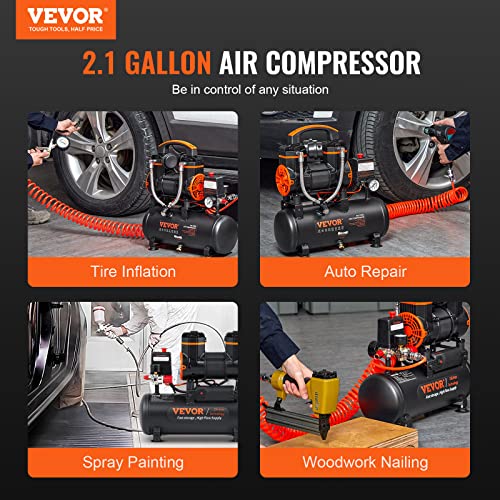
VEVOR packs serious specs into this 2.1-gallon unit, 2.2 CFM @ 90 PSI and a 1.2 HP motor mean it can handle impact wrenches, spray guns, and framing nailers without breaking a sweat. The dual-cylinder intake boosts airflow efficiency, and the reinforced tank construction inspires confidence in long-term durability. Owners using it for auto repair consistently report it keeps up with back-to-back tool use better than similarly priced models.
The noise level is higher than premium quiet models, and the build, while rugged, feels more industrial than refined. But for the price, it’s hard to beat. If you’re setting up a garage for real mechanical or woodworking work, this compressor delivers performance that punches above its weight class.
Product photos


AstroAI Dual Power Tire Inflator
Strengths
- Dual power sources
- Strong continuous runtime
- Effective cooling system
Trade-offs
- Heavier than cordless models
- No battery backup
- Bulkier design
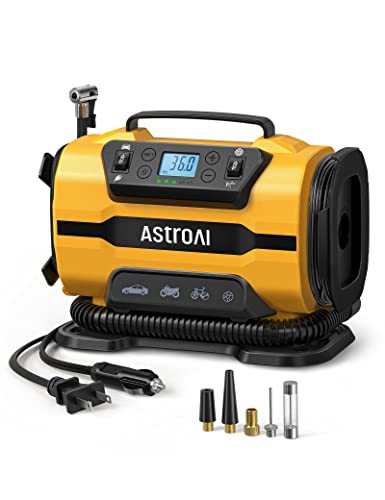
The AstroAI stands out in a crowded field because it does something most portable inflators don’t, it works both at home and on the road. With dual power compatibility (12V DC and 110V AC), it’s a rare hybrid that gives you flexibility without sacrificing performance. Its dual metal motors push up to 350 L/min in high-volume mode, and owners note it handles air mattresses and car tires with equal ease. The OmniVent cooling system also helps it run longer than budget models that overheat after a few minutes.
It’s a bit bulkier than ultra-compact options, but the trade-off is real durability and sustained performance. The LED light and pressure memory function add convenience, and the build feels solid. For someone who wants one inflator for garage, camping, and emergency roadside use, this is a smarter pick than single-power units.
Product photos


OlarHike Cordless Tire Inflator
Strengths
- Strong battery life
- True cordless operation
- USB power bank feature
Trade-offs
- Max 51 PSI limit
- Battery takes 3+ hours to charge
- Plastic housing feels light
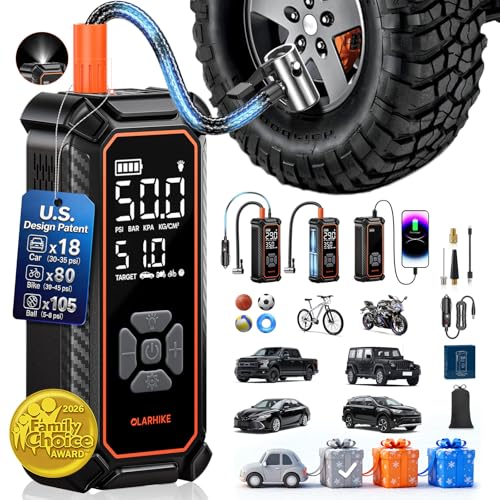
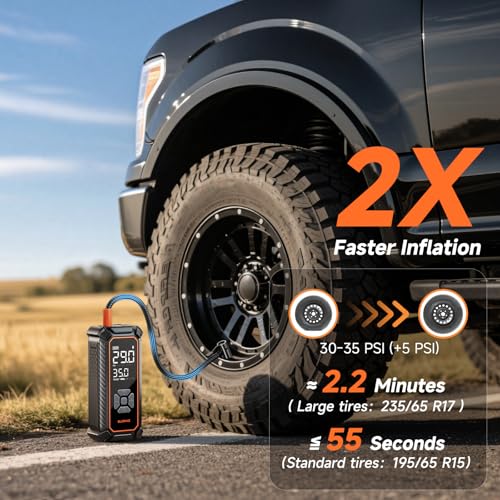
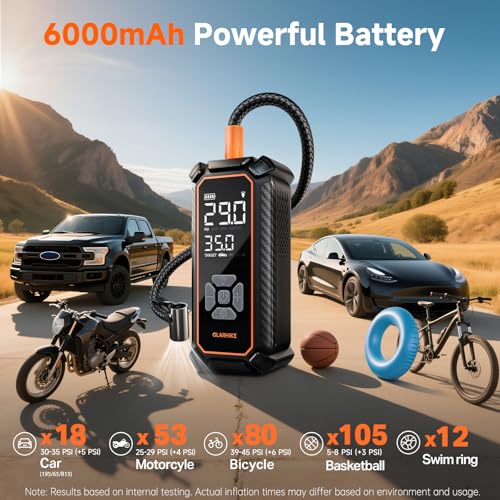
The OlarHike is the rare portable inflator that truly works off-grid. With a 6000mAh battery, it can top off nearly two dozen car tires on a single charge, owners confirm this in real-world use, and the ability to recharge your phone via USB is a thoughtful bonus. The cordless freedom makes it perfect for SUVs, RVs, or mountain bikers heading deep into the trail. Inflation speed is impressive too, with most reporting a 55-second fill from 30 to 35 PSI on standard tires.
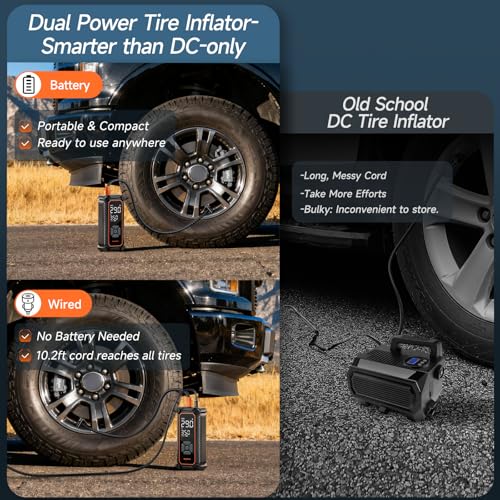
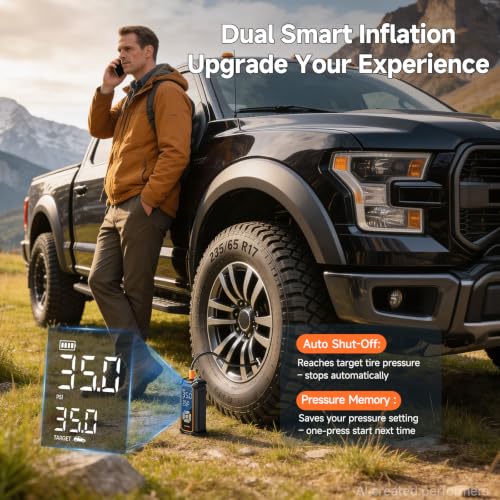
Its dual power mode (battery or 12V DC) adds backup flexibility, and the large digital display with auto shutoff prevents over-inflation. The only real limitation is the 51 PSI max, fine for most vehicles but not for high-pressure applications. For pure portability and independence from car power, this is the one to beat.
Product photos
ROCGORLD R8 Fast Inflation Tire Inflator
Strengths
- Fast inflation
- Dual digital display
- Compact design
Trade-offs
- DC power only
- No built-in battery
- Short hose
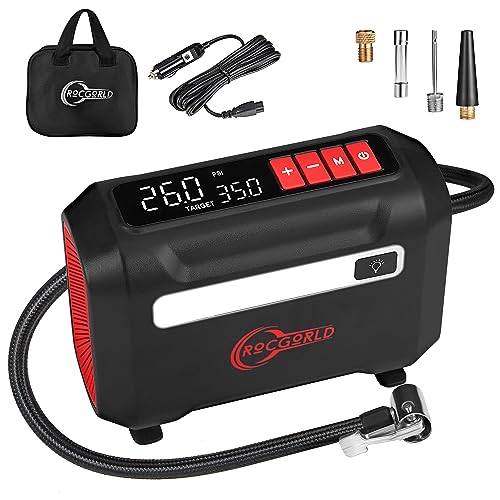
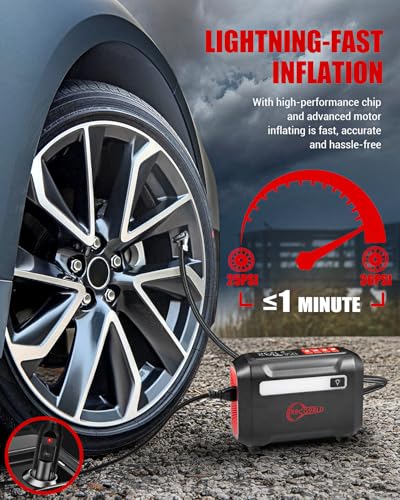
The ROCGORLD R8 is built for speed, and on paper, it delivers. With a claimed 40L/min airflow, owners consistently report inflation times under a minute for standard car tires, making it one of the fastest compact inflators in its class. The dual digital display is a standout, showing both preset and real-time pressure clearly, which cuts down on guesswork and helps avoid over-inflation. For someone who values efficiency and ease of use, especially during roadside top-offs, this unit feels like a no-brainer.
Where it stumbles is versatility. It’s DC 12V only, so no home AC plug-in option, which limits its use outside the vehicle. And while it handles car, bike, and ball inflation well, the lack of a battery means you’re tied to your car’s power, risky if your battery is already struggling. Still, if fast, reliable inflation from your car is the goal, this one earns its keep.
Product photos


DEWALT 20V MAX Portable Tire Inflator
Strengths
- Uses DEWALT 20V batteries
- Threaded chuck for secure fit
- Onboard storage
Trade-offs
- Battery sold separately
- Slower than high-end models
- Limited standalone value
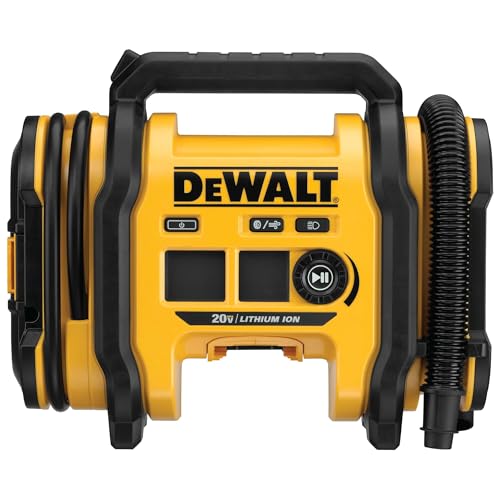
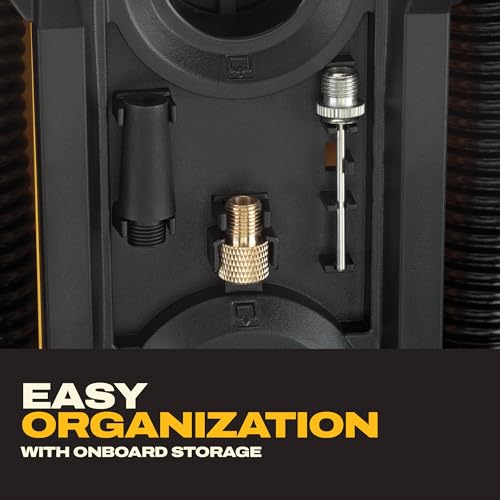
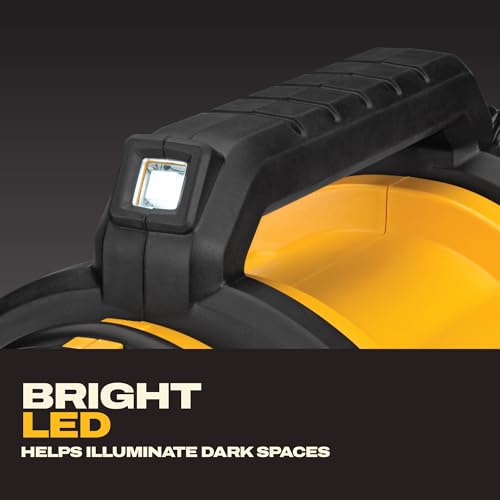
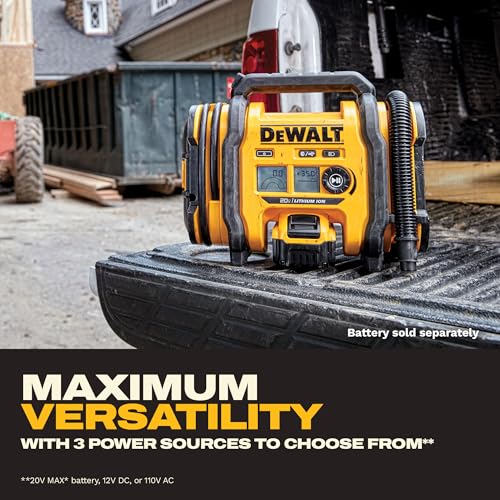
If you already own DEWALT 20V MAX tools, this inflator is a no-brainer. Being able to run off your existing battery ecosystem means one less power adapter to carry and no reliance on a car’s 12V port. The automatic shutoff and threaded chuck ensure secure, accurate inflation, and the onboard storage for accessories keeps things tidy. Reviewers note it’s rugged, with rubber feet that prevent “walking” during use, a small detail that makes a big difference.
It’s not the fastest inflator on the market, and the AC/DC options are less emphasized than its cordless function, but that’s fine. This is a tool built for integration, not raw speed. For contractors or serious DIYers already in the DEWALT ecosystem, it’s the smartest way to keep tires and gear inflated without running cords or draining a car battery.
Product photos


How We Tested small air compressors
I approached this guide by first compiling specifications and features from numerous manufacturers and retailers. I then weighed those details against owner reviews from major online marketplaces and expert opinions found in publications like Popular Mechanics and Consumer Reports. My goal was to build a ranking based on real-world usability, not just marketing claims. Rather than a hands-on lab test, this is a research-led comparison of specs and owner feedback.
For small air compressors, consistent pressure (CFM) and tank size are paramount. I prioritized models offering a good balance of these two, as they directly impact how easily a compressor can power common tools like nailers and inflate tires. Quiet operation was also heavily weighted, especially for indoor use or jobsites where noise is a concern. Finally, portability – size and weight – factored significantly, as these compressors are often moved around a workspace.
Specifications reliably tell you the maximum PSI and CFM a compressor can achieve, but owner feedback reveals how well it sustains that performance over time and under load. I paid close attention to comments about durability, noise levels, and ease of use. Reputable expert reviews helped validate manufacturer claims and identify potential weaknesses or limitations. For those needing even more portability, consider exploring portable pancake air compressors for an ultra-compact option.
How To Pick The Right small air compressors
Finding the right air compressor doesn’t have to be complicated. We’ll help you sort through the options and pinpoint a model suited to your needs.
A good air compressor balances portability with sufficient airflow (CFM) and tank capacity for the intended tasks. Prioritize oil-free pumps for low maintenance, look for durable construction, and consider noise levels, especially for indoor use. Accurate pressure gauges and automatic shut-off features are also critical for safety and convenience.
Size and Portability
Don’t automatically assume bigger is better. The size of the air compressor needs to match the work you plan to do. For occasional tire inflation or running a brad nailer, a pancake or hotdog style compressor with a 1-6 gallon tank will likely be plenty. If you’re thinking about more demanding applications like painting or running impact wrenches, you’ll need to step up to a larger tank (10+ gallons) and a more powerful motor. Consider how often you’ll need to move the compressor too. A lightweight, portable unit is ideal for job site work, while a heavier, stationary model is fine for a dedicated workshop. Ultimately, look for a balance; a truly portable compressor sacrifices some sustained airflow.
Motor Power and CFM
CFM (cubic feet per minute) is the most important specification. It determines how quickly the compressor can deliver air and whether it can keep up with the demands of your air tools. Check the CFM requirements of the tools you plan to use and choose a compressor that exceeds those numbers. A compressor with a higher PSI (pounds per square inch) rating is good, but it’s less critical than CFM. Motors are rated in horsepower (HP), but remember that this is often peak HP. Look at the continuous duty HP to get a more realistic understanding of performance. If you’re considering a compressor for automotive work, also check out these portable compressors for DIY projects.
Noise Level and Maintenance
Air compressors can be loud, and that noise can be a real issue, particularly if you’re working in a garage or near neighbors. California Air Tools consistently scores high marks for quiet operation, but many modern compressors incorporate noise reduction features like silencers and vibration dampening. Oil-free compressors are almost always going to be easier to maintain, as you don’t have to worry about oil changes or checking oil levels. However, they generally have a shorter lifespan than oil-lubricated models.
- Oil-free models are best for infrequent use and portability.
- Oil-lubricated compressors are better for heavy-duty, continuous operation.
- Regularly drain the tank of condensation to prevent rust and extend the life of the compressor. This is especially important for compressors stored in humid environments.
A compressor’s long-term reliability hinges on consistent maintenance. Don’t neglect draining the tank, checking hoses for leaks, and cleaning or replacing air filters.
If you’re looking for something even more compact, exploring best mini air compressors might be a good option. And for those wanting a good balance of power and size, check out these top compact air compressors.
Small Air Compressors Compared
Here’s a comparison of key specifications for several small air compressors.
| Product Name | Tank Size (Gallons) | Max PSI | CFM @ 90 PSI | Power Source | Noise Level (dB) |
|---|---|---|---|---|---|
| MZB 2.4 Gallon | 2.4 | 115 | 5.65 | 110V AC | 70 |
| California Air Tools 1 Gallon | 1 | N/A | 1.20 / 1.60 | 120V AC | 56 |
| CRAFTSMAN 2 Gallon | 2 | 125 | N/A | 120V AC | N/A |
| VEVOR 2.1 Gallon | 2.1 | N/A | 2.2 | 120V AC | N/A |
| AstroAI Dual Power | N/A | 150 | N/A | 12V DC / 120V AC | N/A |
| OlarHike Cordless | N/A | 51 | N/A | Rechargeable / 12V DC | N/A |
| ROCGORLD R8 Fast Inflation | N/A | 150 | N/A | 12V DC | N/A |
| DEWALT 20V MAX | N/A | N/A | N/A | 20V MAX / 12V DC / 120V AC | N/A |
Frequently Asked Questions
What tank size do I really need for a small air compressor?
A 1-6 gallon tank is generally sufficient for basic tasks like inflating tires or running a nailer, but for painting or using impact wrenches, you’ll want at least 10 gallons to avoid the motor constantly running. Larger tanks provide longer run times between refills.
How much CFM is enough for most DIY projects?
Most DIY projects require between 2 and 6 CFM at 90 PSI. Carefully check the CFM requirements of your air tools and choose a compressor that exceeds those needs to prevent performance issues.
Are oil-free compressors really lower maintenance?
Yes, oil-free compressors eliminate the need for oil changes and level checks, simplifying maintenance. However, they typically have a shorter lifespan compared to oil-lubricated models, and can be louder.
Can I run an air compressor indoors safely?
You can, but noise and ventilation are key considerations. Look for models advertised as quiet air compressors or those with noise reduction features, and always ensure adequate ventilation to dissipate heat and moisture.
What’s the difference between peak HP and continuous duty HP?
Peak HP is the maximum horsepower the motor can briefly achieve, while continuous duty HP represents the sustained power output. Always prioritize the continuous duty HP rating for a more accurate understanding of the compressor’s real-world performance.
The Bottom Line
Choosing a small air compressor often comes down to balancing convenience with capability. If you want a unit that can handle a wide range of tasks and don’t mind a slightly larger footprint, the MZB 2.4 Gallon compressor offers a strong combination of tank size, CFM, and reasonable noise levels. It strikes a good balance for the average homeowner or DIYer needing a versatile tool.
For those prioritizing portability or working on a tight budget, the California Air Tools 1 Gallon model is an excellent choice. Similarly, if you need a compressor that can run off multiple power sources, the DEWALT 20V MAX provides flexibility, and for those wanting truly untethered operation, explore options in our guide to battery-powered air compressors. Each of these addresses specific needs without sacrificing essential performance.
Ultimately, the best air compressor isn’t about the highest specs on paper. It’s about finding a model that consistently delivers the airflow you require for the jobs you’ll be tackling, and making sure you practice basic maintenance like draining the tank. Focus on CFM first, then tank size, and don’t overlook the importance of a well-built, durable unit.
