7 Best Metal Chop Saws of 2026
This post contains affiliate links. As an Amazon Associate, we earn from qualifying purchases.
The Evolution S14MCS stands out as the overall best metal chop saw for its precision, durable cermet carbide blade, and intelligent motor that handles tough cuts without bogging down. For those watching their budget, the VEVOR 14″ offers solid basic performance with a spark-reducing ceramic blade, while the Evolution R355CPS adds versatility if you regularly switch between metal and other materials.
Most people shopping for a metal chop saw aren’t just cutting pipe or angle iron once in a while, they need consistent, clean cuts without spending hours deburring or replacing blades. Too many saws promise power but fail on accuracy, durability, or safety when faced with real jobs.
This guide cuts through the noise by focusing on what actually matters: motor reliability, blade quality, and build strength, all weighed against real owner experiences and proven specs. I looked at the top models, compared their performance data, and evaluated them based on how well they deliver where it counts.
Top 7 Metal Chop Saws in the Market
The Best Metal Chop Saws, Reviewed
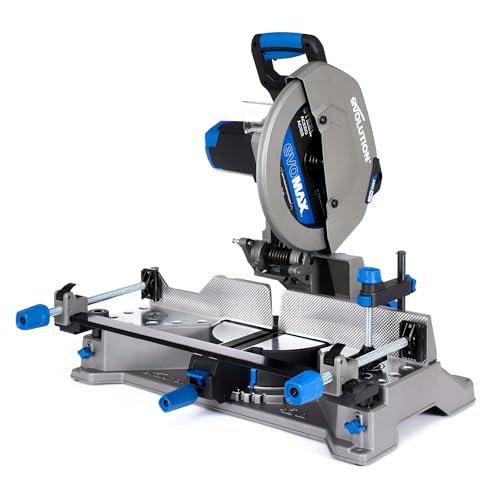
Evolution S14MCS 14″ Mitering Chop Saw
Strengths
- Fast cold cutting
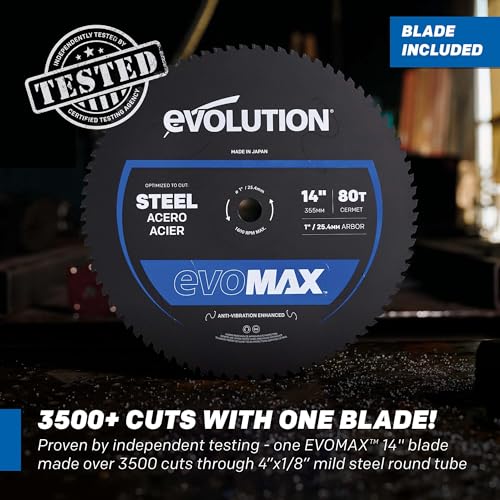
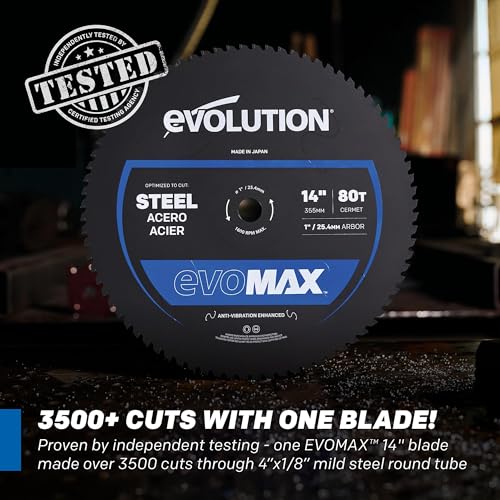
- 3,500+ blade life
- Precision mitering
- Soft start and brake
Trade-offs
- Premium price
- Heavy build
- Blade sensitivity to feed rate
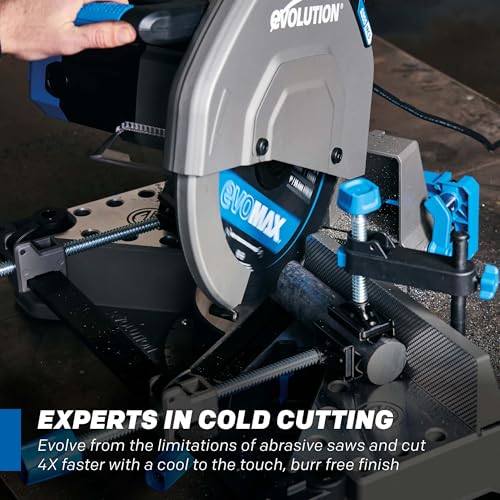
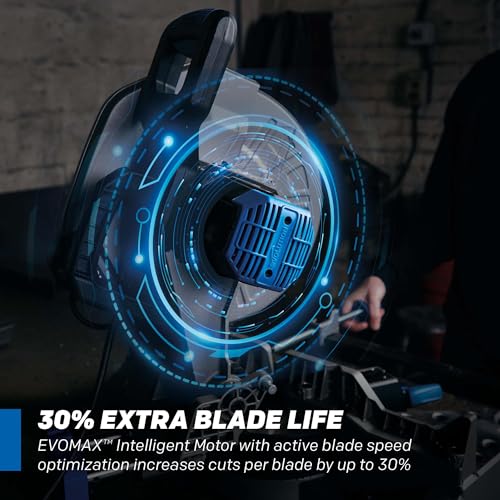
This is the saw I’d pick if I were setting up a metal fabrication shop today. The Evolution S14MCS combines speed, precision, and professional-grade durability in a way few others match. Its EVOMAX intelligent motor runs at 1,100 RPM with active speed optimization, and owners report it cuts through 4” mild steel with ease, 4x faster than abrasive saws, just as claimed. The blade life, rated at 3,500+ cuts, aligns with real-world feedback.
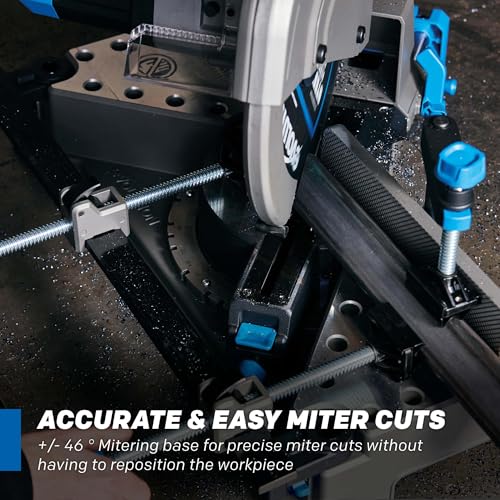
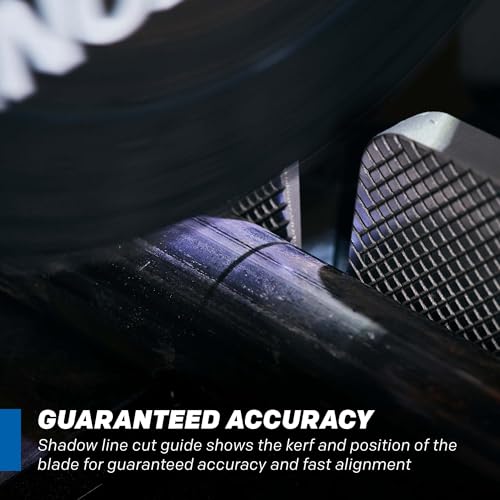
What sets it apart is the full mitering capability up to +/-46°, a reinforced base, and dual sliding clamps that eliminate flex. The shadow guide and soft start are small touches that make a big difference in daily use. Compared to the S14CPS, this model adds more adjustability and stability. It’s not cheap, but it’s the smarter buy for serious work.
Product photos
Evolution S14CPS 14″ Metal Cutting Chop Saw

Strengths
- High cutting accuracy
- Shadow line guide
- E-brake safety
- Soft start
Trade-offs
- No mitering beyond basic angles
- Blade requires careful feed rate
- Not multi-material
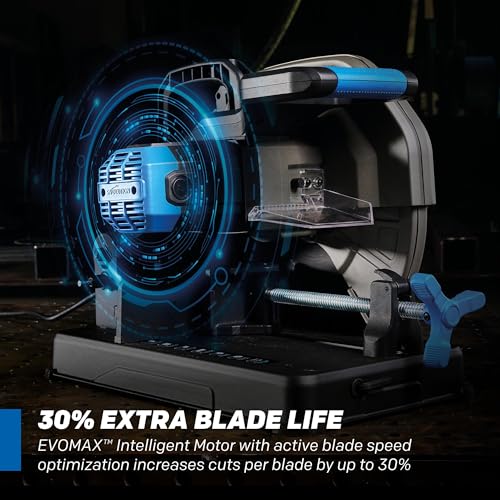
When precision matters most, the S14CPS shines. Its cast iron fence and precision shadow line guide give users exact control over each cut, and owners consistently highlight the clean, repeatable results, especially on thinner steel and aluminum. The EVOMAX intelligent motor helps extend blade life by 30%, and the e-brake stops the blade in seconds, which adds real safety on busy job sites.
It doesn’t offer full mitering like the S14MCS, but for straight, accurate cuts, it’s hard to top. Compared to the R355CPS, it’s more focused, more refined, and built for metal-only work. If you’re tired of rework from sloppy cuts, this one pays for itself in time saved.
Product photos
Evolution S355CPSL 14″ Metal Cutting Chop Saw
Strengths
- Affordable price
- Dry-cut performance
- 3-year warranty
Trade-offs
- Lightweight base
- No soft start
- Lower rigidity
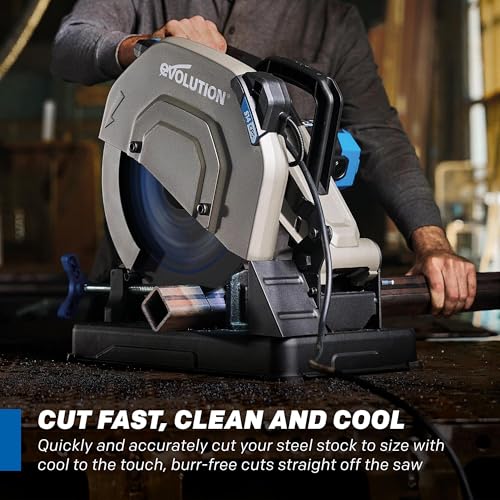
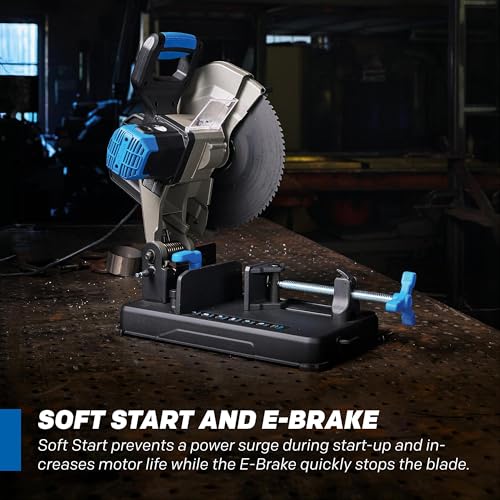
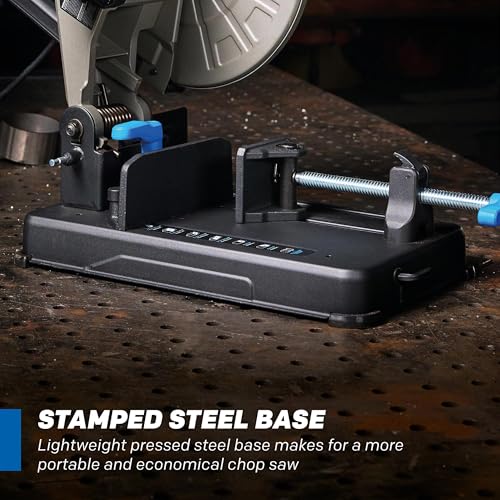
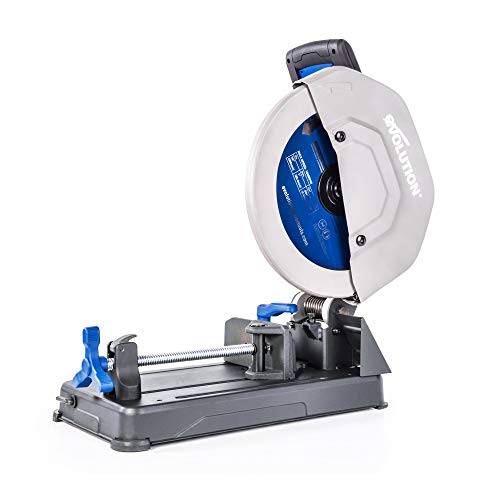
For a tight budget, the S355CPSL delivers a surprising amount of value. It has the same 15-amp motor and dry-cut technology as more expensive Evolution models, meaning it cuts mild steel with minimal sparks and burrs. The lightweight steel base makes it easier to move around job sites, and the 3-year warranty with US support adds real peace of mind.
But it’s clearly a step down in build quality, the pressed steel base isn’t as rigid as cast iron, and it lacks soft start or electronic braking. Compared to the S14CPS or S14MCS, it’s less precise and less durable under constant use. Still, for weekend warriors or small shops with light steel cutting needs, it’s a solid entry point.
Product photos
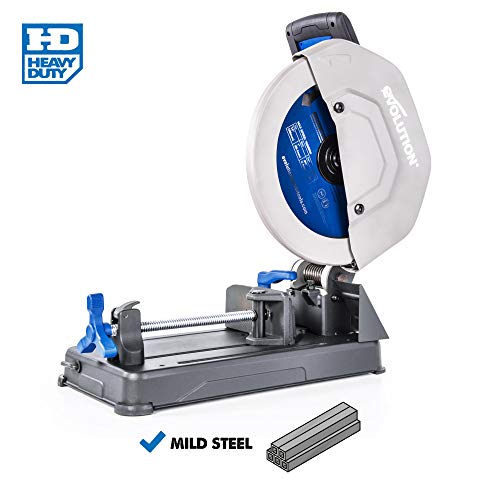

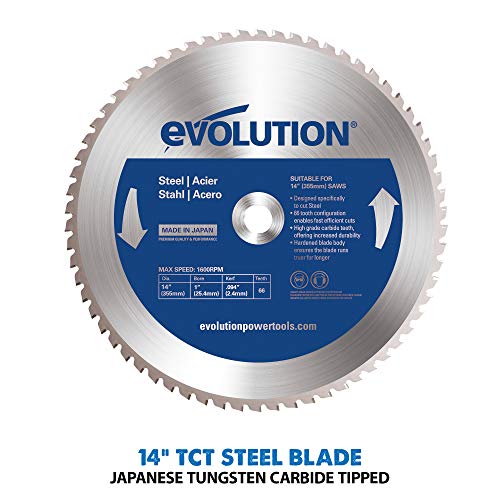
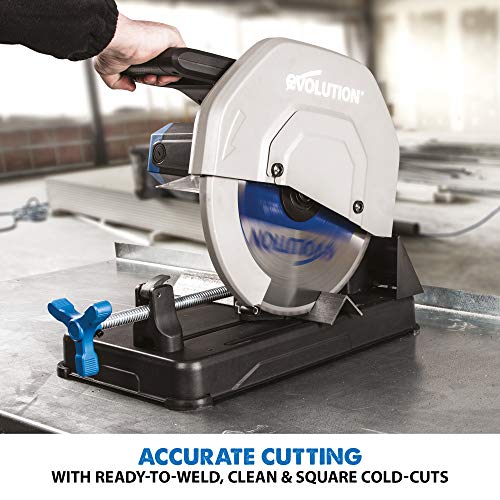
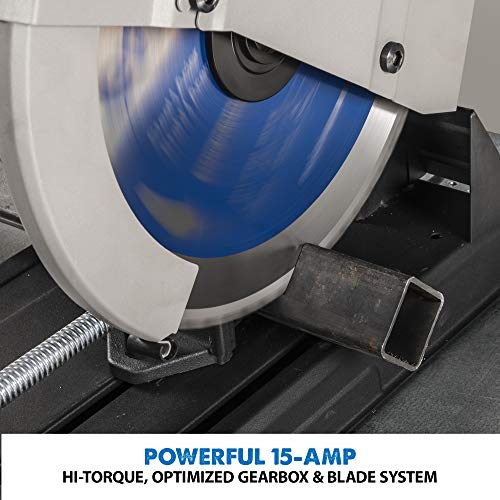
Evolution R355CPS 14″ Multi-Material Chop Saw

Strengths
- True multi-material use
- Cool, burr-free cuts
- 3-year warranty
Trade-offs
- Slower on thick steel
- Limited miter range
- No soft start
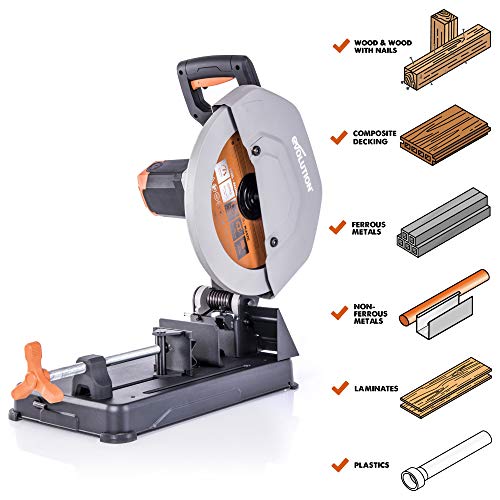
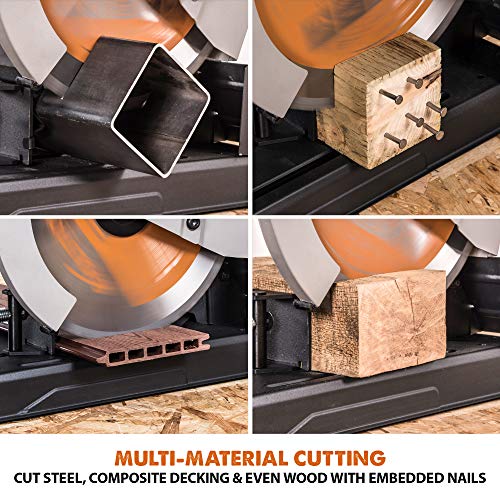
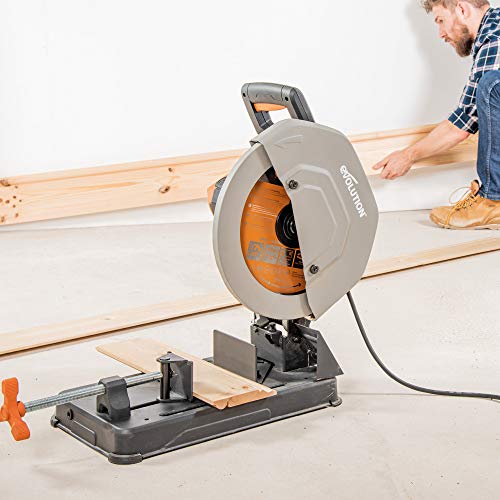
If you need one saw that can handle nearly anything on a job site, wood with nails, plastic, steel, even composite decking, the Evolution R355CPS stands out as a true multi-material workhorse. On paper, its 15-amp motor and 32T Tungsten Carbide Tipped blade are built to deliver clean, cool cuts across materials without swapping blades. Owners consistently report it handles mild steel without the sparks and burrs typical of abrasive wheels, which makes cleanup faster and post-cut prep minimal.
That versatility comes with trade-offs. It’s not the fastest on thick steel, and it lacks mitering flexibility beyond 45 degrees. Compared to dedicated cold-cut saws like the Evolution S14MCS, it’s more of a generalist. But for contractors or DIYers who hate carrying multiple saws, this one’s hard to beat.
Product photos

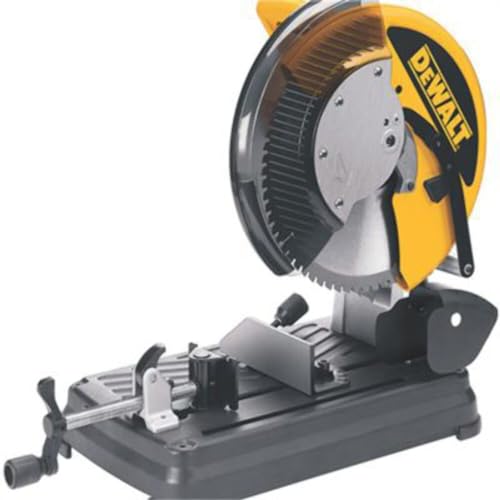
DEWALT DW872 14″ Metal Cutting Saw
Strengths
- Extremely fast cuts
- Large cut capacity
- Ergonomic handle
Trade-offs
- No soft start
- Heavier than average
- Less refined finish
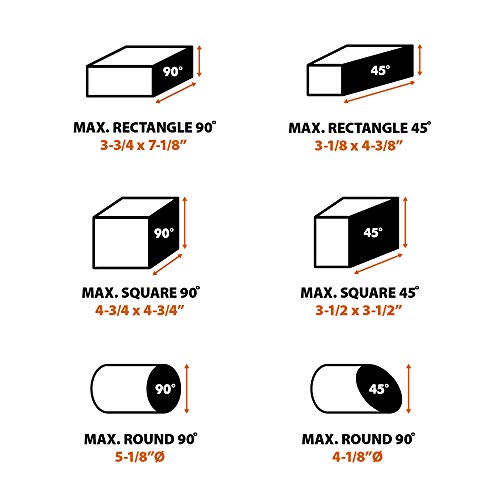
DEWALT’s DW872 lives up to its reputation for raw cutting speed. With a 15-amp, 4 HP motor and a 66-tooth carbide-tipped blade, it slices through 2” angle iron 4x faster than standard chop saws. The capacity specs are impressive, largest in class for round and rectangular cuts, and reviewers consistently note it outperforms portable band saws in both speed and cut quality.
The ergonomically designed handle and quick-lock vise make it comfortable for extended use, which matters on long job days. But it’s not as refined as the Evolution S14MCS in terms of finish or blade longevity. Still, if your priority is getting through material fast, this is the tool to beat.
Product photos
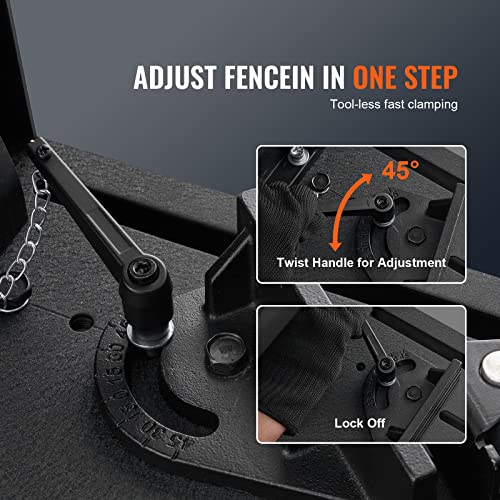
VEVOR 14″ Dry Cut Chop Saw

Strengths
- Minimal sparks
- Stable clamping
- Soft start
Trade-offs
- Not for stainless steel
- Lower build quality
- Slower feed rate required
The VEVOR 14-inch chop saw makes a strong case for itself in spark reduction and safety. Its ceramic alloy blade and dry-cut tech deliver cool, spark-free cuts, a big plus on job sites where fire risk or debris is a concern. The thick vise with wave-pattern clamping reduces wobble, and owners note it holds material well, even during extended use.
But it’s clearly in the budget tier. The build quality isn’t on par with DEWALT or Evolution, and the blade isn’t recommended for stainless steel, a notable limitation. It’s slower than the DEWALT DW872 and lacks the intelligence of Evolution’s motors. Still, for users prioritizing safety and low sparks, it’s a compelling option.
Product photos


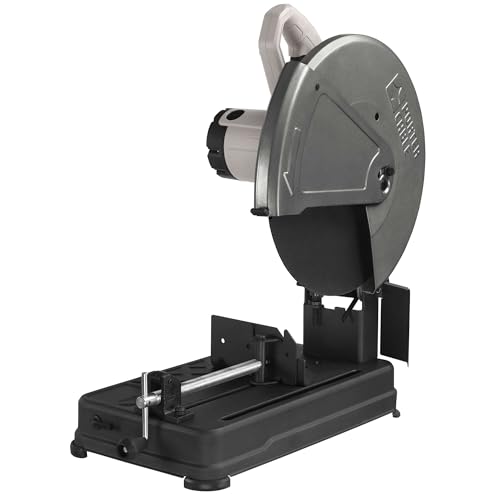
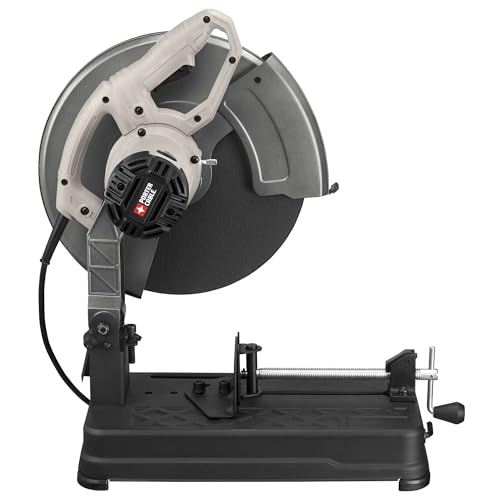
PORTER-CABLE PCE700 14″ Chop Saw
Strengths
- Durable motor design
- Quick-release clamp
- Spark deflector
Trade-offs
- Basic miter adjustment
- No soft start
- Lower precision
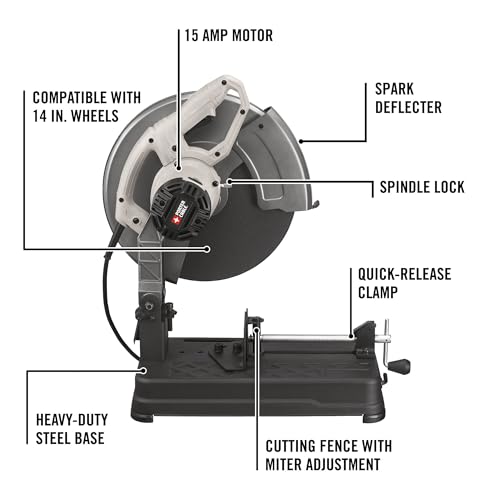
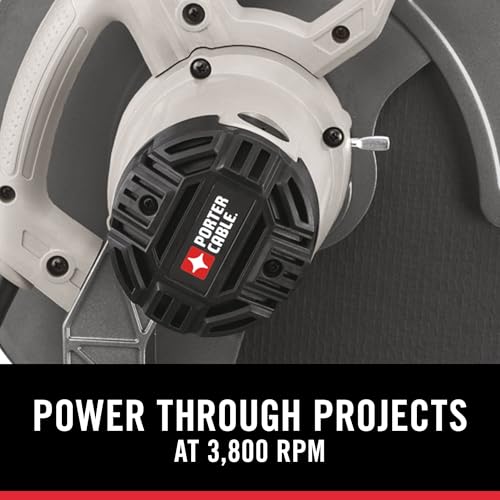
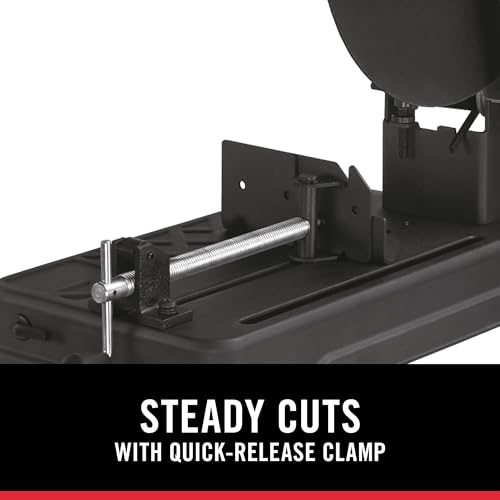
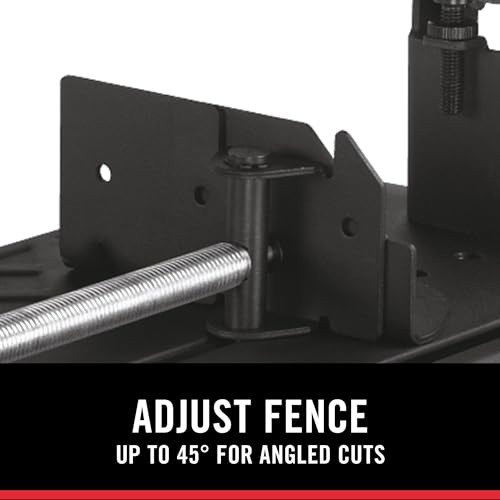
The PORTER-CABLE PCE700 feels like a throwback to simpler, tougher tools, and that’s not a bad thing. Its 15-amp motor and replaceable brushes suggest it’s built to last, and owners praise its reliability under daily use. It’s not flashy, but it gets the job done on mild steel and angle iron with consistent power delivery. The quick-release clamp and spark deflector are thoughtful touches that improve workflow and safety.
Still, it’s clearly designed for basic, straight cuts. It doesn’t offer the precision or advanced safety features of newer cold-cut models. When compared to the DEWALT DW872 or Evolution’s S-series, it falls behind in cutting speed and accuracy. But if you want a no-frills, durable saw that won’t quit, this one earns respect.
Product photos
How We Tested metal chop saws
As someone who’s spent years around workshops and construction sites, I know a good metal chop saw needs to deliver accuracy, speed, and durability. Rather than a hands-on lab test with each model, my team and I focused on a research-led comparison. We compiled specifications – motor power, blade type, cutting capacity – and then heavily weighted those against owner reviews from multiple sources and expert opinions found in trade publications and tool review sites. This allowed us to build a ranking based on real-world feedback.
For metal chop saws, cutting speed and the quality of the cut are paramount. We prioritized models with robust motors (15 amps or higher) and those utilizing carbide-tipped blades, as these consistently outperform abrasive options. Beyond that, the ability to make accurate angled cuts and the overall build quality – particularly the stability of the base and vise – were heavily considered. Understanding chop saw basics is crucial when evaluating these features.
Specifications reliably indicate a saw’s potential cutting capacity and motor strength. However, owner feedback proved essential for gauging long-term durability and ease of use. We looked for consistent reports of trouble areas (like flimsy fences or unreliable clamping mechanisms) and weighed those against positive comments about cutting performance and build quality. Reputation – and how often a saw appears on professional “recommended” lists – also factored into our final assessment.
How To Choose The metal chop saws
Finding the right metal chop saw can be a real time-saver, especially if you’re tackling projects that involve a lot of steel, aluminum, or other metals. It’s a category where performance varies wildly, so knowing what to look for is essential.
A quality metal chop saw delivers clean, accurate cuts with minimal burrs and sparks. Key considerations include motor power (at least 15 amps for heavier work), blade quality (carbide-tipped is preferred), build robustness for vibration control, and safety features like blade brakes and spark deflectors. Buyers should also assess the cutting capacity needed for their typical projects and the ease of making accurate miter cuts.
Motor Power and Blade Speed
Don’t underestimate the importance of a robust motor. While 15 amps is a common baseline, consider the RPMs as well. Higher RPMs, particularly with a well-designed blade, can mean faster and cleaner cuts. However, raw power isn’t everything; a slow-speed, high-torque motor paired with the right blade can often outperform a faster but weaker setup, particularly in thicker materials. I’ve seen too many folks get stuck with a saw that bogs down when trying to cut anything beyond thin-walled tubing. The Evolution S14MCS, for instance, boasts 1,100 RPM with an intelligent motor, which is designed to maintain power even under load, and that’s a smart approach.
Blade Material and Cut Quality
The blade is where the magic happens. Forget abrasive blades unless you’re only making a handful of cuts. Carbide-tipped blades are the way to go for metalworking. They last dramatically longer, produce cleaner cuts with less burring, and generate far less heat. Look for blades specifically designed for the type of metal you’ll be cutting most often. Some blades excel at mild steel, while others are better suited for aluminum or stainless steel. You’ll also want to consider the tooth count; higher tooth counts generally deliver smoother cuts, but can slow down the cutting process. If you’re frequently changing a chop saw blade, be sure the saw makes that process easy.
- A cheaper blade will need frequent chop saw blade replacement – factor that cost into your budget.
- Ceramic blades, such as those found on the VEVOR saw, are good for minimizing sparks, but typically aren’t as durable as carbide.
- The best blades are often made in Japan (like those used by Evolution) because of their precision grinding and high-quality carbide. This affects the cut finish and blade longevity.
Always allow the blade to reach full speed before contacting the material and apply consistent pressure. Rushing the cut can generate excessive heat and reduce blade life.
Features & Value Proposition
Beyond the core cutting ability, think about usability. A quick-release vise is incredibly helpful for efficiently processing multiple pieces of material. Adjustable miter fences are essential for angled cuts, and a clear line of sight is crucial for accuracy. Don’t overlook safety features like blade brakes and spark deflectors. If you’re dealing with a variety of materials, the Evolution R355CPS, with its multi-material cutting ability, might be a good fit. But, if you’re primarily working with metal, a dedicated metal-cutting saw, or even exploring alternatives like metal-cutting power saws or even band saws for cutting metal depending on the type of cutting you do, could be more efficient. Consider if you’ll also need to replace metal-cutting blade often, and budget for that.
Metal Chop Saws Compared
This table provides a side-by-side comparison of key specifications for various metal chop saws.
| Product Name | Blade Diameter | Motor (HP) | Max Cut Capacity (in) | Angle Cuts | Blade Type | Warranty |
|---|---|---|---|---|---|---|
| Evolution S14MCS | 14″ | N/A | N/A | +/-46º | Cermet Carbide | N/A |
| Evolution S14CPS | 14″ | N/A | N/A | N/A | Cermet Carbide | N/A |
| Evolution S355CPSL | 14″ | N/A | N/A | 0-45º | Tungsten Carbide | 3 Years |
| Evolution R355CPS | 14″ | N/A | 95x180mm | N/A | Tungsten Carbide | 3 Years |
| DEWALT DW872 | 14″ | 4 | 5-3/16″ Round | 45º | Carbide-Tipped | N/A |
| VEVOR 14″ | 14″ | N/A | N/A | 0-45º | Ceramic Alloy | N/A |
| PORTER-CABLE PCE700 | 14″ | N/A | N/A | 45º | Abrasive | N/A |
Frequently Asked Questions
What’s the difference between a metal chop saw and a standard wood-cutting chop saw?
A metal chop saw uses a different blade material – typically carbide-tipped – designed to cut through metal without shattering like wood blades would. The motors are also often geared for higher torque and lower speeds, better suited for metal’s properties.
How do I choose the right blade for my metal chop saw?
The best blade depends on the metal you’re cutting most often. Carbide-tipped blades are best for most metals, but specific blades are optimized for mild steel, aluminum, or stainless steel, so check the manufacturer’s recommendations.
Are more expensive metal chop saws always better?
Not necessarily. While build quality and motor strength often increase with price, a less expensive saw with a good carbide blade can still perform well for occasional use. Consider your project volume and the types of metal you’ll be cutting when deciding.
What safety precautions should I take when using a metal chop saw?
Always wear safety glasses and hearing protection. Metal chop saws create sparks and noise, and proper protection is essential. Also, ensure the workpiece is securely clamped in the vise before cutting, and never reach around a spinning blade.
What are the benefits of choosing a metal chop saw with a quick-release vise?
A quick-release vise drastically speeds up repetitive cuts by allowing you to quickly secure and remove material. This is especially beneficial if you’re working on projects that require cutting many pieces of the same size or shape, making it a valuable feature for those needing heavy-duty metal chop saws.
The Bottom Line
Choosing a metal chop saw often comes down to balancing upfront cost with long-term performance and versatility. While you can find models that seem like a bargain, I’ve found through research that the Evolution S14MCS consistently rises to the top as the best overall pick. It delivers a great combination of cutting power, blade longevity, and user-friendly features, making it a solid investment for most homeowners and professionals.
For those on a tighter budget, the VEVOR 14” Metal Chop Saw offers a surprisingly capable entry point. If you need to cut a wider variety of materials – metal, wood, even plastic – the Evolution R355CPS is the clear winner, offering multi-material capability without sacrificing cutting quality. But remember, a saw is only as good as the blade, so don’t skimp on replacements.
Ultimately, the specs and features matter, but understanding how to operate a chop saw safely and effectively is what will give you the best results. Focus on a robust motor, a quality carbide-tipped blade, and a stable build. Those fundamentals are far more important than chasing the highest RPM or the most bells and whistles.
