
2 Best 15 Inch Gauge Finish Nailers of 2026
This post contains affiliate links. As an Amazon Associate, we earn from qualifying purchases.
The Metabo HPT 15 Gauge Angled Finish Nailer stands out as the overall best pick for its reliable performance, tool-free depth adjustment, and 360-degree exhaust. For a more budget-friendly option, the 3PLUS HDA1564SP delivers solid core features without breaking the bank.
If you’ve ever fought with a finicky nailer mid-project, you know how much the wrong tool can slow you down. Jams, awkward angles, and heavy triggers turn what should be a clean job into a frustrating mess. After comparing the field and weighing specs against real-world owner feedback, I focused on models that deliver consistency, control, and comfort, especially for trim, baseboards, and cabinetry work. This guide breaks down the top performers, what actually matters in daily use, and where you can safely save a few bucks.
Top 2 15 Inch Gauge Finish Nailers in the Market
The Best 15 Inch Gauge Finish Nailers, Reviewed
Metabo HPT 15 Gauge Angled Finish Nailer

Strengths
- Excellent weight balance
- Sequential and contact fire
- Integrated air duster
- 360° exhaust
- 5-year warranty
Trade-offs
- Higher price point
- Magazine loading slightly tight
- Not cordless
If you’re serious about trim work and want a finish nailer that balances pro-level performance with user-friendly features, the Metabo HPT NT65MA4 is, in my view, the best overall pick in the 15 gauge angled category. At 4.2 lbs, it’s light and well-balanced, which makes a real difference during long installations like crown molding or stair trim. The selective actuation switch, letting you toggle between sequential and contact firing, is a game-winner for control and speed, and owners praise how smoothly it drives 15-gauge DA nails from 1-1/4″ to 2-1/2″.
What really sets it apart is the thoughtful extras: the 360° adjustable exhaust keeps air and debris off your work, and the integrated air duster is something I wish more brands included, it’s a small thing, but it cuts down on cleanup time. Backed by a 5-year warranty and Metabo HPT’s reputation for durability (and 12 years of Pro Preferred ratings), this is the kind of tool that earns trust over years of use.
Product photos


3PLUS HDA1564SP 15 Gauge Angled Finish Nailer

Strengths
- Lightweight design
- Tool-free depth adjust
- Dual firing modes
- 360° exhaust
- No-mar tip
Trade-offs
- No air duster
- Less refined balance
- Basic warranty
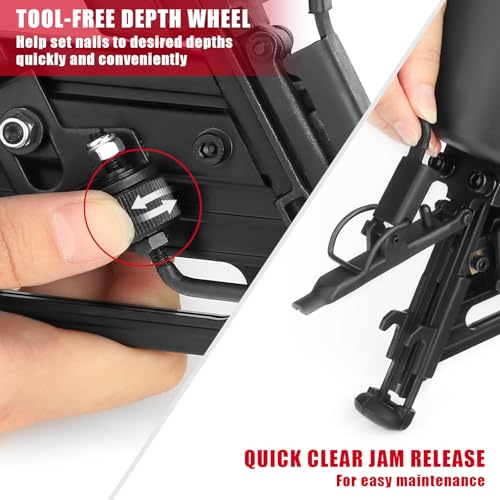
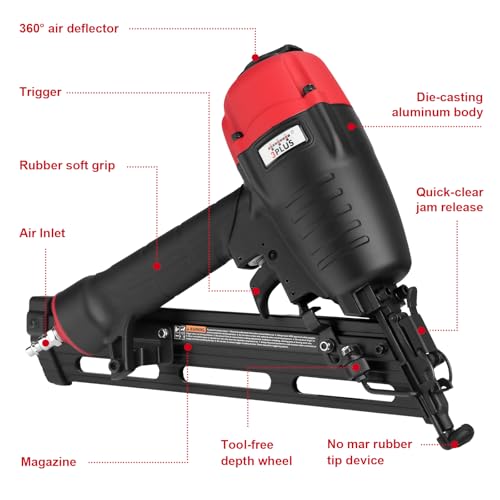
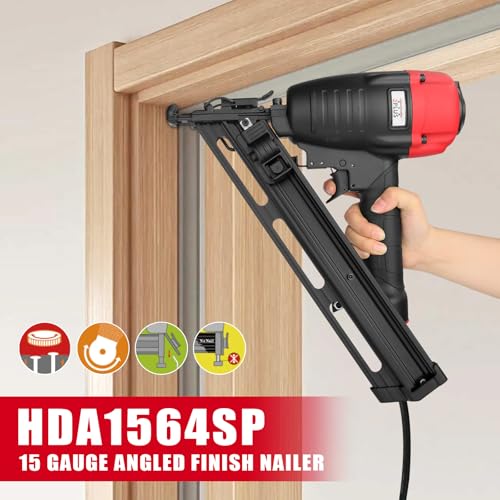
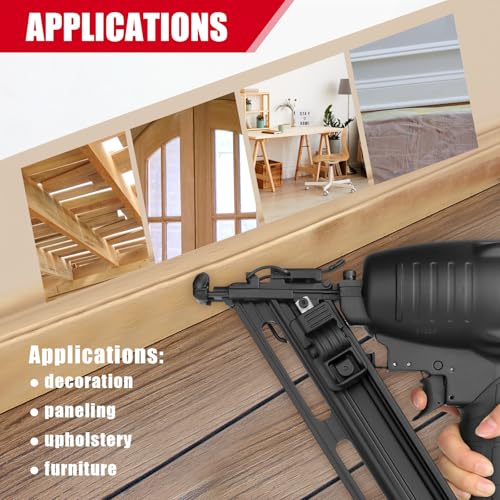
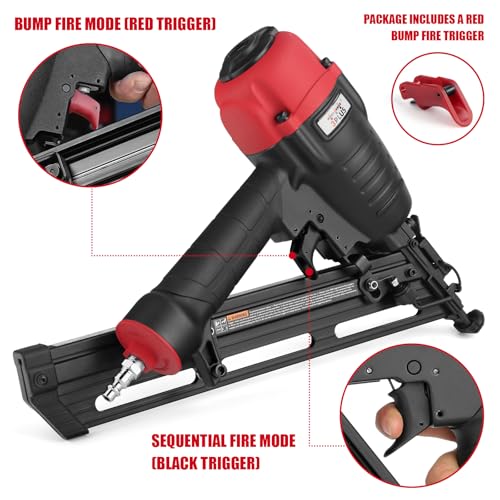
For DIYers watching their budget but still needing a capable 15 gauge angled finish nailer, the 3PLUS HDA1564SP stands out on paper as a solid value pick. It covers the core needs, a tool-free depth adjuster, 360° exhaust, and dual firing modes via an interchangeable trigger, without overcomplicating things. The no-mar tip and contact safety mechanism are standard but well-executed, and owners consistently report it handles 1-1/4″ to 2-1/2″ DA nails reliably in baseboards and trim work.
Where it falls short is in refinement. Compared to the Metabo HPT NT65MA4, it feels a bit bulkier and less balanced, and there’s no integrated air duster, which I consider a small but meaningful convenience on jobsites. Still, for weekend warriors or first-time nailer buyers, the feature set here is impressive for the price tier, and the jam release system gets strong marks in owner feedback for saving time during misfires.
Product photos
How We Chose These 15 inch gauge finish nailers
Rather than a hands-on lab test, my research for these nailers focused on a detailed comparison of published specifications and features. I weighed owner reviews from multiple sources, alongside assessments from reputable trade publications, to get a realistic picture of performance in actual use. My background means I understand what features truly matter for consistent, professional-quality work, and I ranked these nailers based on those criteria.
For 15-gauge angled finish nailers, consistent fastening and ease of use are paramount. I gave significant weight to the depth adjustment mechanisms and the reliability of the firing mechanism – features directly impacting finish quality and reducing frustrating jams. Lightweight design also mattered, as prolonged use can quickly become tiring; a well-balanced tool improves accuracy and reduces fatigue. If you’re also considering portability, exploring cordless finish nailers might be a good fit.
Specifications give a solid foundation; nail capacity and adjustable depth are clearly defined. However, owner feedback revealed a lot about real-world durability and the effectiveness of features like the exhaust port and jam release. Reputation within the trades also played a role, as brands consistently praised by professionals tend to deliver lasting value and minimize downtime.
How To Choose The 15 inch gauge finish nailers
As someone who’s spent years around workshops and job sites, I know picking the right finish nailer can make or break a trim project. It’s not just about driving nails; it’s about speed, precision, and minimizing frustration.
A quality 15-gauge finish nailer should balance power with maneuverability. Look for models accepting a wide nail length range (typically 1-1/4″ to 2-1/2″), tool-free depth adjustment for consistent fastening, and features like adjustable exhaust ports to keep your workspace clear. Selective actuation switches are also key for safety and control, particularly when working in tight spaces.
Nail Capacity and Angle
The first thing I look at is what kind of nails the tool accepts. While 15-gauge is the standard for finish work, some nailers are more flexible than others. A wider accepted nail length range gives you more versatility for different trim thicknesses. Angled nailers (like the ones we’re focusing on) are generally preferred for tighter corners, allowing you to get into spaces a straight nailer simply can’t reach. Don’t assume all angled nailers are created equal; some have more accessible magazines than others.
Actuation and Control Features
Beyond just hammering nails, how easily can you control the process? Selective actuation switches, allowing you to switch between sequential and contact nailing, are a must-have for safety. Sequential actuation requires you to depress the nose of the tool and pull the trigger, preventing accidental firing. Contact nailing lets you hold the trigger down and “bump” the nailer to drive nails rapidly – great for larger runs, but with more risk. A tool-free depth adjustment is also crucial. Constantly fiddling with Allen wrenches is a time-waster.
Here’s what I look for in a good control system:
- Sequential Actuation: Essential for detailed work and preventing mishaps.
- Adjustable Depth: A quick, tool-free adjustment is a huge time saver.
- No-Mar Tip: Protects your finished surfaces from scuffs and damage, especially on softer woods.
Remember this: Don’t sacrifice safety for speed. Always prioritize a nailer with reliable actuation control, even if it means a slightly slower workflow.
Value and Ergonomics
Let’s be real – price matters. You don’t always need the most expensive model, but going too cheap can backfire. I often find that a well-built, mid-range nailer will outlast and outperform a bargain-basement option. Ergonomics are also huge. A lightweight, well-balanced nailer will reduce fatigue during long projects. If you’re considering a step up from 15-gauge nailers, you might want to look at 16-gauge finish nailers for even more delicate work, or compare 16-gauge vs 15-gauge nailers to see which is best for your needs. Don’t forget to check out 16-gauge finish nailer reviews before making a final decision.
15 Inch Gauge Finish Nailers Compared
Here’s a detailed comparison of the specifications for these 15-gauge finish nailers to help you make an informed decision.
| Product | Nail Gauge | Nail Length Range | Weight (lbs) | Actuation Mode | Depth Adjustment | Exhaust Port |
|---|---|---|---|---|---|---|
| Metabo HPT 15 Gauge Angled Finish Nailer | 15 | 1-1/4″ – 2-1/2″ | 4.2 | Sequential/Contact | Tool-less | 360 Degree |
| 3PLUS HDA1564SP 15 Gauge Angled Finish Nailer | 15 | 1-1/4″ – 2-1/2″ | N/A | Single/Bumper | Tool-free | 360 Degree |
Frequently Asked Questions
What nail sizes will a 15-gauge finish nailer typically handle?
Most 15-gauge angled finish nailers accept nails ranging from 1-1/4 inches to 2-1/2 inches long. This range provides versatility for various trim and molding thicknesses, but always confirm the specific nail length compatibility listed in the tool’s specifications.
Are angled finish nailers harder to use than straight nailers?
While angled nailers require a slight learning curve, they excel in tight spaces. The angled design allows access to corners and narrow areas a straight nailer can’t reach, and the benefits often outweigh the initial adjustment period.
What’s the difference between sequential and contact actuation?
Sequential actuation requires depressing the nose and pulling the trigger simultaneously, prioritizing safety and accuracy. Contact actuation allows you to hold the trigger and “bump” the nailer to drive nails rapidly, increasing speed but demanding more caution.
How important is the exhaust port direction on a finish nailer?
An adjustable exhaust port is quite important, as it directs airflow away from your face and eyes. This feature minimizes dust and debris exposure, enhancing visibility and comfort during prolonged use, particularly in enclosed spaces.
I’m a beginner – should I start with a pneumatic or cordless model?
For a first-time user, I often suggest exploring pneumatic finish nailers. They generally offer more consistent power and are often more affordable than cordless options, although you’ll need an air compressor to operate them.
The Bottom Line
Choosing a finish nailer often comes down to balancing control with convenience. If you want a tool that offers a blend of both, the Metabo HPT 15 Gauge Angled Finish Nailer stands out as a strong all-around performer – it consistently receives high marks for its reliability and user-friendly features. It’s a solid choice for anyone looking to tackle a variety of trim projects.
For those on a tighter budget, the 3PLUS HDA1564SP 15 Gauge Angled Finish Nailer provides a lot of value for the money. It may not have all the bells and whistles of more expensive models, but it’s capable of delivering accurate and consistent results for basic trim work. If you’re seeking a deeper understanding of all your options, our finish nailer buying guide offers a broader perspective.
Ultimately, specs aren’t everything. The most important factors are a comfortable feel in your hand, a reliable firing mechanism, and the ability to quickly and easily adjust the depth for consistent nail sets. Focus on those fundamentals, and you’ll be well-equipped to handle any trim project with confidence.
