
Air Compressor vs Air Pump Comparison: Which Do You Need?
This post contains affiliate links. As an Amazon Associate, we earn from qualifying purchases.
An air compressor is for storing energy as high-pressure gas; an air pump is for moving fluid from point A to point B. The compressor squeezes air into a tank at 100+ PSI for tools. The pump uses air to actuate a diaphragm, creating flow to transfer liquids or low-pressure gases. Choosing wrong burns out motors, under-powers tools, or corrodes pump internals in days.
That gap between storing energy and creating flow is where the whole decision lives. A compressor’s job is density, packing air into a fixed volume. A pump’s job is displacement, shifting volume through a system. Confuse them and you buy a machine that can’t do the work.
What follows: the three spec sheets that never align (pressure, medium, duty cycle), the maintenance truth both sales brochures skip, and the one field call that reframes the choice from scratch.
Key Takeaways
- Compressors store pressure, pumps create flow. An air compressor fills a tank to 150 PSI for intermittent, high-force bursts. An air pump like a Graco Husky moves fluid continuously at maybe 5-10 PSI.
- The pressure numbers are in different universes. Compressor output is measured in PSI (pounds per square inch). Pump output is often in inches of water column, a fraction of 1 PSI. A 100 PSI compressor has over 250 times the pressure capability of a typical pump.
- The fluid decides the pump. Pump wetted parts, polypropylene, acetal, stainless steel, must match your chemical. A compressor only cares about clean, dry air.
- Maintenance isn’t simpler, it’s different. A pump has diaphragms and check balls that wear with cycles. A compressor has an air-end with precise rotor tolerances that degrade with heat and contamination.
- For 90% of workshops, you need the compressor first. A quality 20-gallon model runs nailers, impacts, and inflators. You add a pump only when you’re moving paint, chemicals, or water.
The Core Functional Divide: Store Pressure vs. Move Fluid
This isn’t a subtle distinction. It’s a mechanical fork in the road that determines the machine’s entire design, cost, and failure mode.
An air compressor takes in atmospheric air and reduces its volume. A piston slams down or twin screws mesh, forcing the air molecules into a smaller space inside a storage tank. That stored potential energy is your PSI. When you open the valve, the high-pressure air rushes out to do work, driving a nail, spinning an impact wrench, or sandblasting a surface. The compressor’s cycle refills the tank between uses.
The technical reality: Compressor performance is rated in CFM (cubic feet per minute) at a specific PSI, like “5.0 CFM at 90 PSI.” This measures the volume of compressed air it can deliver to a tool under load. The storage tank (e.g., 20-gallon, 60-gallon) buffers demand so a smaller compressor can run a larger tool intermittently.
An air pump, specifically an air-operated double diaphragm (AODD) pump, uses a different principle. Shop air (from your compressor) enters an air valve, shifting a diaphragm back and forth. This diaphragm movement creates a pumping action, drawing fluid in through one check valve and discharging it out another. The pump isn’t storing pressure; it’s transferring volume. The output pressure is just enough to overcome the friction in the hose and lift the fluid to the discharge point.
What’s the Physical Difference Between an Air Compressor and an Air Pump?
Look at their guts. A compressor like an Atlas Copco GA VSD+ has a motor, an air-end (rotary screws or pistons), an oil system, a cooler, and a large pressure vessel. It’s a complex, sealed unit built for continuous pressure cycles.
A pump like a Graco Husky 716 or a Yamada NDP-40 is simpler in intent. You’ll see a central air valve, two fluid chambers with diaphragms, and four check balls (inlet and outlet for each chamber). Its housing is a material chosen for fluid compatibility, polypropylene for mild chemicals, stainless steel for corrosives. There’s no storage tank.
Where this goes sideways: Using a compressor to “pump” a fluid by blowing air into a container. You have zero flow control, it’s incredibly inefficient, and you risk pressurizing a vessel not rated for it. Using a pump to “compress” air is impossible, it can’t generate meaningful PSI.
Pressure, Capacity, and Real Output: Why the Numbers Don’t Compare
This is the most common point of confusion. People see “maximum pressure” on both spec sheets and think they’re equivalent. They are not.
| Specification | Air Compressor (e.g., Sullair 1600H) | Air Pump (e.g., Graco Husky 515) |
|---|---|---|
| Primary Output | Pressure (PSI) | Flow (GPM) |
| Typical Working Range | 100 – 200 PSI (6.9 – 13.8 bar) | 5 – 100 PSI (0.3 – 6.9 bar) AIR INPUT. Fluid output pressure is much lower. |
| Key Rating | CFM at PSI (e.g., 5 CFM @ 90 PSI). Dictates tool runtime. | GPM (Gallons Per Minute) at a specific viscosity. Dictates transfer speed. |
| Energy Storage | Yes, in an air receiver tank (e.g., 11–42 gallon). | No. Operates only when air supply is on. |
| Critical Limiter | Motor/engine horsepower and air-end efficiency. Heat kills. | Diaphragm material and fluid compatibility. Chemical attack kills. |
A compressor’s 100 PSI can lift a car. It’s enough force to actuate a pneumatic cylinder with thousands of pounds of thrust. The Sullair 1600H delivers 1600 CFM at 150 PSI, enough to run multiple heavy-duty paving breakers.
A pump’s output is often measured in “inches of water column” (in WC). 27.7 inches of water column equals just 1 PSI. So when a pump spec says it can produce 100 inches of water column, that’s about 3.6 PSI. Its job isn’t to exert force, but to overcome system resistance to move fluid. The Graco Husky 515 has a maximum fluid working pressure of 100 PSI, but that’s a pressure rating for the housing, not the typical output.
Common mistake: Matching a pump to a compressor based on “maximum air pressure.” The pump’s 100 PSI rating is for the air supply side from your compressor. The fluid side pressure is determined by the air supply pressure and the pump’s ratio. Most AODD pumps have a 1:1 ratio, if you feed it 80 PSI shop air, the maximum fluid pressure it can generate is also 80 PSI, minus losses.
The 3 Decisions That Tell You Which Machine You Need
Stop looking at brands first. Answer these three questions in order. The answer is usually clear by the second one.
1. What Are You Moving: Air or Liquid?
This is the absolute line. * Air/Gas only, and you need high pressure: You need an air compressor. Full stop. This covers 95% of workshop and job site tasks: impact wrenches, nail guns, sandblasters, spray painting, inflation. * Liquid, slurry, or viscous material: You need an air-operated diaphragm pump. This is for transferring paint, chemicals, oils, wastewater, or adhesives. A compressor cannot handle liquids.
2. What’s Your Primary Goal: Force or Flow?
- Force (High PSI): You need to create a powerful, intermittent action. Driving a nail, breaking concrete, tightening a large bolt. This is compressor territory.
- Flow (High Volume): You need to empty a 55-gallon drum of coolant, circulate a tank, or transfer a large volume of liquid from one place to another. This is pump territory. The required PSI is just to push the liquid through the hose.
3. What’s the Duty Cycle: Continuous or Intermittent?
- Intermittent, high-demand bursts: A compressor with a storage tank is ideal. The tool uses air faster than the compressor makes it, but the tank acts as a buffer. The compressor motor cycles on and off.
- Steady, continuous operation: A diaphragm pump excels here. Fed by a continuous air supply, it can run for hours transferring fluid. A compressor running a tool continuously must be sized much larger (higher CFM) to keep up, or it will overheat.
| Your Scenario | Likely Tool | Reason |
|---|---|---|
| Running a framing nailer, DIY auto repair | Air Compressor (e.g., 20-30 gal) | Needs stored high-pressure air for short, powerful bursts. |
| Transferring kerosene from a bulk tank | AODD Pump (Polypropylene or Acetal) | Moves liquid safely; material compatible with fuel. |
| Operating a sandblaster for 8 hours | Large Compressor (e.g., 5+ HP, 60+ gal) | High, continuous CFM demand. A pump is irrelevant. |
| Draining a flooded basement | Trash Pump (Electric or Gas) | Not an AODD pump. This is a different pump category for high-volume water. |
| Dispensing sealant from a drum | AODD Pump (with drum adapter) | Provides steady, controlled flow of viscous material. |
Maintenance Realities: Neither is “Easy”
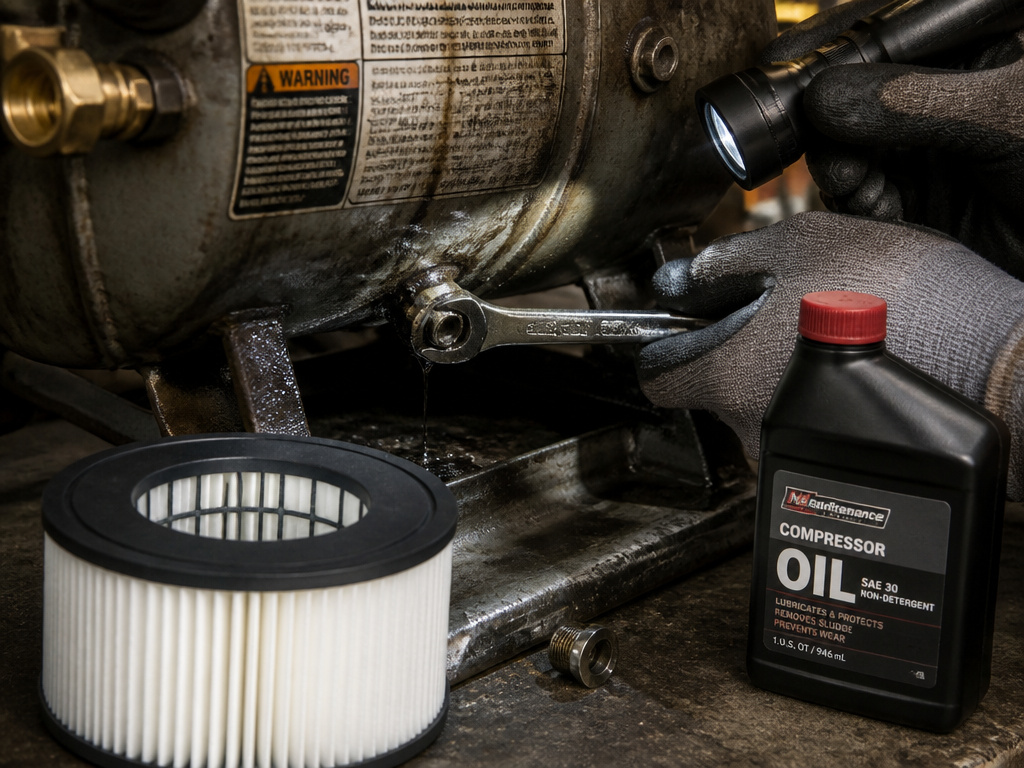 The YouTube line that “pumps are easier to maintain” is half true at best. The maintenance is different, and each has a critical, expensive component that fails if ignored.
Air Compressor Maintenance: It’s About Heat and Cleanliness.
The air-end, whether piston rings or screw rotors, has tight tolerances. Contamination is the enemy. 1. Drain the tank after every use. Condensed water causes internal rust, which flakes off and is blasted into your tools and the air-end. 2. Change the compressor oil on schedule (for oil-lubricated models). The oil cools and seals the air-end. Overheated, broken-down oil leads to reduced efficiency, then catastrophic wear. The Atlas Copco GA VSD+ manual specifies intervals based on operating conditions. 3. Clean or replace the intake air filter. A clogged filter makes the compressor work harder, increasing heat and shortening component life.
The part nobody mentions: In a rotary screw compressor, the airend is a sealed, balanced unit. When it fails from poor maintenance, you’re not rebuilding it in your garage. You’re replacing a core component that costs more than some entire compressors.
Air Pump Maintenance: It’s About the Fluid and Cycles.
The wear items are the diaphragms and check balls/valves. Their life is determined by what you’re pumping and how fast you cycle the pump. 1. Match the wetted parts to the fluid. Pumping a solvent through a Buna-N diaphragm will cause it to swell and fail quickly. The Yamada NDP-40 datasheet lists diaphragms in PTFE, EPDM, and Viton for different chemicals. 2. Inspect diaphragms regularly for cracks or pinholes. A failed diaphragm lets air into the fluid or fluid into the air valve, shutting down operation. 3. Clean the check balls and seats. Debris or dried material will prevent a proper seal, causing the pump to lose prime or reduce flow. The Graco Husky series has easily serviceable fluid sections for this reason. 4. Lubricate the air valve. A drop of pneumatic tool oil in the air inlet every few weeks keeps the spool valve moving freely and prevents sticking.
TL;DR: Compressor maintenance prevents a $2,000 airend replacement. Pump maintenance prevents process downtime and chemical spills. Neither is optional.
The Bottom Line: Which One Do You Buy First?
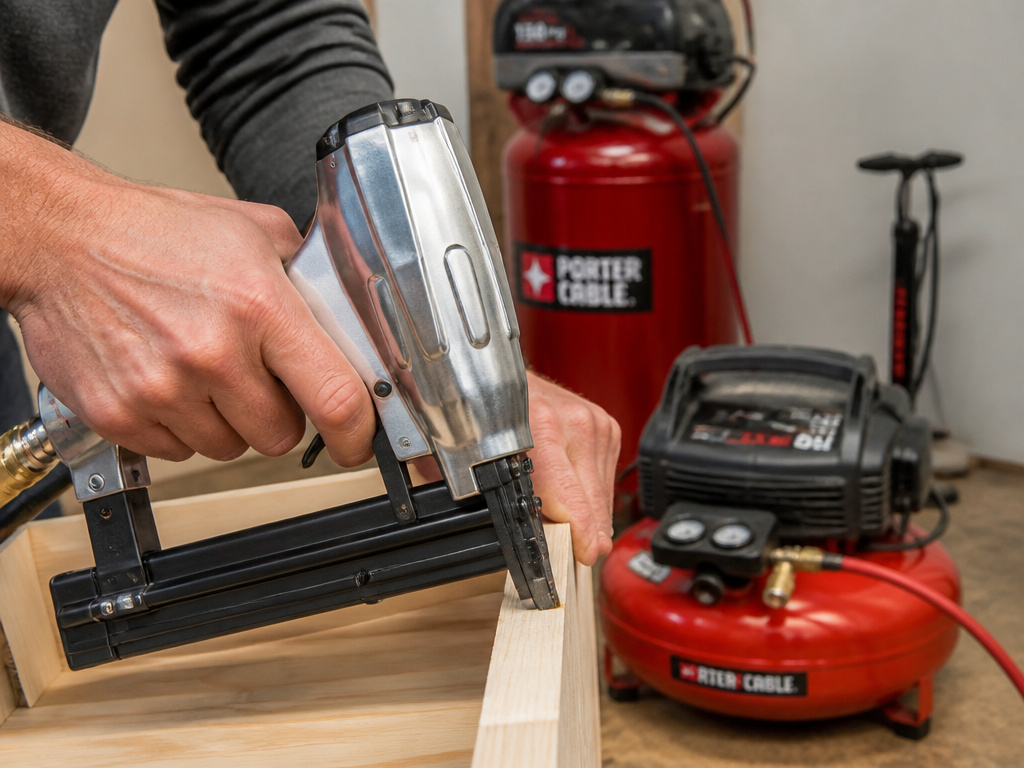 For a home workshop or garage, the answer is almost always an air compressor. It unlocks a universe of tools and tasks a pump cannot touch. Start with a quality 5-6 gallon pancake compressor if you only use a brad nailer or inflate tires. Step up to a 20-30 gallon upright single-stage compressor if you run impact wrenches, ratchets, and die grinders. That covers 90% of DIY and prosumer needs.
You only bring an air-operated diaphragm pump into the equation when you have a specific, recurring liquid transfer job. Even then, you need the compressor to power it. For most, renting a pump for the one time you need to move 50 gallons of something is the smarter financial move.
Understand the divide: one stores force, the other enables flow. Buy for the job you actually have, not the one the marketing copy imagines.
Frequently Asked Questions
Can I use my air compressor as a pump?
No, not for liquids. You can use the compressed air to push a liquid out of a sealed container (like a sprayer), but you have no flow control and it’s dangerously inefficient. You risk over-pressurizing the container. For any deliberate liquid transfer, a dedicated pump is the correct and safe tool.
What is an air pump used for?
Air-operated double diaphragm (AODD) pumps are used to transfer liquids, slurries, and viscous materials where electricity is undesirable or where fluid compatibility is key. Common uses include off-loading drums of paint or adhesive, transferring chemicals in a plant, emptying frac tanks, or moving wastewater. Their seal-less design and material options make them safe for tough fluids.
Is an air pump the same as an inflator?
No. An inflator (like a tire inflator) is a small, specialized type of air compressor designed to output air at a set PSI to fill tires, balls, or air mattresses. An “air pump” in common conversation often refers to these, but in industrial/mechanical contexts, it means a fluid-transfer pump. This article discusses the industrial fluid-transfer pump.
How do I size an air compressor for my tools?
You match two numbers: PSI and CFM. Check your tool’s manual for its required PSI (e.g., 90 PSI) and its CFM consumption (e.g., 4 CFM). Your compressor must deliver a higher PSI and a CFM rating at least as high as the tool’s requirement. For multiple tools, add the CFM of the tools you might run simultaneously. Always err on the side of more CFM.
Can a pump generate high pressure like a compressor?
Rarely, and not efficiently. Some reciprocating piston pumps can generate high fluid pressure (thousands of PSI for hydraulic systems), but they are fundamentally different from AODD pumps. The standard diaphragm pump discussed here is not designed for high-pressure output. Its strength is safe, reliable transfer, not creating intense force.
