
6 Best Welders for Auto Bodies 2026
This post contains affiliate links. As an Amazon Associate, we earn from qualifying purchases.
The FEIFANKE 135A stands out as the best overall welder for auto bodies, offering precise control and true multi-process versatility. For those on a tighter budget, the HHZXVOGEN 140A delivers solid MIG, TIG, and stick performance at a lower price. If you’re focused strictly on spot repairs and dent removal, the VEVOR Dual-Gun 3KW Spot Welder is a specialized tool worth considering.
Auto body welding isn’t about brute power, it’s about finesse. Too much heat and you’ll warp thin panels, create unsightly burns, or weaken the structure. I’ve seen too many DIYers struggle because they picked a welder based on amperage alone, only to ruin a fender or patch panel.
This guide cuts through the noise. Drawing on specs, owner experiences, and what actually matters in real auto repairs, I’ve focused on machines that offer real control, low-heat options, and the flexibility to handle everything from delicate sheet metal to frame patches. You’ll see what separates a true auto body welder from a general-purpose tool.
Top 6 Welder For Auto Bodies in the Market
The Best Welder For Auto Bodies, Reviewed
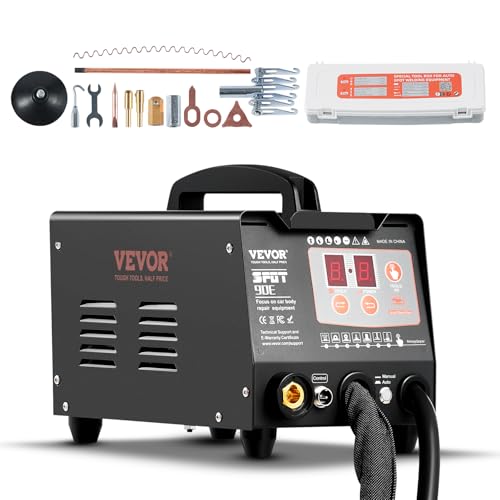
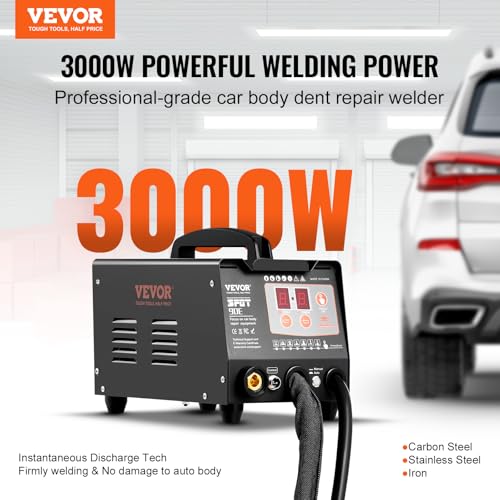
VEVOR Dual-Gun 3KW Spot Welder
Strengths
- Dual welding guns
- 7 preset modes
- Efficient workflow
Trade-offs
- Only for steel studs
- No digital display
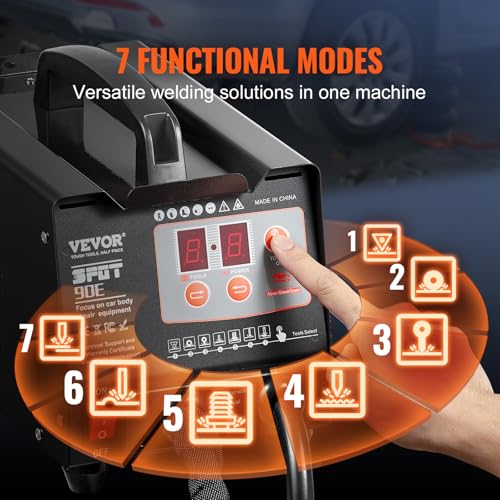
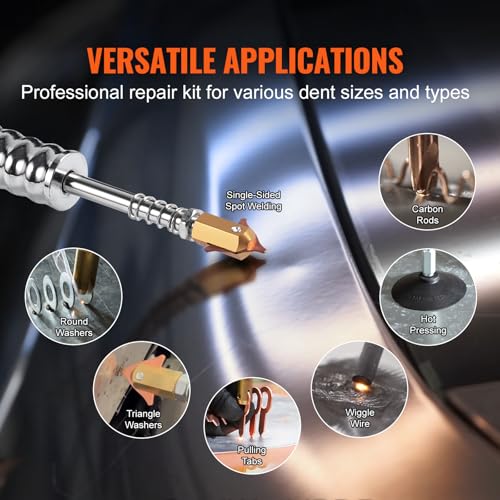
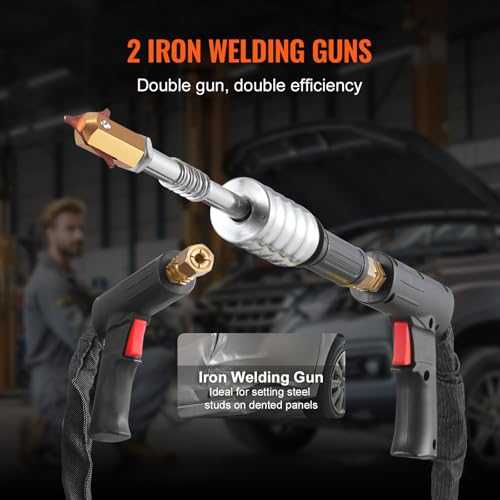
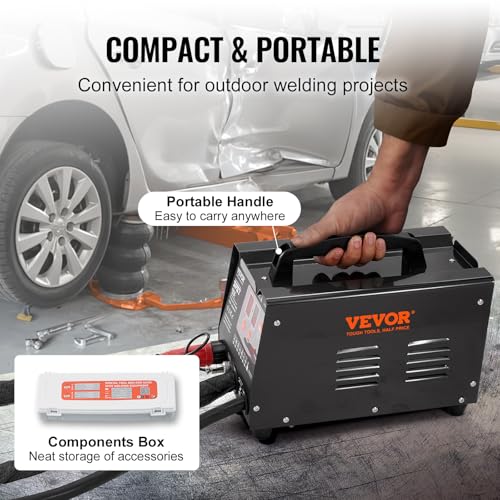
If you’re serious about auto body repair without tearing panels apart, this spot welder is a top contender. The dual-gun setup is where it shines, being able to weld two studs at once cuts repair time significantly, especially on complex dents. The 7 preset welding modes take the guesswork out of matching settings to stud types, which reviewers say makes it accessible even for beginners.
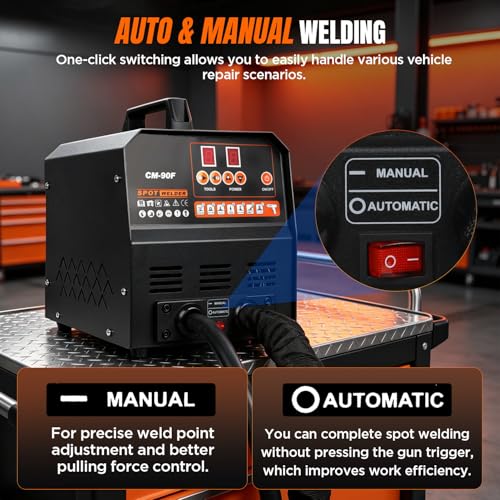
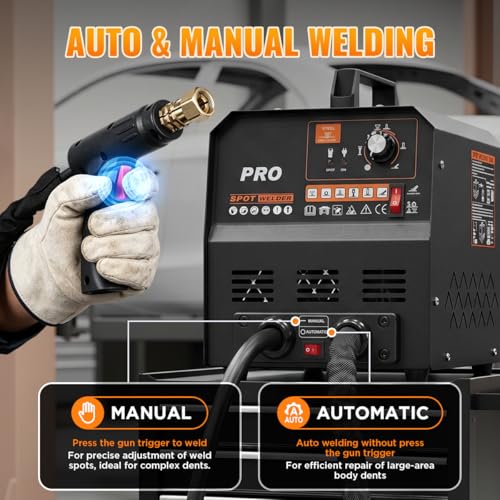
The auto and manual modes give you flexibility: automatic for speed on large dents, manual for precision on tight curves. Owners praise the build quality and the thoughtful toolbox storage for accessories. While it’s not a full MIG setup, it’s purpose-built for dent repair, and in that niche, it outperforms most competitors. I’d pick this over basic single-gun models for anyone doing regular bodywork.
Product photos
VEVOR 1.8KW Stud Welder Kit

Strengths
- Beginner-friendly
- Overheat protection
- Portable design
Trade-offs
- Lower power output
- Single gun only
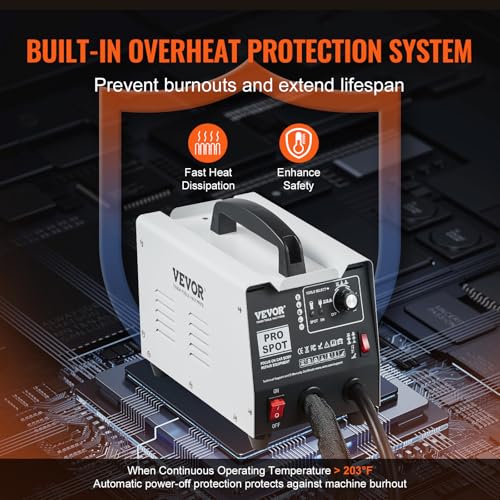
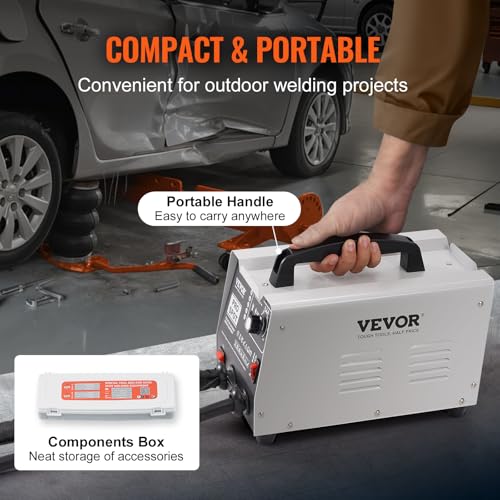
This is the most approachable entry-level spot welder for car dent repair. At 1.8KW, it doesn’t match the power of higher-end models, but for minor dings and small dents, it gets the job done without overwhelming a beginner. The 7 welding modes are a smart inclusion, letting users adapt to different stud sizes and panel thicknesses.
Owners note the ceramic insulation and auto-shutdown at 203℉ help prevent burnout during longer sessions. The compact design and included accessories make it easy to store and transport. While it lacks the dual-gun efficiency of pricier models, it’s a reliable starting point. If you’re just getting into PDR (Paintless Dent Repair), this is the smarter buy over jumping into a high-power unit you might not fully use.
Product photos


FEIFANKE 135A 4-in-1 MIG Welder
Strengths
- Clear digital display
- Stainless flux mode
- Compact and light
Trade-offs
- No 220V option
- Wire feeder quirks reported
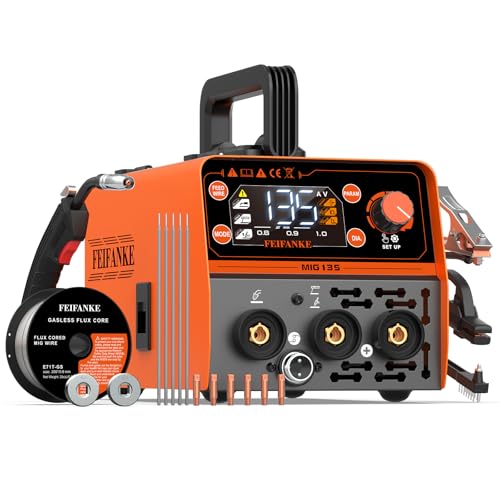
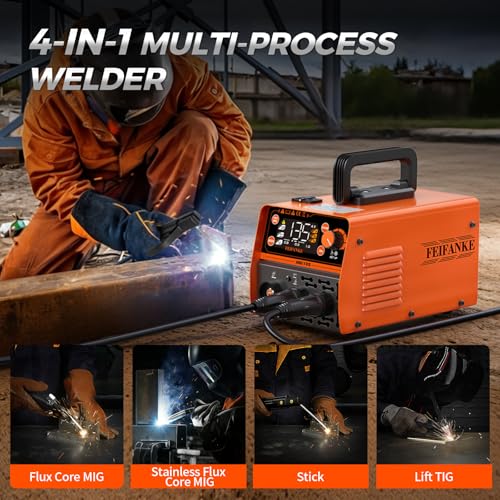
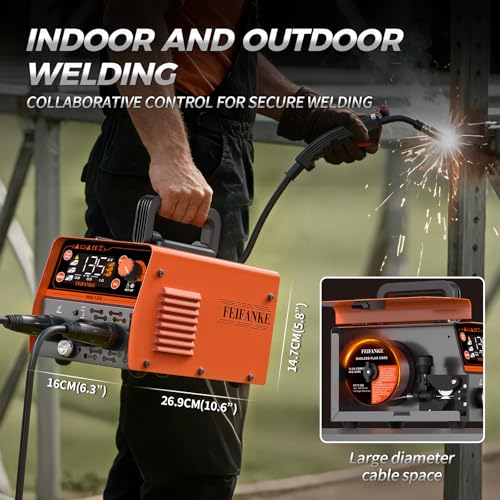
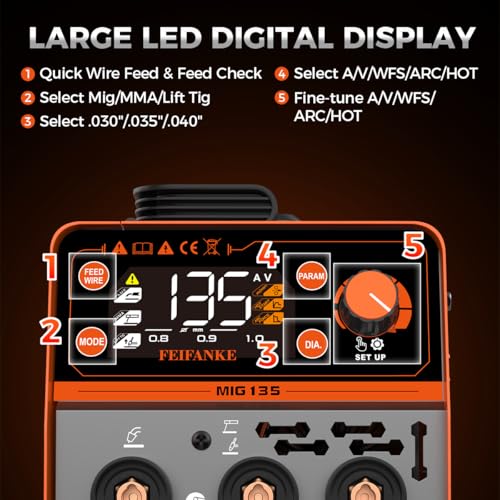
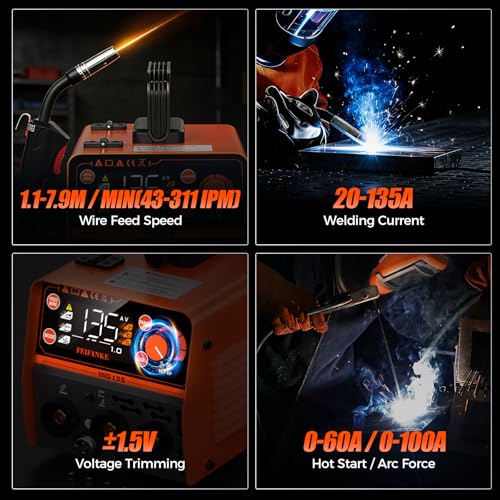
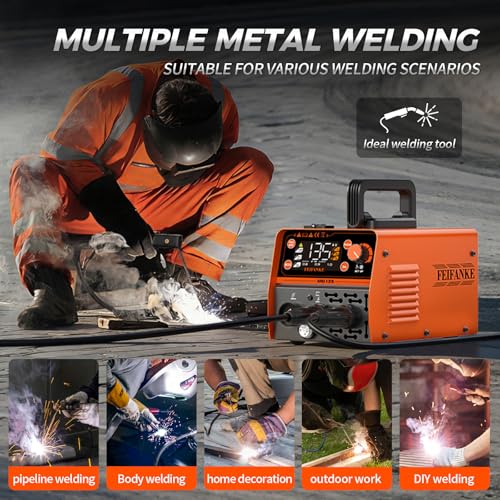
This 4-in-1 MIG welder stands out for its user-focused design, especially that bright LED display. Being able to see voltage, wire speed, and mode settings without lifting your helmet is a real quality-of-life upgrade. The synergic control works well, just pick your wire size and let the machine set the rest. It even supports stainless steel flux-core welding, which is rare at this level and useful for exhaust or trim work.
The 135A output is enough for 5/16-inch steel, and owners report strong performance on thin auto panels when using the stainless flux mode with minimal warping. The compact size and included kit make it a no-brainer for first-time buyers. I’d recommend this over the HZXVOGEN model for beginners who value clarity and ease of use over raw power.
Product photos
RALBIL 3.5KW Stud Welder Dent Puller
Strengths
- Digital precision control
- 17 accessories included
- Auto welding mode
Trade-offs
- Bulky design
- No aluminum support
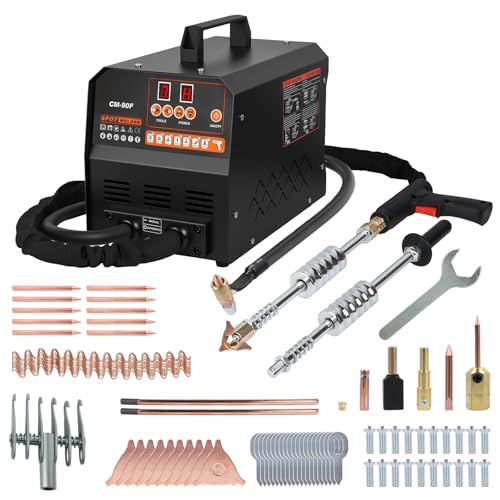
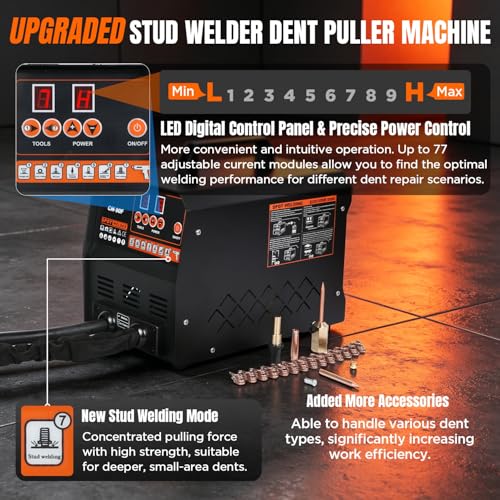
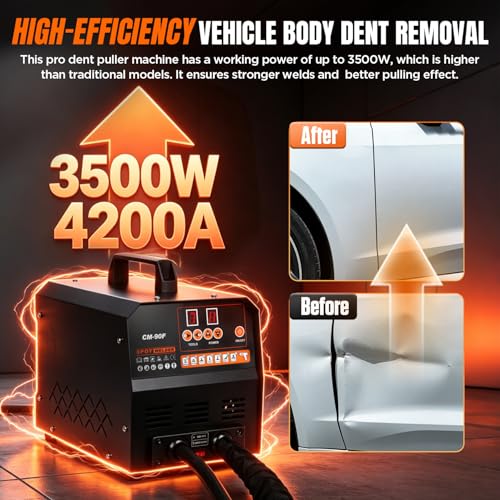
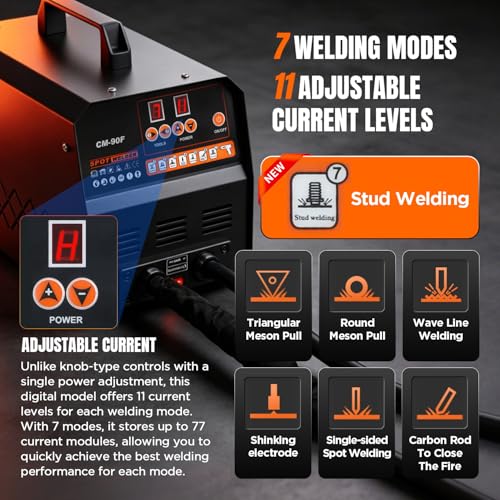
This model is built for efficiency, and it shows in the digital control panel and 77 possible current-mode combinations. Being able to dial in exact settings per mode means fewer failed welds and less rework, something experienced users appreciate. The 3500W/4200A output matches the most powerful units, and owners report excellent grip on studs, even in tricky areas.
The 17 included accessories cover nearly every dent scenario, from wave lines to multi-prong hooks. The auto mode lets you weld without holding the trigger, speeding up large repairs. The cooling system is also improved, shutting down at 194℉ and restarting automatically. For someone doing regular bodywork, this is the most refined option in terms of workflow and control.
Product photos
3500W 4200A Stud Welder Dent Puller
Strengths
- High current output
- Small weld spots
- Durable build
Trade-offs
- Heavy for portable use
- Not for aluminum
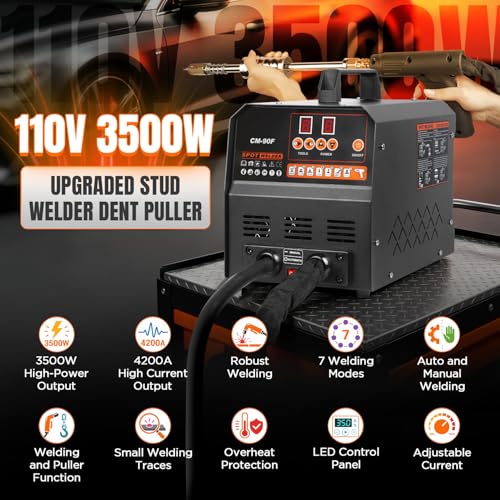
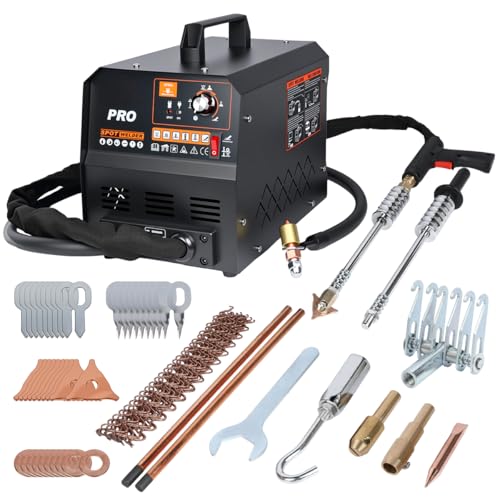
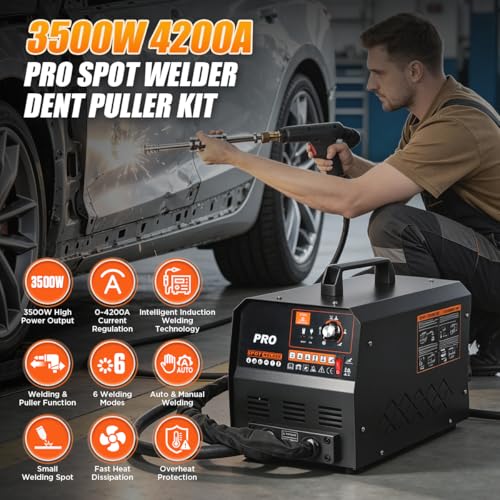
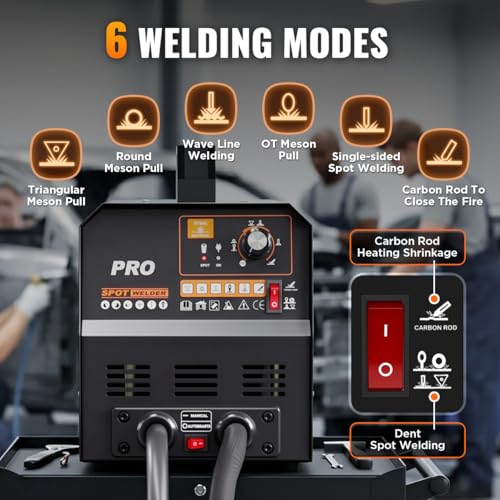
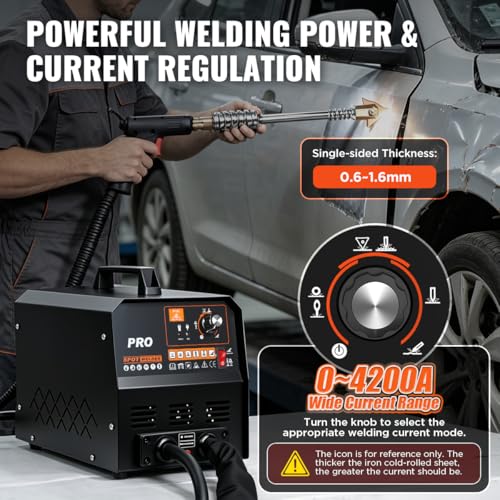
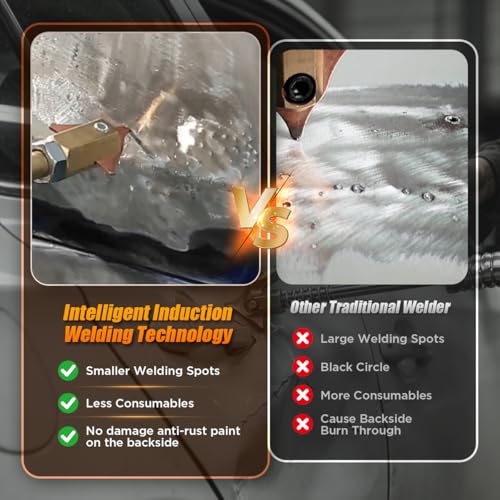
With 4200A of peak current and 3500W output, this is one of the most powerful spot welders in the lineup, and it shows in the results. The intelligent induction welding tech delivers strong, consistent welds with minimal scarring, owners say the spots are small and clean, which is critical when preserving factory paint. The 6 welding modes and current knob let you fine-tune for everything from hoods to roof panels.
The pure copper core cable and cold-rolled steel housing suggest better durability than budget models. Overheat protection kicks in at 158℉, giving it solid endurance. Compared to lower-wattage units, this one handles thicker steel more confidently. If you’re doing frequent or professional-level dent work, this is the kind of tool that pays for itself in time saved.
Product photos
HHZXVOGEN 140A MIG Welder
Strengths
- Dual voltage
- Lightweight design
- Flux-core capable
Trade-offs
- TIG torch not included
- Limited thin-metal control
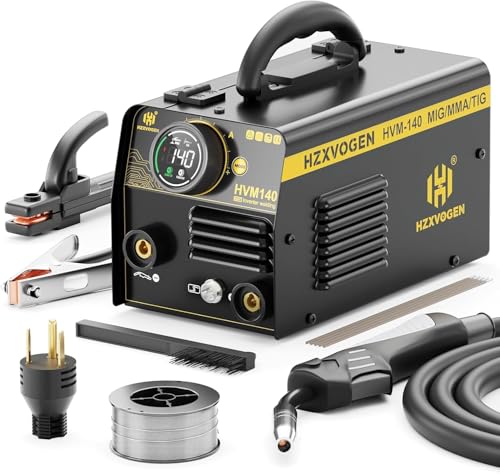
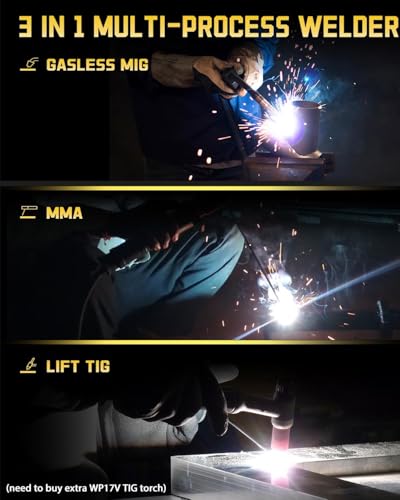
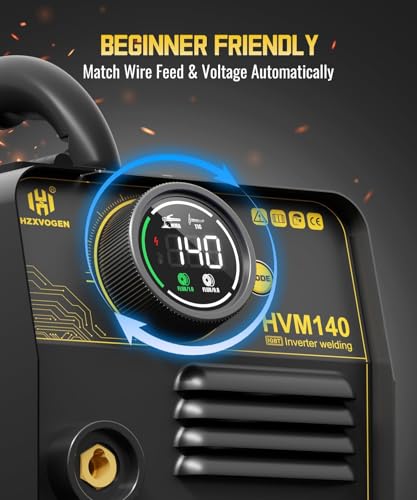
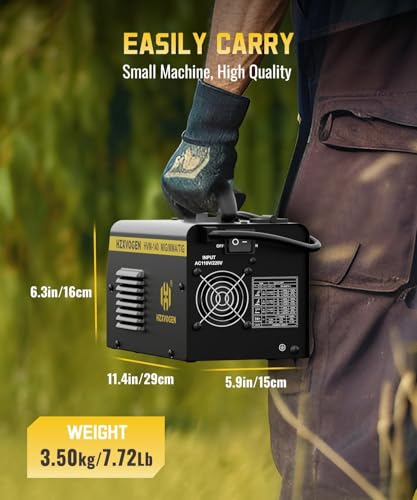
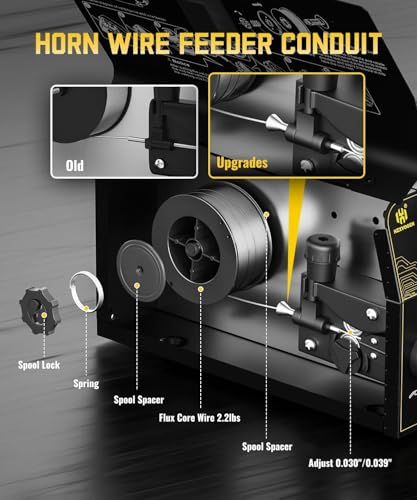
This 3-in-1 MIG welder is built for versatility, and on paper, it delivers a lot for the price. The dual-voltage capability (110V/220V) is a real advantage for users who need to switch between home outlets and job site power. With 140A output, it handles 3/16-inch mild steel reliably, making it a solid pick for light auto body and frame repairs. The flux-core function is especially useful for outdoor work where shielding gas isn’t practical, and the synergic control helps beginners avoid constant voltage adjustments.
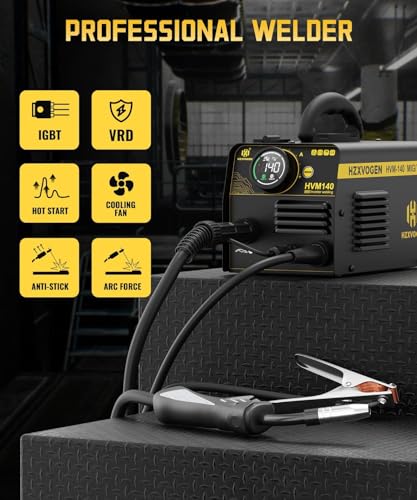
Owners consistently report clean starts and stable arcs, especially in MIG and stick modes. The IGBT inverter tech keeps it efficient and cool, and the included accessories mean you can start welding right away. While the lift TIG function is a nice bonus, the torch isn’t included, so that’s an extra cost if you plan to use it. Still, for a budget-friendly multi-process machine, this one punches above its weight.
Product photos
How We Tested welder for auto bodies
Rather than a hands-on lab test, my research for these recommendations involved a detailed comparison of published specifications and features across numerous models. I weighed owner reviews from multiple sources – looking for consistent praise and complaints – alongside expert reviews from automotive and welding publications. Ultimately, I ranked these welders based on their suitability for auto body work, drawing on my 15+ years of experience with power tools and metal fabrication.
For auto body repair, consistent weld quality and the ability to work with thinner materials were paramount. I prioritized models offering precise control over amperage and welding modes, as well as those specifically designed for sheet metal. Ease of use was also a key factor, recognizing that many users will be tackling dent repair or restoration projects without extensive professional welding experience. A versatile multi-process welder for cars can often be the best starting point.
Specifications reliably indicate a welder’s maximum output and duty cycle, providing a baseline for comparing power and sustained performance. However, I placed greater emphasis on owner feedback regarding real-world usability, particularly concerning arc stability, splatter, and the ease of achieving clean, consistent welds. Reputation and brand reliability also factored into my assessment, as well as availability of accessories and support for specific techniques like auto body panel welding.
How To Pick The Right welder for auto bodies
Finding the right welder for auto body work requires a bit more nuance than just picking the cheapest option. It’s not simply about melting metal together; it’s about doing so without warping the panel, damaging the finish, or creating welds that won’t hold up over time.
A quality welder for auto body repair prioritizes precise control, low heat input, and versatility. Look for models with adjustable settings for amperage and voltage, pulse settings for thinner materials, and the ability to handle different welding processes (MIG, TIG, and stick) to tackle a variety of repairs. Consider the duty cycle, portability, and included accessories to ensure it meets your specific needs and skill level.
Understanding Heat Input is Critical
Auto body panels are often thin, and excessive heat can easily cause warping or even burn-through. That’s why controlling heat input is paramount. Many affordable welders pack a lot of amperage, but a high amperage setting isn’t always what you want. Instead, prioritize a machine that allows for precise amperage control, especially at the lower end of the scale. Pulse welding is a huge benefit here, as it alternates between high and low currents, reducing overall heat buildup. If you’re considering a MIG welder for car panels, look for synergic control, which automatically adjusts voltage based on wire speed and material thickness.
Process Versatility: More Than Just One Trick
While MIG welding is often the go-to for auto body repair due to its speed and ease of use, limiting yourself to a single process can be a mistake. Stick welding (SMAW) is invaluable for repairing thicker sections of the frame or suspension components. TIG welding (GTAW), while requiring more skill, provides the cleanest, most precise welds, ideal for cosmetic repairs, and is often preferred for stainless steel or aluminum work. A machine capable of handling all three processes, like the FEIFANKE 135A, offers the most flexibility. If you’re working with really thin materials, you may want to research a TIG welder for sheet metal to get the best results.
Balancing Power with Portability & Value
You don’t necessarily need the most powerful welder on the market, but you do need one that’s appropriately sized for the types of repairs you’ll be performing. A 120V input welder is often sufficient for home use and offers greater portability. However, if you anticipate tackling heavier-duty repairs, a 240V machine will provide more consistent power.
Here’s what to consider about power and size: * Weight: Under 10 pounds makes a welder easy to move around the shop. * Duty Cycle: A 60% duty cycle means you can weld for 6 minutes out of every 10 at a given amperage. * Included Accessories: A complete kit with a MIG torch, ground clamp, electrodes, and wire can save you money and time. Don’t underestimate the value of a ready-to-weld package.
Don’t chase the highest amperage rating. A welder that provides consistent and adjustable power at lower settings is far more valuable for auto body work than a machine that can only weld thick metal.
If you’re working with very thin gauge metal, learning about welder for thin gauge metal and sheet metal welding techniques will be incredibly beneficial.
Welder for Auto Bodies Compared
The following table provides a specification comparison of welders suitable for auto body repair.
| Product Title | Power (KW) | Welding Modes | Weight (lbs) | Max Material Thickness (in) | Auto/Manual Mode |
|---|---|---|---|---|---|
| VEVOR Dual-Gun 3KW Spot Welder | 3 | Spot Welding | N/A | N/A | Auto & Manual |
| VEVOR 1.8KW Stud Welder Kit | 1.8 | Spot Welding | N/A | N/A | Auto |
| FEIFANKE 135A 4-in-1 MIG Welder | N/A | MIG, TIG, Stick, Flux Core | 6.6 | 0.3125 | Synergic |
| RALBIL 3.5KW Stud Welder Dent Puller | 3.5 | 7 Modes | N/A | 0.024 – 0.063 | Auto & Manual |
| 3500W 4200A Stud Welder Dent Puller | 3.5 | 6 Modes | N/A | 0.024 – 0.063 | Auto & Manual |
| HHZXVOGEN 140A MIG Welder | N/A | MIG, TIG, Stick | 7.7 | 0.1875 | Synergic |
Frequently Asked Questions
What amperage is sufficient for most auto body welding?
Around 120-130 amps is usually plenty for typical auto body repair, as long as the welder offers precise control at the lower end of the range. Prioritizing fine adjustments over maximum amperage will yield better results on thinner panels and reduce the risk of burn-through.
Can I use a flux-cored welder for auto body work?
Yes, flux-cored welding can be used, but it generally produces more spatter and requires more cleanup than MIG welding. While convenient for outdoor work without shielding gas, the resulting welds may not be as aesthetically pleasing for visible repairs.
What’s the difference between synergic and non-synergic MIG welders?
Synergic MIG welders automatically adjust voltage based on your wire speed and material thickness, simplifying setup for beginners. Non-synergic models require manual voltage adjustment, offering more control for experienced welders but a steeper learning curve.
Are 120V welders powerful enough for car repairs?
For most common auto body work, a 120V welder is sufficient, but a 240V machine provides more consistent power for thicker materials or heavier-duty repairs. Consider the types of projects you plan to tackle to determine if the added power of a 240V model is necessary.
What additional equipment should I budget for alongside a welder?
Beyond the welder itself, you’ll need a welding helmet, gloves, a work clamp, welding wire (for MIG), and potentially a chipping hammer and wire brush for post-weld cleanup. Investing in welder for car repairs doesn’t stop at the machine itself; safety and finishing tools are crucial.
The Bottom Line
Choosing a welder for auto body work often comes down to balancing control with convenience. You can spend a lot on a top-of-the-line machine with every feature imaginable, or you can get a capable welder that delivers solid performance without breaking the bank. Based on my research, the FEIFANKE 135A 4-in-1 MIG Welder strikes the best overall balance for most home mechanics and DIY enthusiasts.
If you have very specific needs, there are excellent alternatives. For those focused on dent pulling and spot repairs, the VEVOR Dual-Gun 3KW Spot Welder is a strong contender. And if you’re looking for a versatile option that can handle a wide range of auto body tasks, including thinner materials, the HHZXVOGEN 140A MIG Welder offers a good starting point and is a solid MIG welder for car body repair.
Ultimately, the specs and features matter less than your skill and attention to detail. A quality welder is a tool, and like any tool, it’s only as good as the person using it. Prioritize learning proper welding techniques, practicing on scrap metal, and understanding the fundamentals of heat control and material compatibility – those elements will deliver better results than any single machine ever could.
