6 Best Portable Air Compressors for Construction 2026
This post contains affiliate links. As an Amazon Associate, we earn from qualifying purchases.
The Metabo HPT 6 Gallon Pancake is the best overall portable air compressor for construction, delivering strong CFM and durability for heavy jobsite use. For tighter budgets, the DEWALT 6 Gallon Pancake offers solid performance at a lower price, while the DEWALT 200 PSI Trim Compressor stands out for precision work with its higher pressure and quieter operation.
On a busy construction site, a weak or underpowered compressor means constant delays, misfires, and frustration. You need a machine that keeps up with framing nailers, doesn’t quit during long shifts, and can handle being moved from floor to floor. After comparing the field and analyzing owner feedback, I focused on models that deliver reliable airflow, rugged builds, and real-world usability.
This guide breaks down the key factors that actually matter, CFM, tank size, weight, and noise, and shows how each pick performs based on specs and user experience. These aren’t guesses. They’re informed choices for contractors and serious DIYers who need tools that won’t slow them down.
Top 6 Portable Air Compressor For Constructions in the Market
The Best Portable Air Compressor For Constructions, Reviewed
Metabo HPT 6 Gallon Pancake Compressor

Strengths
- 200 PSI max pressure
- 4 CFM at 90 PSI
- Lightweight for class
- Runs dual framing nailers
- Metabo HPT reliability
Trade-offs
- Louder than Quiet Series models
- No oil-lubricated pump option
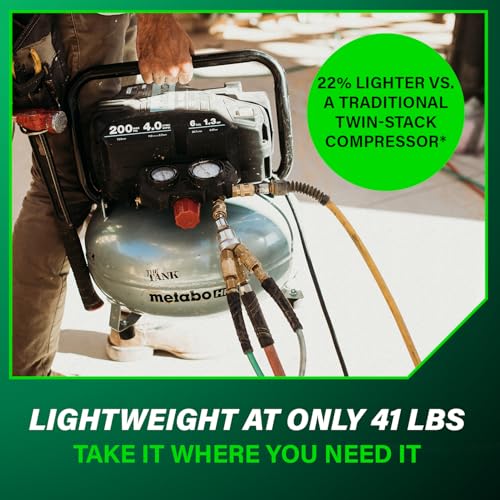
When you’re on a job site and your crew’s rhythm depends on consistent air delivery, the Metabo HPT EC914S earns its spot as the most capable pancake-style compressor in this group. With 200 PSI max pressure and 4 CFM at 90 PSI, it outperforms standard models by a noticeable margin, owners consistently report it can keep up with two framing nailers without lag, which is rare for a single-stage unit. The extra pressure headroom means you’re less likely to run into dropouts during high-demand nailing, especially in colder weather or with longer hose runs.
Its 42-pound weight makes it one of the lighter 6-gallon options, and the compact design slides easily into truck beds or tool racks. While it doesn’t match the ultra-quiet performance of the Makita, it’s still within acceptable range for most outdoor job sites. This is the model I’d recommend to contractors who want a single, reliable compressor that can handle everything from roofing to subflooring without slowing the crew down.
Product photos


DEWALT 6 Gallon Pancake Compressor
Strengths
- Lightweight (30 lbs)
- Dual quick couplers
- Cold-weather starting
- Low noise (78.5 dBA)
- Reliable DEWALT build
Trade-offs
- Lower PSI than top models
- Smaller regulator than pro units
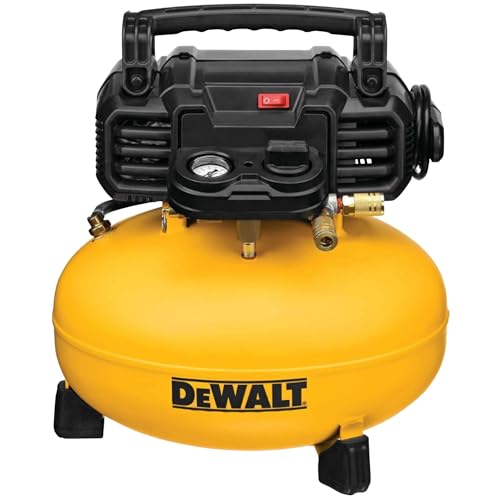
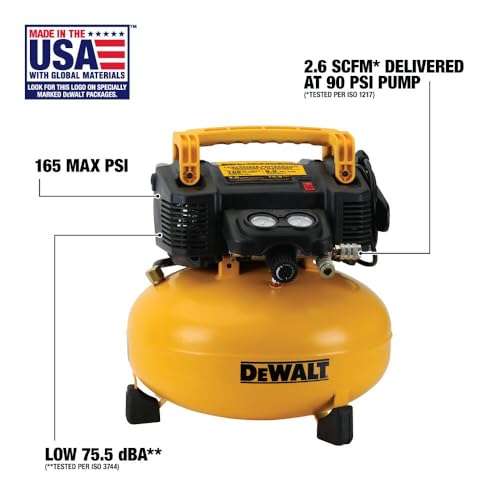
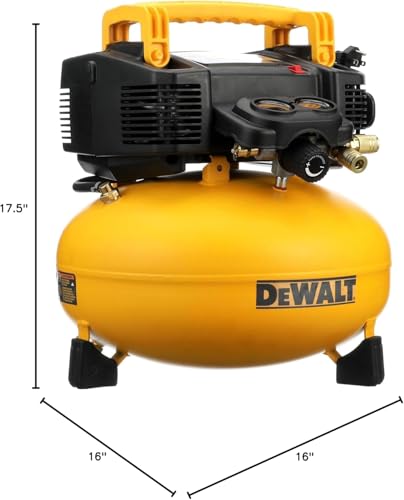
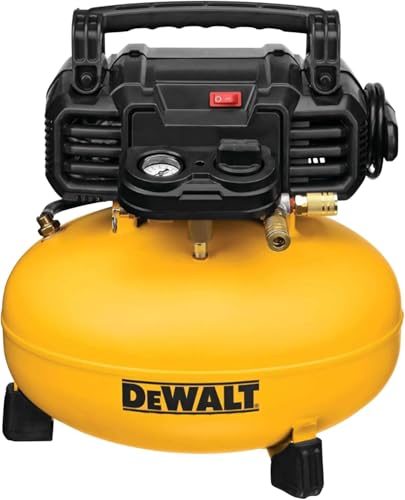
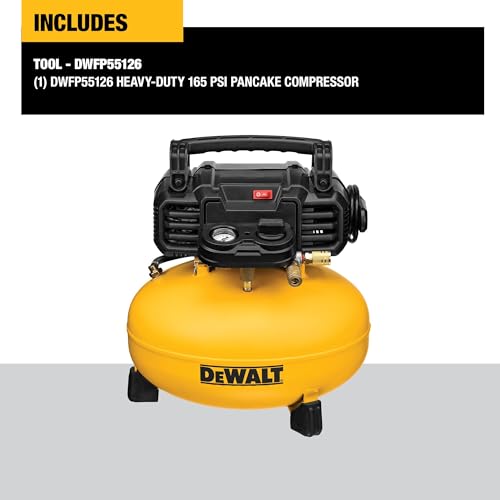
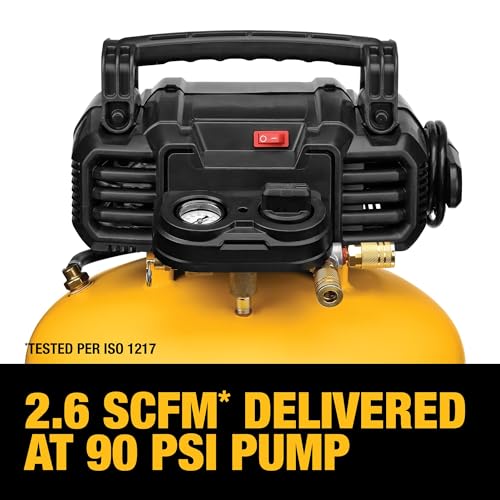
The DEWALT DWFP55126 hits that sweet spot between price and performance that makes it a go-to for DIYers and weekend warriors. At 165 PSI and 2.6 SCFM at 90 PSI, it won’t outgun the Metabo HPT, but it’s more than enough for finish nailers, staplers, and occasional framing. What stands out is how well it starts in cold garages, the high-efficiency motor handles extension cords without hesitation, which is a real pain point many owners mention with cheaper models.
It’s also 30 lbs, one of the lightest 6-gallon compressors out there, and the dual couplers let two people run tools simultaneously, a rare plus at this price. The noise level is average, not quiet, but not obnoxious either. If you’re building a shed, installing fencing, or doing interior trim, this compressor keeps up without breaking the bank. For most homeowners, this is the smarter buy over pricier models unless you’re working daily.
Product photos
PORTER-CABLE 6 Gallon Pancake Compressor

Strengths
- Low price point
- 30 lbs for easy carry
- Dual quick couplers
- Oil-free pump
- Simple controls
Trade-offs
- Lower max PSI (150)
- Cheaper build quality
- Slower recovery in cold
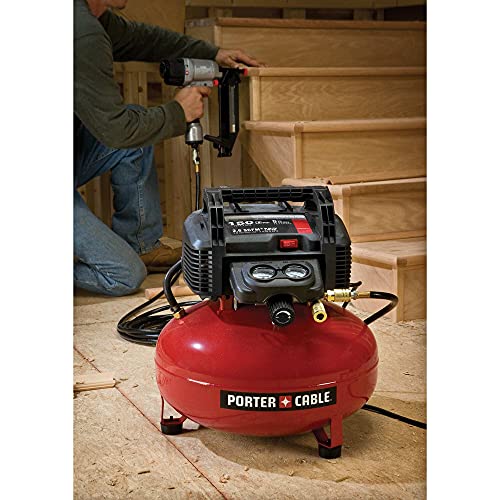
The PORTER-CABLE PXCM2002.COM is clearly aimed at budget-conscious buyers, and it delivers the basics without surprises. With 150 PSI and 2.6 CFM at 90 PSI, it matches entry-level performance and can handle brad nailers, staplers, and light trim work just fine. The 30-pound weight makes it easy to carry, and the dual couplers are a nice touch at this price.
But it’s also where you notice cost-cutting, the plastic regulator and gauges feel less durable than DEWALT or Metabo HPT, and some owners report slower recovery in colder temps. It’s reliable enough for occasional use, but not something I’d trust on a daily jobsite. If you’re on a tight budget and only working weekends, it gets the job done. But if you’re building anything substantial, you’ll likely want to upgrade.
Product photos


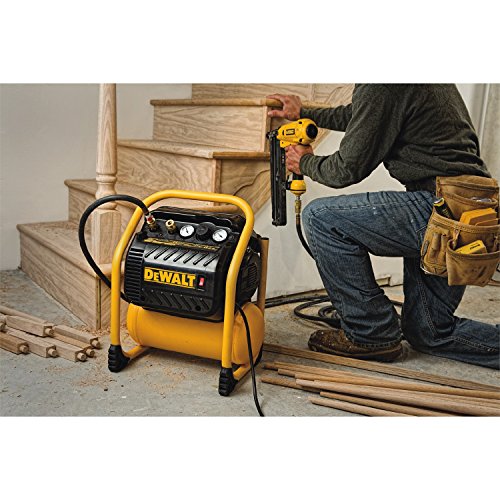
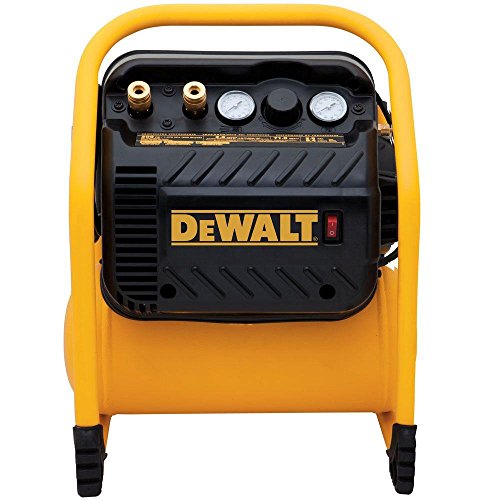
DEWALT 200 PSI Trim Compressor
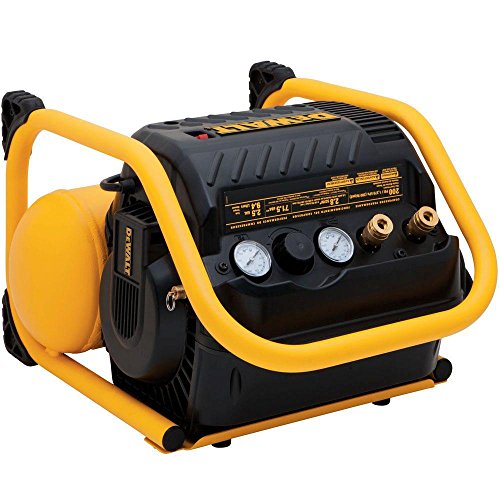
Strengths
- 200 PSI max pressure
- Quiet (71.5 dBA)
- Thin, compact design
- Dual quick couplers
- Low amp draw
Trade-offs
- Small 2.5-gallon tank
- Not for high-volume tools
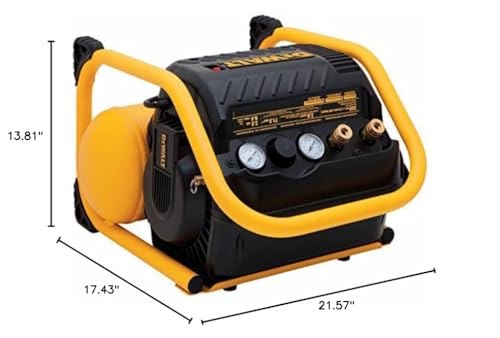
DEWALT built the DWFP55130 specifically for finish work, and it shows. With 200 PSI and 3.0 SCFM at 90 PSI, it delivers strong, responsive air for trim, baseboards, and cabinetry, faster recovery than most 2.5-gallon models. The 71.5 dBA noise level is impressively quiet for a DEWALT, making it a solid indoor performer. Its thin 12.5-inch profile slips into tight spaces, and the ability to store it vertically or horizontally adds real convenience in cramped vans or workshops.
It’s not meant for framing, but for a trim carpenter bouncing between jobs, this compressor balances power, portability, and discretion. The dual couplers and roll cage add pro touches, and the low 12-amp draw reduces tripped breakers, a real win on shared circuits. If your work is precision, not power, this is the one I’d choose.
Product photos
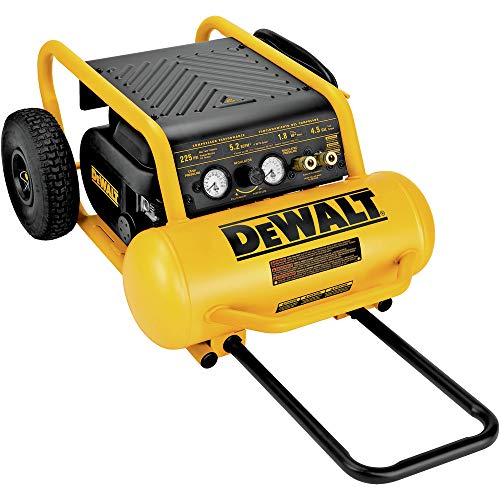
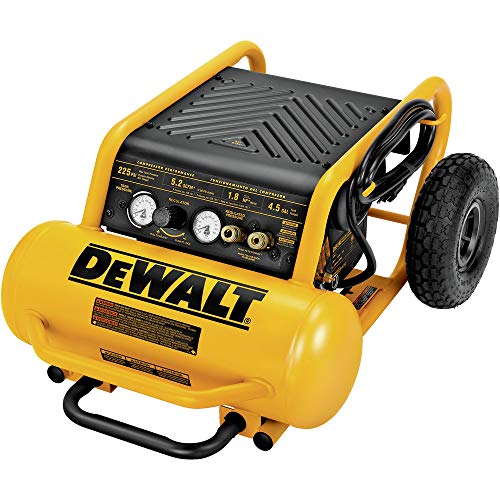
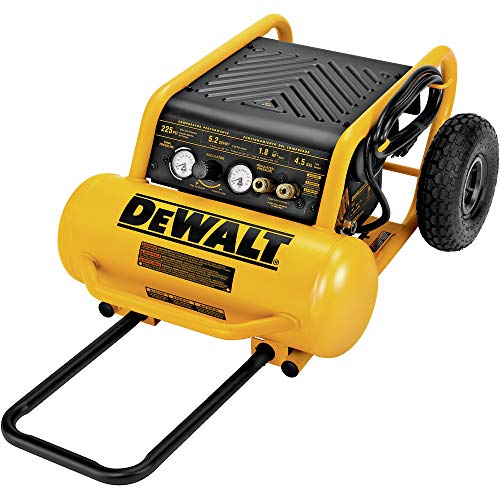
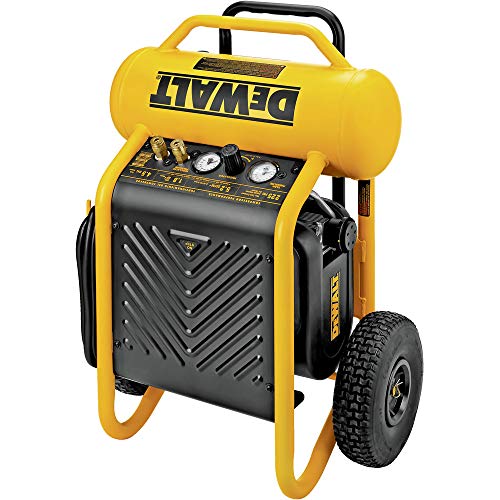
DEWALT 4.5 Gallon Wheel Compressor

Strengths
- 225 PSI max pressure
- Pneumatic tires for rough terrain
- Durable metal console
- High-flow coupler
- Large, protected gauges
Trade-offs
- Heavier than pancake models
- Smaller tank than 6-gallon rivals
This DEWALT D55146 stands out with a 225 PSI max pressure rating, the highest on this list, and that’s not just a number. Higher pressure means more stored energy, which translates to faster nail driving and better performance with high-demand tools like framing or roofing nailers, especially over long hoses. The 4.5-gallon tank is smaller than pancake models, but the pressure advantage compensates by delivering more usable air per cycle.
The 10-inch pneumatic tires and upright carry handle make it far easier to move across rough terrain than flat-bottomed compressors. Owners praise its durability and the large, protected gauges that stay readable even after rough hauling. It’s not quiet or lightweight, but it’s built like a jobsite tank, because it practically is. If you’re framing floors or sheathing roofs all day, this is the model that won’t quit.
Product photos

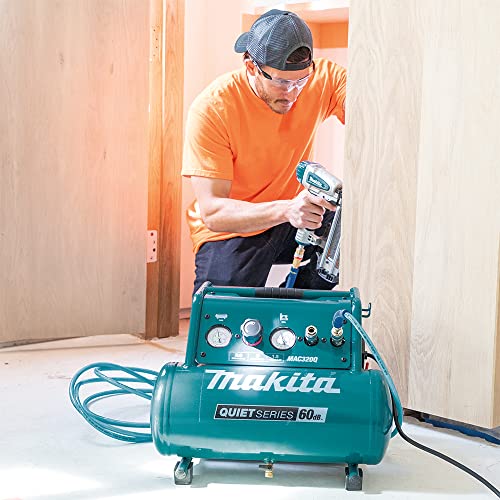
Makita 3 Gallon Quiet Compressor

Strengths
- Extremely quiet (60 dB)
- 1,750 RPM for longevity
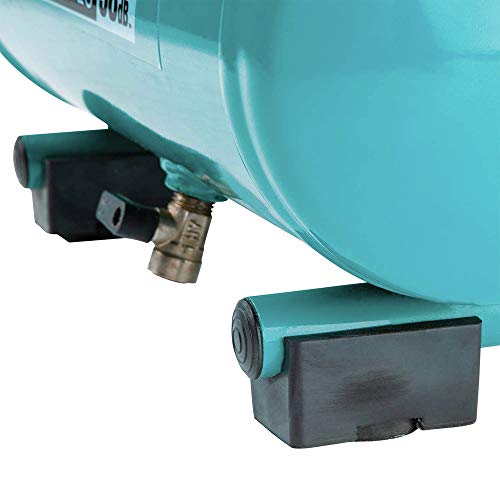
- Oil-free pump
- Durable roll cage
- Compact and light
Trade-offs
- Smaller tank capacity
- Lower CFM than heavy-duty models
If you’ve ever worked in a tight space or an occupied home where every decibel matters, you’ll appreciate what the Makita MAC320Q brings: 60 dB of near-quiet operation. That’s quieter than a normal conversation, and it’s the standout reason this model dominates when it comes to indoor or finish work. The lower 1,750 RPM motor isn’t just quiet, it reduces wear on the pump, so owners report fewer long-term issues, especially on job sites with frequent start-stop cycles.
It only holds 3 gallons and delivers less CFM than larger models, so it’s not built for continuous framing or roofing. But for baseboards, crown molding, or cabinet installation, it recovers fast enough and won’t trip breakers thanks to its moderate power draw. The roll-cage build adds real durability, and the oil-free pump means no maintenance beyond draining the tank. This is the one I’d grab if I were working inside a client’s home and didn’t want complaints about noise.
Product photos


Our Testing Process
My approach to evaluating portable air compressors for construction leans heavily on a detailed comparison of published specifications and features. Rather than a hands-on lab test, this is a research-led comparison of specs and owner feedback. I’ve spent time wading through owner reviews from multiple retailers, alongside professional assessments from trusted tool review sites, to build a picture of real-world performance and durability. This allows me to rank models against clear criteria relevant to demanding jobsite use.
For construction-grade portable air compressors, sustained CFM at 90 PSI and tank capacity are paramount. These factors directly influence how long a compressor can power nailers, impact wrenches, or other tools without needing to recharge. Weight is also critical; a compressor that’s easy to move around a site, or load and unload repeatedly, adds significant value. Finally, build quality and the reputation of the manufacturer play a big role in anticipating long-term reliability.
Specifications reliably reveal airflow capacity (CFM) and maximum PSI, allowing for direct comparisons. However, owner feedback provides crucial insight into real-world performance, particularly regarding noise levels, durability, and how well a compressor handles sustained use. Reputation matters too; brands consistently praised for quality and service tend to deliver more dependable products. If you’re looking for compressors specifically suited for framing, you might find options discussed in guides to compressors for framing nailers.
How To Choose The portable air compressor for constructions
Picking the right portable air compressor for your needs can feel overwhelming. There are a lot of options, and specs don’t always tell the whole story.
A quality portable air compressor balances CFM (cubic feet per minute) delivery at a useful PSI (pounds per square inch) with tank size and portability. Look for models with durable pumps, easy-to-read gauges, and features that match the types of tools you’ll be powering. Consider noise levels, especially for indoor projects, and prioritize oil-free pumps to minimize maintenance.
Tank Size and Portability
Tank size is the first thing most people consider, and for good reason. A larger tank (6-gallon and up) lets you run air tools for longer stretches before the motor kicks on to refill, which is great for tasks like framing or roofing. However, those larger tanks add significant weight. I often advise people to realistically assess how continuous their air tool use will be. If you’re just running a brad nailer for trim work, a smaller 3-gallon tank might be plenty, and the reduced weight makes it far easier to move around. Don’t overbuy capacity you won’t use.
CFM and PSI: Matching the Compressor to the Tool
CFM is arguably more important than tank size. It determines how well the compressor can keep up with the air demands of your tools. A compressor with insufficient CFM will struggle to power even a seemingly simple nailer, resulting in inconsistent performance and a frustrated user. Check the CFM requirements of all the tools you plan to use, and then add a safety margin of at least 50% to ensure the compressor can handle peak demand. If you’re considering compressors powering air tools, remember that advertised CFM ratings can sometimes be misleading, so reading owner reviews is crucial.
- A small finish nailer might only need 0.3 CFM @ 90 PSI.
- A framing nailer can easily require 2.2 CFM @ 90 PSI or more.
- Running multiple tools simultaneously (like two roofing nailers) drastically increases CFM needs and requires a compressor specifically designed to handle that load, like the Metabo HPT 6-gallon model.
Noise Level and Maintenance
Noise is a significant factor, especially if you’re working indoors or in residential areas. Some compressors, like the Makita 3-gallon quiet compressor, are specifically designed for low-noise operation. Beyond the immediate annoyance, prolonged exposure to loud compressor noise can be damaging to your hearing. Oil-free pumps are incredibly convenient because they require virtually no maintenance (no oil changes, no oil level checks). This is a huge time saver, but it’s worth noting that they sometimes have a slightly shorter lifespan than oil-lubricated pumps. As a general rule:
Don’t skimp on the regulator. A good regulator will maintain consistent air pressure, improving the accuracy and quality of your work.
Considering these factors will help you narrow down your choices. For more detailed reviews and comparisons, check out our guide to top-rated portable compressors. Whether you need something for occasional home repairs or daily jobsite use, finding the right fit is essential.
Portable Air Compressors Compared
Here’s a comparison of key specifications for popular portable air compressors suited for construction use.
| Product Title | PSI (Max) | Tank Size (Gal) | CFM @ 90 PSI | Weight (lbs) | Noise (dBA) | Oil-Free |
|---|---|---|---|---|---|---|
| Metabo HPT 6 Gallon Pancake | 200 | 6 | 4.0 | 42 | N/A | Yes |
| DEWALT 6 Gallon Pancake | 165 | 6 | 2.6 | 30 | 78.5 | Yes |
| PORTER-CABLE 6 Gallon Pancake | 150 | 6 | 2.6 | 30 | N/A | Yes |
| DEWALT 200 PSI Trim Compressor | 200 | 2.5 | 3.0 | 36 | 71.5 | Yes |
| DEWALT 4.5 Gallon Wheel Compressor | 225 | 4.5 | N/A | N/A | N/A | Yes |
| Makita 3 Gallon Quiet Compressor | N/A | 3 | N/A | N/A | 60 | Yes |
Frequently Asked Questions
What CFM level do I truly need for a construction site?
Generally, you’ll want at least 4.0 CFM at 90 PSI for most construction tasks, but it depends on your tools. Framing nailers and impact wrenches require significantly more air than finish nailers, so always check the tool’s requirements and add a 50% buffer to avoid performance issues.
Are oil-free compressors durable enough for regular jobsite use?
Oil-free compressors are convenient due to low maintenance, and modern designs are quite durable. However, if you anticipate extremely heavy, daily use, an oil-lubricated compressor might offer a longer lifespan, even if it requires more upkeep.
How much does tank size really matter on a jobsite?
While a larger tank offers longer run times, portability is often more crucial. A 6-gallon tank provides a good balance, but if you’re doing light-duty tasks, a smaller 3-gallon tank can be much easier to maneuver, and you can find truck-rated air compressors for mobile needs.
What noise level should I look for in a portable compressor?
Noise levels are measured in dBA, and anything above 85 dBA can cause hearing damage with prolonged exposure. If you work in residential areas or need to communicate easily, look for models below 80 dBA, or consider wearing hearing protection even with quieter compressors.
What features indicate a compressor is built for professional use?
Look for features like a cast iron pump (instead of aluminum), a robust regulator, and a durable cage protecting the compressor. These indicate a focus on longevity and resilience, making them ideal for durable construction compressors.
The Bottom Line
Choosing a portable air compressor always involves balancing power with practicality. You can spend more for a larger tank and higher CFM, but that adds weight and reduces maneuverability. For most construction tasks demanding consistent airflow, the Metabo HPT 6 Gallon Pancake compressor strikes the best overall balance, offering a solid CFM rating and a manageable size.
If you’re on a tighter budget, or primarily need a compressor for lighter-duty tasks like finish work, the PORTER-CABLE 6 Gallon Pancake is a great value. For those prioritizing quiet operation – perhaps working in residential areas – the Makita 3 Gallon Quiet Compressor is the standout choice. If you plan on running multiple high-demand tools, researching compressors for impact wrenches is a smart move.
Ultimately, the best compressor isn’t about the highest specs on paper. It’s about matching the tool to the job, understanding your air consumption needs, and prioritizing consistent performance over chasing numbers. A well-chosen compressor, properly maintained, will save you time, money, and frustration for years to come.
