9 Best Kitchen Knife Sharpening Tools 2026
This post contains affiliate links. As an Amazon Associate, we earn from qualifying purchases.
The Work Sharp Precision Adjust is the best overall kitchen knife sharpener for its precise angle control and durable diamond and ceramic plates, while the Sharp Pebble Premium Whetstone offers the best value for those who prefer a traditional sharpening stone. For a no-fuss budget pick, the AccuSharp delivers quick touch-ups with minimal learning curve.
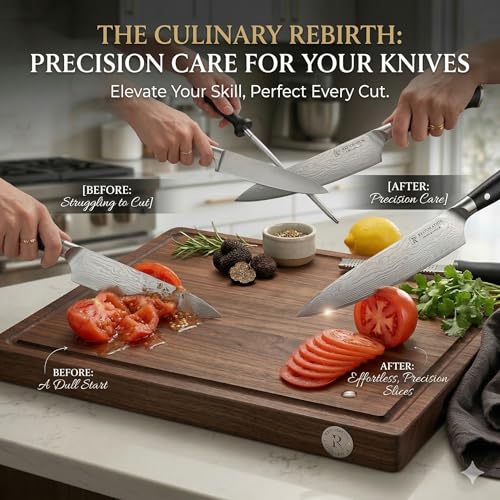
Most home cooks know the frustration of a dull knife, slipping on tomatoes, sawing through bread, and the extra effort that turns simple prep into a chore. But picking the right sharpener isn’t just about fixing that; it’s about finding a tool that matches your routine, your knives, and your confidence level.
After researching the top models, analyzing specs, and reviewing real-world feedback from owners and experts, I’ve focused on what actually matters: consistent angles, durable abrasives, and ease of use. This guide cuts through the hype to show you which sharpeners deliver reliable results without wasting your time or wearing down your blades.
Top 9 Kitchen Knife Sharpening Tools in the Market
The Best Kitchen Knife Sharpening Tools, Reviewed
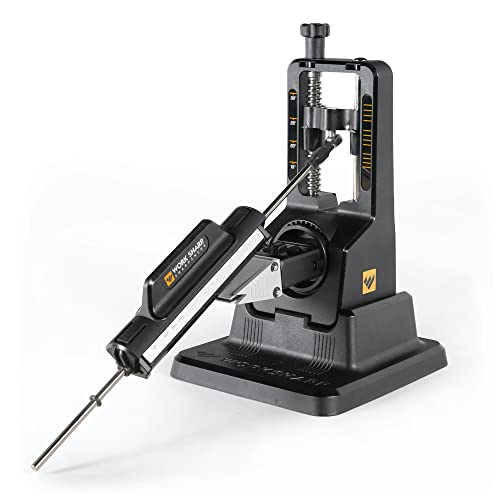
Work Sharp Precision Adjust Knife Sharpener
Strengths
- Adjustable 1-degree increments
- Tri-abrasive sharpening
- V-block clamp
Trade-offs
- Higher price point
- Larger footprint
This is the kind of tool I’d recommend to someone who owns a serious knife collection and wants repeatable, pro-level results. The adjustable angle system, 15 to 30 degrees in 1-degree increments, is where it pulls ahead. You can match any factory bevel or customize edge geometry for specific tasks, which matters if you’re tuning a chef’s knife versus a heavy cleaver. The tri-abrasive rod with coarse and fine diamond plus ceramic gives you full control over stock removal and polishing.
Owners consistently report it handles both Western and Japanese knives with ease, and the v-block clamp keeps the blade secure without marring the finish. It’s more expensive, but the 3-year warranty and Oregon-built quality suggest it’s built to last. Compared to fixed-angle systems, this one offers real versatility. If you’re serious about knife care, it’s the smarter long-term buy.
Product photos


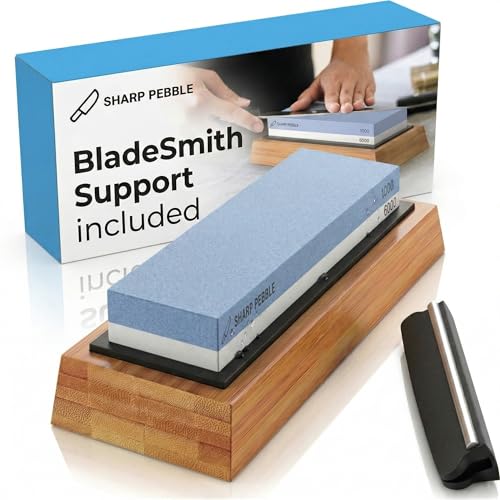
Sharp Pebble Premium Whetstone Sharpening System
Strengths
- Angle guide included
- CBN-infused stone
- Dual grit efficiency
Trade-offs
- No coarse grit for damaged edges
- Bamboo base can swell
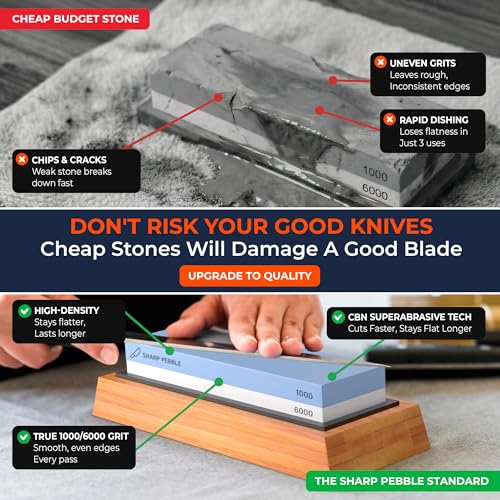
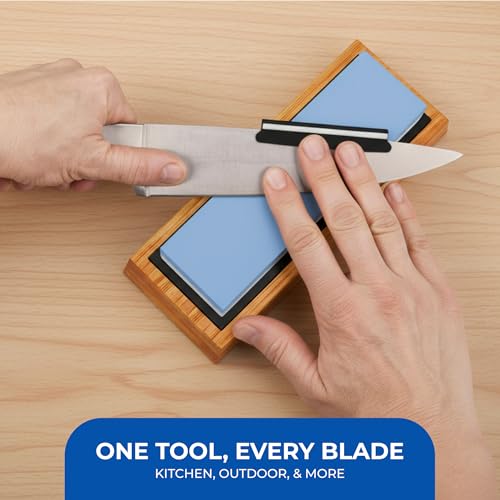
This kit stands out as a smart entry point for beginners who want real sharpening control without the intimidation factor. The angle guide is a standout on paper, it removes the guesswork that trips up most first-time whetstone users, and owners consistently report achieving clean, sharp edges within minutes. The CBN-infused stone is notable, too. Unlike softer aluminum oxide stones that dish quickly, this one holds its flatness longer, which translates to more consistent results over time.
The 1000/6000 grit combo covers most real-world needs: rebuilding a worn edge and then polishing it to a refined finish. Reviewers note it outperforms many electric sharpeners in edge quality, especially on Japanese-style knives that benefit from a precise bevel. It’s not the most advanced setup, but for the price, it delivers pro-level results with minimal learning curve.
Product photos



SHARPAL 191H Knife Scissors Sharpener

Strengths
- Strong suction base
- Scissors-specific slot
- Tungsten carbide blades
Trade-offs
- Not for aggressive sharpening
- No angle control
This little tool solves a real pain point: sharpening scissors without sending them off or struggling with inconsistent results. The dedicated tungsten carbide scissors slot actually works, owners confirm it restores household and kitchen shears effectively, which is rare in compact sharpeners. The suction base is a standout feature, locking it securely to countertops so you don’t have to brace it by hand. That makes it safer and more consistent, especially for left-handed users.
It’s not meant for full blade reprofiling, but for touch-ups and maintenance, it’s efficient. The carbide and ceramic stages handle light sharpening and honing well, though it won’t fix badly damaged edges. Its compact size means it can live in a drawer or garage without taking space. For the niche it targets, it’s one of the few tools that actually delivers.
Product photos


AccuSharp Knife Sharpener
Strengths
- Sharpens in seconds
- Durable tungsten blades
- Works on serrated knives
Trade-offs
- Limited edge refinement
- Not for blade repair
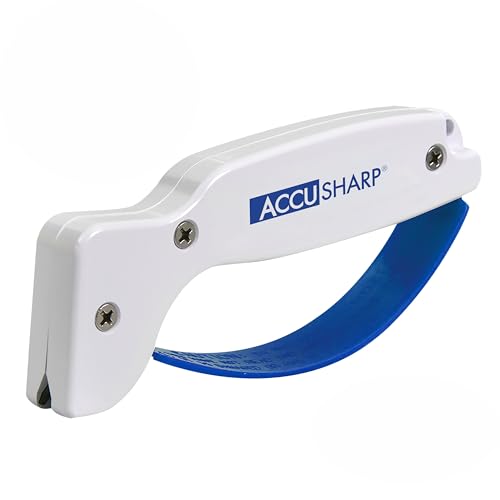
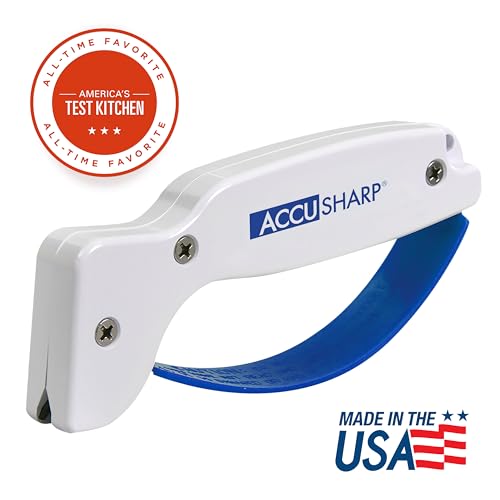
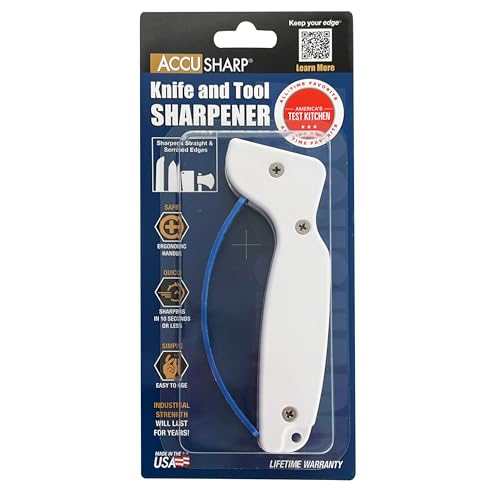
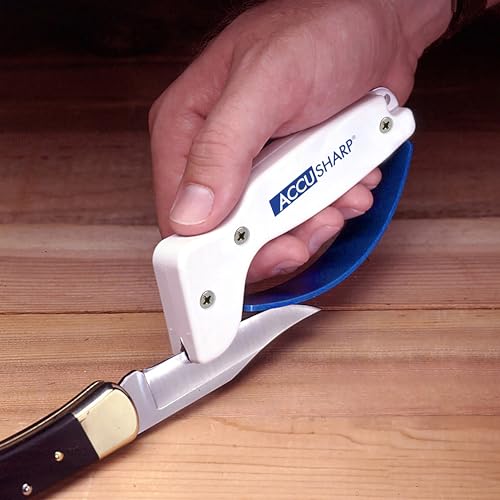
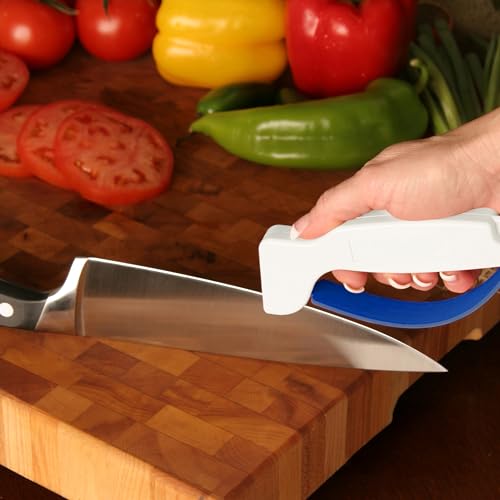
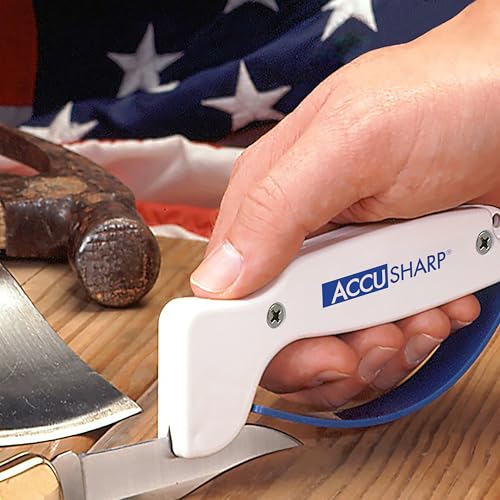
When speed and simplicity matter most, the AccuSharp delivers. It’s not a precision sharpening system, but for restoring a slightly dull blade in 10 seconds, it’s unmatched. The diamond-honed tungsten carbide blades bite quickly and create a clean edge, and the ergonomic handle with full guard makes it safe for all users. Owners love how long it lasts, many report years of daily use with no degradation.
It works on both straight and serrated knives, which is rare at this price. But it’s not for reprofiling or deep sharpening, think of it as a honing tool with more bite. Compared to whetstones or guided systems, it’s less precise, but for most home kitchens, that’s not the goal. It’s the right tool when you just need your chef’s knife functional again before dinner prep.
Product photos
Intelitopia Complete Knife Sharpening Stone Set

Strengths
- Wide grit range
- Flattening stone included
- Leather strop
Trade-offs
- Rubber bases can slip
- No CBN or diamond
This kit is the most complete whetstone package in the lineup, you get everything but the instruction video. The dual-sided stones (400/1000 and 3000/8000) cover a wide range of needs, from repairing dull blades to achieving a mirror polish. The inclusion of a flattening stone is a big win; most kits skip this, and owners of traditional whetstones know how critical it is for maintaining performance. The angle guide and leather strop add pro-level functionality that beginners and experienced users alike will appreciate.
The corundum material performs well on most steels, though it doesn’t cut as fast as CBN or diamond. Still, the value is strong, you’re getting multiple grits, accessories, and a durable bamboo base. Some owners note the rubber bases slip on wet counters, but that’s easily fixed with a damp towel. For those who want a full manual sharpening station, this kit delivers.
Product photos


AIERLIAN Rolling Knife Sharpener Kit

Strengths
- Precise 15° and 20° angles
- Diamond and ceramic discs
- Includes leather strop
Trade-offs
- Not for serrated knives
- No coarse stage for repairs
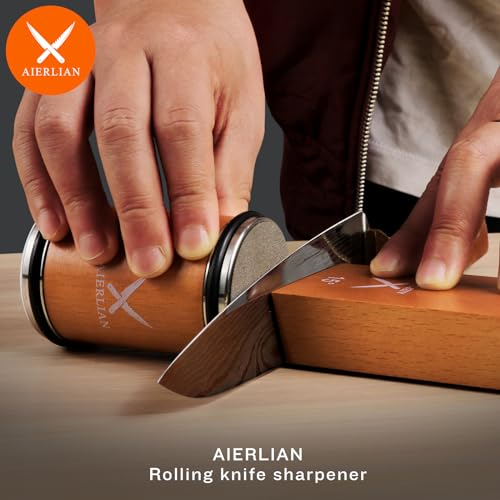
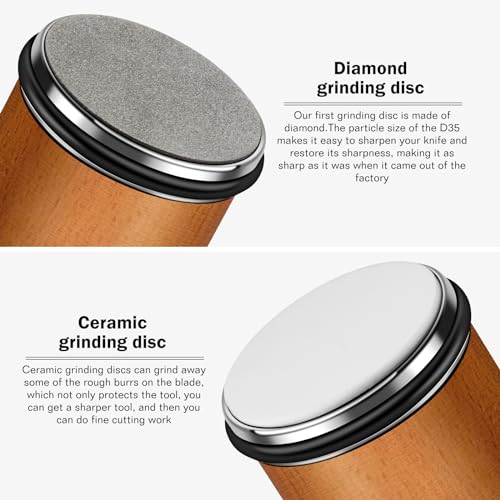
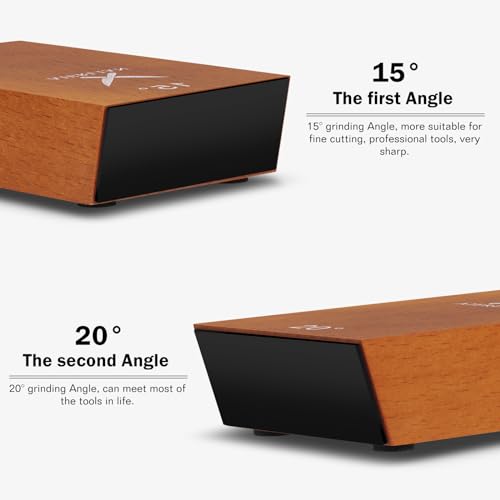
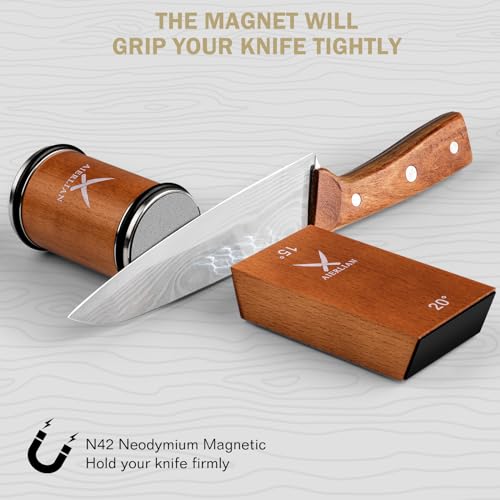
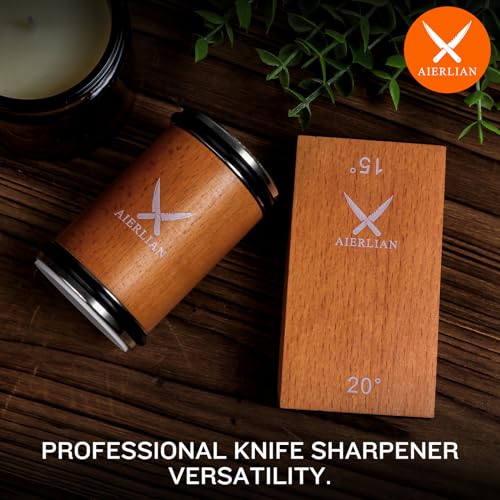
If you care about precise edge geometry, this roller sharpener earns its keep. The dual magnetic angle guides, 15 and 20 degrees, let you match factory specs exactly, which matters for high-hardness steel knives that demand consistency. Owners praise the diamond and ceramic disc combo: the #400 diamond cuts fast enough to reprofile without gouging, and the #3000 ceramic leaves a clean, polished edge. The magnetic base is strong and stable, and the wood housing gives it a premium feel on the counter.
The leather strop is a thoughtful addition, not just window dressing. It helps refine the apex and remove micro-burrs, something most guided systems skip. That said, it’s not built for aggressive stock removal or serrated blades. But for maintaining high-end kitchen cutlery, this system delivers repeatable, reliable sharpness that rivals more expensive setups.
Product photos
RUIXIN PRO RX-008 Knife Sharpener

Strengths
- 10 whetstones included
- G-clamp stability
- Handles S30V steel
Trade-offs
- Steep learning curve
- Many small parts
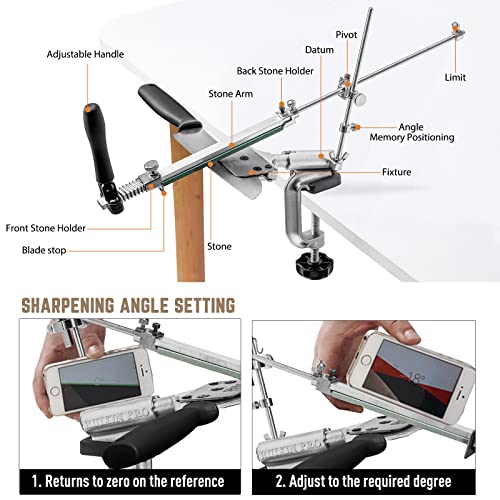
With 10 whetstones and a stainless steel fixture, this sharpener is built for users who want maximum flexibility in grit selection. The range, from 120 to 3000 grit, means you can tackle chipped or neglected blades and bring them all the way to a polished edge. The 360° flip design is clever, letting you switch sides with minimal angle deviation, and the G-clamp setup keeps it rock-solid on any workbench.
Owners appreciate the industrial build and the ability to sharpen serrated knives by adjusting the angle manually. However, the sheer number of stones means more upkeep, you’ll need to store and track them. It’s overkill for casual users, but for a workshop or pro kitchen, it’s a durable, long-term solution. The ability to handle S30V steel is a real plus for users with high-end pocket knives.
Product photos


Orange Ninja 4-Stage Knife Sharpener

Strengths
- Dedicated serrated slot
- 4-stage sharpening
- Ergonomic grip
Trade-offs
- Fixed slot angles
- Plastic body flex
This sharpener earns its spot if you own serrated knives, the dedicated serrated slot actually works, which many multi-slot systems fail to do. The 4-stage system (carbide, diamond, ceramic, serrated) gives you a full sharpening path in one pass. Owners report it brings old serrated bread knives back to life, which is no small feat. The carbide blades handle aggressive reshaping, while the fine ceramic stage polishes the edge.
The ergonomic ABS body feels sturdy, and the non-slip grip keeps it anchored during use. However, it’s not designed for precision, the slots don’t guide the blade at exact angles, so results can vary with technique. It’s best for users who want a simple, all-in-one solution and don’t mind trading some control for convenience.
Product photos


Knife Sharpener Rod 13 Inch Carbon Steel
Strengths
- Magnetized for filings
- Corrosion-resistant
- Ergonomic handle
Trade-offs
- Honing only, not sharpening
- No angle guide
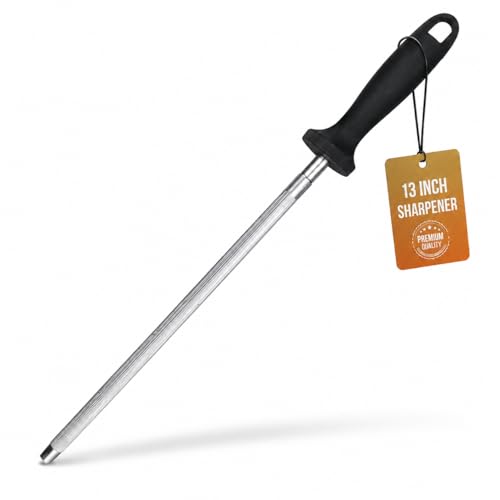
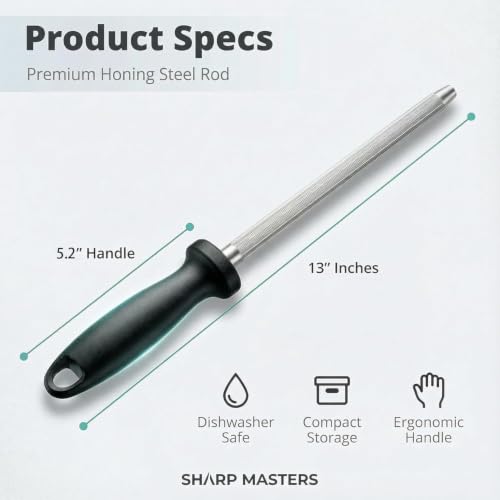
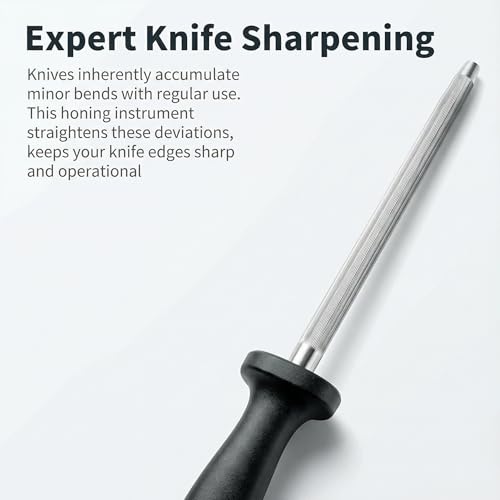
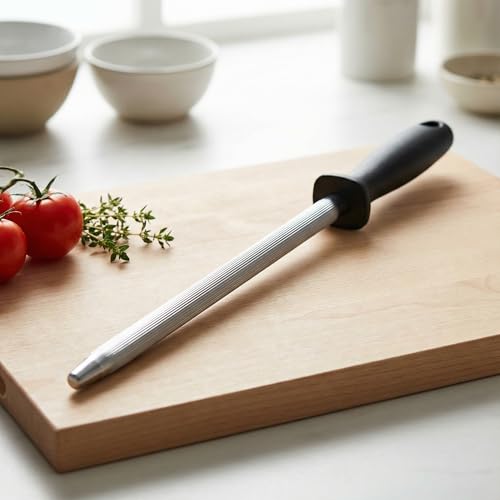
This is a honing steel, not a sharpener, and that distinction matters. It won’t restore a dull edge, but it excels at maintaining one. The magnetized rod is a smart upgrade: it pulls in metal filings during use, keeping your cutting board and food clean. The 13-inch length gives good blade coverage, and the nickel-chrome plating resists corrosion better than bare steel rods.
Owners note the sawtooth pattern realigns edges quickly, and the PP handle offers a secure grip without bulk. It’s lighter than traditional steels, so it’s easier to use daily. But if your knife is truly dull, you’ll still need a stone or system to re-establish the edge first. As a maintenance tool, though, it’s one of the cleaner, more user-friendly options.
Product photos

Our Testing Process
My approach to evaluating kitchen knife sharpening tools centered on a research-led comparison of published specifications, features, and, crucially, owner and expert feedback. Rather than a hands-on lab test of every model, I compiled data from manufacturer details, analyzed user reviews across multiple retailers, and considered assessments from trusted cooking and tool review websites. This allowed me to rank options based on a combination of objective capabilities and real-world performance reports.
For this category, the factors that most heavily influenced my rankings were the consistency of sharpening results, the ease of use for a range of skill levels, and the durability of the sharpening components. Consistent angles are paramount for a good edge, and user feedback quickly reveals which tools deliver that reliably. Durability matters because repeatedly replacing sharpening components adds to the overall cost and hassle. If you’re looking for more involved metalwork, exploring a bench-mounted sharpening systems might be a worthwhile consideration.
Published specifications reliably indicate the abrasive materials used (diamond, ceramic, tungsten carbide) and the number of sharpening stages. However, judging long-term performance and ease of use required careful consideration of owner reviews. Those reviews often highlighted issues like stability, the effectiveness of included angle guides, and the longevity of the abrasive surfaces. Expert assessments helped validate those findings and provided insight into the suitability of each tool for different knife types and sharpening needs, including the ability to handle serrated edges.
How To Pick The Right kitchen knife sharpening tools
Choosing the right kitchen knife sharpener can feel overwhelming, but getting it right means the difference between effortless food prep and frustrating struggles with dull blades.
A quality knife sharpener restores a blade’s edge by removing microscopic metal to create a new, sharp bevel. Look for models offering adjustable angles, durable abrasive materials (diamond, ceramic, or tungsten carbide), and a stable base for safe operation. Consider the types of knives you own – serrated, Japanese, Western – as some sharpeners excel with specific blade geometries.
Understanding Sharpening Methods
The first thing I always tell people is to think about how you want to sharpen. There’s a big difference between the convenience of an electric sharpener and the control offered by a whetstone. Electric models are fast and easy, but they can remove more metal than necessary, shortening the life of your knives. Whetstones require practice but provide the most precise results. Don’t immediately dismiss manual options either; many offer excellent control and are surprisingly effective. Ultimately, the best method fits your skill level and how often you plan to sharpen.
Angle Adjustment is Critical
Knife sharpening isn’t just about abrasion; it’s about geometry. Maintaining the correct angle is paramount for achieving a truly sharp edge. Most Western-style knives perform best around a 20-degree angle, while Japanese knives often benefit from a narrower 15-degree edge. Some sharpeners, like the Work Sharp Precision Adjust, allow for precise angle adjustments in one-degree increments. If you’re new to sharpening, look for models with built-in angle guides, such as those found in many kitchen knife sharpeners.
Here’s what to consider when looking at angle adjustment: * Fixed Angle: Simplest, but least versatile. Good for beginners with a specific knife type. * Adjustable Angle (Limited): Offers a few preset angles. A decent compromise between ease of use and flexibility. * Fully Adjustable: Provides the most control, allowing you to match any blade angle. Ideal for serious cooks and those with diverse knife collections.
A consistent angle is more important than the grit of the abrasive. A slightly dull knife sharpened at the correct angle will always outperform a razor-sharp knife with a poorly formed edge.
Balancing Features and Value
You don’t need to spend a fortune to get a functional knife sharpener. The AccuSharp is a prime example of a budget-friendly option that gets the job done for everyday knives. However, if you’re serious about knife care, investing in a more versatile system, like the Sharp Pebble, or even exploring professional sharpening stones can be worthwhile. Consider how often you’ll use the sharpener and the types of knives you own when determining your budget. Don’t overlook the value of included accessories; a good kit might include a cleaning brush, angle guide, or even a leather strop for final polishing. You might also consider looking into manual and electric sharpeners depending on your preference.
Kitchen Knife Sharpening Tools Compared
Here’s a comparison of key specifications for various kitchen knife sharpening tools to help you make an informed decision.
| Product Name | Grit Options | Angle Guide | Material | Best For | Special Features |
|---|---|---|---|---|---|
| Work Sharp Precision Adjust | Coarse/Fine Diamond/Ceramic | Yes | Abrasive/Metal | Best Overall | Adjustable angle (15-30 degrees) |
| Sharp Pebble Premium Whetstone | 1000/6000 | Yes | CBN Stone/Bamboo | Best Value Whetstone Kit | Angle guide, complete kit |
| SHARPAL 191H | Tungsten Carbide/Ceramic | No | Metal/Plastic | Scissors & Knives | Suction base, 3-stage sharpening |
| AccuSharp | N/A | No | Tungsten Carbide | Best Budget Friendly | Diamond-honed, reversible blades |
| Intelitopia Complete Stone Set | 400/1000/3000/8000 | Yes | Corundum/Bamboo | Best Complete Whetstone Kit | Flattening stone, leather strop |
| AIERLIAN Rolling Knife Sharpener | 400 Diamond/3000 Ceramic | Yes (20/15°) | Wood/Metal | Precision Angles | Magnetic support, leather strop |
| RUIXIN PRO RX-008 | 180-3000+ | Yes | Metal/Whetstones | Multiple Grit Options | G-Clamp, 360° rotation, 10 whetstones |
| Orange Ninja 4-Stage | Coarse/Med/Fine/Serrated | No | ABS Plastic/Carbide | Serrated Knives | 4-in-1 system, serrated slot |
| Knife Sharpener Rod 13 Inch | N/A | No | Carbon Steel | Best Honing Steel | Magnetized, ergonomic handle |
Frequently Asked Questions
What grit should I start with when using a whetstone?
You should always begin with a coarser grit (around 400-1000) to repair significant damage or reshape the blade. Progressing to finer grits (3000-8000) then refines the edge for sharpness.
Can I sharpen serrated knives with all sharpeners?
Not all sharpeners can handle serrated knives; you’ll need one specifically designed for them, or a system with a serrated edge slot. Many standard sharpeners will damage the delicate teeth of a serrated blade.
How often should I sharpen my kitchen knives?
The frequency depends on usage, but generally, professionally sharpened knives should be touched up every few months with a honing steel. A full sharpening with a stone or sharpener is typically needed 2-4 times per year for regular home cooks.
Are diamond sharpeners better than ceramic sharpeners?
Diamond sharpeners remove metal faster and are better for repairing damaged blades, while ceramic sharpeners are excellent for refining an edge and producing a very fine polish. Ultimately, many cooks benefit from having both types of sharpeners available.
What’s the difference between honing and sharpening?
Honing realigns the blade’s edge, maintaining its sharpness, while sharpening actually removes metal to create a new edge. Think of honing as straightening a slightly bent edge, and sharpening as rebuilding it. Consider exploring cordless electric sharpeners for quick touch-ups.
The Bottom Line
Choosing a knife sharpener often comes down to balancing convenience with control. If you want quick, reliable sharpening and aren’t overly concerned with maximizing blade life, the Work Sharp Precision Adjust delivers consistently sharp edges and adjustable angles that suit most kitchens. It strikes a fantastic balance between ease of use and professional-level results.
For those on a tighter budget, or looking for a versatile kit to learn with, the Sharp Pebble Premium Whetstone is an outstanding pick. And if you have a collection of knives – including serrated blades – or want the ability to hone and maintain a variety of edges, the AIERLIAN Rolling Knife Sharpener offers a thorough solution. Don’t underestimate the value of having essential manual workshop tools on hand for all sorts of projects, too.
Ultimately, the best knife sharpener isn’t about fancy features or a high price tag. It’s about understanding your knives, maintaining consistent angles, and using the right abrasive for the job. Focusing on those fundamentals, and keeping your blades clean, will deliver sharper, safer, and longer-lasting results than any single product ever could.
