What is a Band Saw? The Expert Guide to Types, Uses & Selection
This post contains affiliate links. As an Amazon Associate, we earn from qualifying purchases.
A band saw is a power saw that uses a continuous, flexible, toothed metal blade looped over two or more wheels. One wheel is powered, driving the blade in one direction through a work table where material is cut. This design allows for straight cuts, intricate curves, and resawing thick lumber into thinner boards, making it one of the most versatile stationary tools in a workshop.
Most people think a band saw is just for rough cuts or curves they can’t manage with a jigsaw. They buy a cheap model, throw on whatever blade came in the box, and wonder why their cuts wander, burn the wood, or snap blades every few months. The machine gets blamed, but the problem is almost always a mismatch between the blade, the material, and the setup.
This guide breaks down exactly how a band saw functions, the critical differences between the six main types, and the blade science that determines success or failure. You’ll learn how to match a saw to your projects and avoid the setup mistakes that waste time and money.
Key Takeaways
- Band saws cut with a continuous loop blade, which produces less vibration and waste (kerf) than circular saws, making them ideal for resawing expensive lumber and detailed curves.
- Blade selection is everything: width dictates minimum curve radius, and teeth-per-inch (TPI) must match material thickness. Using a wood blade on metal destroys the temper in one cut.
- Proper guide and thrust bearing adjustment, not brute force tension, prevents blade drift and breakage. Guides set too tight create friction heat that weakens the blade.
- Floor-standing models offer stability and power for serious resawing, but a well-tuned 10-inch benchtop saw handles 90% of homeowner and small shop tasks.
- Band saws generate far less airborne metal dust than angle grinders or reciprocating saws when cutting metal, a significant health benefit in enclosed workshops.
How Does a Band Saw Work? (The Continuous Loop)
The core mechanism is simple but relies on precise alignment. A flexible steel band with teeth welded into a loop is stretched over a driven wheel (usually the bottom one) and an idler wheel (usually the top). An electric motor turns the driven wheel, which pulls the blade in a single, downward direction through the cutting area of the table. The downward cutting action holds the workpiece firmly against the table, a key safety feature.
The band saw’s continuous loop blade applies cutting force evenly across its entire length, unlike a reciprocating saw blade that pushes and pulls. This constant, one-way motion reduces vibration, allows for a thinner kerf (as little as 1/32-inch), and enables the blade to follow intricate paths without buckling. The system requires precise tracking adjustment to keep the blade centered on the wheel crowns and correct tension to prevent deflection under load.
The table, which can often be tilted for bevel cuts, surrounds the blade. Just above and below the table are the blade guides—blocks or bearings that prevent the blade from twisting sideways under cutting pressure. A thrust bearing sits behind the blade to absorb forward pressure.
Getting this guide system adjusted correctly is 80% of achieving accurate cuts. If the side guides are too tight, they create friction and heat. Too loose, and the blade wanders, creating a tapered cut.
The first time I set up a used 14-inch floor-standing saw, I cranked the tension lever as far as it would go, thinking tighter meant straighter cuts. The blade sang a high-pitched whine. My first test cut in a 4×4 was dead straight, so I thought I was a genius.
Twenty minutes later, mid-way through a resaw cut on a 6-inch wide maple board, the blade snapped with a sound like a gunshot. The fracture was straight across the back of the blade—a classic sign of fatigue from overtensioning. I’d turned the spring into a brittle piece of metal. Now I use a tension gauge, and blades last for years.
The 6 Main Types of Band Saws (And What Each Does Best)
Not all band saws are created for the same job. The configuration of the wheels and table dictates its primary function. Choosing wrong means fighting the tool forever.
1. Vertical Band Saws
This is the classic woodworking band saw. The blade runs vertically, and you maneuver the workpiece on a horizontal table. It’s the go-to for curves, irregular shapes, and resawing. They range from 9-inch benchtop models for craft projects to massive 36-inch industrial machines for milling lumber.
2. Horizontal Band Saws
Here, the blade runs horizontally. The workpiece is clamped in a vise, and the entire blade assembly (or sometimes just the blade) swings down through the material like a guillotine. This is almost exclusively a metal shop tool. It’s designed for one job: cutting bar stock, pipe, and tubing to length. It’s faster and leaves a cleaner cut than an abrasive chop saw for metal.
| Saw Type | Primary Use | Best For | Limitation |
|---|---|---|---|
| Vertical Band Saw | Curves, resawing, intricate wood/metal shapes | Woodworkers, metal fabricators needing contour cuts | Not efficient for cutting long stock to length |
| Horizontal Band Saw | Cutting metal stock to length | Metal shops, plumbing, fabrication | Cannot make curved or interior cuts |
| Benchtop Band Saw | Light woodworking, small curves, hobby projects | Limited space, occasional users, model makers | Limited power and resaw capacity (usually under 4 inches) |
| Floor-Standing Band Saw | Heavy resawing, frequent use, thick hardwoods | Serious woodworkers, small professional shops | Floor space, higher cost, requires 220V for larger models |
| Portable Band Saw | On-site cutting of pipe, conduit, rebar | Plumbers, electricians, HVAC technicians | Requires two hands, less precision, no table for support |
| Meat Cutting Band Saw | Cutting frozen meat, fish, and bones | Butchers, commercial kitchens | Not safe or suitable for wood/metal; specialized sanitation |
3. Benchtop vs. Floor-Standing Models
This is about size and stability, not blade orientation. A benchtop saw sits on a workbench, has lighter castings, and a smaller motor (often 1/2 to 3/4 HP). It’s perfect for the garage workshop. A floor-standing model has a dedicated stand, heavier iron frames to dampen vibration, and more powerful motors (1.5 HP and up). That weight and power translate directly to smoother cuts in dense material and the ability to resaw taller boards.
4. Portable Band Saws
Think of this as a handheld version of a horizontal band saw. It’s a vital tool for tradespeople. You clamp the material and guide the saw through it, or use it freehand for rough cuts. It will never match the precision of a stationary saw, but for cutting a piece of 2-inch conduit under a sink, it’s irreplaceable.
5. Meat Cutting Band Saws
These are specialized, food-grade versions with easy-clean stainless steel housings and specially designed blades that cut through frozen tissue and bone without shattering. Never use a wood/metal band saw for food, and never use a meat saw for anything else. The contamination risk and blade mismatch are severe.
6. Timber Mill Band Saws
These are industrial giants. Head saws make the initial cuts into logs, and resaws slice thick slabs into thinner boards. Their massive wheels and wide blades are designed for one thing: converting logs into lumber with minimal kerf waste. You won’t have one in your shop.
Band Saw Blades: The Tooth Geometry and Steel That Makes the Cut
The blade is the consumable heart of the saw. Getting this wrong makes every other adjustment pointless. Blades are defined by three things: width, teeth per inch (TPI), and tooth geometry.
- Width: Determines the smallest radius you can cut. A 1/4-inch blade can turn a 1-inch circle. A 1-inch blade is for straight cuts and resawing only. The wider the blade, the more it resists twisting, promoting straighter cuts.
- Teeth Per Inch (TPI): Dictates cut speed and smoothness. Low TPI (3-6) has big, aggressive gullets that clear chips from thick, soft material like wood. High TPI (10-24) makes slower, smoother cuts in thin metal and plastic. A general rule: at least three teeth should be in contact with the material thickness at all times. Fewer than that, and the teeth can snag and rip.
- Tooth Geometry: The shape of the tooth matters. A regular tooth blade has evenly spaced teeth and is a good all-arounder. A skip tooth blade has wider gaps between teeth to prevent clogging in green or resinous wood. A hook tooth blade has a deep, aggressive gullet and a 10-degree positive rake angle for fast, rough cuts in thick stock.
The steel the blade is made from is equally critical. Most wood blades are made from flexible carbon steel. Metal-cutting blades are a different beast. Bimetal blades are the standard for serious work. They have a high-speed steel (HSS) tooth edge welded to a flexible carbon steel back.
The HSS teeth stay sharp cutting through steel, while the carbon back absorbs the twisting and tension. The best of these use a grade called M51 steel, which is often cryogenically treated. This process aligns the steel’s molecular structure, reducing microscopic fractures and increasing edge life by a factor of three or more. It’s not marketing. I’ve run a cryo-treated Lenox Diemaster 2 blade through a pile of 2-inch square tubing that would have dulled three standard bimetal blades.
Never use a dry wood blade to cut metal, even aluminum. The friction heat generated in one cut will draw the temper (soften) the teeth. They’ll be visibly discolored—blue or straw-colored—and dull instantly. That blade is now trash for any material.
What Can You Use a Band Saw For? (Beyond Just Curves)
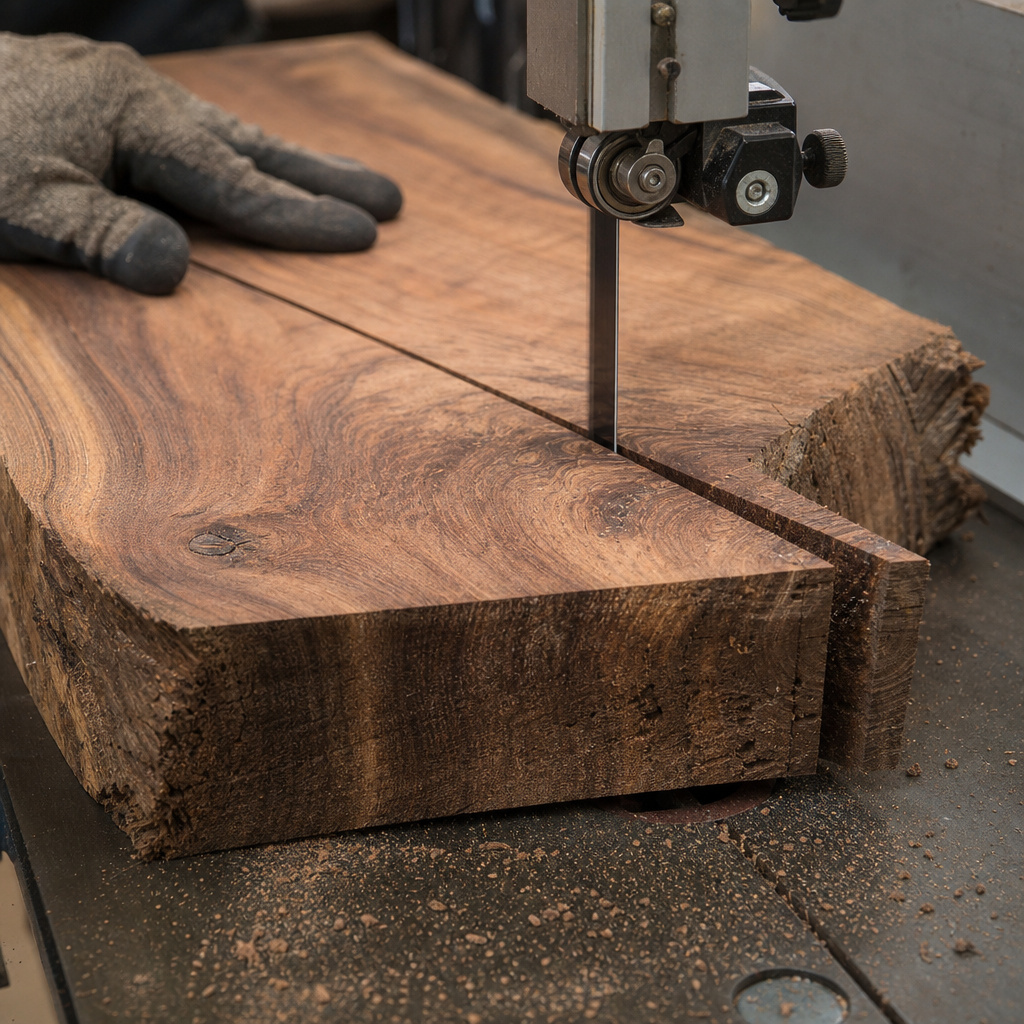
Its versatility is its superpower. While known for curves, its other capabilities often go overlooked.
- Resawing: This is the process of slicing a thick board into two or more thinner slabs along its face. A table saw can’t do this safely on wide boards. A band saw with a wide blade and a tall fence extension can resaw 8-inch or wider lumber, allowing you to make bookmatched panels or veneer from expensive wood. The thin kerf saves you wood, which is money.
- Cutting Irregular Shapes: From cabriole legs to wooden puzzle pieces, if you can draw it, a band saw can usually cut it. This is where learning proper band saw operation pays off, as technique prevents breaking thin blades.
- Roughing Out Stock: Quickly removing large amounts of waste material before final shaping on a spindle sander or router. It’s faster and safer than trying to make a dozen intricate passes on a jigsaw.
- Cutting Metal: With the correct blade and often a reducer in speed (many wood saws run too fast), a band saw cleanly cuts bar stock, pipe, and sheet metal. It produces neat chips, not the hazardous fine dust and sparks of an abrasive wheel.
- Joinery: With jigs, you can cut tenons, dovetails, and finger joints. It’s not as fast as a dedicated router jig for production, but for one-off pieces, it’s incredibly effective.
The environmental point is underrated. Cutting metal with an abrasive chop saw or grinder creates a cloud of fine metallic dust and toxic fumes from the bonding agent in the wheel. A band saw produces relatively large, cool chips. In a home garage without industrial dust collection, that difference is the difference between wearing a respirator and not.
Critical Band Saw Setup: Tension, Tracking, and Guides
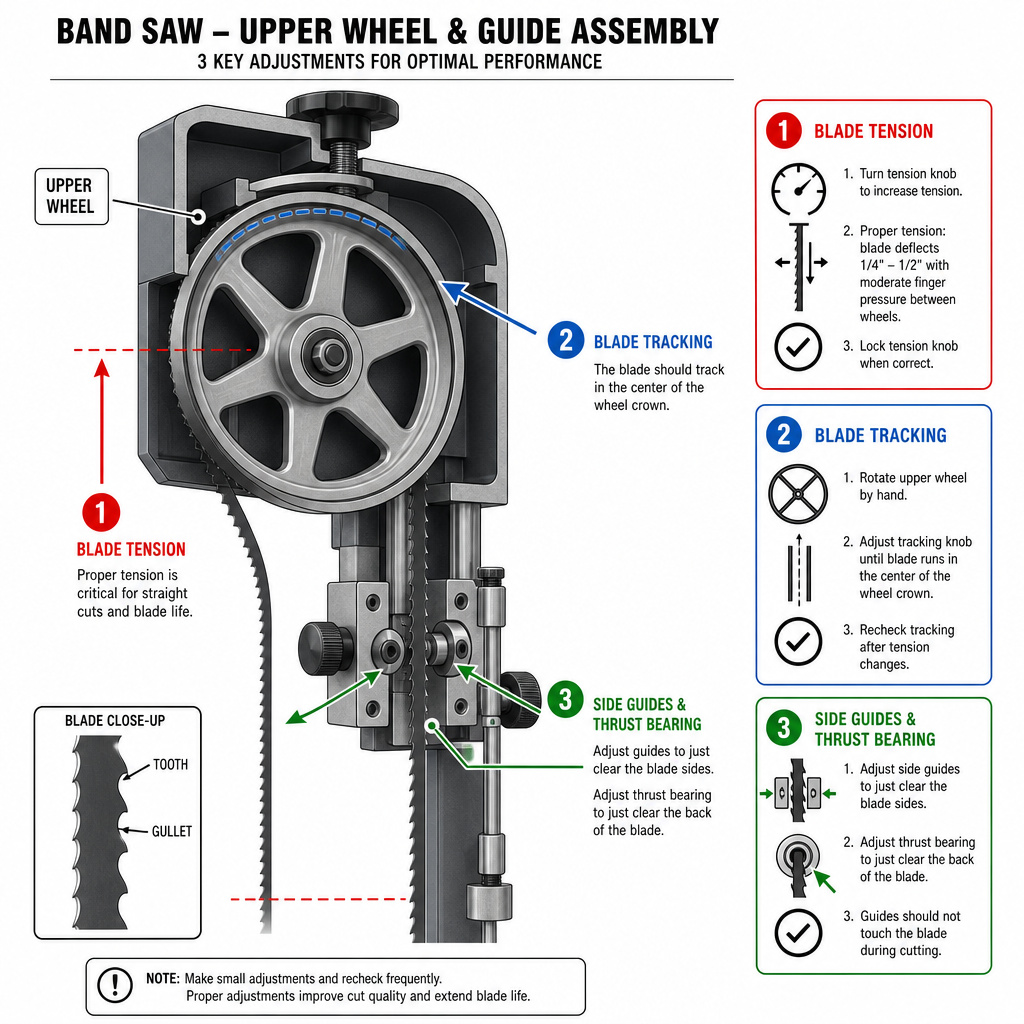
You can have a $3000 saw and a $100 blade, but if these three things are off, your cuts will be terrible. This is the fine-tuning that most manuals gloss over.
Tension: The blade needs to be tight enough to not flex sideways under cutting pressure, but not so tight it undergoes plastic deformation. Overtensioning is the #1 cause of premature blade breakage. The tension scale on most saws is notoriously inaccurate. A better method: with the guides retracted, push the side of the blade (midway between the wheels) with your thumb. It should deflect about 1/4 inch. That’s a good starting point. Listen to the pitch when you pluck it like a guitar string. With use, you’ll learn what “right” sounds like for a given blade width.
Tracking: This adjusts the blade’s position on the wheel crowns. The goal is to have the blade running so the teeth hang just off the front edge of the wheel. If it runs too far forward, it can slip off. Too far back, and the back of the blade rubs on the guide bearing. Adjust the tracking knob with the machine running at low speed (unplugged, spin the wheel by hand) until the blade stabilizes in the center of the wheel.
Guides and Thrust Bearing: The side guides (whether block or bearing) should be positioned just behind the blade’s gullets, not touching the set of the teeth. You should be able to slide a piece of printer paper between the guide and the blade with a slight drag. The thrust bearing should be about 1/32-inch behind the blade when the blade is at rest. It only contacts the blade when you feed material.
| Symptom | Likely Cause | Immediate Fix | If Ignored |
|---|---|---|---|
| Blade wanders, cuts a curve | Dull blade; Incorrect feed speed; Guides too loose | Check blade sharpness; Slow feed; Adjust side guides closer | Ruined workpiece; Increased risk of blade breaking from twisting |
| Burn marks on wood | Dull blade; Feed rate too slow; Blade speed too high for material | Increase feed pressure; Check blade; Ensure correct speed setting | Glazed, hardened cut surface that’s difficult to sand; Fire risk |
| Excessive vibration or chirping | Blade not seated on wheel crowns; Loose wheel bearings; Bad weld on blade | Re-track blade; Inspect wheels and bearings; Check blade joint | Premature bearing failure; Inaccurate cuts; Noise damage |
| Blade breaks suddenly | Overtensioning; Forcing a cut; Blade fatigue from small radius cuts | Reduce tension; Let blade cut at its own pace; Use wider blade for curves | Projectile hazard; Cost of new blade; Potential damage to guides |
Band Saw vs. Other Saws: When to Use What
It’s not a replacement for everything. It complements other tools. Understanding the trade-offs keeps you safe and efficient.
- Band Saw vs. Scroll Saw: A scroll saw uses a tiny, reciprocating blade that can be threaded through a drilled hole to make interior cuts. It’s for ultra-fine, delicate work like marquetry. A band saw is for heavier, faster cuts on thicker material. You wouldn’t use a band saw to cut a 1/8-inch intricate ornament.
- Band Saw vs. Jigsaw: A jigsaw is portable and can start a cut in the middle of a panel. It’s also much cheaper. But for any curve longer than a foot or in material over 1.5 inches thick, the band saw’s stability and power win. The jigsaw blade will deflect, giving you a tapered cut.
- Band Saw vs. Table Saw: The table saw is the king of straight, repeatable cuts, especially long rip cuts. You can rip on a band saw, and it’s safer for narrow stock, but it’s slower and less accurate for sheet goods. Use the table saw for breaking down plywood, the band saw for the curves and resawing that come next.
- Band Saw vs. Miter Saw: A miter saw or chop saw is a dedicated cross-cutting machine. It’s faster and more accurate for cutting boards to length and making precise angled cuts for trim. The band saw can crosscut, but it’s not its strength.
Safety First: The Non-Negotiable Rules
Before you start: The blade moves at several thousand feet per minute and will remove flesh before you feel it. Always wear safety glasses—a broken tooth can become a projectile. Hearing protection is needed for extended use. Never wear loose clothing, gloves, or jewelry that can be pulled into the blade. Use a push stick when your hands will come within 4 inches of the blade, especially when resawing.
The blade guard should be adjusted to just above the workpiece, no more than 1/4 inch gap. This maximizes visibility while protecting you from a broken blade or accidental contact. Always know where your hands are. If you feel yourself reaching over the blade line to support a falling offcut, stop the saw. That offcut is not worth a finger.
Make sure the workpiece has a flat face against the table and is stable. Cutting a small, irregular piece is asking for it to spin and pull your hand. Use a jig or a sacrificial backing board.
Finally, never back out of a cut while the blade is moving. It can catch and pull the workpiece—and your hand—upward into the blade. If you need to adjust, turn the saw off, wait for the blade to stop, then back the piece out.
Frequently Asked Questions
What size band saw do I need for a home workshop?
14-inch floor-standing model is the sweet spot for versatility and capacity. It can handle a 6-inch resaw height, which covers most lumber, and accepts a wide range of common blade sizes. If space and budget are tight, a quality 10-inch benchtop model from a brand like Rikon or Wen will handle the vast majority of curved cuts and light resawing.
Can I cut metal with my wood band saw?
Yes, but with major caveats. You must use a metal-cutting blade (bimetal recommended). Many wood band saws run too fast for steel, which overheats and dulls the blade. You need a speed of around 250 feet per minute (FPM) for mild steel. Some saws have a gearbox or pulley system to reduce speed; if yours doesn’t, you’re limited to softer metals like aluminum and brass, and you must use cutting fluid to manage heat.
Why does my band saw blade keep breaking?
The three most common reasons are overtensioning, forcing the workpiece (feeding too fast), and trying to cut a radius tighter than the blade width can handle. A blade stressed by a too-tight radius develops a fatigue crack in the back, which then propagates. Inspect the break. A straight fracture across the back is usually tension or fatigue. A shredded end often indicates it was forced or pinched.
What is “blade drift” and how do I fix it?
Blade drift is when the blade doesn’t cut in a straight line parallel to the fence; it wants to veer off at an angle. It’s caused by the set of the teeth, the sharpening, or how the blade was welded. You don’t fix the blade. You compensate by adjusting the fence to match the blade’s natural path. Make a freehand straight cut on a scrap piece, then clamp a straightedge along that cut line to use as a temporary fence.
How often should I replace or sharpen my band saw blade?
Sharpen when you notice you have to push harder, see burn marks, or the cut quality degrades. High-quality bimetal blades can often be professionally sharpened 2-3 times. For carbon steel wood blades, it’s usually more cost-effective to replace them. A sharp blade should cut through 3/4-inch hardwood with light pressure and sound smooth. A dull blade sounds labored and feels grabby.
Before You Go
A band saw’s value isn’t in doing one thing perfectly, but in doing a dozen things very well. It’s the bridge between rough stock and refined parts. Success hinges on respecting the blade—its metallurgy, its geometry, and its need for a precise setup.
Skip the generic big-box store blade and buy a quality bimetal or carbide-tipped blade matched to your most common task. That single upgrade will improve cut quality more than any other change. Remember, the machine only guides the cut; the blade does the work. Invest in the blade, tune the guides, and let the saw’s unique continuous motion turn complex shapes and wasteful thick boards into usable, precise parts.
