
What Is A Chop Saw
This post contains affiliate links. As an Amazon Associate, we earn from qualifying purchases.
What Is a Chop Saw? The Complete Guide
If you need to make fast, straight cuts through tough materials like metal or concrete block, you might be looking at a chop saw. But what is it, what does it do that a miter saw doesn’t? and how can you tell the difference?
This guide cuts through the confusion. You’ll learn the clear definition, the key features that set it apart, and the exact jobs where it’s the right, and wrong, tool for the task.
A chop saw is a powerful stationary saw designed specifically for making straight, 90-degree crosscuts in hard materials like metal, masonry, and rebar. It uses a circular abrasive cutting wheel or a diamond blade, mounted on a pivoting arm that lowers straight down onto a secured workpiece. Its brute-force design prioritizes speed and power over the precision and versatility of a wood-cutting miter saw.
The trick to identifying a chop saw isn’t about brand or color. It’s about matching three specific things: the blade type, the cutting action, and the intended material. Most people get confused because the tools look similar. I’ve seen seasoned DIYers ruin a perfectly good wood blade by throwing it on a chop saw meant for metal. Let’s get the identification right.
Key Takeaways
- Blade Type is the First Clue: Chop saws use abrasive wheels (for general metal) or diamond blades (for masonry/tile). If the tool uses a toothed wood-cutting blade, it’s not a chop saw.
- The Cutting Action is Vertical: The blade assembly on a chop saw only pivots straight down in a single plane. If the head can tilt or rotate to make angled (bevel) cuts, it’s a miter saw.
- Material Purpose is Built-In: These saws are engineered for hard, abrasive materials. They operate at lower RPMs (around 2,500 RPM) to prevent blade overheating. Attempting wood on one is inviting poor results and potential danger.
- Power and Speed Over Precision: Chop saws excel at repetitive, heavy-duty cuts where absolute accuracy isn’t the top priority.
- Safety Features are Non-Negotiable: A proper chop saw must have a sturdy base, a secure clamping mechanism, an intact blade guard. Sparks are normal; flying debris is a major hazard.
Key Features of Chop Saws
How They Differ From Miter Saws
Table Saws
Other Tools
To spot a chop saw, you look for a combination of features that other saws lack or arrange differently.
The Blade: Abrasive or Diamond, Not Toothed
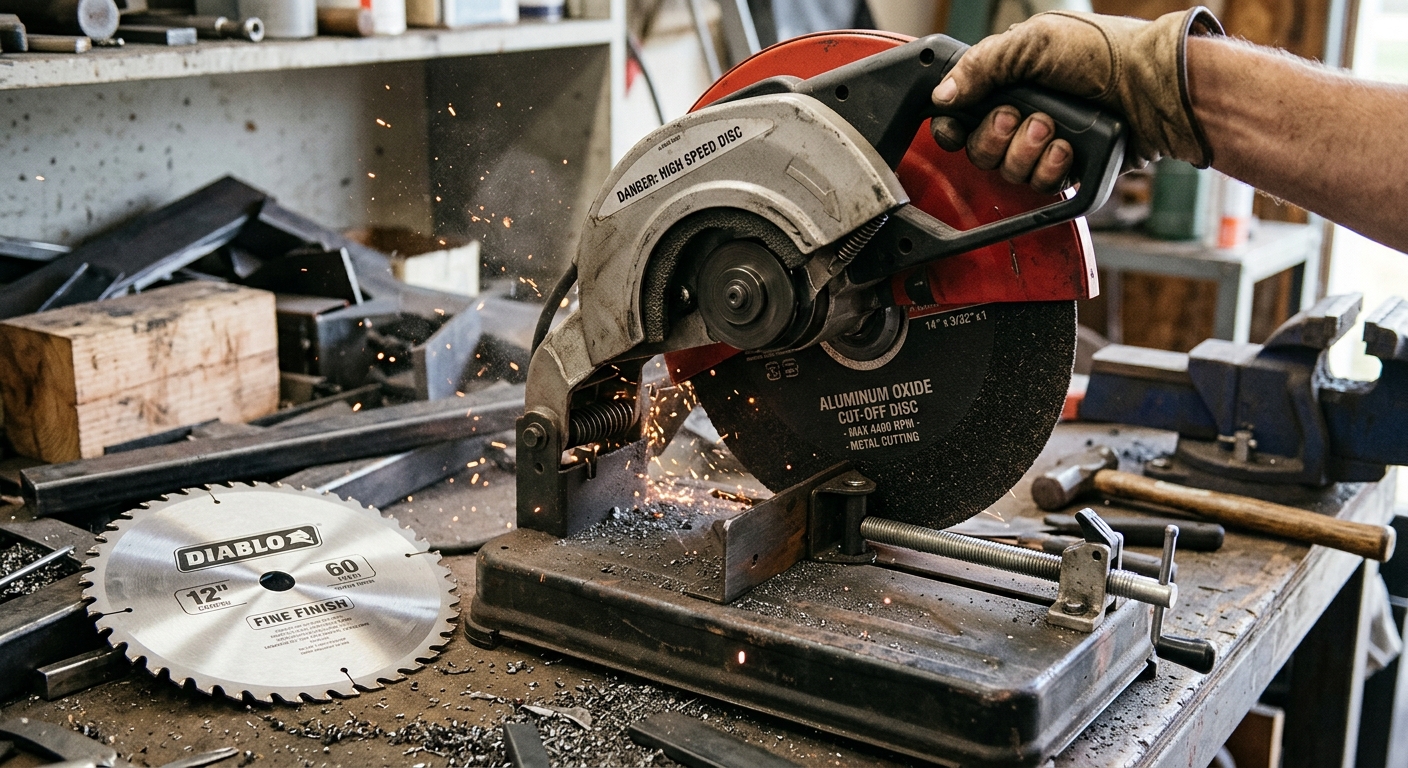
This is the single most reliable identifier. Open the blade guard. A chop saw blade looks like a thick, dark disc, often labeled for “aluminum oxide” or “silicon carbide. It has no visible teeth. In contrast, a miter saw blade has sharp, pointed teeth designed to slice wood fibers. A table saw blade also has teeth, though they may be configured differently.
The abrasive wheel works by grinding through material at high speed. It throws sparks and creates fine dust. A diamond blade, used for masonry, has diamond grit embedded in its edge. You might mistake a diamond blade for a very fine-toothed blade, but closer inspection shows no gullets (the gaps between teeth).
The Cutting Head: Straight-Down Pivot Only
Lift the saw’s head. On a chop saw, it should only hinge up and down on a single vertical axis. There is no ability to tilt the head left or right to make a bevel cut, no rotating table to set an angle. This simple, robust action is why it’s sometimes called a “drop saw” or “cut-off saw.”
A miter saw has both a pivoting action and a tilting head. A table saw’s blade rises from within a stationary table. The vertical-only motion is your dead giveaway.
The Base and Fence: Heavy-Duty and Stationary
Chop saws are designed for bench-top use. They are heavy, feature a solid, often steel, baseplate with holes for bolting them down. This stability is crucial for handling the vibration of cutting metal.
You’ll also see a sturdy fence at the back to square the workpiece, often a large, integrated clamping mechanism on the arm to hold material secure. While some miter saws have clamps, the ones on chop saws are typically more heavy-duty.
Intended Material: Metal, Masonry, Rebar
The tool’s purpose is baked into its design. Check the manufacturer’s label and manual. It will explicitly state the materials it’s designed to cut: mild steel, aluminum, rebar, conduit, cast iron, brick, block, or tile.
If the manual or specs primarily discuss wood cutting, blade kerfs, or fine finish work, you’re holding a different tool. A chop saw’s world is one of sparks, grit, and brute force.
What Is A Chop Saw Used For? (Common Applications)
You don’t use a chop saw for fine carpentry. You use it when the job is about strength and speed.
- Cutting Metal Conduit and EMT: Electricians use them daily to cut conduit to length quickly.
- Fabricating Metal Framing: Cutting steel studs, angle iron, Unistrut for construction and shop projects.
- Preparing Rebar: Cutting reinforcing bar to size for concrete work.
- Trimming Masonry Blocks: Sizing bricks, concrete blocks, or pavers with a diamond blade.
- Cutting Bolts, All Thread, and Rods: Quickly shortening threaded stock or bolts.
I once tried to use a friend’s abrasive chop saw to cut some aluminum trim. I figured metal is metal, right? The cut was rough, the blade loaded up, leaving a jagged, melted edge. I learned the hard way that even within “metal,” blade selection matters. An aluminum-cutting blade has a specific formulation to prevent loading. The right tool with the wrong accessory still gives bad results.
What to Look For When Buying
You’re in the market for a saw. Here’s how to decode the specs.
Blade Size: 14-inch is the most common. You’ll also find 12-inch models. Larger sizes exist for industrial work.
** Motor Power: Look for amps (e.g., 15A) for corded models. Higher amps mean more cutting power for thicker stock.
** RPM (Revolutions Per Minute): This is critical. Chop saw RPM is low (1,200–3,800 RPM) to prevent abrasive blades from overheating. Miter saw RPM is high (3,000–5,500 RPM) for clean wood cuts. Never put a high-RPM wood blade on a low-RPM chop saw motor. The motor can’t handle the speed, the blade can disintegrate.
** Voltage: 120V for most shop models. 240V for larger industrial units.
** Safety Features: A non-negotiable. Must have a clear, functioning blade guard that retracts automatically, a secure vise or clamp, and a stable base. A spark deflector is also key.
Frequently Asked Questions
Can a chop saw cut wood?
Technically, yes, with the right blade, it’s a terrible idea. Abrasive wheels create extreme friction burn marks on wood. A diamond blade will crush rather than cut wood fibers. The low RPM also leads to slow, burning cuts. Use the right tool: a miter saw or circular saw for wood.
What’s the difference between a chop saw and a miter saw?
chop saw makes only straight 90-degree cuts in hard materials via a vertical drop. A miter saw makes angled (miter) and bevel cuts primarily in wood using a high-speed toothed blade. They look similar but are built for different worlds.
Is a chop saw the same as a cut-off saw?
Yes, the terms are used interchangeably. “Cut-off saw” is a broader category that can also include handheld models (like a gas-powered cut-off saw), but when referring to a bench-top tool, it’s typically a chop saw.
How dangerous is a chop saw?
It’s among the more dangerous power tools. Hazards include flying abrasive fragments, sparks that can start fires, intense noise, violent kickback if the blade binds. Respecting it requires full safety gear: ANSI-approved safety glasses, a face shield, hearing protection, and leather gloves.
Can I use a miter saw blade on a chop saw?
No. Absolutely not. The motor speeds are incompatible. The blade arbor (center hole) size may also differ. Using a wood blade can cause catastrophic failure.
The Bottom Line
Before you buy any saw claiming to “cut metal, masonry, do your homework. Open the guard. See an abrasive or diamond disc? Check the head motion, does it only go up and down?
Read the manual. If it says “metal” and “straight cut,” you’ve found a chop saw. It’s the undisputed champion for heavy, straight cutting. For everything else, angles, wood, precision, reach for a different tool in your arsenal. Knowing the difference saves your project, your safety.
