
What Is a Pole Saw? The 3 Types, Uses & How to Pick One
This post contains affiliate links. As an Amazon Associate, we earn from qualifying purchases.
A pole saw is a cutting tool with a long handle, designed to prune tree branches from the ground. It combines a saw blade or small chainsaw head mounted at the end of a pole, often telescopic, to reach heights of 10 to 20 feet without a ladder.
Most people think a pole saw is just a chainsaw on a stick. That’s wrong. The pole is the critical part, it’s not just an extension. It’s a lever that multiplies your effort, and a weak or poorly balanced pole turns a simple cut into a shaky, dangerous chore. You pick the wrong one, you fight the tool instead of the branch.
This guide covers the three main types, manual, electric, and gas, how they work, what they’re actually good for, and how to pick the one that won’t leave you frustrated.
Key Takeaways
- Manual pole saws are for light, occasional pruning of branches under 1.5 inches thick. They’re quiet and cheap, but you’ll feel every stroke in your shoulders after 30 minutes.
- Cordless electric pole saws are the suburban default. They handle 2-inch branches cleanly, but the battery dies after 45 minutes of continuous cutting on a thick oak.
- Gas pole saws are for acreage and storm cleanup. They cut through 4-inch limbs, but they smell like exhaust, weigh 15 pounds extended, and require mixing fuel and changing the spark plug yearly.
- Telescopic poles add reach but reduce stability. A wobble at full extension makes precise cuts impossible. Fixed-length poles are sturdier and cheaper.
- Storage matters. Leave a gas model with fuel in the tank over winter, and the carburetor gums up by spring. Store a battery pole saw with the battery detached, or it drains slowly and won’t hold a charge.
How Does a Pole Saw Work?
The mechanics are simple, but the execution trips up beginners. A cutting head, either a curved pruning blade or a miniature chainsaw bar, is mounted at the end of a pole. You extend the pole, position the head against the branch, and pull or push to cut. The leverage from the long pole lets you apply force from a safe distance below the falling debris.
A telescopic pole saw uses a multi-section locking mechanism, usually a twist-lock or pin-lock system, to adjust its length. The sections slide together for storage and extend outward for reach. At full extension, the locking points are the weakest part of the structure; a loose lock introduces wobble that translates directly to blade chatter against the branch.
The cutting action depends entirely on the head type. A manual blade requires you to pull a rope or push the pole to draw the sharp teeth through the wood.
An electric or gas-powered chainsaw head spins a small chain around a guide bar, driven by a motor at the base of the pole or integrated into the head itself. That motor’s power, measured in amps for electric, cc for gas, determines how thick a branch it can chew through before stalling.
You hold the tool with both hands, one near the head for control and one lower down for stability. If you grip only at the very end, the pole acts like a giant fishing rod, any vibration amplifies, and you’ll miss your cut line.
Your stance matters too. Stand directly under the branch you’re cutting, not off to one side. The falling limb has a habit of bouncing once it hits the ground, and a sideways stance puts your legs in the bounce zone.
The 3 Pole Saw Types: Manual, Electric, and Gas
You don’t pick a pole saw based on price first. You pick it based on your trees, your frequency of use, and your tolerance for noise, weight, and maintenance. Getting the type wrong means either wasted money on an underpowered tool or wasted effort wrestling an overbuilt one.
Manual Pole Saw
This is the original. A curved pruning blade with aggressive teeth, mounted on a fiberglass or aluminum pole. You pull a rope attached to the blade, or you physically push and pull the pole to saw through the branch. No engine, no battery, no cord.
They’re light, often under 5 pounds total. They’re silent. And they’re the cheapest option, usually under sixty bucks. The blade is replaceable, and the pole sections are typically fixed-length, not telescopic.
They’re also slow. Cutting a 2-inch branch with a manual pole saw takes about forty strokes, and your arms will feel it. The blade binds in wet wood. It requires a clean, straight pull every time; if you let the rope slack, the teeth don’t bite.
I used a manual saw on a young maple for two seasons. It worked fine for the 1-inch new growth. Then the tree thickened. A 2-inch dead branch took me ten minutes of sweating, rope-pulling, and repositioning. I switched to electric the next week.
When to choose a manual pole saw:
- You prune once or twice a year.
- Your branches are consistently under 1.5 inches in diameter.
- You value quiet operation and zero maintenance.
- Your budget is tight.
When to avoid it:
- You have mature trees with thick deadwood.
- You need to clear storm damage quickly.
- You have more than a few trees to maintain.
Electric Pole Saw
Electric models add a motor. They split into corded and cordless. Corded gives you unlimited run time but tethers you to an outlet and a extension cord. Cordless runs on a rechargeable battery, usually lithium-ion, offering freedom but a finite cutting window.
The cutting head is a small chainsaw bar, typically 6 to 10 inches long. The motor sits either at the base of the pole, driving the chain via a shaft, or integrated into the head itself (more common in cordless designs).
Power is measured in volts (for battery) or amps (for corded). A 40V cordless pole saw will cut through a 3-inch oak branch, but it’ll eat half the battery charge doing it. A 10-amp corded model has consistent power but drags a 100-foot cord through your yard.
Cordless is the popular choice now. Brands like EGO, Ryobi, and Greenworks dominate this segment. The convenience is real, no fuel, no cord, instant start.
The limitation is real too. That battery lasts about 45 minutes of continuous cutting under load. If you’re clearing a fence line of overgrowth, you’ll need a second battery or you’ll be done for the day after a few trees.
I keep a Ryobi 40V pole saw for my suburban lot. It’s perfect for the six trees I have. But when a storm dropped a dozen 3-inch branches across the backyard, the first battery died on the fifth branch. I had to wait two hours for the second battery to charge before finishing. Gas would have taken twenty minutes.
When to choose an electric pole saw:
- You have a typical suburban yard with several trees.
- Your branches are mostly 1–3 inches thick.
- You want a tool that starts instantly with minimal maintenance.
- You already own a compatible battery system (like Ryobi ONE+ or EGO).
When to avoid it:
- You’re clearing large acreage or frequent storm damage.
- You need to cut branches over 4 inches thick regularly.
- You don’t have a backup battery and charger.
Gas-Powered Pole Saw
This is the professional and landowner’s tool. A gas engine, usually two-stroke, powers a chainsaw head through a drive shaft inside the pole. They’re loud, they smell, and they weigh 12 to 18 pounds fully extended. Brands like Stihl and Husqvarna lead here.
They cut through anything a pole can reach. A gas pole saw with an 8-inch bar will take down a 4-inch limb in three seconds. They have no battery limit, no cord restriction. You mix fuel (gas and oil), fill the tank, and work until the tank is empty, about 30 to 45 minutes of run time.
The trade-off is maintenance. A gas pole saw requires the same care as a gas chainsaw: seasonal spark plug changes, air filter cleaning, carburetor adjustments if it sits. If you store it with fuel in the tank over the winter, the carburetor varnishes. You’ll spend an hour cleaning it next spring, or it won’t start at all.
They’re also the most dangerous type in terms of kickback. The small bar can grab if you touch the tip to another branch, and the extended pole makes controlling that sudden jerk harder. You need experience with chainsaw handling before you run one on a pole.
| Pole Saw Type | Best For | Max Practical Branch Diameter | Maintenance Burden |
|---|---|---|---|
| Manual | Occasional light pruning | 1.5 inches | Blade cleaning, rust prevention |
| Cordless Electric | Suburban yard maintenance | 3 inches | Battery charging, chain lubrication |
| Gas-Powered | Frequent use, large properties, storm cleanup | 4+ inches | Fuel mixing, spark plug, air filter, seasonal storage |
What Can You Actually Cut With a Pole Saw?
A pole saw isn’t a replacement for a full chainsaw. It’s for reach, not raw power. The cutting capacity is limited by the bar length (6–12 inches) and the motor’s ability to drive the chain through thick wood without stalling.
For manual saws, the limit is your strength and the blade’s stroke length. You can technically cut a 3-inch branch, but it will take fifty pulls and you’ll be exhausted. Realistically, stick to branches under 1.5 inches.
Electric pole saws, especially 40V and higher models, handle 2- to 3-inch hardwood branches like oak and maple. Softwood like pine goes up to 4 inches. The chain speed is lower than a gas saw, so you need to let the tool work, pushing it hard causes the battery to overheat and the chain to dull faster.
Gas pole saws are built for the thick stuff. An 8-inch bar on a Stihl HT 103 can slice through a 4-inch oak limb in one pass. But even here, there’s a ceiling.
Trying to cut a 6-inch branch with a pole saw is a mistake. The leverage is wrong, the bar is too short, and the risk of the chain pinching and kicking back is high. For anything over 4 inches, use a proper tree trimming techniques with a standard chainsaw and a ladder, or call a professional.
Common uses for a pole saw:
- Removing deadwood from mature trees.
- Thinning out crowded branches to improve tree health.
- Clearing branches overhanging roofs, fences, or power lines (stay at least 10 feet away from power lines).
- Shaping hedges that are too tall for a hedge trimmer.
- Cleaning up after storms, downed limbs that are still partially attached.
What it cannot do:
- Fell a tree. The pole isn’t designed for that weight and leverage.
- Cut branches thicker than the bar length.
- Replace a ladder for close-up pruning. If you can reach the branch with your hand, use a handsaw or a reciprocating saw basics for more control.
Pole Saw Features That Matter (Beyond Power)
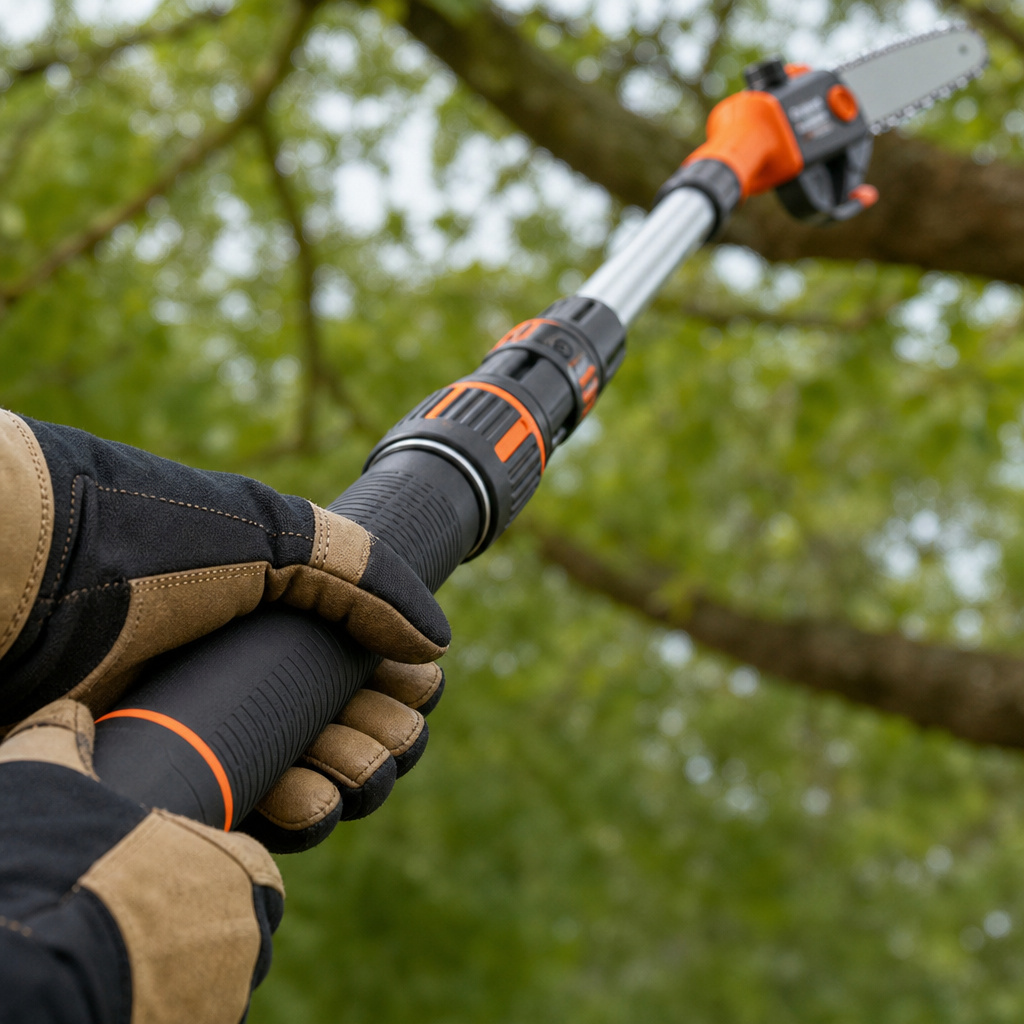
The motor type is the first decision, but these four features decide whether the tool feels right in your hands or fights you every time you use it.
Pole Length and Type
Telescopic poles adjust from maybe 6 feet to 12 or 15 feet. They’re versatile but introduce wobble at full extension if the locking mechanism is weak. Fixed-length poles are one solid piece or two pinned sections, they’re more stable but you buy the reach you need. For most homeowners, an 8- to 10-foot reach is enough. If you have tall pines or maples, go telescopic and accept that you’ll need to tighten the locks before each use.
Weight and Balance
A pole saw is a lever. The weight at the head end matters more than the total weight. A poorly balanced tool, where the head is too heavy or the motor is bulky, will feel like you’re holding a shaking flagpole. Gas models are the worst here; the engine weight is at the bottom, but the extended pole still magnifies any vibration. Look for models that advertise “balanced design” or have the motor integrated into the head (common in cordless).
Chain or Blade Quality
For powered saws, the chain is the consumable. A low-kickback, semi-chisel chain is standard and safer for pole use. For manual saws, the blade should be replaceable and made of hardened steel. Cheap blades dull after one season on hardwood.
Anti-Vibration and Ergonomics
Your hands are the contact point for hours of vibration. Gas saws transmit engine vibration up the pole. Good models have rubberized handles and anti-vibration systems in the shaft. Missing this feature means your hands go numb after thirty minutes of cutting. It’s not optional if you’re using a gas saw.
How to Pick the Right Pole Saw for Your Property
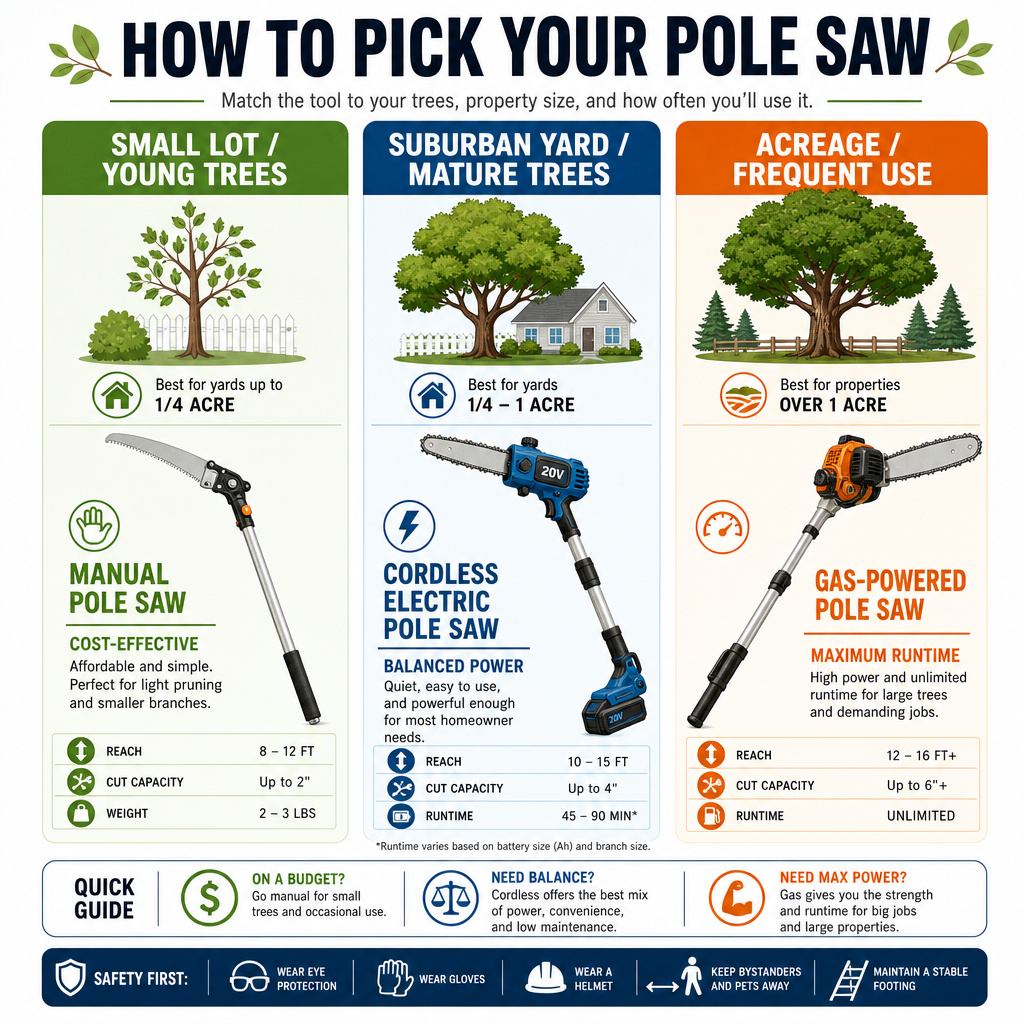
Match the tool to the trees, not to the price tag. Walk your yard first. Count the trees.
Measure the thickest branch you need to cut, use a tape measure, not a guess. Look at the height. Is it 8 feet up or 15?
For a small lot with young trees, a manual pole saw is fine. It’s a fifty-dollar tool that sits in the shed until you need it. For a typical suburban yard with mature oaks and maples, a cordless electric pole saw is the default. Buy into a battery system you already own (Ryobi, EGO, DeWalt) to save cost.
For acreage, woodland, or frequent storm cleanup, go gas. The run time and cutting power justify the noise, smell, and maintenance. Brands like Stihl and Husqvarna are the benchmarks here. Their pole saw operation manuals are detailed, and their service networks are wide.
Before you start: Wear safety goggles, cut-resistant gloves, a hard hat, and sturdy boots. Clear the area below the branch of people, pets, and anything you value. Never use a pole saw within 10 feet of a power line, the pole is conductive, and a mistake can be fatal. Check that all pole sections are locked and the cutting head is secure. A loose head detaches at full extension and falls toward you.
Step-by-Step Selection Guide
- Survey your trees. Identify every branch you want to remove. Note the diameter and height. If most are under 2 inches and under 10 feet high, a manual or light electric saw will work.
- Check your power source. Do you have outdoor outlets? If yes, a corded electric saw gives unlimited run time. If no, cordless or gas.
- Consider frequency. If you’ll use it once a year, manual is fine. If you’ll use it monthly, electric or gas.
- Handle the tool. Go to a store and extend a telescopic model fully. Feel the wobble. Grip the handles. The one that feels solid and balanced in your hands is the one you should buy.
- Plan for storage. Gas saws need dry storage. Electric saws need battery removal. Manual saws need a clean blade. Choose a tool whose storage routine fits your shed or garage.
Pole Saw Safety: The Rules You Can’t Skip
The long pole changes the risk profile. You’re not just operating a saw; you’re operating a lever with a saw at the end. The forces are different.
Rule 1: No ladders. The entire point of a pole saw is to work from the ground. Putting it on a ladder adds instability, and a falling branch can knock you off. If you can’t reach the branch with the pole saw fully extended, it’s too high for this tool. Use a different method.
Rule 2: Cut one branch at a time. It’s tempting to clear multiple small limbs in one area. But overlapping cuts can pinch the bar, and a falling branch can swing into another, causing a cascade. Isolate each branch, cut it, let it fall, then move to the next.
Rule 3: Wear the gear. Safety goggles are mandatory, wood chips fly downward toward your face. Gloves protect your hands from sap and the pole’s vibration. A hard hat protects against a falling small limb or a dropped tool. Sturdy boots prevent slips.
Rule 4: Mind the kickback. Powered pole saws can kick back if the chain tip touches another branch or object. Keep the tip away from other wood. If you feel the saw jerk, release the throttle immediately and reposition.
Rule 5: Store it safely. Gas saws: run them dry before storage, or use a fuel stabilizer. Electric saws: remove the battery and store it separately in a cool place. Manual saws: clean the blade of sap and dirt to prevent rust. A rusted manual blade binds on the next cut and requires twice the force.
Frequently Asked Questions
What’s the difference between a pole saw and a pole pruner?
They’re often the same tool. “Pole saw” usually refers to the powered version with a chainsaw head. “Pole pruner” can refer to the manual version with a pruning blade, or sometimes a tool with a rope-activated cutting head. In practice, the terms overlap. If you’re buying, look at the cutting head description, blade or chainsaw, not the name.
Can a pole saw cut through thick vines?
Yes, but it’s inefficient. The chainsaw head is designed for wood. Vines wrap around the bar and clog the chain. Use a reciprocating saw use with a pruning blade for vines, or a dedicated brush cutter.
How long does a cordless pole saw battery last?
Under load, cutting 2- to 3-inch branches, a 40V 2.5Ah battery lasts about 30–45 minutes. A 5Ah battery doubles that. If you’re doing light trimming of small branches, you might get 90 minutes. Always have a spare battery charged if you’re clearing more than a few trees.
Do I need to lubricate the chain on an electric pole saw?
Yes. Most electric pole saws have an automatic oiler, but you still need to fill the oil reservoir before each use. Running a chain dry for even five minutes dulls the teeth and can damage the bar. Check the oil level every time you check the battery.
Can I use a pole saw on wet wood?
Technically yes, but it’s harder. Wet wood is softer and gums up the chain or blade faster. It also binds more, increasing the chance of kickback on powered saws. Wait for dry weather if you can. If you must cut wet wood, clean the chain or blade immediately after to prevent rust and sap buildup.
The Bottom Line
A pole saw is a reach tool, not a power tool. Its value is keeping you on the ground while you work above your head. Pick the type that matches your tree size and your willingness to maintain it.
Manual for light, occasional jobs. Cordless electric for the suburban homeowner. Gas for the large property or the frequent user.
Ignore the telescopic hype if stability matters more than reach. A fixed-length pole is cheaper and steadier. And never, ever use it on a ladder.
That’s the one mistake that turns a safe tool into a hospital visit. Store it right, wear the gear, cut one branch at a time. It’s straightforward once you know the rules.
{
“@context”: “https://schema.org”,
“@type”: “HowTo”,
“name”: “How to Choose and Use a Pole Saw”,
“totalTime”: “PT30M”,
“tool”: [
{
“@type”: “HowToTool”,
“name”: “Manual pole saw with pruning blade”
},
{
“@type”: “HowToTool”,
“name”: “Gas pole saw with 8-inch bar”
},
{
“@type”: “HowToTool”,
“name”: “Safety goggles and cut-resistant gloves”
}
],
“step”: [
{
“@type”: “HowToStep”,
“name”: “Identify your tree and branch”,
“text”: “Survey the tree. Look for deadwood, crossing branches, and limbs over 2 inches thick that are within the pole’s reach. Plan the cut sequence so falling branches don’t hit you.”
},
{
“@type”: “HowToStep”,
“name”: “Select the right pole saw type”,
“text”: “Match the tool to the job. Manual for small, infrequent cuts under 1.5 inches. Cordless electric for suburban yards with 2-inch branches. Gas for thick, frequent cutting on large properties.”
},
{
“@type”: “HowToStep”,
“name”: “Check the tool and gear”,
“text”: “Inspect the saw for secure connections and sharp blades. Put on safety goggles, gloves, and a hard hat. Clear the area below the branch.”
},
{
“@type”: “HowToStep”,
“name”: “Make the cut”,
“text”: “Extend the pole fully. Grip with both hands. For thick branches, make a small notch on the underside first to guide the fall. Cut from the top with firm, controlled strokes.”
},
{
“@type”: “HowToStep”,
“name”: “Clean and store”,
“text”: “After use, wipe sap off the blade or bar. For gas models, run the saw dry before storing. For battery models, charge the battery separately. Store the pole saw horizontally to prevent bending.”
}
]
}
{
“@context”: “https://schema.org”,
“@type”: “FAQPage”,
“mainEntity”: [
{
“@type”: “Question”,
“name”: “What’s the difference between a pole saw and a pole pruner?”,
“acceptedAnswer”: {
“@type”: “Answer”,
“text”: “They’re often the same tool. “Pole saw” usually refers to the powered version with a chainsaw head. “Pole pruner” can refer to the manual version with a pruning blade, or sometimes a tool with a rope-activated cutting head. In practice, the terms overlap. If you’re buying, look at the cutting head description, blade or chainsaw, not the name.”
}
},
{
“@type”: “Question”,
“name”: “Can a pole saw cut through thick vines?”,
“acceptedAnswer”: {
“@type”: “Answer”,
“text”: “Yes, but it’s inefficient. The chainsaw head is designed for wood. Vines wrap around the bar and clog the chain. Use a reciprocating saw use with a pruning blade for vines, or a dedicated brush cutter.”
}
},
{
“@type”: “Question”,
“name”: “How long does a cordless pole saw battery last?”,
“acceptedAnswer”: {
“@type”: “Answer”,
“text”: “Under load, cutting 2- to 3-inch branches, a 40V 2.5Ah battery lasts about 30–45 minutes. A 5Ah battery doubles that. If you’re doing light trimming of small branches, you might get 90 minutes. Always have a spare battery charged if you’re clearing more than a few trees.”
}
},
{
“@type”: “Question”,
“name”: “Do I need to lubricate the chain on an electric pole saw?”,
“acceptedAnswer”: {
“@type”: “Answer”,
“text”: “Yes. Most electric pole saws have an automatic oiler, but you still need to fill the oil reservoir before each use. Running a chain dry for even five minutes dulls the teeth and can damage the bar. Check the oil level every time you check the battery.”
}
},
{
“@type”: “Question”,
“name”: “Can I use a pole saw on wet wood?”,
“acceptedAnswer”: {
“@type”: “Answer”,
“text”: “Technically yes, but it’s harder. Wet wood is softer and gums up the chain or blade faster. It also binds more, increasing the chance of kickback on powered saws. Wait for dry weather if you can. If you must cut wet wood, clean the chain or blade immediately after to prevent rust and sap buildup.”
}
}
]
}
