
Understanding Saw Blade Kerf: The Key to Precision Cuts
This post contains affiliate links. As an Amazon Associate, we earn from qualifying purchases.
Kerf is the width of the material removed by a saw blade during a cut. It’s not just the thickness of the blade’s plate; it’s the final width of the groove left in the wood, determined by the blade’s body, the angle of its teeth (the set), and any side-to-side movement (wobble) during the cut. A standard 10-inch table saw blade has a kerf of about 1/8 inch (3.2mm), while a thin-kerf blade is around 3/32 inch (2.4mm).
Most people think kerf is a minor detail until they finish a cabinet side and find the shelf is a sloppy 1/16 inch too narrow for its dado. That gap didn’t come from bad measuring.
It came from planning the dado width based on the blade thickness listed on the package, not the actual cut width your wobbling contractor saw produces. You account for the wood, the square, the clamp pressure, but the cut itself eats material, and if you don’t know how much, your joinery whispers your mistake back to you.
This guide walks through what kerf actually is, why the number on the blade is often a lie, and how to measure and use your real kerf width so your parts fit on the first try.
Key Takeaways
- Your saw’s actual kerf is always wider than the blade’s stated thickness due to tooth set and blade wobble. Measure it with calipers on a test cut.
- Ignoring kerf in a multi-part project guarantees at least one piece will be undersized by the total kerf width of all your cuts, which can exceed an inch of lost material.
- Thin-kerf blades (≈2.4mm) save material and strain underpowered saws but can deflect in thick hardwoods, creating a tapered, non-square cut.
- For precise joinery like dadoes and rabbets, you must test-cut and measure the kerf in your actual setup; assuming a standard 1/8 inch will fail.
- Dull blades create a wider, ragged kerf from increased friction and tearing, which ruins glue-up surfaces and changes fit dimensions.
What Does “Kerf” Really Mean on a Saw Blade?
Technically, kerf refers to the notch or groove made by a cutting tool. In woodworking, it’s the width of the slot your saw blade carves out of the board. This is a critical distinction. You aren’t just separating wood along a line of zero thickness. You are evaporating a precise amount of material into sawdust.
The kerf width is the sum of three things: the steel plate of the blade, the outward angle of the teeth (called the set), and any lateral runout or wobble in the blade or arbor. The set is there to create clearance so the blade body doesn’t bind in the cut. Wobble is usually an undesired artifact of a less-than-perfect saw or a slightly bent blade. Together, they determine how much wood disappears.
A 10-inch 40-tooth combination blade with a published plate thickness of 0.098 inches (2.5mm) and a 10-degree alternate top bevel tooth set will typically produce a finished kerf between 0.115 and 0.125 inches (2.9–3.2mm) on a stable cabinet saw. On a jobsite saw with a hint of arbor runout, that same blade can easily cut a 0.135-inch (3.4mm) kerf.
Forget this, and your cut list math is fiction. If you need five 12-inch shelves from a 60-inch board, you might think it’s perfect. But four cuts, each with a 1/8-inch kerf, remove half an inch of material. Your fifth shelf comes up short by that half-inch. This is the classic “kerf surprise” that hits every new woodworker once.
Why Kerf Width is a Non-Negotiable Measurement
Precision woodworking is the management of cumulative error. Kerf is a primary source of that error. Its importance branches into three areas: material yield, joint fit, and cut quality.
On a large project like built-in bookshelves, the kerf from dozens of rips and crosscuts can add up to several board feet of wasted expensive hardwood. That’s real money. More immediately, kerf dictates joint fit.
The width of a dado must match the thickness of the shelf that goes into it. If you plow the dado with a blade that cuts a 3.2mm kerf but calculate for a 2.8mm blade, the shelf will rattle. The reverse, a shelf too thick for its slot, is a more frustrating problem to fix.
Cut quality ties directly to kerf. A blade that deflects during a cut, often a issue with thin-kerf blades on thick stock, doesn’t produce a straight, parallel-sided kerf. It produces a slightly tapered slot.
This means the two faces of your cut aren’t parallel. When you try to glue those pieces edge-to-edge, a hidden gap runs along the seam. You’ll see it only after the clamps come off.
How to Measure Your Saw Blade’s Actual Kerf
Never trust the number printed on the blade collar or the product description. You must measure the kerf your specific saw produces. The process takes two minutes and saves hours of rework.
You need a scrap of wood (use the same species and thickness as your project if possible), your saw, and a pair of digital calipers. A precise ruler can work, but calipers are far more accurate for this.
- Mark a clear line on your scrap. Make a single, confident cut along that line. Let the saw do the work, don’t force it, as that can induce deflection and artificially widen the kerf.
- Let the wood cool for a minute. Friction heat can cause very slight expansion.
- Use the calipers to measure the width of the slot at the top, middle, and bottom of the cut. Write down the numbers.
The variation in those numbers tells its own story. If they’re identical, your blade and saw are stable. If the kerf is wider at the top of the cut, your blade might be leaning or the wood is drifting. If it’s wider at the bottom, you might have arbor runout or blade deflection under load.
The average of your measurements is your working kerf. Use this number for all your layout math and when inputting data into any cut list optimizer software. I round up to the nearest 0.1mm. It’s better to lose a hair more material than to have a part come up short.
Thin-Kerf vs. Full-Kerf Blades: When to Use Which
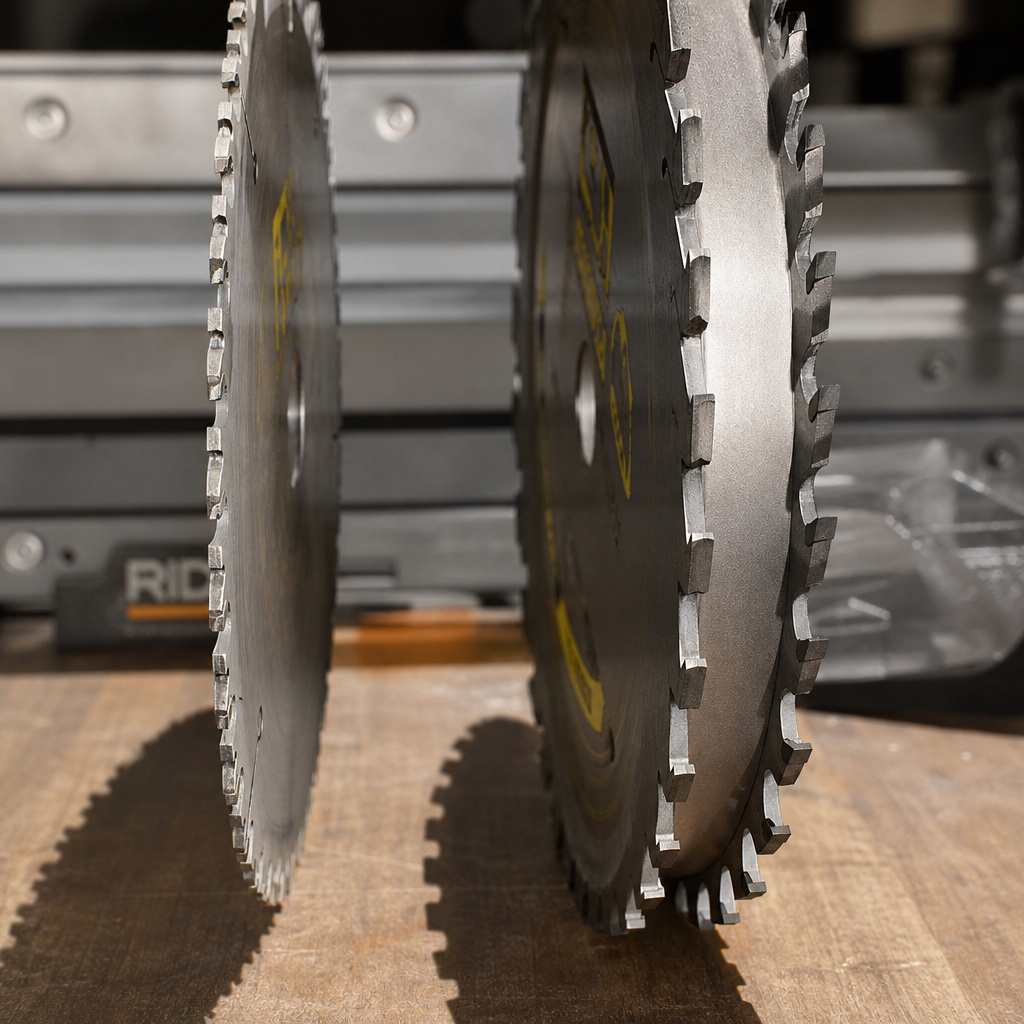
The choice between thin and full kerf isn’t about good versus bad. It’s about matching the blade to your saw’s power and your project’s demands.
| Blade Type | Typical Kerf Width | Best For | Risk If Misapplied |
|---|---|---|---|
| Thin-Kerf | 3/32″ (≈2.4mm) | Lower-powered saws (≤1.5 HP jobsite saws), cutting expensive hardwoods, reducing sawdust volume. | Deflection in cuts over 1-inch thick, leading to tapered kerfs and burned edges. Less stable in dense material. |
| Full-Kerf | 1/8″ (≈3.2mm) | Cabinet saws (≥3 HP), thick stock, ripping hardwoods, applications demanding maximum stability and vibration damping. | Overloading underpowered saws, causing bog-down, tripped breakers, and excessive motor wear. |
| Industrial/Heavy-Duty | 0.138″–0.177″ (3.5–4.5mm) | Industrial panel saws, heavy ripping, non-ferrous metals. | Severe binding and kickback on standard contractor saws not designed for the torque required. |
I learned this distinction the hard way with a CMT 10-inch thin-kerf combination blade on an old contractor saw. Ripping 8/4 maple, the blade would visibly flex. The cut was clean, but the two faces weren’t parallel by about half a millimeter over the 2-inch depth.
Every glue-up from that batch had a hairline gap. I switched to a Freud Premier Fusion full-kerf blade for thick stock and kept the thin-kerf for sheet goods and trim work. Problem solved.
The physics are simple. A thicker plate resists lateral forces better. It vibrates less at high RPM.
This stability translates to a straighter cut. But it also requires more power to push through the wood and removes more material. A 3HP cabinet saw doesn’t notice. A 15-amp jobsite saw will groan.
The Hidden Factors That Change Kerf Width
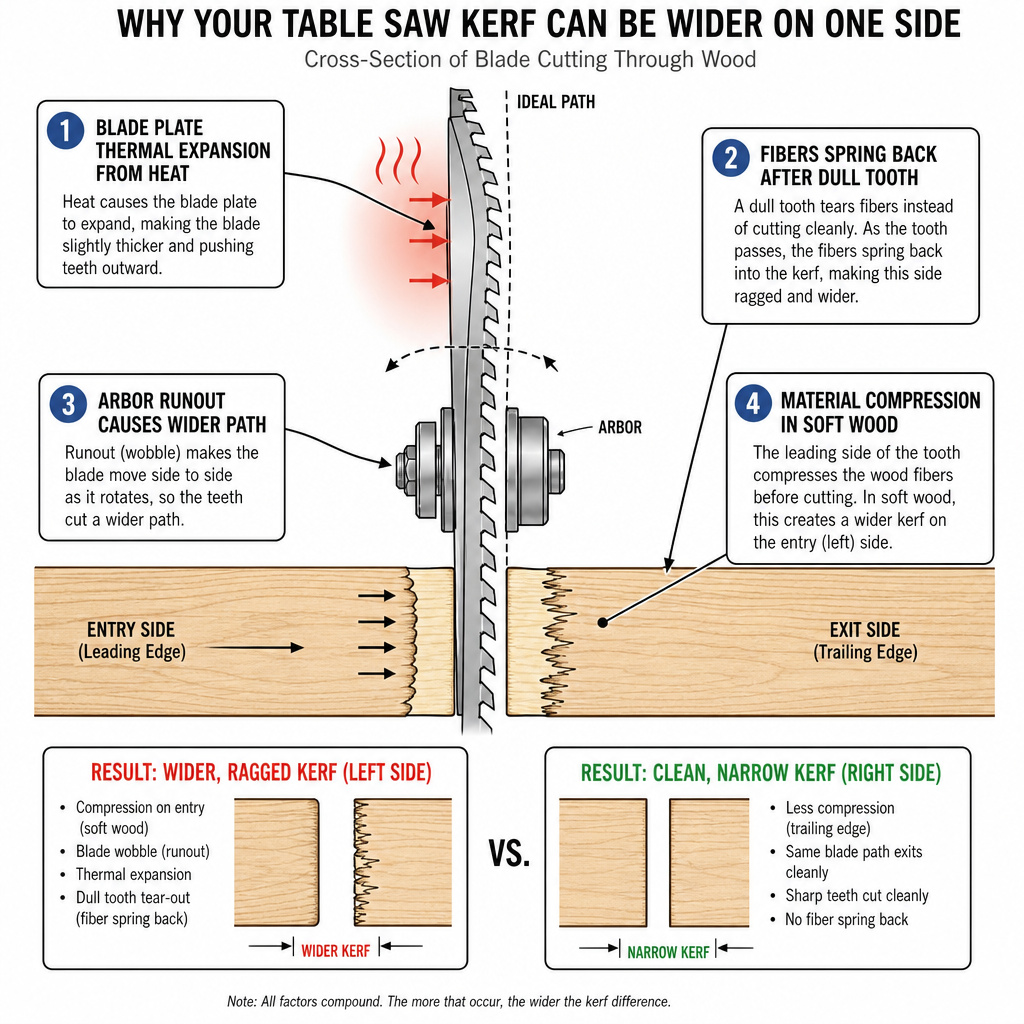
Blade thickness and tooth set are designed-in. Several other factors are dynamic, changing your kerf in real time.
Blade Sharpness: A dull blade doesn’t slice fibers cleanly; it tears and hammers them. This increased friction generates more heat, which can thermally expand the blade plate slightly. More importantly, the torn fibers spring back after the tooth passes, creating a ragged, effectively wider kerf. A blade that started life cutting a clean 3.1mm kerf can stretch to 3.3mm when dull, and the cut surface will be fuzzy, ruining it for glue-ups.
Material Hardness & Moisture: Cutting a dense, dry hardwood like hickory or white oak requires more force than cutting pine. This increased pressure can cause momentary blade deflection, momentarily widening the kerf. Softer, wetter woods can compress and then spring back, also affecting the final cut width.
Saw Setup & Health: This is the big one. Arbor runout, a slight wobble in the shaft the blade mounts to, forces the blade to cut a wider path. A warped blade does the same. A misaligned fence that pushes the wood slightly into the blade’s side will also increase kerf width and create dangerous kickback conditions. This is why measuring kerf on your own saw is non-negotiable. Your buddy’s identical saw blade might cut a different width.
If you hear a rhythmic thump-thump-thump or see a slightly wavy cut line instead of a laser-straight one, you have blade wobble. That sound is the blade alternately digging into each side of the kerf, and it will widen your cuts unpredictably. Stop and check arbor runout before chasing measurement ghosts.
How to Account for Kerf in Your Woodworking Projects
Accounting for kerf is a mindset shift. You stop thinking of a cut as a line and start thinking of it as a rectangle of removed material.
For Cut Lists & Layout: When you draw your cut line on a board, the kerf is the space to the right of that line (for a typical table saw setup). The finished piece is to the left. You must ensure there’s enough “waste” material to the right of the line to accommodate the kerf. In practice, this means when you place multiple parts on a board, you leave space between them equal to your kerf width. Cut list software does this automatically, this is the “kerf allowance” field you fill in.
For Joinery: This is where measuring your actual kerf is critical. Let’s say you’re cutting a 3/4-inch wide dado to hold a shelf. If you use a standard 1/8-inch kerf blade and make two passes to widen the dado, you might expect a 3/4-inch slot. But if your blade’s real kerf is 0.135 inches, two passes only give you 0.270 inches. You’re 0.105 inches short. You’ll need a third pass, which changes your layout. Always do a test joint in scrap.
For Bending Wood (Kerf Cutting): This is a specific technique where you make a series of closely spaced, deep cuts (the kerfs) on one side of a board to allow it to bend. Here, the kerf width and depth directly control the bend radius. A wider kerf allows for a tighter bend. This is a deliberate, constructive use of the material-removal property of kerf.
Before you start: Always disconnect power before measuring or changing a blade. A spinning saw blade is unforgiving. Use a push stick for any rip cut narrower than 6 inches. Sawdust contains fine particulates, wear a dust mask or respirator, especially in an enclosed shop.
Frequently Asked Questions
Can I just use the kerf width listed on the blade package?
No. That number is typically the blade plate thickness, not the cut width. It doesn’t account for tooth set or your saw’s wobble. Using it is the fastest way to make undersized parts. Measure the actual kerf from a test cut.
My thin-kerf blade is bending during cuts. What should I do?
You’re likely pushing too hard or cutting material too thick for the blade. Feed the wood slower. Let the blade teeth do the cutting. If you’re regularly cutting hardwoods over 1 inch thick, switch to a full-kerf blade. Deflection creates unsafe conditions and poor-quality cuts.
How does kerf affect my choice of saw blade for a job?
Match the kerf to your saw’s power and the cut’s purpose. Use thin-kerf for maximizing yield from expensive wood on a low-power saw. Use full-kerf for stable, vibration-free cuts on thick material with a powerful saw. For finish cuts where glue surface quality matters, use a sharp, stable full-kerf blade.
Do different tooth grinds (ATB, TCG, FTG) affect kerf width?
The primary grind (Alternate Top Bevel, Triple-Chip, Flat Top) changes how the tooth attacks the wood, not the fundamental kerf width set by the tooth’s bend. However, a severely worn ATB tooth can tear more than cut, creating a de facto wider, messier kerf. A fresh TCG grind might leave a slightly cleaner wall in abrasive materials but won’t change the physical slot width if the set is identical.
The Bottom Line
Kerf isn’t a theoretical spec. It’s the physical space your tool claims as its own. Ignoring it means donating that space, and the precision of your project, to a pile of sawdust. Grab a scrap of wood, make one cut, and measure the gap with calipers.
That number is more valuable than any printed on a blade. Use it to space your parts, size your joinery, and buy your material. Your cuts will fit, your glue lines will vanish, and you’ll stop wondering where that last inch of board went. That’s the real point of understanding kerf.
