How to Use a Tree Trimmer: Safety, Cutting, and Power Types
This post contains affiliate links. As an Amazon Associate, we earn from qualifying purchases.
Using a tree trimmer, or pole saw, requires matching three things: the right power type for your job, the correct cutting technique for the branch size, and a non-negotiable set of safety gear. A 10-foot pole saw in the hands of a 6-foot person can reach about 18 feet off the ground, letting you trim branches up to 6-8 inches thick without a ladder.
Most people get this wrong by focusing on the cutting and skipping the setup. They pick a tool that can’t handle their oak tree, or they stand right under the branch they’re sawing. The first mistake wastes an afternoon. The second one sends you to the emergency room.
This guide walks through choosing your tool, gearing up correctly, and executing cuts that keep both you and the tree healthy. We’ll cover the hard rules about power lines, the physical reason kickback happens, and what to do when the blade starts to bind.
Key Takeaways
- Never operate a pole saw within 10 feet of overhead power lines. Contact your utility company instead, this isn’t a DIY moment.
- For branches over 2 inches thick, you must use the three-cut method. Skipping the initial undercut tears a strip of bark down the trunk as the branch falls, wounding the tree.
- Battery-powered pole saws (like ECHO or Ryobi models) are ideal for 90% of homeowner jobs and cut branches up to 4-5 inches thick. Save the heavier gas saws for professional-grade work on thicker, harder wood.
- Your safety gear list is non-negotiable: ANSI Z87.1 rated goggles, cut-resistant gloves, sturdy boots, and hearing protection for gas models. Sawdust and wood chips fly directly at your face.
- Immediately step back after a cut. Let the branch fall freely. Trying to catch or control its fall is how you get hit by a swinging limb.
What Exactly is a Tree Trimmer (Pole Saw)?
A pole saw is a cutting tool with a long, telescoping pole and a saw blade or powered cutting chain at the end. Its entire purpose is to let you prune high branches while keeping both feet firmly on the ground. The alternative, using a chainsaw on a ladder, is a documented, severe safety hazard that insurance companies and arborists warn against every season. A pole saw eliminates that risk by giving you the reach without the instability.
The tool goes by a few names. “Pole pruner” often refers to manual or powered units with a small chainsaw-style cutting head. “Pole saw” is the broader category. “Tree trimmer” is the common search term that covers them all. They all solve the same problem: how to safely remove limbs 8 to 20 feet overhead.
A pole pruner consists of a cutting head, manual saw blade, battery-powered chain, or gas-powered chain, attached to a lightweight, telescoping aluminum or fiberglass pole. The pole length, typically 6 to 16 feet extended, determines the maximum safe working height, which is your reach plus the pole’s length.
Which Pole Saw Power Type is Right for You?
This is the first and most important choice. Picking the wrong power source means you’ll either fight the tool or it will fight the tree. The decision hinges on branch thickness, property size, and how much maintenance you’re willing to do.
| Power Type | Best For | Max Branch Thickness | Key Limitation |
|---|---|---|---|
| Manual (Hand Saw) | Occasional light pruning, quiet operation, zero maintenance. | 5-6 inches (with effort) | Requires significant physical exertion. Multiple strokes needed. |
| Battery-Powered (Cordless) | Most homeowner jobs: trimming oaks, maples, pines. Quiet, instant start, minimal upkeep. | 4-5 inches | Runtime limited by battery amp-hours. Power can fade on the hardest woods. |
| Electric Corded | Extended use near an outlet on light-medium branches. Consistent power. | 4 inches | Mobility restricted by cord length. Presents a serious trip hazard. |
| Gas-Powered | Thick, hard branches (oak, hickory). Large properties with no power access. | 6-8 inches+ | Heavier, louder, requires fuel mixing and seasonal engine maintenance. |
Battery-powered models, like the ECHO PPT-2620 or the Ryobi 40V, have become the default for a reason. They start with a trigger pull, not a yank on a starter cord. They don’t smell like a lawnmower.
The torque on a good 40V or 80V system will surprise you, it powers through 4-inch maple limbs without bogging down. The limitation is real, though. If you’re felling 6-inch thick, dead oak limbs all afternoon, the battery will drain, and the motor can overheat. That’s the gas saw’s territory.
Gas saws, like the Stihl HT 101 or Husqvarna 525P5S, are heavier and louder. You’ll feel the weight at full extension after twenty minutes. They also demand more care: mixing 2-cycle oil and gas, storing fuel safely, and dealing with carburetor issues if they sit. But for pure cutting power on the toughest jobs, they’re still the benchmark.
I learned the battery vs. gas lesson the hard way on a row of overgrown crabapple trees. The first one went fine with my 40V saw. By the third tree, the battery was hot, the cuts were slow, and I was forcing the bar.
I switched to a borrowed gas model. The weight was a chore, but it sliced through the remaining limbs in half the time. Now I recommend battery for everything under 4 inches and occasional use. For a full day of serious trimming, or for wood that’s known to be dense, rent or borrow a gas saw.
Essential Safety Gear You Can’t Skip
You wouldn’t use a chainsaw in shorts and sandals. A pole saw demands the same respect because it puts a cutting tool directly overhead. The debris, sawdust, wood chips, tiny twigs, rains down on you. The gear isn’t optional.
Safety Goggles (ANSI Z87.1 Rated): Standard glasses won’t cut it. You need sealed goggles. Sawdust finds its way into the corners of your eyes on every upward cut. One piece of flying bark can cause a corneal abrasion. It happens fast.
Cut-Resistant Work Gloves: These protect your hands from the rough pole, from the sharp teeth of the manual blade, and from the chain if you need to handle it. They also improve your grip when your hands get sweaty.
Sturdy Boots with Slip-Resistant Soles: You’re looking up, not down. Your footing has to be automatic. Boots protect your feet from falling branches and give you stability on uneven ground.
Hearing Protection: Mandatory for gas models. A gas-powered pole saw operates at around 100-105 decibels. Prolonged exposure without protection leads to permanent hearing damage. For battery saws, it’s still a good idea for extended use.
Hard Hat / Forestry Helmet: The professional standard. A forestry helmet combines head protection with a face screen and hearing muffs. For the homeowner doing a few branches, a hard hat is the bare minimum if you’re under dense, dead wood that could drop unexpected debris.
Before you start: The two most immediate hazards are overhead power lines and kickback. Always visually confirm branches are at least 10 feet from any line. If they’re closer, call the utility company, they will trim them for free. Kickback occurs when the moving chain’s tip contacts a solid object, forcing the saw bar upward and backward toward you. Maintain a firm, two-handed grip and never let the tip touch wood.
How to Inspect Your Work Area Like a Pro
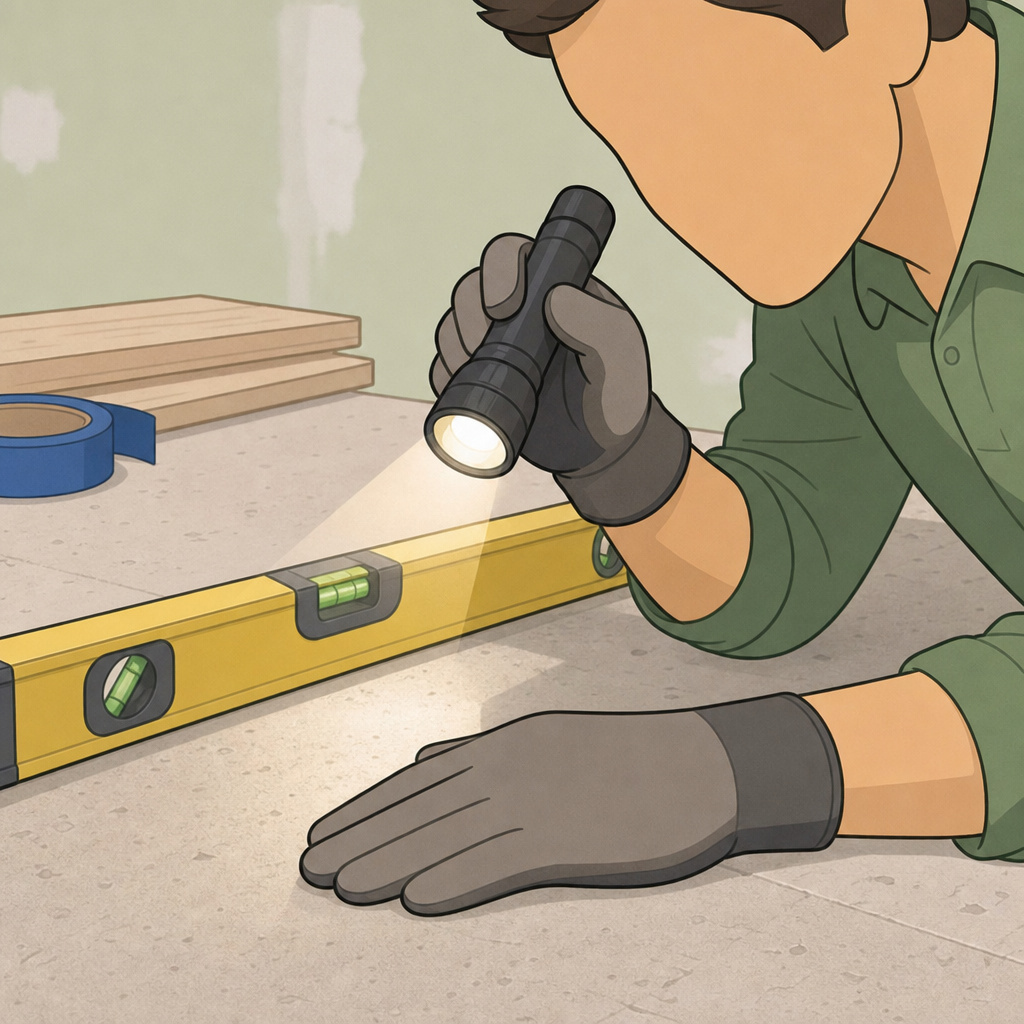
Most accidents happen because of something on the ground, not in the tree. A five-minute walk-around prevents them.
- Clear the Drop Zone: Remove patio furniture, kids’ toys, garden hoses, and potted plants from under and around the tree. A falling branch has a surprising reach as it tumbles through other limbs.
- Check for People and Pets: Make sure everyone is inside or well away from the area. Announce you’re starting work. A curious dog or a neighbor walking over can enter the danger zone silently.
- Identify Escape Routes: Never box yourself in. Position yourself so you can take two quick steps backward without tripping over a root, a rock, or the tool’s case.
- Survey the Tree Itself: Look for dead, broken limbs hanging above your work area (“widowmakers”). Look for hornet or wasp nests. A disturbed nest at 15 feet turns a pruning job into a panic.
- Weather Check: Do not operate a pole saw in rain or high winds. Wet conditions increase electrocution risk for electric/battery tools and make footing slippery. Wind makes branch falls unpredictable.
If you’re tackling a large branch, have a spotter on the ground. Their only job is to watch for hazards you can’t see and warn you if anything goes wrong. Working alone on big stuff is how small problems become big ones.
How to Make the Right Cut Every Time
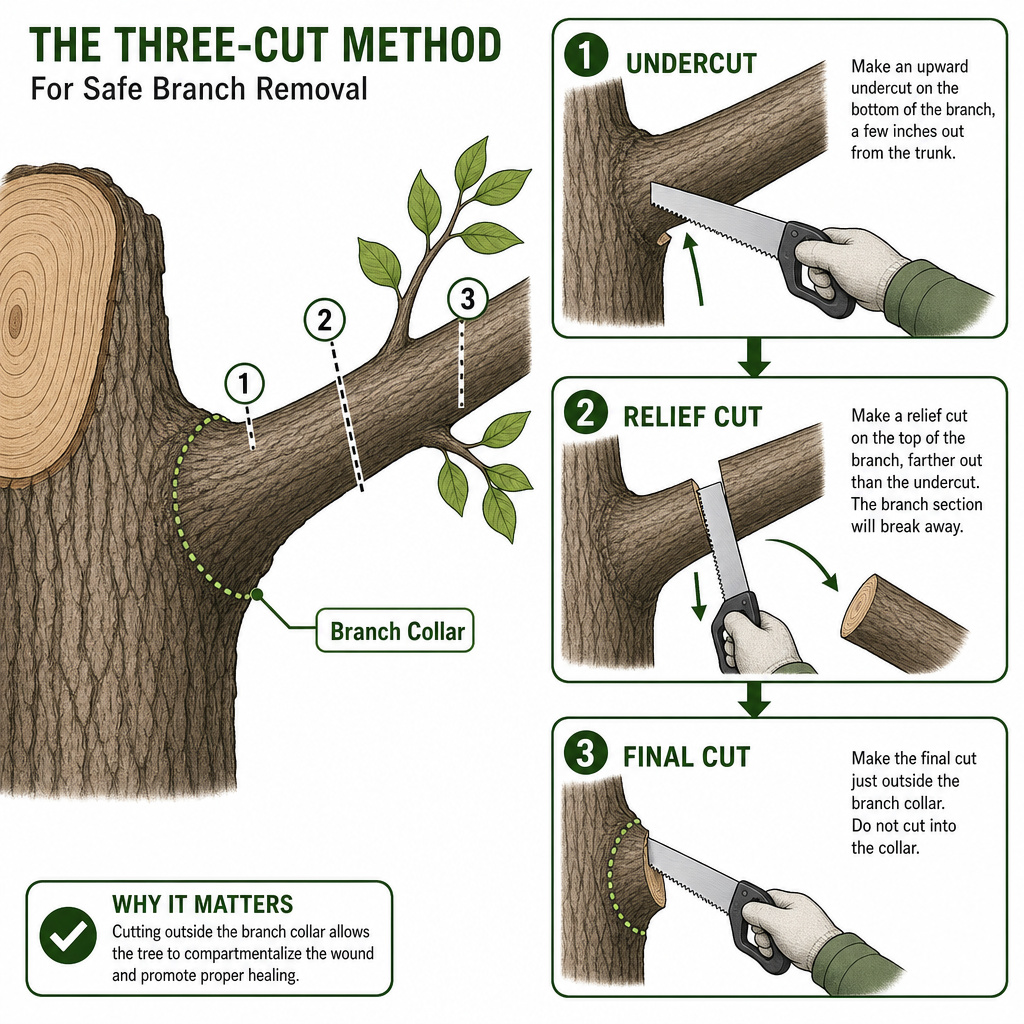
There are two cutting techniques. Picking the wrong one damages the tree. The rule is simple: any branch thicker than your wrist (about 2 inches) needs the three-cut method. Smaller branches get a single, angled cut.
The Three-Cut Method for Large Limbs
This method prevents bark tearing. When a heavy branch falls, its weight can rip a long strip of bark off the trunk as it peels away. This “bark tear” opens a huge wound for insects and disease. The three-cut method relieves the weight before you make the final cut.
- The Undercut (First Cut): About 12 inches out from the trunk, cut upward into the bottom of the branch. Go only one-quarter of the way through the branch’s diameter. This cut creates a hinge and a stopping point for the bark tear.
- The Relief Cut (Second Cut): Move 2-3 inches further out from the undercut. Saw down through the branch from the top until it breaks off and falls. The undercut stops the bark from tearing past that point. The heavy limb is now gone.
- The Final Cut (Third Cut): Now you can safely remove the 12-inch stub. Cut just outside the “branch collar”, the slightly swollen ring of tissue where the branch meets the trunk. Do not cut flush with the trunk. The branch collar contains specialized cells that allow the tree to seal the wound. Cutting it off makes the wound take years longer to heal.
Single Cuts for Small Branches
For branches under 2 inches, it’s straightforward. Position the saw at a 60-degree angle to the branch. Make a single, smooth cut.
Angling the cut allows water to run off the stub, reducing rot. Let the saw do the work. Forcing a manual saw or pushing a powered saw too hard binds the blade and strains the motor.
I won’t recommend a manual pole saw for anything over 3 inches. The physics work against you. On a 4-inch green maple branch, you’ll make fifty strokes, your arms will burn, and the cut will be ragged. A battery saw does it in eight seconds with a clean kerf. Your time has value.
Operating Your Pole Saw: Stance, Grip, and Control
The tool is long for a reason. Use the length.
Stance: Stand to the side of the branch’s fall path, at roughly a 45-degree angle. Your feet should be shoulder-width apart, knees slightly bent. This keeps you stable and out of the direct drop line. Never, ever stand directly underneath the branch you’re cutting.
Grip: Use both hands. One hand goes near the trigger or the base of the pole. The other hand goes further up the pole for guidance and control. Your grip should be firm but not white-knuckled. A tense grip transfers vibration directly to your muscles and tires you out faster.
Control and Cutting Motion: For manual saws, use long, smooth, full-length strokes. Let the teeth do the cutting. Short, jerky strokes are inefficient and tire you out. For powered saws, engage the chain and let it touch the wood. Apply gentle, consistent forward pressure. The moment you hear the motor bog down or see smoke, you’re forcing it. Ease off, let the chain clear the kerf, and resume.
The most common mistake is overreaching. If the branch is just out of reach, the instinct is to stretch your arms and go up on your toes. That kills your balance. Instead, move your feet.
Reposition yourself. If you still can’t reach it, the branch is too high for your tool. It’s not a failure, it’s a boundary. Hire a professional with the right equipment.
What Maintenance Does a Pole Saw Need?
A clean, sharp saw is a safe saw. Neglect here leads to kickback, binding, and premature wear.
After Every Use:
- Wipe down the pole, handle, and cutting head with a dry cloth. Remove sap and dirt.
- For powered saws with a chain, check the bar oil level and refill if needed. A dry chain ruins the bar and the chain in minutes.
- Inspect the chain for dull or damaged teeth. A dull chain requires more force to cut, increasing the risk of kickback.
Sharpening the Chain: You’ll know it’s dull when the saw produces fine dust instead of small wood chips, and you have to push much harder to make progress. Use a round file matching the chain’s gauge (often 5/32″ or 3/16″). File each cutter at the manufacturer’s specified angle (usually 30-35 degrees). Maintain the same number of strokes per tooth for an even sharpening. A poorly sharpened chain cuts in circles.
Long-Term Storage:
- For gas models, either run the carburetor dry or add fuel stabilizer to the tank. Old gas turns to varnish and clogs the carburetor.
- For battery models, store the battery in a cool, dry place, partially charged.
- Loosen the chain tension slightly to prevent it from stretching the drive links.
Following a basic trimmer maintenance routine after each use adds years to the tool’s life. It’s the same discipline required for sharpening hedge trimmer blades or any cutting tool.
When Should You Call a Professional?
Knowing when to stop is a sign of experience, not weakness. Call a certified arborist for:
* Branches within 10 feet of power lines. This is the absolute rule.
* Very large or heavy branches high in the tree. Their weight and fall path are unpredictable.
* Branches that are dead, diseased, or cracked. These can fail in unexpected ways when cut.
* Work that requires climbing or a ladder. If your pole saw can’t reach it safely, the job is above your pay grade.
* Any doubt about the tree’s health or stability. An arborist can assess risk you might not see.
The cost of a professional for a few hours is far less than the cost of a hospital visit, a new roof, or a lawsuit.
Frequently Asked Questions
How thick of a branch can a pole saw cut?
Most homeowner-grade pole saws can handle branches up to 6-8 inches in diameter. Battery and electric models perform best on branches up to 4-5 inches thick. Gas-powered models have the torque for the larger 6-8 inch range. Always check your specific model’s manual for its rated capacity.
Can you use a pole saw on a ladder?
No. Never. Using a pole saw on a ladder is extremely dangerous. The tool’s length creates leverage, and any kickback or shift in balance can easily knock you off the ladder. The whole point of a pole saw is to keep you safely on the ground.
What’s the difference between a pole saw and a hedge trimmer?
They are completely different tools for different jobs. A pole saw is for cutting individual tree branches, typically over 1/2 inch thick. A hedge trimmer is for shearing the soft, small-diameter growth of hedges and shrubs. Using a hedge trimmer on a tree branch will damage the tool and likely not cut through.
How do you prevent the saw blade from getting stuck?
Blade binding happens when the weight of the branch closes the kerf (the cut) onto the blade. For larger branches, this is why you use the three-cut method, the relief cut removes the weight. For smaller branches, avoid forcing the cut. If it starts to bind, stop pushing, wiggle the blade gently to open the kerf, or slightly adjust your cutting angle.
Is it better to prune trees in the spring or fall?
The general best practice is to prune during the dormant season, late winter or very early spring, before new growth starts. This minimizes stress on the tree and reduces the risk of disease entering fresh cuts. However, dead, damaged, or diseased branches should be removed as soon as you notice them, regardless of the season.
Before You Go
Using a tree trimmer correctly boils down to preparation and patience. Match the tool’s power to the job, battery for most things, gas for the big stuff. Gear up with goggles, gloves, and boots every single time. Your stance matters: stand to the side, grip with both hands, and never overreach.
For any branch over two inches thick, the three-cut method isn’t just a suggestion; it’s how you protect the tree from a devastating bark tear. Finally, know your limits. If the branch is near power lines, too high, or looks rotten, put the saw down. Call a professional. A clean, safe yard isn’t worth a trip to the emergency room.
