What is a Forstner Drill Bit Used For? | Flat-Bottom Holes
This post contains affiliate links. As an Amazon Associate, we earn from qualifying purchases.
A Forstner drill bit is a specialized wood-boring tool designed to cut exceptionally clean, flat-bottomed holes with smooth sides. Its unique rim-guided cutting action lets it start holes on edges, over existing holes, or at an angle, tasks impossible for standard twist or spade bits. The most common use is drilling 35mm diameter, 12.5mm deep cups for European concealed hinges in cabinet doors.
That rim is the whole game. It scores the wood’s circumference before the main cutters engage, which is why the hole’s edge is splinter-free even in plywood or across end grain. The flat bottom and smooth walls make it the default for hinge cups, dowel joinery, and any project where a hole needs to look finished or house another component precisely.
What follows: a breakdown of the three parts that make it work, the five jobs it does that other bits can’t, and the one material where it will fail in under a minute. We’ll also cover why you almost always want a drill press, what the 35mm standard actually is, and how to spot the difference between a $15 bit that smokes and a $50 bit that lasts.
Key Takeaways
- The Forstner bit’s continuous outer rim scores the wood first, creating a clean edge and allowing it to start a hole anywhere, even overlapping an existing hole.
- Its flat bottom and smooth walls are essential for European concealed hinges (35mm diameter, ~12.5mm deep), dowel joinery, and creating precise mortises.
- Always use a drill press when possible. Handheld drilling with bits over 25mm (1 inch) is difficult due to the lack of self-feed and can lead to dangerous kickback.
- High Carbon Steel (HCS) bits are fine for softwoods but dull quickly in MDF or hardwoods. For those materials, a Tungsten Carbide Tipped (TCT) bit like the P&N 35mm is the only sensible choice.
- Dull bits burn wood. If you smell burning or see smoke, stop immediately. The bit is too hot, the RPM is too high, or the chips aren’t clearing.
The Forstner Bit’s Unique Design (And Why It’s Not a Spade Bit)
Look at the business end. A Forstner bit has three distinct parts working together, and missing any one ruins the cut.
First, the continuous outer rim. This sharpened ring is what defines a Forstner. It’s a circular cutter that scores the full circumference of the hole before anything else touches the wood. That initial score is why you get a clean, tear-out-free edge in materials like plywood where a spade bit would shred the top layer. The rim also guides the entire bit, it doesn’t rely on a central point for alignment like a brad point bit. This lets it start a cut on a curved surface, over an existing hole, or at a steep angle.
Second, the two main cutting wings. These are the flat, chisel-like arms that extend from the center to the rim. Their job is to scrape out the bulk of the material, lifting it up as chips. They create the flat bottom. If these wings aren’t sharpened evenly, one side will cut more aggressively than the other, causing the bit to wobble and produce an oversized, out-of-round hole.
Third, the center brad point. This small spur in the middle helps with initial positioning and stability, but it’s not the primary guide. On some cheaper bits, this point is overly long. That becomes a problem on thin stock.
Where this goes sideways: On a standard bit, the center point extends 3–5mm past the cutting wings. If you’re drilling a 12.5mm deep hinge cup into a 16mm thick cabinet door, that point can punch through the front face before the cup is fully formed, leaving a visible pinhole on the show side. The fix is a dedicated hinge boring bit with a shorter point or meticulous depth control.
This design is why a Forstner bit is in a different class than a spade bit or hole saw. A spade bit is for rough, fast holes where tear-out doesn’t matter, framing, running wire. A hole saw is for large-diameter through-holes. A Forstner is for precision joinery where the hole itself is part of the finished product.
| Bit Type | Best For | Hole Quality | Can Start on Edge/Overlap? |
|---|---|---|---|
| Forstner Bit | Flat-bottomed holes, hinge cups, dowels, joinery | Very clean walls, flat bottom | Yes |
| Spade Bit | Fast, rough boring in framing lumber | Ragged edges, splintering | No |
| Hole Saw | Large diameter through-holes (e.g., for pipes) | Clean rim but ragged bottom plug | No |
| Brad Point Bit | Precise, straight through-holes in wood | Clean entry/exit, pointed tip | No |
What is a Forstner Drill Bit Used For? The 5 Core Jobs
The clean, flat-bottomed hole is the goal. Any application that needs that specific result is Forstner territory.
1. European Concealed Hinge Cups. This is the single biggest reason Forstner bits exist in modern workshops. The standard for European-style cabinet hinges (like those from Blum or Hettich) is a 35mm diameter cup, drilled to a depth of about 12.5mm. No other bit can produce that perfect, smooth-walled cylindrical recess as quickly or consistently. The workflow is simple: mark the center, set your drill press depth stop, and drill. The hinge cup drops in flush.
2. Dowel Joints. For strong, hidden joinery, you drill matching holes in two pieces of wood and glue in a dowel. A Forstner bit’s straight, smooth walls ensure maximum glue surface area and a tight fit. Its flat bottom means the dowel seats squarely against the end of the hole, transferring force evenly. A twist bit leaves a conical bottom that concentrates stress on the dowel’s tip.
3. Creating Mortises. You can’t drill a square hole with a round bit, but you can get close. By drilling a series of overlapping Forstner holes, you can quickly excavate most of the waste for a mortise, then clean up the sides with a chisel. The flat bottoms line up neatly, and the clean walls mean less chisel work.
4. Decorative Inlays and Recesses. Need a shallow recess for a glass panel, a speaker grill, or a decorative wood plug? The flat bottom is non-negotiable. The clean edge means the inlay fits tightly without needing filler or extensive sanding.
5. Angled Holes and Pocket Holes (The Specialty). Because the rim guides the cut, you can start a Forstner bit on an angled surface. This is how you create pocket holes for face frames without a dedicated jig, though a Kreg jig is faster for production work. You can also drill partially into the edge of a board to create a hidden wire channel or a stopped groove.
A 2008 Fine Woodworking magazine test of 18 brands drilled 100 one-inch-deep holes in hickory at 480 RPM. Bit temperatures ranged from 134°F to 268°F. The cleaner-cutting bits ran cooler; the ones that tore and clogged got hot enough to scorch the wood on the first dozen holes.
When a Forstner Bit is the Wrong Choice
It’s a precision tool, not a universal one. Reach for something else in these four scenarios.
- Drilling through metal, plastic, or masonry. The cutting geometry is for wood only. In metal, it will skate, dull instantly, and likely break. Use a twist drill bit for metal and a masonry bit for concrete.
- Drilling deep holes (more than 2x the diameter) in one go. Forstner bits are poor at ejecting chips. In a deep hole, packed sawdust creates immense friction, overheats the bit, and can weld itself to the cutting edges. The solution is peck drilling: drill in 5–10mm increments, lifting the bit completely to clear chips each time.
- When speed is the only priority. A spade bit is three times faster. If you’re drilling 50 holes for electrical runs in a stud wall and appearance doesn’t matter, use the faster, cheaper tool.
- Drilling into MDF or particle board with a standard HCS bit. These engineered materials are abrasive. They contain glue and silica that act like sandpaper on the cutting edges of a High Carbon Steel (HCS) bit. You’ll get maybe a dozen clean holes before it starts burning and tearing. For MDF, you need a Tungsten Carbide Tipped (TCT) Forstner bit.
Forstner Bit Sizes, Materials, and What to Buy
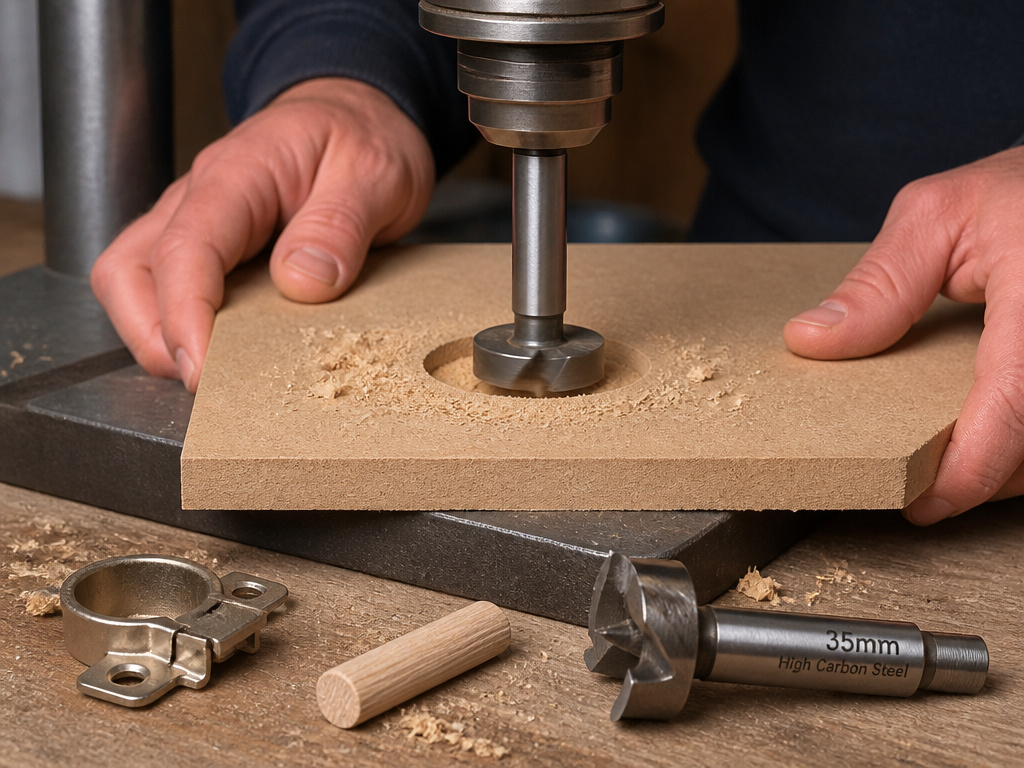
Sizes run from under 6mm (1/4″) for small dowels up to 75mm (3″) or more for large recesses. The two sizes you’ll reach for constantly are 20mm and 35mm, one for standard dowels, the other for hinge cups.
The material choice is binary: HCS or TCT.
High Carbon Steel (HCS) bits are the standard. Brands like Sutton Tools make excellent HCS sets. They’re affordable and perfect for softwoods like pine, cedar, and poplar. They can be hand-sharpened with a fine diamond file or honing stone 3–5 times over their life. But run an HCS bit into oak, maple, or MDF and it will dull before you finish your first project. You’ll smell the burn before you see it.
Tungsten Carbide Tipped (TCT) bits have brazed carbide cutting edges. The P&N 35mm Tungsten Carbide Forstner Bit is the benchmark for cabinet shops. Carbide is vastly harder and more heat-resistant. It laughs at MDF and hardwoods. The trade-off is cost and sharpening, you can’t hand-sharpen carbide. It requires a diamond wheel grinder, so most people treat them as disposable, though they last 5–10 times longer than HCS in abrasive materials.
Common mistake: Buying a 35mm Forstner bit for hinge cups without checking the center point length. On a thin (16mm) cabinet door, a standard bit’s point will punch through. Either use a hinge boring bit (designed for the task) or verify your door is at least 18mm thick.
What should you buy? If you’re setting up a shop and plan to work with real wood, start with a Sutton Tools 4-piece HCS set (16, 20, 26, 35mm). It covers 90% of cabinetry tasks. If you’re building speaker boxes or furniture from sheet goods like MDF, buy the single P&N 35mm TCT bit and add HCS sizes as needed. Don’t buy a giant 12-piece set with sizes you’ll never use.
How to Use a Forstner Bit Correctly (Speed, Pressure, and the Drill Press Rule)
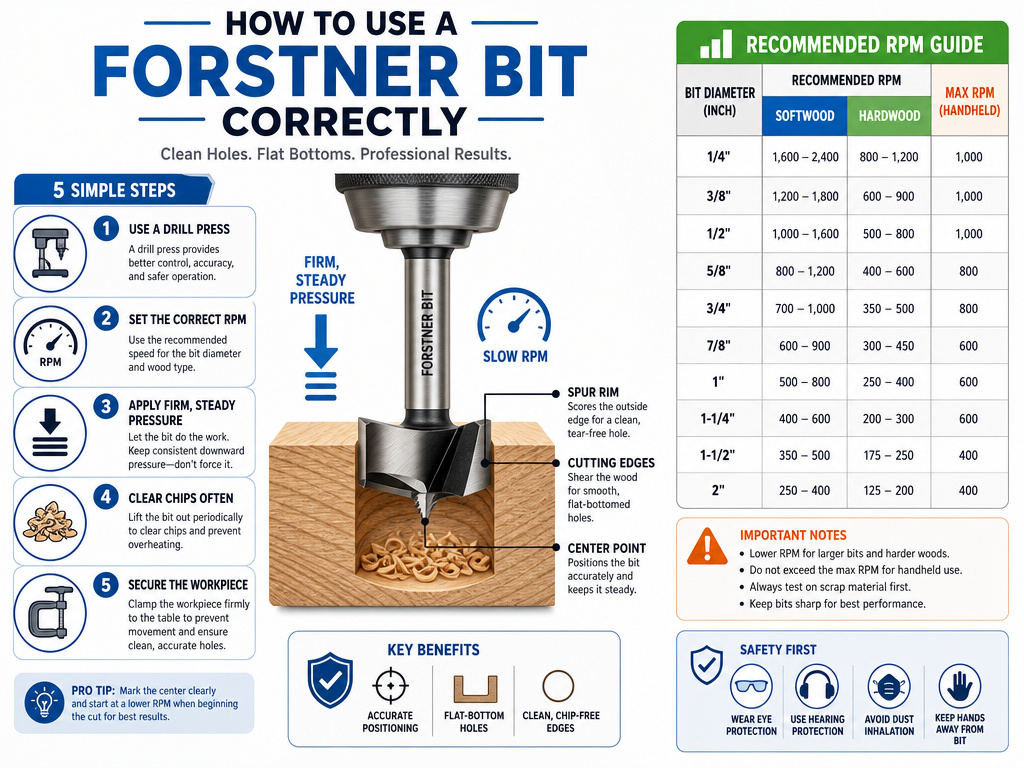
The technique is different from a standard twist drill bit. Get it wrong, and you’ll burn the wood, break the bit, or stall your drill.
- Use a drill press whenever possible. The lack of self-feed means you must supply constant, even downward pressure. A drill press provides perfect vertical alignment and controlled feed. Handheld drilling is viable for bits under 25mm (1 inch) in softwood, but it’s tiring and less accurate.
- Set the correct RPM. Slow is safe. For bits up to 25mm, 1000-1500 RPM is a good start. For the common 35mm size, drop to 600-900 RPM. Larger diameters need even slower speeds, a 50mm bit should run under 500 RPM. High speed creates friction heat, which dulls the bit and burns the wood.
- Use firm, steady pressure. Don’t lean on it. Let the cutting edges scrape. If the motor bogs down, you’re feeding too fast or the bit is dull. If you hear a high-pitched squealing, the RPM is too high.
- Clear the chips. For any hole deeper than the bit’s cutting head, use the peck-drill method. Drill about 10mm, lift completely to clear the flutes, then go back in. This prevents packing, which is the main cause of overheating.
- Secure your workpiece. Clamp it down. The cutting action of a Forstner bit can grab and spin a loose board, especially at the moment of breakthrough.
| Bit Diameter | Recommended RPM (Softwood) | Recommended RPM (Hardwood/MDF) | Max Handheld? |
|---|---|---|---|
| Up to 1/2″ (13mm) | 1500 – 2000 | 1200 – 1500 | Yes |
| 1/2″ to 1″ (13-25mm) | 1000 – 1500 | 600 – 1000 | Yes (with care) |
| 1″ to 1-1/2″ (25-38mm) | 600 – 900 | 400 – 600 | Not recommended |
| Over 1-1/2″ (38mm+) | 400 – 600 | 250 – 400 | No |
What happens if you run it too fast? The wood burns at the rim, leaving a black charred ring. The bit turns blue from heat tempering, permanently losing its hardness. In MDF, the glue in the material melts and gums up the flutes, rendering the bit useless in seconds.
Maintaining and Sharpening a Forstner Bit
A sharp Forstner bit cuts with a quiet scraping sound and produces thin, curly chips. A dull one screams, smokes, and makes fine dust.
You can hand-sharpen HCS bits. You need a fine, flat diamond file or an Arkansas stone. The goal is to restore the original angles on the two cutting wings and the outer rim. Do not touch the center brad point.
- Sharpen the flat cutting wings. Lay the file flat against the wing’s top surface (the relief face) and push along the existing bevel. Do 3-5 light passes per wing, trying to match the original angle. Do more passes on the wing that looks more worn.
- Touch up the outer rim. This is delicate. Use a round or triangular diamond file to follow the curve of the rim, sharpening only the inside edge. Two or three light passes are enough.
- Test for balance. After sharpening, press the bit’s center point into a soft piece of wood and spin it by hand. Both wings should contact the wood evenly. If one wing hits first, it’s longer, go back and sharpen the other wing a bit more to even them out.
TCT bits cannot be hand-sharpened. The carbide is too hard for files. They require a diamond grinding wheel. For a single bit, this service often costs more than a new bit. This is why TCT bits are treated as long-life consumables in professional shops.
Frequently Asked Questions
Can you use a Forstner bit in a hand drill?
You can, but you shouldn’t for bits over 1 inch (25mm). The lack of self-feed requires significant downward pressure, which is hard to maintain steadily by hand. It’s also easy to tilt, creating an oval hole. For small diameters in softwood, it’s possible. For anything serious, use a drill press.
Why is my Forstner bit burning the wood?
Three reasons, usually in combination: the bit is dull, the RPM is too high, or you’re not clearing chips. Dull blades rub instead of cut, creating friction heat. High RPM multiplies that heat. Packed chips insulate the bit, trapping the heat in the wood. The fix is always the same: stop, let it cool, sharpen it, slow your speed, and peck-drill to clear chips.
What’s the difference between a Forstner bit and a hole saw?
Hole saw cuts a ring, leaving a solid plug in the middle and a ragged bottom. It’s for making large through-holes. A Forstner bit excavates the entire hole, leaving a flat, smooth bottom and walls. It’s for creating precise recesses. Use a hole saw to make a hole for a pipe. Use a Forstner bit to make a recess for a hinge.
How do you drill a flat-bottom hole without a Forstner bit?
You don’t, not really. You can use a spade bit and then clean up the bottom with a chisel or a router, but it’s messy and imprecise. You can use an end mill in a router, but that requires a CNC or a very steady hand. For a true, clean, flat-bottomed hole in wood, the Forstner bit is the right tool.
Can a Forstner bit be used on plastic or aluminum?
Not effectively, and not without risk. In plastic, the bit can grab and crack the material. In aluminum, it will likely skate, dull immediately, or break. Use a step drill bit for thin metal and plastic sheet, or a standard twist bit for thicker stock.
Before You Go
A Forstner bit isn’t a general-purpose drill bit. It’s a joinery tool. Its value is in the clean, flat-bottomed, precisely located hole, something no other bit on your rack can produce. If you’re installing cabinet hinges, fitting dowels, or making decorative inlays, it’s the only correct choice.
For everything else, there’s probably a faster, cheaper bit. Keep a 35mm TCT bit for cabinets and an HCS set for occasional dowel work. Clamp your stock, slow your drill press, and clear the chips every few millimeters. That’s the difference between a crisp hinge cup and a charred, torn mess that needs filling and sanding. The tool does the work, but only if you let it cut instead of rub.
