
What Is a Hand Drill | The Standards That Define It
This post contains affiliate links. As an Amazon Associate, we earn from qualifying purchases.
A hand drill is a motor-operated tool with a rotating chuck designed to bore holes in materials like wood, metal, and plastic, and to drive screws. The formal international standard, IEC 62841-2-1, defines it as a tool equipped with either a typical three-jaw chuck or a machine taper. It includes both corded and cordless drills, as well as impact drills which have a built-in percussion system for masonry.
That definition is the starting line. It tells you what the tool is, not when you need it or how to pick one. The real choice happens after you know the materials you’re drilling and the force you need to apply.
What follows is a breakdown of the two main types, how they actually work, the critical safety standards that aren’t optional, and the one spec that decides whether a job takes five minutes or ruins your Saturday.
Key Takeaways
- The international standard IEC 62841-2-1 is the legal definition of a hand drill and an impact drill, it’s the document that separates them from rotary hammers and impact wrenches.
- An impact drill is not just a stronger drill; it adds a hammering action for masonry but lacks the brute force of a rotary hammer, making it a middle-ground tool.
- The chuck type, keyed, keyless, or SDS, dictates bit changes and the tool’s maximum capacity. Using the wrong bit in an SDS+ chuck is a fast path to injury.
- ANSI Z87.1-rated safety glasses are non-negotiable for any drilling operation. Everyday glasses are not safety glasses.
- Drilling capacity isn’t a suggestion; it’s the point where the motor stalls or the bit snaps. Exceeding it burns out the tool’s brushes or gearbox.
The Two Main Types of Hand Drills
The split isn’t between corded and cordless. It’s between the tool that spins and the tool that spins and hits.
IEC 62841-2-1, the international safety standard, draws the line: a “drill” bores holes in metal, plastic, and wood. An “impact drill” is similar in appearance but has a built-in percussion system for an axial hammering motion, specifically for concrete and stone.
A standard drill delivers pure rotational torque. You use it for wood, metal, plastic, and driving screws. An impact drill adds a hammering action along the axis of the bit. This pounding chips away masonry while the rotation clears the dust. It’s for concrete, brick, and stone.
But an impact drill is not a rotary hammer. The standard is explicit: it does not apply to rotary hammers. A rotary hammer uses a piston mechanism, hitting much harder. An impact drill is for occasional holes in a block wall; a rotary hammer is for core-drilling a foundation.
The Standard Drill: Your Go-To for Everything Else
This is the workhorse. Its job is to apply rotational force, torque, to a bit. You’ll find it in two main chuck styles: the classic three-jaw chuck you tighten with a key, and the modern keyless chuck you tighten by hand.
The keyless chuck is faster. The keyed chuck grips harder, which matters when you’re driving large lag bolts into dense timber. Under the hood, a clutch lets you set a torque limit. Hit that limit, and the clutch disengages with a rapid clicking sound. This prevents over-driving screws or stripping threads. For drilling, you set the clutch to the drill icon, which bypasses the clutch and sends all available torque to the chuck.
The Impact Drill: The Masonry Specialist
When you push the selector to the hammer icon, you engage the impact mechanism. Two ribbed metal discs, called an impact mechanism, ride against each other. One is fixed to the motor, the other to the chuck. As they rotate, the ribs cam in and out, slamming the chuck forward thousands of times per minute.
A model like the Ryobi PBLHM101K lists a hammer speed of 0–31,000 blows per minute (BPM). That’s the pounding. The rotation continues simultaneously, usually at 0–2,100 RPM. This combined action is why you must use carbide-tipped masonry bits, standard HSS bits will dull in seconds and can shatter.
| Feature | Standard Drill | Impact Drill |
|---|---|---|
| Primary Action | Rotation only | Rotation + axial hammering |
| Best For | Wood, metal, plastic, driving screws | Masonry (concrete, brick, stone) |
| Chuck Type | Keyed or keyless 3-jaw | Often keyless 3-jaw or SDS+ |
| Sound | Whirring motor | Distinct rapid brrrrrrt from hammer mechanism |
| Risk If Misused | Stripped screws, snapped bits in metal | Shattered masonry bits, damaged chuck bearings from lateral force |
How a Hand Drill Works
Forget the motor for a second. The crucial interface is the chuck. It’s the clamp that holds the bit. A worn or dirty chuck will never hold a bit straight, and a wobbling bit makes oval holes and burns out fast.
Inside the housing, a universal or brushless motor spins. That spin goes through a planetary gearbox, a set of stacked gears that reduce speed and increase torque. A two-speed selector switches between a low-gear, high-torque setting for driving screws or drilling large holes, and a high-gear, low-torque setting for faster drilling in softer materials.
The trigger isn’t just an on/off switch. It’s a variable-speed trigger. Squeeze it lightly for slow, controlled starting, essential for preventing drill bits from “walking” on metal or for driving screws without stripping the head. Pull it fully for max RPM.
Where this goes sideways: Using the high-speed setting for driving screws. The gearbox delivers less torque in high gear, so the motor strains and the clutch can’t regulate properly. You’ll either stall the drill or strip the screw head. Always start in low gear for any task requiring force.
The forward/reverse switch is a simple lever that changes the motor’s polarity. Use reverse for backing out screws and for extracting broken bolts with a left-hand drill bit.
Critical Specs and What They Actually Mean
Manufacturer spec sheets are a minefield of jargon. Three numbers matter.
Voltage (V) & Amp Hours (Ah): For cordless tools, voltage roughly equals power. An 18V drill has more oomph than a 12V. Amp-hours are the gas tank, a 5.0Ah battery lasts longer than a 2.0Ah under the same load. For corded tools, amperage (A) is the draw. A 7.8-amp motor pulls more current and is generally more powerful than a 5-amp motor.
No-Load Speed (RPM): This is how fast the chuck spins with nothing in it. It’s a maximum, not a target. Higher RPM is better for small holes in soft materials; lower RPM delivers more torque for large bits or hard materials.
Torque (in-lbs or Nm): This is twisting force. It’s what drives screws and turns large auger bits. More torque is better, but only if the clutch can manage it. A drill with 750 in-lbs of torque but a weak clutch will just break screws.
Drilling Capacity: This is the maximum diameter bit the manufacturer says the drill can handle. It’s not a challenge. Exceed it, and you risk stalling the motor or snapping the bit. * Metal: 1/2 inch (13 mm) is typical for a full-size drill. * Wood: 1 inch (25 mm) spade bits are common. * Concrete: 3/8 inch (10 mm) for a standard hammer drill; 1 inch (25 mm) for an SDS-plus model.
The Benchmark 7.8 AMP 1/2” hammer drill manual states these exact capacities. Going bigger burns out the motor’s brushes on a corded tool or triggers thermal shutdown on a cordless one.
The Non-Negotiable Safety Rules
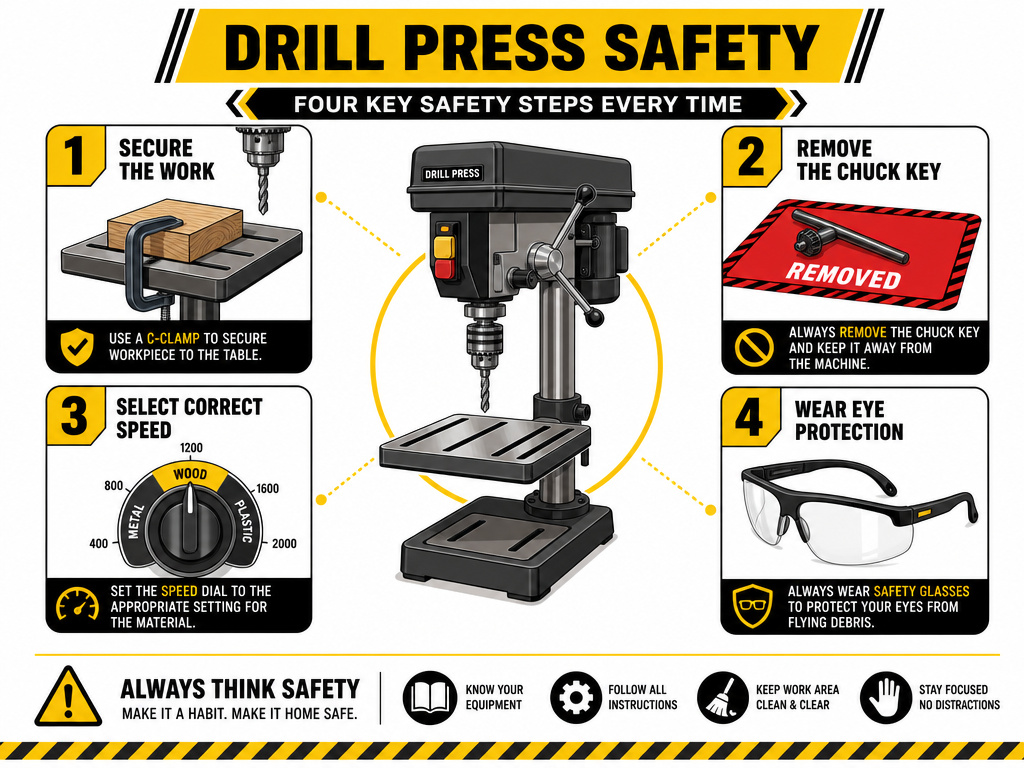 This isn’t scare talk. Drills spin sharp metal at high speeds and can generate significant torque. The manuals are blunt for a reason.
Eye protection is not optional. You need safety glasses or a face shield marked as compliant with ANSI Z87.1. Everyday prescription glasses are not safety glasses, they aren’t designed to stop a high-velocity metal shard. The operator’s manual for a generic SDS+ hammer drill states this as the first rule.
Hearing and lung protection are for specific jobs. The hammer function is loud. A dusty concrete hole produces silica dust. The manual for the same drill mandates a face or dust mask and hearing protection for extended operation or when using the hammer function.
Secure your workpiece. Never hold a piece of wood or metal in your hand while drilling. The bit can catch and spin the material, or worse, drive the drill into your hand. Use clamps or a vise.
Use the right bit for the material and the mode. Never use a standard twist bit in hammer mode. It will fail. The Ryobi PBLHM101K manual is explicit: “Use only hammer drill bits and accessories that are designed for use with a hammer drill.” A shattered carbide tip is a projectile.
Inspect the cord on a corded tool. Frayed insulation is a shock hazard. For extension cords, gauge matters. A 50-foot cord should be at least 14 AWG. A thinner cord causes voltage drop, the motor strains, and it overheats.
Choosing the Right Drill for the Job
 You don’t need one of everything. You need the one that matches 80% of your work.
For general DIY, building shelves, hanging pictures, assembling furniture, a 12V or 18V cordless drill/driver is the default. The convenience outweighs the raw power of a corded model for most people. Brands like DeWalt, Makita, and Milwaukee dominate the pro space for a reason: their chucks hold tight and their batteries last.
If you’re drilling into concrete foundation for a deck or running conduit through a brick wall, you need hammer function. For a few holes a year, a combo kit with a drill and an impact driver often includes a hammer drill capable enough. For regular masonry work, a dedicated SDS-plus rotary hammer is the real tool.
Skip the extended warranty if you only drill a few times a month. You’ll spend more on the coverage than the likely repair. Put that money toward a better battery or a set of quality bits instead.
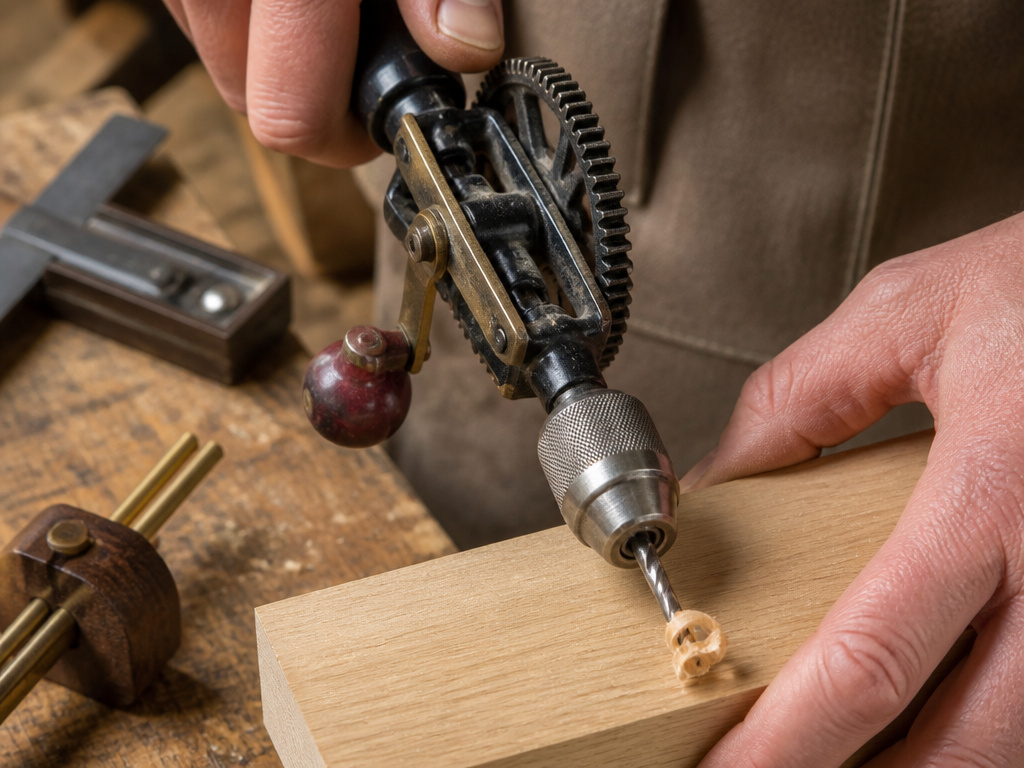
What about a classic manual hand drill? It’s a niche tool now, perfect for fine woodworking where you need absolute control and zero chance of tear-out, or for electrical work where you can’t risk hitting a live wire. It belongs in a set of essential hand tools, not as a primary hole-maker.
Frequently Asked Questions
What’s the difference between a drill and an impact driver?
Drill is for making holes and can drive screws. An impact driver is almost exclusively for driving screws and bolts. It uses a rotational hammering action (different from a hammer drill’s linear action) to deliver extremely high torque for loosening rusty bolts or driving long lag screws. They are covered under a different standard (IEC 62841-2-2) and are not designed for precision drilling.
Can I use a hammer drill as a regular drill?
Yes. Every quality hammer drill has a selector to turn the hammer function off. In “drill only” mode, it operates exactly like a standard drill. Just remember to switch it back if you go into masonry.
What does SDS stand for on a drill chuck?
SDS stands for “Slotted Drive System” or “Steck-Dreh-Sitz” (Insert-Turn-Sit) in German. It’s a specialized chuck system that allows the bit to slide back and forth freely for the hammer action while being locked rotationally. It’s faster to change bits than a keyless chuck and transfers hammer energy more efficiently. You must use SDS-plus bits in an SDS-plus chuck.
Why does my drill bit keep slipping in the chuck?
The chuck jaws are likely worn or dirty. For a keyless chuck, open it fully and clean the jaws and the interior with a brush and some rubbing alcohol. For a keyed chuck, the issue is often wear on the internal gears. It might be time for a replacement chuck. Also, ensure you’re tightening it properly, hand-tight is not enough for a keyless chuck; give it a firm final turn.
How do I maintain my hand drill?
Keep it clean. Blow out the air vents after heavy use to prevent dust from clogging the motor. For corded tools, check the power cord regularly for nicks. For cordless tools, keep battery contacts clean. Don’t store batteries fully depleted or fully charged; a 40-60% charge is ideal for long-term health. And finally, store it in a dry place. Moisture is the enemy of the motor and electronics.
The Bottom Line
A hand drill is defined by its ability to rotate a bit in a chuck. The international standards make the distinction between a standard drill and an impact drill clear, one bores, the other bores and pounds. Your choice comes down to material: wood and metal demand a standard drill; masonry demands the hammer function.
Ignore the drilling capacity specs at your own cost. And never, ever skip the ANSI Z87.1 eye protection. The right bit in the right mode, with the workpiece clamped down, turns a potentially dangerous tool into the most reliable one in your shop. For most homeowners, a mid-range 18V cordless drill/driver combo handles 95% of tasks. Buy that first, then add the specialty tools later.
