Metal Drill Bit Appearance Explained: Visual Guide to Parts
This post contains affiliate links. As an Amazon Associate, we earn from qualifying purchases.
A metal drill bit is a cylindrical cutting tool with a pointed tip and helical grooves (flutes) running along its body. It has a sharp cutting lip at the tip, a specific point angle (usually 118° or 135°), and a shank that fits into your drill chuck. High-speed steel (HSS) bits are silver-gray, while cobalt bits have a distinctive gold hue and titanium nitride coatings are bronze.
That description covers the basic silhouette. The real story is in the geometry you can’t see at a glance, the angles and tolerances that decide whether the bit cuts cleanly or snaps on contact.
This guide walks through the anatomy. You’ll learn to read a bit like a blueprint: what each part does, how to spot the difference between a general-purpose bit and one built for stainless steel, and why a five-degree shift in point angle changes everything.
Key Takeaways
- The point angle (118° for general use, 135° for harder metals) determines how aggressively the bit starts and whether it walks on curved surfaces.
- Helical flutes are not just grooves; their twist rate (20° to 30° per the Ruko spec) controls how fast chips clear. Clogged flutes cause immediate overheating.
- Coatings like Titanium Nitride (TiN) are bronze-colored and increase surface hardness to ~2300 HV, but they are a thin veneer, once the coating wears through, the underlying steel dulls fast.
- A split-point tip has a self-centering grind that looks like a tiny chisel point; it prevents walking on sheet metal but requires more frequent sharpening than a conventional point.
- Using a wood bit on metal will burn the wood bit’s edges in seconds, leaving a discolored, rounded tip and producing smoke instead of chips.
The 4 Parts You Can Identify in 10 Seconds
Look at any metal twist drill bit. From the chuck to the tip, four sections do specific jobs. Missing one’s function is how holes end up oval or bits break mid-cut.
- The Shank. This is the smooth end that your drill chuck grips. Its diameter must match your chuck’s capacity, a 1/2-inch shank won’t fit a 3/8-inch chuck. A shank with three flat sides (like on many Milwaukee THUNDERBOLT bits) prevents spin-out under high torque. If the shank is scored or dented from chuck slippage, the bit will never run true again.
- The Body. The main cylindrical section between the shank and the point. Its job is stiffness. A longer “jobber length” body flexes more than a “stub length” body, which is why drilling deep holes with a standard bit often leads to wander and breakage.
- The Flutes. These are the helical grooves cut into the body. They are not decoration. Flutes lift cut material (swarf) out of the hole. A high helix angle (around 30°) clears chips fast in soft metals like aluminum but can clog in stringy materials. A low helix angle (around 20°) is for metals that tend to gall, like copper and some stainless steels. The Ruko Jobber Length spec sheet notes a standard helix range of 20° to 30°.
- The Point. The business end. It contains the cutting lips (the sharp edges that shear the metal) and the chisel edge (the small, flat section at the very center that pushes material aside). The angle between the cutting lips is the point angle, and it’s the first thing to check when selecting a bit.
Where this goes sideways: Using a bit with a rounded or chipped cutting lip. The lip won’t bite; it will rub and generate heat instead of chips. You’ll smell burning steel before the hole is halfway through, and the work-hardened metal will become nearly impossible to finish.
Point Angles: 118° vs 135° vs 130° – Which Geometry Actually Cuts?
The point angle isn’t a mild suggestion. It’s a engineered compromise between penetration speed, edge strength, and walking resistance. Get it wrong, and the bit either skates across the surface or snaps under load.
| Point Angle | Best For | How It Starts | Risk If Misused |
|---|---|---|---|
| 118° | General-purpose drilling in mild steel, wood, plastic. | Can walk on curved or hard surfaces. | On stainless steel or hardened metal, the sharper angle chips at the cutting edge, ruining the bit in 3-4 holes. |
| 135° | Harder metals: stainless steel, cast iron, alloy steel. | Self-centering split point resists walking. | In soft aluminum, the blunter angle can cause grabbing and tear-out unless you use a firm, steady feed. |
| 130° | Specific HSS-G bits (per DIN specs) for alloyed steel. | Split-point design; starts without a pilot hole up to 10mm. | Rare in consumer sets; using a 118° bit where a 130° is specified increases breakage risk in tough alloys. |
The Milwaukee THUNDERBOLT BLACK OXIDE bits use a 135° split point geometry. That split point is a secondary grind on the chisel edge that looks like a tiny center punch. It eliminates almost all walking, which is why it’s the standard for portable drill use. The Bosch PRO Metal HSS-G twist drill bits also feature a split point for precise starting.
A split-point tip on a 135° bit requires about 30% less downward force to start a hole than a conventional 118° point. That difference is the margin between a controlled start and the bit skating off into a deep scratch on your workpiece.
Why the angle matters physically: A sharper 118° point acts like a wedge, prying material apart. It’s efficient in soft stuff. A blunter 135° point acts more like a punch, crushing a smaller volume of material directly under it. That focused pressure withstands the higher resistance of hard metals without deflecting. It’s not stronger, it’s more direct.
Material & Finish: How to Tell HSS, Cobalt, and Coated Bits Apart
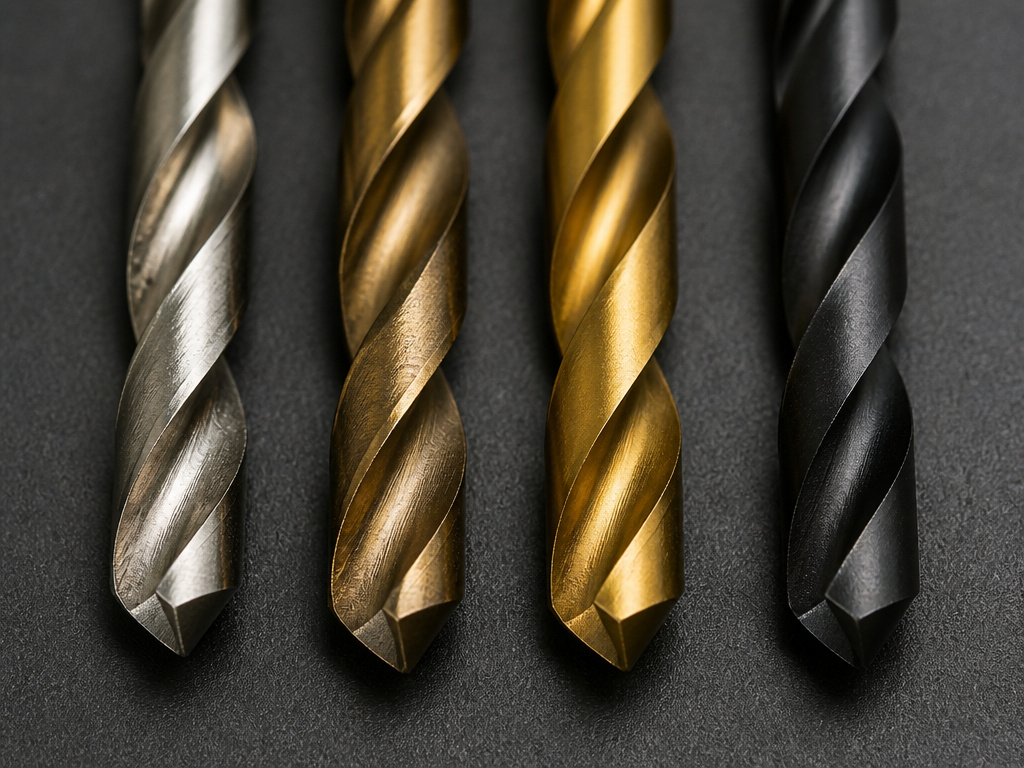
The color and sheen tell you what the bit is made of and what it’s coated with. This isn’t marketing. The material defines the bit’s maximum working temperature and what it can cut.
- High-Speed Steel (HSS): The standard. It has a dull, silver-gray finish. It’s hardened to resist wear but will lose its temper (soften) if overheated. Good for most mild steels and non-ferrous metals. If you see a bit labeled HSS-G, the “G” means it’s fully ground for higher precision, like the Bosch PRO Metal series.
- Cobalt (HSS-Co5 or HSS-E): Contains 5-8% cobalt alloy. It has a distinctive, slightly goldish hue. Cobalt retains hardness at higher temperatures, making it the default for stainless steel and other tough metals. It’s also more brittle, a sideways knock can snap a thin cobalt bit where an HSS bit would just bend.
- Titanium Nitride (TiN) Coating: A thin, bronze-colored ceramic coating applied to an HSS bit. It increases surface hardness and reduces friction. The Ruko spec notes TiN coating boosts heat resistance to 600°C (1100°F). The coating eventually wears off, usually at the cutting lips first. A TiN-coated bit is an HSS bit with a wear layer, not a fundamentally different material.
- Black Oxide Finish: A black, matte coating (seen on Milwaukee THUNDERBOLT bits). It provides mild corrosion resistance and some lubricity. It’s a treatment, not a hardening coating like TiN. It helps with chip flow and prevents rust in a toolbox.
Common mistake: Buying a titanium coated bit for drilling hardened steel. The coating helps, but the substrate is still standard HSS. For truly hard materials, you need the heat resistance of solid cobalt or a carbide-tipped bit. The coating will flake off on the first hole if the base metal can’t take the heat.
Specialized Metal Bits: When the Standard Twist Drill Isn’t Right
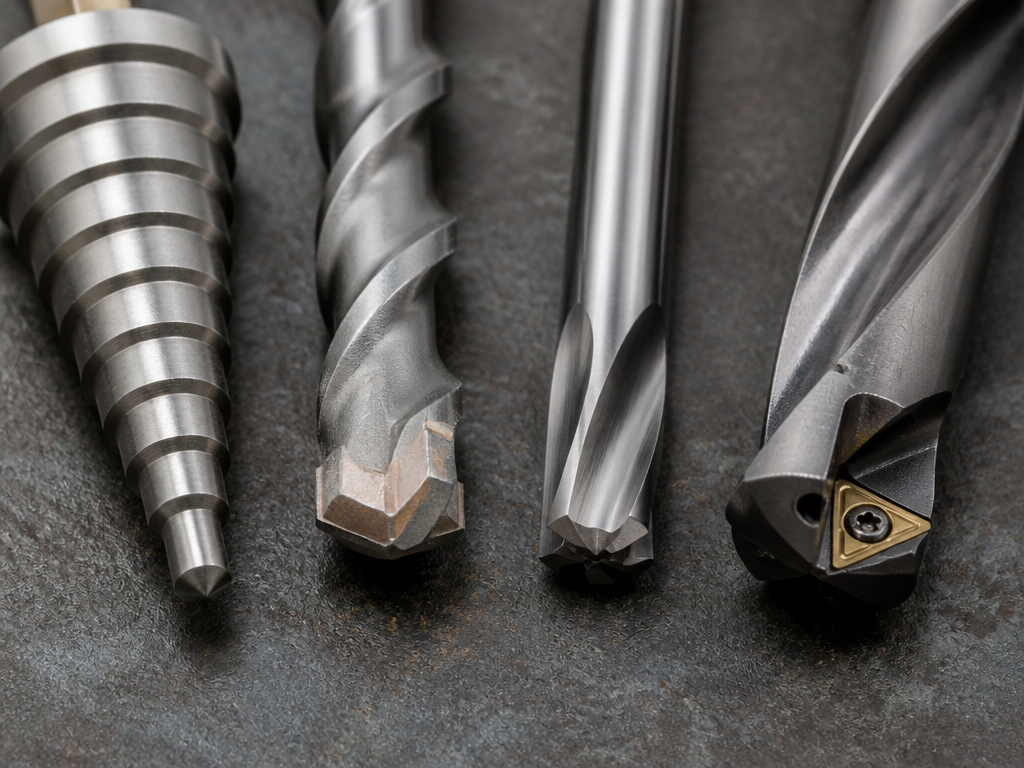
Twist drills handle 90% of work. For the other 10%, the bit looks completely different. Knowing these exists saves a project.
- Step Bits (Unibits): Cone-shaped with stepped diameters. They cleanly drill thin sheet metal and plastic without grabbing. The cutting edges are ground at each step. They are not for thick material.
- Carbide-Tipped Masonry Bits: Have a chisel-like, brazed carbide tip. While for masonry, a fresh one can drill through hardened steel or cast iron in a pinch, but it will destroy the carbide tip for future masonry work. It’s a last resort.
- Solid Carbide Bits: Entirely made of tungsten carbide. They are extremely rigid and brittle, usually silver-gray and often with a straight flute (no helix). Used for precision drilling in hard metals on drill presses or mills, not hand drills.
- Indexable Insert Drills: Used in machining. They have a replaceable, triangular carbide insert mounted in a steel body. You’ll never see these in a hardware store, but they’re how production shops drill large, deep holes fast.
Selecting the wrong type here has immediate consequences. A step bit used on thick bar stock will snap at the first step. A solid carbide bit in a hand-held drill will almost certainly shatter.
What a Worn-Out or Wrong Bit Looks Like (Failure Gallery)
A damaged bit is a hazard. It makes bad holes and can break violently. Here’s what to scrap immediately.
| Symptom | What It Looks Like | Cause | Result if Used |
|---|---|---|---|
| Discolored Tip | Blue, purple, or brown burn marks behind the cutting lips. | Overheating from lack of cutting fluid, excessive speed, or dull bit. | The steel is softened (lost temper). It will dull almost instantly and may snap. |
| Rounded Cutting Lips | The sharp edge is visibly worn back, forming a small radius. | Normal wear from abrasive materials or drilling hardened metal. | The bit won’t cut; it will rub and generate extreme heat, work-hardening the metal. |
| Chipped Edge | A small piece missing from the cutting lip or split point. | Hard impact (dropping) or hitting a hard inclusion in the metal. | Creates an uneven, vibrating cut that produces an oversized, rough hole. |
| Closed Flutes | Flutes are packed solid with melted, gummy metal (especially aluminum). | No chip clearance, insufficient pecking (retracting the bit), or no lubricant. | Causes instant binding and almost always results in a broken bit stuck in the workpiece. |
The moment you see blueing, that bit is done for heat-treated steel. You can resharpened a slightly dulled bit, but a burned one has lost its core properties.
Frequently Asked Questions
What does a split point on a drill bit look like?
Split point has a small, ground notch in the center of the chisel edge, making it look like a tiny “W” or arrowhead when viewed straight on the tip. This grind eliminates the dead spot that causes walking, so the bit starts cutting the instant it touches the metal. The Milwaukee THUNDERBOLT and Bosch PRO Metal bits feature this.
Can you use a metal drill bit on wood?
Yes, a metal drill bit will cut wood, but inefficiently. The flutes are designed for small metal chips, not long wood fibers, so they can clog. The 118° point angle works, but a dedicated wood bit (brad point or spade) will give a cleaner, faster hole in wood. The reverse, using a wood bit on metal, will ruin the wood bit immediately.
How can you tell if a drill bit is for metal or masonry?
Metal twist bit has symmetrical, sharp cutting lips and helical flutes. A masonry bit has a blunt, chisel-like carbide tip brazed onto a spiral steel shaft. The masonry tip is much wider than its shaft and is not sharp in the traditional sense, it crushes material via hammering action.
Why are some metal drill bits gold or black?
Gold color usually indicates a titanium nitride (TiN) coating on an HSS bit for increased wear resistance. A black color is typically a black oxide finish, which provides corrosion resistance and some lubricity. A dull gold alloy color (not a coating) often means it’s a cobalt steel bit (HSS-Co5), which is harder and more heat-resistant.
What’s the difference between a 118° and 135° drill bit?
The 118° drill bit has a sharper point for faster penetration in softer materials like mild steel and plastic. The 135° drill bit has a flatter point, often with a split-point grind, that resists “walking” on curved surfaces and is stronger for drilling into harder metals like stainless steel. The choice impacts how you start the hole and what material you’re cutting.
Before You Go
Identifying a metal drill bit starts with its silhouette, the cylindrical body, helical flutes, and pointed tip. The real expertise is decoding the specifics: the point angle printed on the box, the color that signals its material, and the grind of its tip.
Remember the split point for sheet metal, the cobalt alloy for stainless, and the helix angle for chip clearance. When you pick up a bit, you’re not just grabbing a tool; you’re choosing a geometry and a material grade engineered for a specific job. Match them right, and the bit does the work. Guess wrong, and you’ll be left with a burnt, broken stub and a half-finished hole.
For most home shops drilling mild steel and aluminum, a set of Bosch PRO Metal HSS-G bits covers the bases. If stainless steel is in the mix, step up to a cobalt set like those from Irwin. And always, always look for that split point, it’s the difference between starting on the mark and chasing a scratch across your workpiece.
