
What Are Stepped Drill Bits Used For? Core Uses Explained
This post contains affiliate links. As an Amazon Associate, we earn from qualifying purchases.
Stepped drill bits drill multiple clean, burr-minimized holes in thin sheet materials like metal, plastic, and wood, typically up to 4mm (5/32″) thick. They replace a case of individual twist drills for electricians, metalworkers, and HVAC techs who need various hole sizes on-site without changing bits.
That 4mm limit isn’t a suggestion. It’s the point where the stepped geometry stops working. Each step is only about 1/8″ tall, so drilling thicker plate leaves a stepped, unfinished hole inside the material and overheats the cutting edge.
What follows: the four trades that actually rely on them, the two flute types that decide performance, the exact RPMs that keep the bit cool, and the five situations where you should reach for a hole saw or an annular cutter instead.
Key Takeaways
- Step bits excel in thin materials under 4mm, sheet metal, plastic, electrical enclosures. They fail in thick plate.
- Spiral flute designs (Ideal 36-705, Klein QRST series) cut faster and run cooler than straight-flute bits for regular trade use.
- Run them slow. For bits 7/8″ and under, 650 RPM is the sweet spot (per Ideal’s datasheet); over 7/8″, drop to 470 RPM.
- They are not for impact drivers (unless impact-rated hex-shank) or precision engineering work needing reamed tolerances.
- Choose a multi-hole bit (like the ITM Kwik Stepper 34403) for flexibility, or a single-hole bit for a specific, repeated diameter.
What Exactly Is a Stepped Drill Bit?
A stepped drill bit is a single conical tool with a series of machined steps, each a precise diameter. You drill until the step matching your needed size passes through the material. The hole is the size of that step at the surface.
A step drill bit, also called a step bit, stepped drill bit, or unibit, is a conical cutting tool with a series of progressively larger stepped diameters machined into a single shank. Instead of drilling one fixed hole size like a standard twist drill, each step represents a specific diameter. You drill until the step you need disappears into the material, and that’s your hole.
This design delivers two concrete advantages. First, one tool covers a range of sizes, a 4–20mm bit gives you holes at 4, 6, 8, 10, 12, 14, 16, 18, and 20mm. Second, the conical shape and stepped relief minimize burrs, especially on the exit side of thin sheet metal. A clean hole means less time with a deburring tool.
The trade-off is capacity. Each step is only about 1/8″ (3.2mm) tall. That geometry makes them perfect for sheet goods but useless for deep or thick stock.
What Materials Can You Drill With a Step Bit?
Step bits have a narrow, specific domain. They work on any thin, sheet-based material where a clean edge matters more than drilling speed.
Sheet Metal (up to 4mm / 5/32″): This is their home turf. They create clean holes for fasteners, conduit knockouts, and ventilation in steel, aluminum, copper, and brass sheet. The ITM Kwik Stepper 34403 is rated for mild steel up to 3/8″ (9.5mm), but that’s a multi-step process for a single hole, for plate that thick, an annular cutter is faster.
Plastic and Composites: Acrylic, PVC, polycarbonate, and fiberglass. The sharp, relieved steps shear cleanly without cracking or grabbing. No pilot hole is needed.
Thin Wood and Plywood (under 1/2″): They work, but they’re not optimal. A spade bit is faster in solid timber. A step bit makes sense only when you’re switching between metal and wood on the same job and want one bit in the chuck.
Where this goes sideways: Using a step bit on material thicker than its rated capacity. Drilling 1/4″ steel plate forces multiple steps to engage partially, generating extreme heat. The cutting edge turns blue and dulls after one or two holes.
The limit is physical, not advisory. The Steelmax HSS Step Drill datasheet explicitly states a maximum thickness of 5/32” (4mm). The Hilti TS-BT requires a minimum base material thickness of 6mm for its specialized application. If your material is thicker than a few millimeters, you need a different tool.
| Material | Max Recommended Thickness | Why It Works (Or Doesn’t) |
|---|---|---|
| Sheet Metal (Mild Steel) | 4mm (5/32″) | Steps fully engage; clean shear with minimal burring. |
| Aluminum Sheet | 4mm (5/32″) | Low resistance; bit stays cool if RPM is correct. |
| Plastic (PVC, Acrylic) | 6mm (1/4″) | Sharp steps cut without cracking; no pilot needed. |
| Solid Wood | Not recommended | Flutes clog; slower than spade or auger bits. |
| Steel Plate (>6mm) | Do not use | Partial step engagement causes extreme heat and rapid wear. |
The Core Uses: Where Step Bits Actually Save Time
Step bits aren’t a general-purpose drill bit. They solve specific problems for trades that work with thin sheet materials and need multiple hole sizes quickly.
1. Electrical Work: This is the biggest use case. Electricians use them to create knockouts in panel boxes, run conduit through studs, and make holes for cable glands in enclosures. A single Klein Tools QRST14 bit (3/16″ to 7/8″) covers most conduit sizes.
2. Metal Fabrication and HVAC: For installing vents, ducting, and brackets in sheet metal. The deburring action is key here, it saves a separate finishing step.
3. Plumbing: Running pipes through thin metal studs or creating access panels. The ability to incrementally enlarge a hole is useful for dry-fitting components.
4. General Maintenance and DIY: Mounting equipment, making custom brackets, or modifying electronic cases. For a home workshop, one step bit can replace a dozen individual types of drill bits for light metal and plastic work.
Their value isn’t in drilling a single hole faster. It’s in eliminating bit changes. If your project needs a 1/4″ hole, then a 3/8″ hole, then a 1/2″ hole in the same material, a step bit does it in one continuous operation. That’s where the 30% time savings some studies mention comes from.
Spiral Flute vs. Straight Flute: The $20 Difference
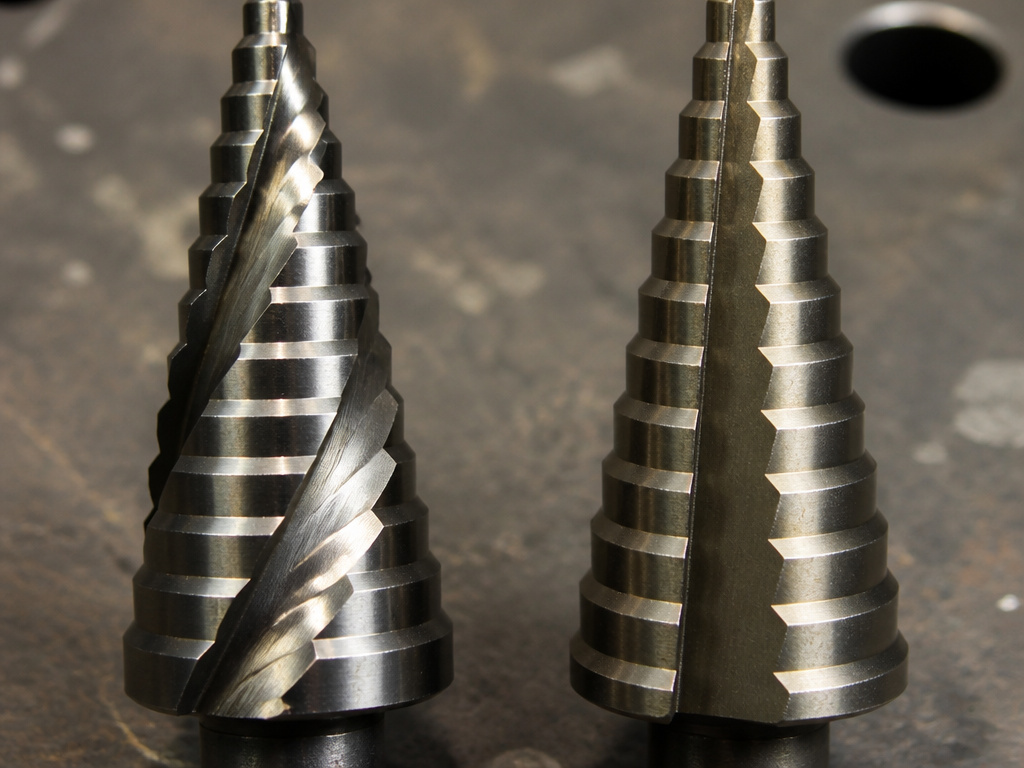
All step bits are not equal. The flute design determines performance, heat management, and lifespan.
Spiral Flute: The professional choice. The helical groove acts like a screw conveyor, actively pulling chips up and out of the hole. This keeps the cutting edge cooler and reduces binding. Brands like Ideal (36-705 series) and Klein (QRST series) specialize in spiral flute bits. They cost more but last significantly longer under regular use.
Straight Flute: The basic design. Flat-sided flutes rely on gravity and rotation to clear chips. They are lower cost and adequate for occasional, low-volume work. Under sustained drilling, chips pack in the flutes, heat builds up, and the bit dulls quickly.
The choice is straightforward. If you’re a tradesperson or serious DIYer drilling more than a few holes a month, buy spiral flute. The Ideal 36-705 Spiral Step Bit is a benchmark. If you need a bit for a one-time project, a straight-flute version will suffice.
Common mistake: Running any step bit too fast. Heat is the enemy. The Ideal Spiral Step Bits datasheet gives exact numbers: 650 RPM for bits ≤7/8”, 470 RPM for bits >7/8”. Doubling that RPM can destroy the cutting edge on the first hole.
How to Use a Step Drill Bit Correctly (And How Not To)
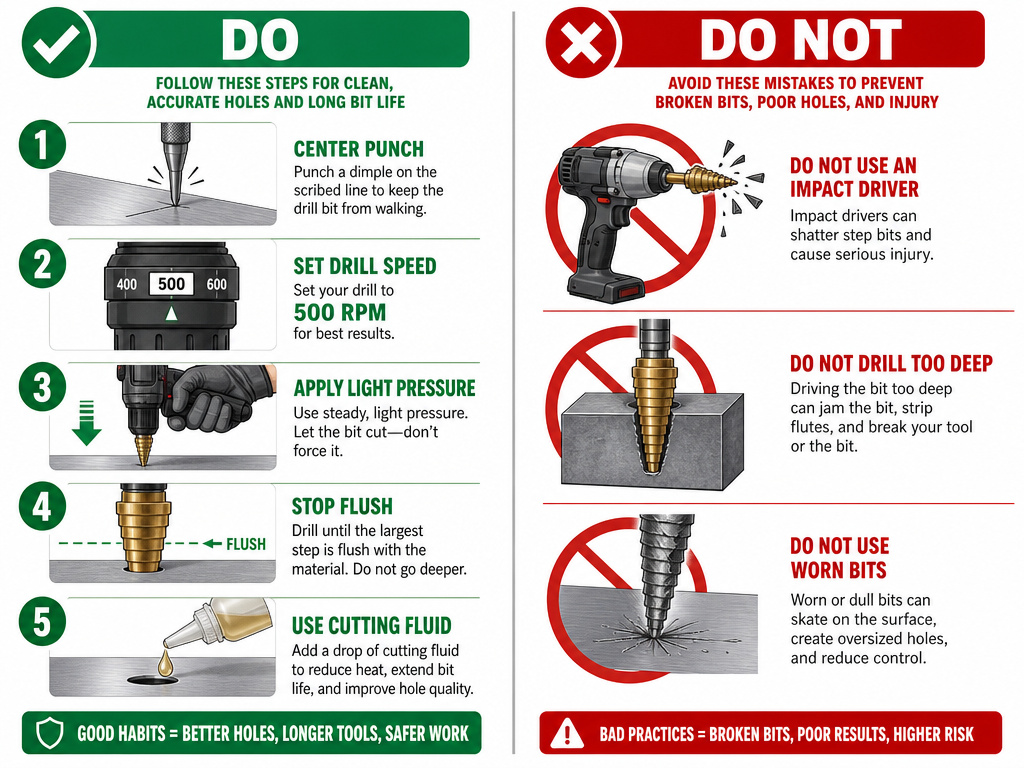
The process is simple, but three mistakes burn out bits prematurely.
- Mark and Punch. For sheet metal, a scribed line is enough. For harder materials or to prevent wandering, use a center punch.
- Set the Speed. Refer to the manufacturer’s RPM guide. If unknown, start slow, around 500 RPM for bits up to 3/4″. High speed equals instant heat damage.
- Drill with Steady, Light Pressure. Let the bit’s sharp edges do the work. Do not lean on the drill. You should hear a consistent cutting sound, not a high-pitched squeal.
- Stop at the Right Step. Drill until the step you need is flush with the material’s surface. Going deeper engages the next step and enlarges the hole.
- Use Cutting Fluid for Metal. It’s not optional for steel. A few drops of oil dramatically reduce heat and extend bit life. It keeps the titanium drill bits or HSS coating from breaking down.
What not to do:
- Don’t use it in an impact driver. Standard round-shank step bits are not impact-rated. The hammering action can shatter the bit or cause the shank to slip in the chuck. Only hex-shank, impact-rated models like the Alpha ONSITE Impact are built for that.
- Don’t drill deep holes. The cutting action only happens at the tip. In a deep hole, chips have no escape and will jam the bit, leading to breakage.
- Don’t force a dull bit. A worn step bit will skate, chatter, and generate excessive heat. Resharpening a step bit is complex; often, replacement is more economical than sharpening drill bits this specialized.
Single-Hole vs. Multi-Hole Step Bits: Choosing Your Weapon
Not all step bits offer the same flexibility. Manufacturers design them for different workflows.
| Type | Design | Best For | Example Model |
|---|---|---|---|
| Multi-Hole | Multiple marked diameters on one bit; drill to any step. | On-site work requiring various hole sizes. | ITM Kwik Stepper 34403 (7/8”) |
| Single-Hole | All steps converge to one final diameter; you drill to full depth. | Production work needing many identical holes. | Hilti TS-BT (for specific studs) |
A multi-hole bit is the classic choice. The ITM Kwik Stepper 34403 provides 13 sizes from 1/8″ through 1-3/8″. It’s the go-to for electricians who might need a 1/2″ hole for conduit followed by a 3/4″ hole for a fitting.
A single-hole bit is a specialist. The Hilti TS-BT is designed to drill a pilot hole of exact depth and diameter for a specific threaded stud. All steps lead to one final size. You’d use this for repetitive industrial fastening, not general-purpose work.
For most people, a multi-hole bit is the only one to consider. It delivers the core benefit of a step bit: versatility.
When a Step Bit Is the Wrong Tool
Knowing the limits is as important as knowing the uses. Step bits are terrible for five specific scenarios.
- Thick Materials (>4mm / 5/32″): Already covered. Use an annular cutter or hole saw.
- Precision Tolerance Holes: Step bits are accurate to about 1mm. If you need a hole to be 10.00mm ±0.05mm for a bearing press-fit, drill undersize with a twist drill and finish with a reamer.
- High-Volume Production Drilling: If you need fifty 1/2″ holes in plate, a dedicated 1/2″ twist drill in a drill press is faster and cooler per hole.
- Deep Hole Drilling: Any hole deeper than the bit’s stepped section (usually about 1-2 inches) will clog and bind.
- Hardened Steel or Stainless Steel: While cobalt step bits exist, their stepped geometry is still weak against abrasion. For hardened materials, a solid cobalt vs carbide drill bits comparison leads to a carbide twist drill or hole saw.
Their strength is flexibility in thin materials. Their weakness is everything else. Don’t try to make them something they’re not.
Frequently Asked Questions
Can you use a step bit on wood?
Yes, but it’s not the right tool. Step bits work on plywood and thin boards under 1/2″. For solid timber, spade bits or auger bits are faster, produce cleaner walls, and don’t clog. A step bit only makes sense if you’re alternating between metal and wood and want to avoid changing bits for wood and metal.
What’s the difference between HSS and cobalt step bits?
HSS (High-Speed Steel) is the standard material, fine for mild steel, aluminum, and plastic. Cobalt step bits (like the HSS-Co5 used in some Ideal bits) add cobalt alloy for higher heat resistance. They last longer in stainless steel or harder alloys. For most users, HSS is sufficient. For professional metal shops, cobalt is worth the upgrade.
Why does my step bit chatter and vibrate?
Chatter means one of three things: RPM is too high, the workpiece isn’t clamped, or the bit is dull. First, clamp the material securely. Second, reduce your drill speed. Third, inspect the cutting edges. If they’re rounded or discolored, the bit is done. A sharp bit with correct speed should cut smoothly with a consistent hum.
Are step bits self-starting?
Most are. Modern step bits feature a split-point tip that bites immediately, preventing “walking” on curved surfaces. This eliminates the need for a pilot hole in thin sheet metal and plastic, which is a major time-saver on-site.
How do I choose the right size step bit?
Look at the range stamped on the shank (e.g., 4–20mm). Ensure it covers all the hole diameters you need for your project. Consider step increments: 1mm steps offer more sizing options, while 2mm steps are faster for larger jumps. For electrical work, a bit covering 3/16″ to 7/8″ handles most conduit.
The Bottom Line
A stepped drill bit is a specialist for thin sheet materials. Its job is to make multiple clean, burr-free holes without a tool change. For an electrician modifying an enclosure or a metalworker fabricating a bracket, it’s a time-saver that pays for itself quickly.
But respect its limits. That 4mm thickness ceiling is real. Run it at 650 RPM or less. Buy the spiral flute version if you’ll use it more than once. And keep it away from impact drivers and thick plate steel.
For the average workshop, a single quality step bit like the Ideal 36-705 or Klein QRST14 can replace a whole index of smaller twist drills for light metal and plastic work. It won’t be your most-used bit, but when you need it, nothing else does the same job. That’s the point.
