The Essential Types of Drill Bits for Woodworking Projects
This post contains affiliate links. As an Amazon Associate, we earn from qualifying purchases.
Choosing the right drill bits for wood means matching three things: the hole size, the required finish, and the tool you’re using. The six essential types are brad point, twist, spade, Forstner, auger, and hole saw bits. Each has a specific job, using a spade bit for a cabinet hinge leaves a torn mess, while a Forstner bit makes that hinge pocket clean and flat-bottomed.
That match between bit design and material removal is the whole game. A bit isn’t just a sharp stick; its geometry controls how it enters the wood, how it cuts the fibers, and how it clears the resulting chips. Get the geometry wrong, and you fight the tool all day.
What follows is a breakdown of those six bit types by their actual job. You’ll get the specs that matter, the common failure each one faces, and the one set to buy first if you only get one.
Key Takeaways
- Brad point bits are for precision. Their center spur stops wandering, making them the default for dowel joints, pocket holes, and any drilling where the hole location is critical.
- Spade bits are for rough, fast holes. They hog out material quickly in framing and plumbing work, but they tear the exit side. Keep them for jobs where the hole is hidden.
- A Forstner bit cuts a flat-bottomed hole. It’s the only common bit that can bore a blind hole with a smooth, clean sidewall and a flat bottom, essential for cabinet hinges and mortises.
- Speed burns bits. Drilling hardwood at high RPM generates enough heat to soften the cutting edge of an HSS bit in seconds, turning it blue and ruining it.
- The wrong bit for the drill chuck breaks things. Never force a 1/2″ round-shank auger bit into a 3/8″ keyless chuck; the slippage under load will round off the shank and can damage the chuck jaws.
The 6 Essential Drill Bits for Wood (And What Each Does)
A bit’s shape tells you its job. The tip starts the cut, the flutes clear the waste, and the cutting spurs define the hole’s edge. Mix them up, and you work against the design.
Technical Snapshot: Brad point and Forstner bits use peripheral spurs to score the wood’s circumference before the main cutters engage, preventing tear-out. Auger and spade bits rely on a central screw point to pull the bit into the work, prioritizing speed over a clean edge. The material. High-Speed Steel (HSS) or carbon steel, determines heat resistance and longevity.
1. Brad Point Bits: For When the Hole Must Be Exactly Here
You need a brad point bit for dowel joints, pocket holes, or any project where a 1/16-inch error ruins the piece. The defining feature is a sharp, central spur flanked by two cutting spurs.
The center spur acts like a bradawl. It bites into the wood exactly where you place it, preventing the “walking” that plagues standard twist bits. The outer spurs score a clean circle before the main cutters lift the chips. This sequential cutting is why a brad point bit leaves almost no tear-out, even on plywood.
Where this goes sideways: Using a brad point in a quick-change hex chuck. The inherent slop in those chucks introduces wobble, which defeats the bit’s precision. The hole ends up oversized and ragged. Use them in a tight, keyed drill chuck or a drill press.
A named default pick is the Bosch PRO Wood HSS Brad Point Drill Bit set. The HSS construction handles the heat from repeated use, and the working lengths are printed right on the case.
2. Twist Drill Bits: The General-Purpose Workhorse
The standard twist drill is what most people picture. It has a conical tip with two cutting edges and spiral flutes for chip removal. Its job is versatility, it can drill wood, metal, and plastic.
For wood, a standard twist bit works fine for small-diameter holes (under 1/4″) or when finish isn’t critical. It’s your go-to for drilling pilot holes for screws. The problem is the tip geometry. It’s designed to cut, not score. On the exit side of a through-hole, it often splinters the last layer of wood fibers because nothing supports them.
Common mistake: Assuming a twist bit is “good enough” for all wood drilling. For holes larger than 1/4″ or in veneered plywood, the lack of a scoring spur guarantees tear-out. Switch to a brad point or Forstner.
3. Spade Bits: The Framing and Plumbing Hog
Need a 1-inch hole through a stud for a pipe? That’s a spade bit’s job. It has a flat, paddle-shaped blade with a central screw point and two cutting edges. The screw point pulls the bit in aggressively, and the wide blade removes material fast.
They are cheap, fast, and durable. They are also messy. The cutting action shears the wood fibers, leaving a rough hole with significant tear-out on the back side. This is why they belong in rough construction, not fine woodworking.
| Spade Bit Size (IRWIN) | Typical Use Case | The Trade-Off |
|---|---|---|
| 1/4″ to 3/4″ | Electrical boxes, small plumbing runs | Fast, but the hole is rarely round; expect to clean up with a file |
| 7/8″ to 1-1/2″ | Large drain pipes, venting | Can bind in deep holes; you must back out frequently to clear chips |
| 16″ length | Drilling through stacked floor joists or sill plates | The long shaft flexes; you must drill slowly to avoid wandering |
For drilling large holes where appearance doesn’t matter, an IRWIN spade bit is a solid choice. Just know its limits.
4. Forstner Bits: The Cabinet Maker’s Choice
When you need a flat-bottomed, clean-sided hole that doesn’t go all the way through, you need a Forstner bit. It has a flat bottom with a small center point and a cylindrical rim lined with cutting teeth.
The rim scores a perfect circle. The bottom-facing cutters then plane away the wood inside that circle, leaving a smooth, flat bottom. This makes it ideal for hinge mortises, installing concealed hardware, or drilling overlapping holes.
Why-layer: A Forstner bit can cut on its entire perimeter, not just its tip. This lets it cut overlapping holes or bore right up to the edge of a workpiece, something a spade or hole saw cannot do. The trade-off is that it requires significant downward force and a powerful drill, as it’s cutting with a large surface area.
Easy to miss: Forstner bits generate a lot of fine, packed dust instead of chips. If you don’t lift the bit frequently to clear it, the dust compacts, overheats the bit, and creates burn marks on your beautiful hardwood.
5. Auger Bits: For Deep, Straight Holes
Auger bits are for depth. They have a long, spiral flute (like a corkscrew) that aggressively pulls the bit into the wood and ejects chips out of the hole. They come in solid-center and hollow-center designs.
A solid-center auger (like the IRWIN 7-1/2″ length) is for general deep drilling. A hollow-center auger is for very deep holes, as the open center provides a channel for chips to escape from depths up to 29 inches. This is the bit for running wire through joists or drilling fence posts.
The screw point is aggressive. In a hand drill, it can pull the tool right out of your hands if you’re not braced. In a drill press or a powerful corded drill, it makes the work effortless.
6. Hole Saws: For Big, Round Cuts
For holes larger than 2 inches in diameter, a hole saw is often the only practical option. It’s a cylindrical saw blade attached to a mandrel and pilot bit. It cuts a ring, leaving a solid plug of waste wood in the center.
They are perfect for installing door knobs, running ducting, or creating ports for speakers. The cut is relatively clean, but the pilot bit can cause tear-out on the back side. The fix is to drill until the pilot bit just breaks through, then finish the cut from the other side.
The Right Speed Stops Burning and Binding
Drill speed isn’t a suggestion. Running a 1-inch Forstner bit at full throttle on your drill’s highest setting will generate smoke in under ten seconds. The friction heat softens the steel, permanently dulling the cutting edge.
The rule is simple: larger diameter = slower speed. A smaller bit can spin faster because its cutting edges have less material to engage per revolution. A big bit needs time to bite and clear chips.
Bosch’s drilling guide notes that using a coolant can extend drill bit life by a factor of six, but that’s rarely practical for wood. The alternative is the correct RPM.
| Bit Diameter | Softwood (Pine, Cedar) RPM | Hardwood (Oak, Maple) RPM | What Happens if You’re Too Fast |
|---|---|---|---|
| 1/8″ – 1/4″ | 2000 – 3000 | 1500 – 2000 | Minor burning, reduced bit life |
| 1/2″ – 3/4″ | 1200 – 1500 | 800 – 1000 | Significant burning, binding from packed chips |
| 1″ – 1-1/2″ | 600 – 800 | 400 – 600 | Severe binding, risk of stalling the drill or breaking the bit |
| 2″ + (Hole Saw) | 300 – 500 | 200 – 300 | Almost certain binding, potential for the hole saw to seize |
If your drill has a speed control, use it. If it doesn’t, start slow and apply steady, firm pressure. Let the bit’s design do the work.
Brad Point vs. Twist vs. Spade: Which One Wins Your Job?
This isn’t about having a complete set. It’s about reaching for the right tool. Here’s the head-to-head for common scenarios.
- Drilling a 3/8″ hole for a shelf pin in finished furniture: Brad point bit wins. The twist bit will wander on the hard laminate surface. The spade bit would destroy it. The brad point’s spur locks on target.
- Making a 1″ hole through a 2×4 wall stud for a cable: Spade bit wins. It’s fast, cheap, and the rough finish doesn’t matter inside the wall. A Forstner bit would be overkill and slower.
- Boring a 35mm flat-bottomed hole for a European cabinet hinge: Forstner bits win. Neither a spade nor a hole saw can create a flat bottom. A Forstner bit does it cleanly in one step.
- Drilling a 1/4″ pilot hole for a #8 screw in pine: Twist bit wins. It’s perfectly adequate, and you likely have one already. Save the precision bits for when precision matters.
The pattern is clear. Match the bit’s strength to the job’s requirement: speed, cleanliness, or precision.
The Two Bits You Can Probably Skip (For Now)
 The tool aisle is full of specialty bits. Most are solutions looking for a problem.
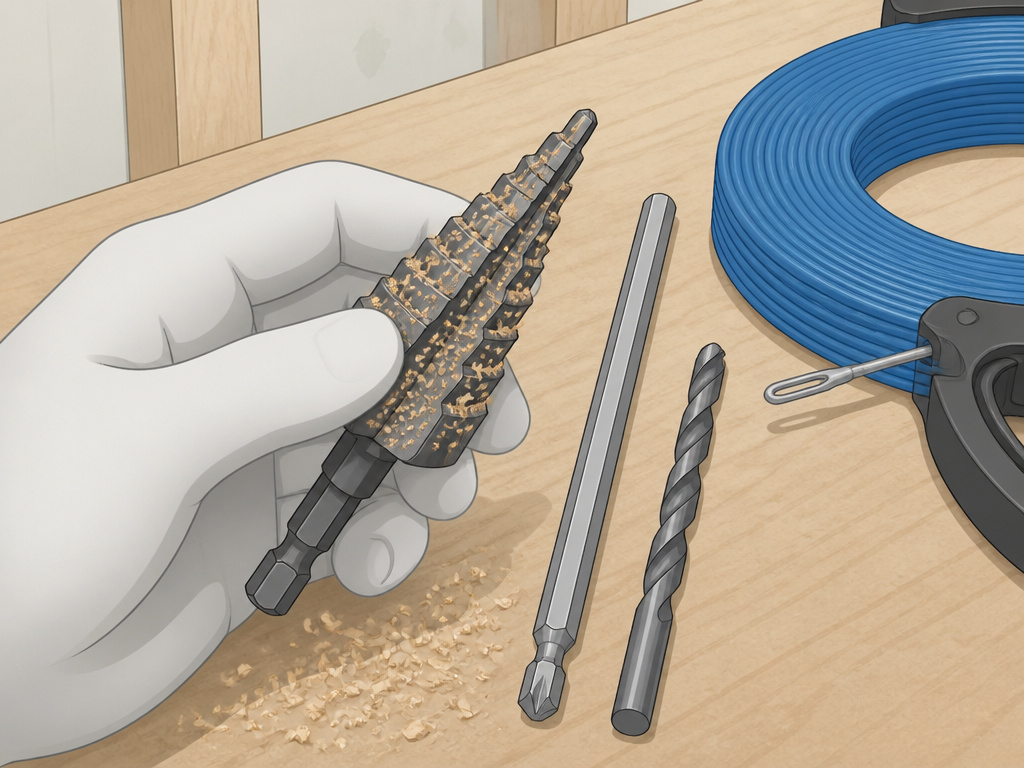
Step drill bits for wood promise variable-sized holes with one tool. In practice, they are best for thin sheet metal. In wood, the steps clog with chips almost instantly, and they overheat because the cutting edges are small. For the occasional odd-sized hole, drill the nearest smaller size and clean up with a round file. It’s faster.
Installer bits are long, flexible bits with a hole near the tip for pulling wire. They are a niche tool for electricians and low-voltage installers running cable through finished walls. If you’re not fishing wire regularly, a standard long-length drill bit and a fish tape is a more versatile combination.
The part nobody mentions: The hex-shank versions of fine bits like brad points are often lower quality. The manufacturer assumes you want quick-change convenience over precision. For your best bits, insist on a round shank and a good keyed chuck.
How to Not Ruin Your Drill Bits
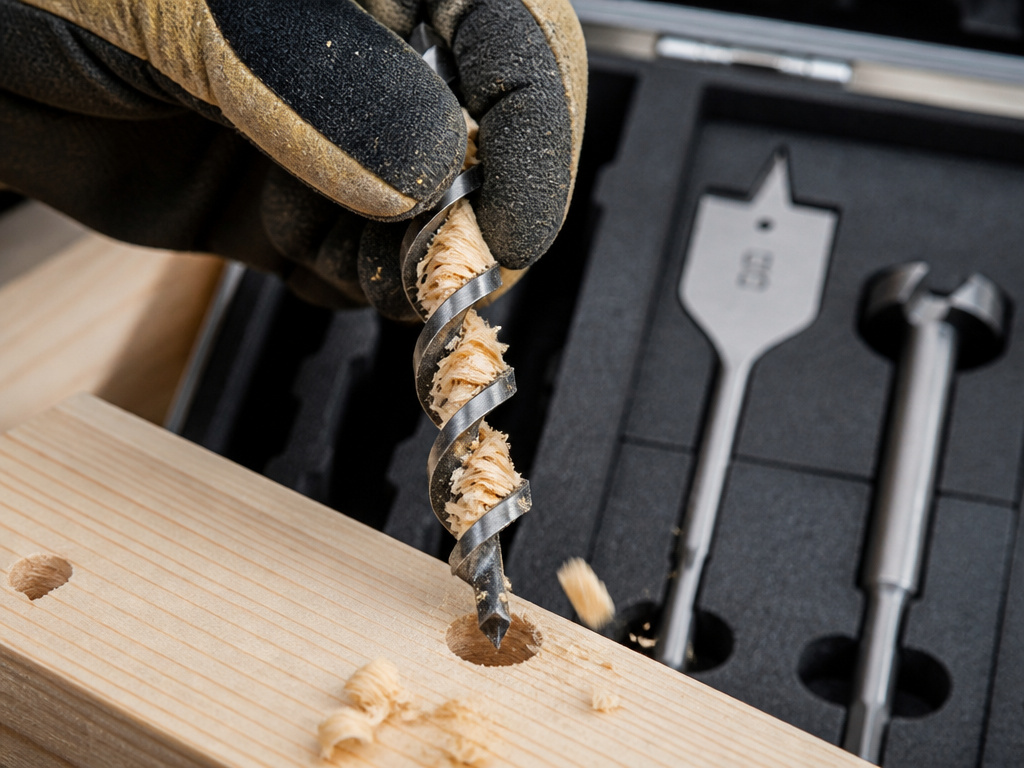 A dull bit is worse than no bit. It burns wood, requires excessive force, and makes miserable work.
- Clear the chips. Especially with auger, Forstner, and spade bits. When the flutes are full, the bit is just rubbing, not cutting. Pull out every inch or so.
- Don’t force a bend. Let the bit’s screw point or cutting geometry pull it in. Pushing too hard deflects the bit, binds it, or snaps it. You’ll feel the drill’s load change when it’s cutting properly.
- Store them so the edges don’t touch. Throwing bits loose in a toolbox is a guarantee they’ll be dull when you need them. Use a bit holder or the case they came in.
- Recognize the smell of burning wood. It’s your first warning that the RPM is too high or you’re not clearing chips. Stop immediately.
Sharpening drill bits by hand is a skill. For HSS twist bits, a simple drill bit sharpener jig is a worthwhile investment. For brad point or Forstner bits, replacement is often more cost-effective than professional sharpening unless you use them daily.
Frequently Asked Questions
What is the most versatile drill bit for wood?
For the DIYer doing a mix of tasks, a set of HSS brad point bits from 1/8″ to 1/2″ covers the most ground. They provide the precision for finish work and are durable enough for general drilling. They are the clear step up from basic twist bits.
Can I use a metal drill bit on wood?
You can, but you shouldn’t if you care about the hole. Metal drill bits have a different tip angle designed for cutting, not shearing, metal. They will drill through wood, but they are more prone to wandering on start and cause significant tear-out on the exit side because they lack cutting spurs.
Why does my drill bit keep burning the wood?
You are either drilling too fast, not clearing chips, or using a dull bit. The friction from the bit’s sides rubbing against packed wood dust generates intense heat. Refer to the RPM table, make a habit of pecking, drilling in and out to clear waste, and inspect your bits for sharpness.
What’s the difference between an auger bit and a spade bit?
An auger bit has a deep, continuous spiral flute designed to pull itself in and eject chips efficiently from deep holes. A spade bit has a flat blade; it’s for speed in shallow-to-medium depth holes. Use an auger for depth and straightness, a spade for speed where finish doesn’t matter.
Do I need a special drill for large Forstner bits?
Yes. Large-diameter Forstner bits (over 1-1/2″) present a huge cutting surface area to the wood. They require high torque and slow speed. A standard 12V cordless drill will stall or overheat. A powerful corded drill or, ideally, a drill press is recommended for bits over 2 inches.
Before You Go
Your drill is only as good as the bit you put in it. Start with a foundational set of brad point bits for your precision work. Add a few spade bits for rough carpentry. Invest in a quality Forstner bit set when you tackle cabinetry.
Remember the two rules: big holes need slow speeds, and clean holes need bits that score the wood’s perimeter before cutting. Everything else, the brand, the coating, the packaging, is secondary to those two facts. Now go make some clean holes.
