7 Best Welds of 2026
This post contains affiliate links. As an Amazon Associate, we earn from qualifying purchases.
The strongest, most reliable pick is J-B Weld Original, it’s the standard for a reason, with a 5020 PSI bond and 550°F heat resistance. For quick fixes, KwikWeld stands out with a 6-minute set time, while SteelStik is ideal when you need to shape and rebuild metal parts by hand.
Most people don’t realize how different epoxy welds can perform depending on the job. A fix that works great on a dry garage shelf might fail completely underwater or under engine heat. I’ve seen too many DIYers grab the wrong type and end up redoing the same repair twice.
This guide cuts through the confusion by comparing real-world performance, not just marketing claims. I looked at specs, owner feedback, and use cases to find the best J-B Weld products for specific needs, from extreme heat to underwater fixes, so you can pick the right one the first time.
Top 7 Welds in the Market
The Best Welds, Reviewed
J-B Weld Original 10 oz Steel Epoxy

Strengths
- 5020 psi strength
- High heat resistance
- Steel reinforced
Trade-offs
- Long cure time
- Messy mixing
This is the benchmark all other J-B Weld products are measured against. With a 5020 psi tensile strength and the ability to withstand 550°F, it’s the strongest and most heat-resistant standard epoxy in the lineup. The 10 oz size makes it practical for larger jobs, and the steel-reinforced formula delivers a bond that’s literally stronger than steel on many surfaces.
Yes, it takes 15-24 hours to fully cure, slower than the quick-set versions, but that long cure is what gives it unmatched durability. Reviewers use it for cracked engine blocks, trailer frames, and heavy machinery. I consider this the smarter buy for serious repairs where failure isn’t an option.
Product photos


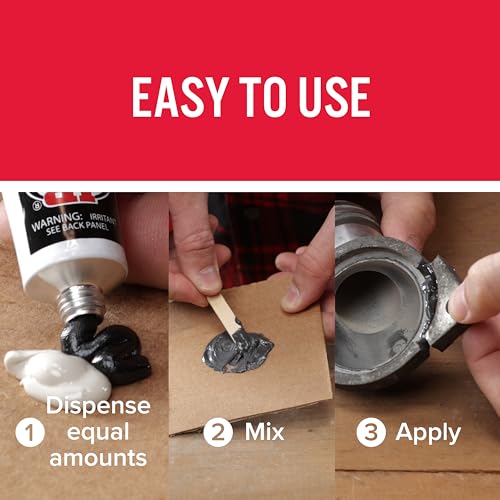
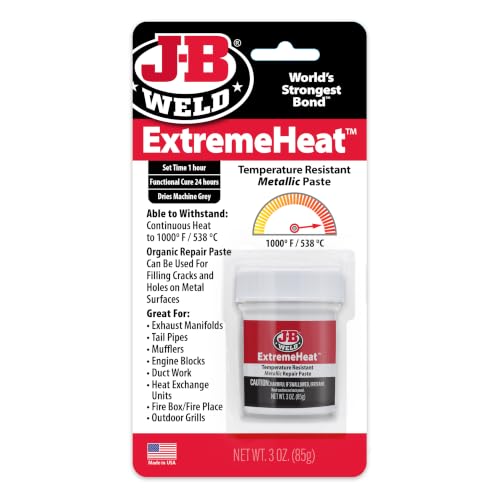
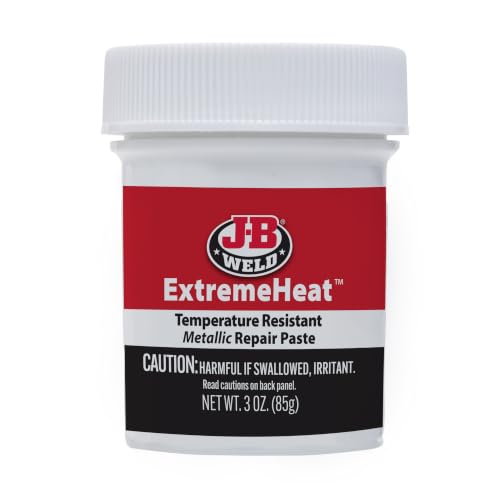
J-B Weld ExtremeHeat High Temp Paste
Strengths
- Withstands 1000°F
- Non-flammable
- No VOCs
Trade-offs
- Slow curing
- Messy application
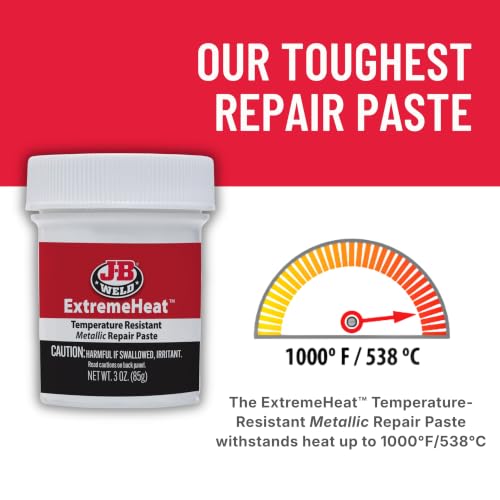
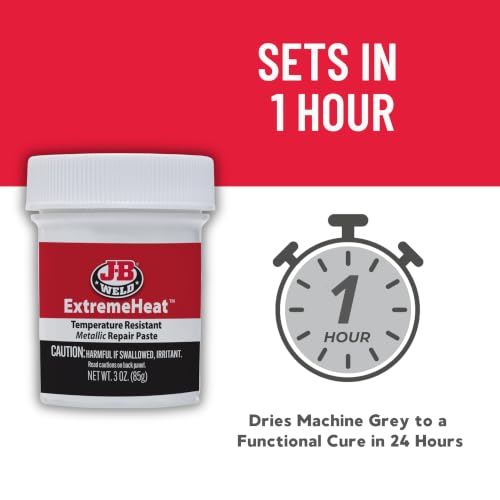
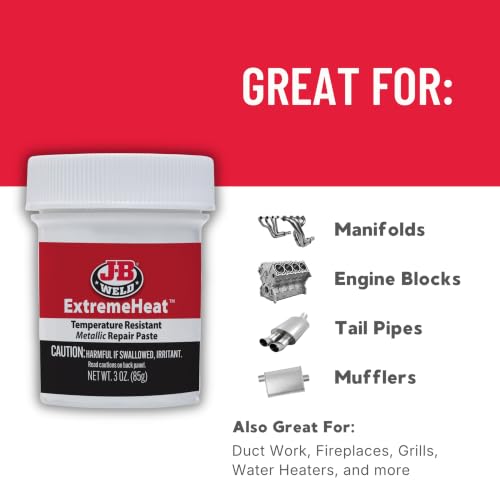
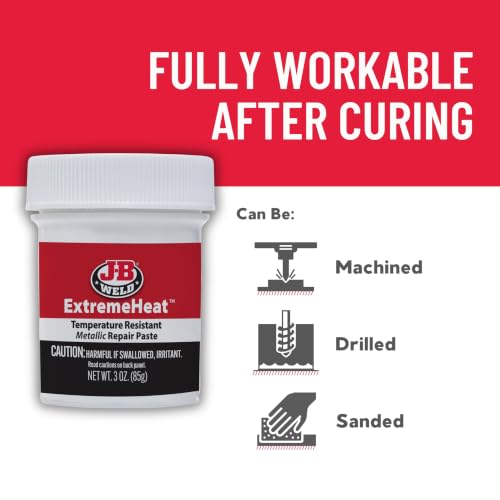
If you’re patching an exhaust manifold or sealing a cracked flange near a furnace, ExtremeHeat is the only J-B Weld product that makes sense. It’s rated for continuous exposure up to 1000°F, which blows every other epoxy in the lineup out of the water. Owners confirm it holds up on mufflers and grills where other epoxies fail within days.
It’s not fast, requires 4-6 hours to set, and lacks the convenience of a syringe, but in this class, heat resistance trumps convenience. It’s not NSF certified for potable water, so don’t use it on plumbing. For extreme heat zones, there’s no real alternative.
Product photos
J-B Weld SteelStik Epoxy Putty Stick

Strengths
- Fast 5-minute set
- Moldable and sandable
- NSF certified
Trade-offs
- Lower tensile strength
- Not for extreme heat
SteelStik is built for metal, specifically when you need to rebuild a broken fin, fill a hole, or restore a stripped mounting point. The putty stick is easy to shape by hand, and the 5-minute set time means you’re not waiting long. With a max intermittent temp of 450°F, it handles more heat than KwikWeld, and owners say it sands and drills cleanly once cured.
It’s NSF certified, so it’s safe for water pipes, and the 900 psi lap strength is decent for a putty. It doesn’t match the original J-B Weld in raw strength, but for sculpting and shaping metal repairs, it’s more user-friendly. I’d take this over liquid epoxy for anything that needs bulk filling.
Product photos


J-B Weld KwikWeld Fast Setting Epoxy
Strengths
- Fast 6-minute set
- Steel reinforced
- Easy 1:1 mix
Trade-offs
- Lower heat resistance
- Not for extreme temps
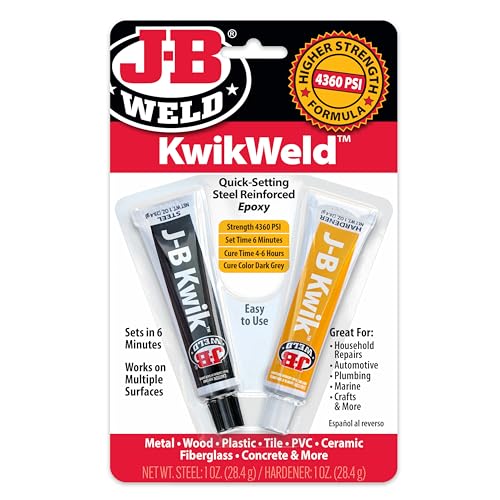
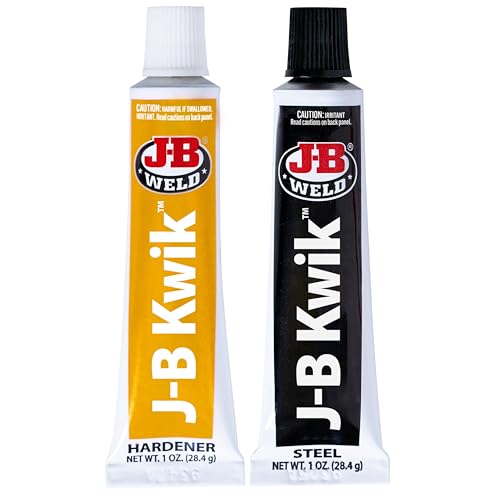
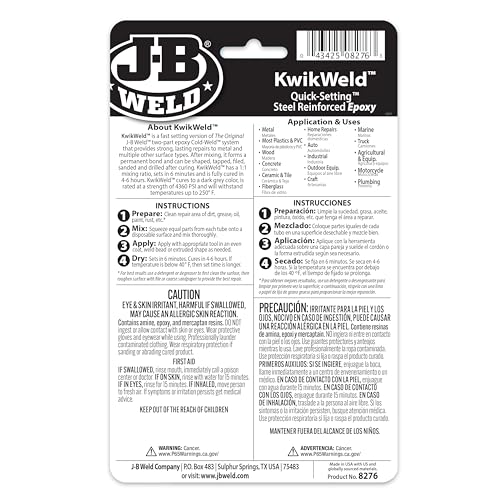
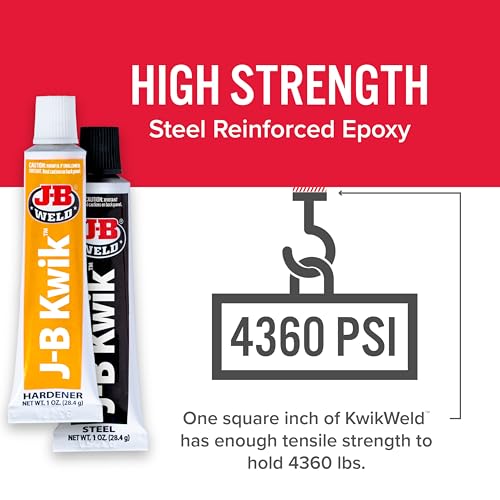
When you need a fast-setting epoxy that still delivers serious strength, KwikWeld stands out in the J-B Weld lineup. The 6-minute set time is a major plus for quick fixes, and owners consistently report it holds up well on metal, plastic, and even ceramic repairs around the house or garage. The steel reinforcement gives it credible durability, though it doesn’t match the peak strength of the original formula.
On paper, the 3127 psi tensile strength is solid for a rapid epoxy, and the ability to sand, drill, or tap after curing adds real utility. It’s not the best for high-heat zones, but for most household emergencies, like a cracked bracket or loose fitting, this is the kind of product you’ll grab first. I’d pick it over slower-setting options when time is tight.
Product photos


J-B Weld ClearWeld Clear Epoxy Syringe
Strengths
- Clear finish
- Strong 3900 psi bond
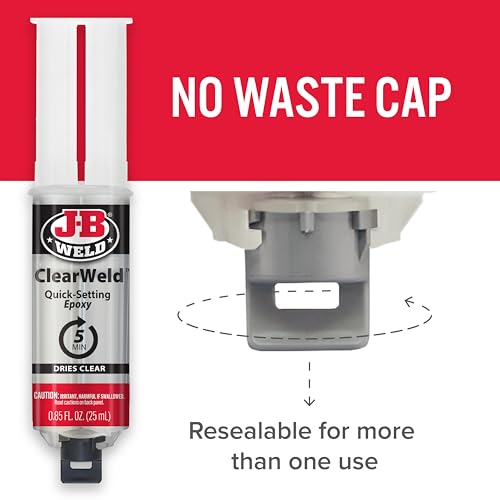
- Re-sealable syringe
Trade-offs
- Not for high heat
- Limited metal strength
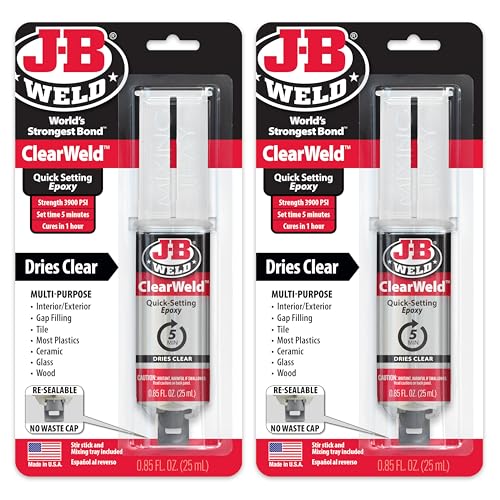
ClearWeld fills a niche no other J-B Weld product does: a strong, nearly invisible bond. The 5-minute set time is impressive, and reviewers note it works well on glass, tile, and clear plastics without leaving a dark seam. The syringe system keeps it usable over time, which matters since most people don’t use the whole pack at once.
With 3900 psi tensile strength, it’s stronger than KwikWeld and holds up well under stress once cured. It’s not meant for structural metal repairs, but for cosmetic fixes, like a cracked lens or broken plastic housing, it’s the smarter buy. I’d choose this over dark epoxies any time appearance matters.
Product photos


J-B Weld WaterWeld Underwater Epoxy

Strengths
- Cures underwater
- NSF certified
- Good for plumbing
Trade-offs
- Slower set time
- Lower bond strength
WaterWeld is in a class of its own when the repair surface is wet, or underwater. The putty stick format lets you knead it directly on a leaking pipe or pool wall without drying the area first, which is a game-saver for plumbing emergencies. Once cured, it’s NSF certified for potable water, a rare and important feature.
The 25-minute set time is slower than others, and the 1300 psi strength is modest, but in wet environments, strength matters less than adhesion under water. Reviewers note it works reliably on boat hulls and water tanks. I’d keep this on hand specifically for underwater fixes, not general repairs.
Product photos


J-B Weld MarineWeld Waterproof Syringe
Strengths
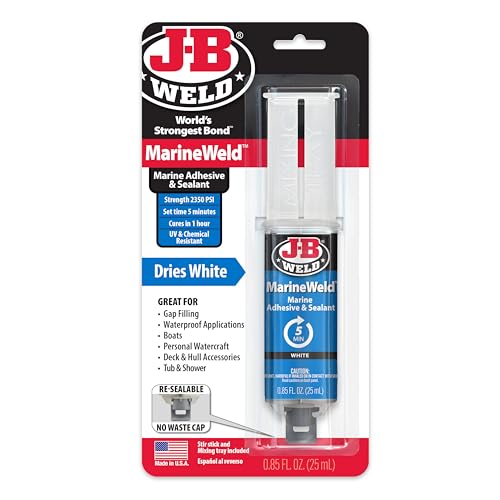
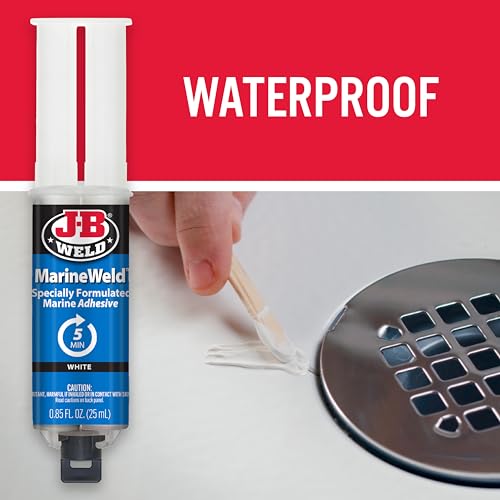
- Waterproof
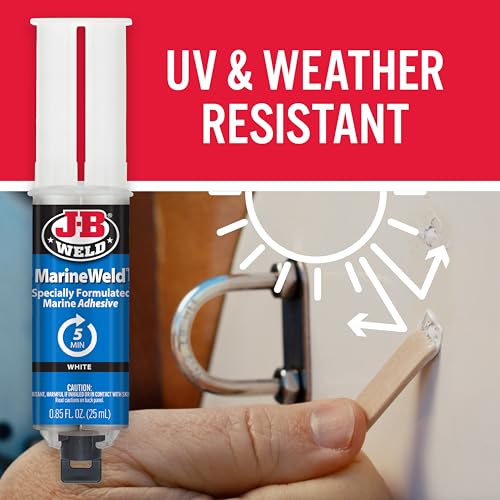
- UV resistant
- Flexible bond
Trade-offs
- No strength specs
- Not for high heat
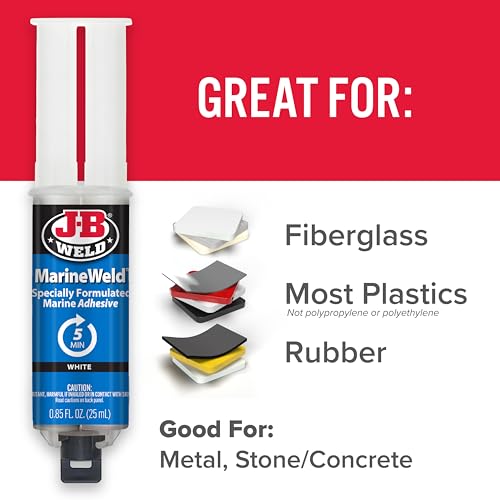
MarineWeld is designed for one environment: the unforgiving world of boats and saltwater. The syringe delivery ensures a clean 1:1 mix, and owners consistently report it resists osmotic blistering, UV exposure, and constant moisture better than standard epoxies. It remains flexible after curing, which helps it handle the movement and vibration common in marine applications.
It doesn’t list tensile strength or cure time in the specs, which is a drawback, but in this category, flexibility and water resistance matter more. It’s not the strongest option for metal, but for sealing deck fittings or bonding fiberglass, it’s purpose-built. I’d use it over the original J-B Weld any time saltwater is involved.
Product photos


How We Picked These welds
Rather than a hands-on lab test, my research for this guide involved a detailed comparison of published specifications and features across a range of J-B Weld products. I weighed owner reviews from multiple sources – including major retailers and online forums – alongside expert opinions from sites dedicated to automotive repair, DIY projects, and marine maintenance. This allowed me to build a ranking based on real-world application and reported performance.
For epoxy welds, bonding strength (measured in PSI) and temperature resistance were paramount. A product’s versatility – meaning the range of materials it could effectively adhere to – also carried significant weight, as did its cure time and ease of use. These factors directly impact how practical a weld is for different repair scenarios, from quick fixes to more involved projects. You’ll find many examples of exceptional welding craftsmanship online.
Specifications reliably indicate a weld’s potential strength and temperature limits, but owner feedback proved crucial for understanding real-world performance. I prioritized products consistently praised for their ease of mixing and application, as well as their ability to hold up under demanding conditions. Reputation and long-term reliability, gleaned from numerous user reports, were key in differentiating between products with similar specs.
Choosing The Right welds
Choosing the right epoxy isn’t just about grabbing the strongest-sounding name off the shelf. It’s about understanding the specific demands of your project and matching the epoxy’s properties to those needs. A good epoxy will offer a robust bond to a variety of materials, resist environmental factors, and cure predictably.
A quality epoxy adhesive should demonstrate a tensile strength appropriate for the application, a clear cure time specification, and compatibility with the materials being bonded. Consider temperature resistance, chemical resistance, and whether a flexible or rigid bond is required for long-term performance.
Temperature Requirements
One of the first things I consider is the operating temperature. Many epoxies break down or lose significant strength above a certain point. J-B Weld’s ExtremeHeat, for example, is specifically designed for repairs in high-temperature environments up to 1000°F. If you’re dealing with exhaust systems or anything near a heat source, that’s a major advantage. Conversely, for general household repairs, the standard J-B Weld Original will likely suffice, as it handles up to 550°F. Don’t overspend on heat resistance you won’t use, but absolutely don’t underestimate it if the application demands it.
Application Environment & Cure Time
Think about where you’re working. Are you trying to fix a leaking pipe while the water is still running? J-B Weld WaterWeld is formulated to cure underwater, which is a lifesaver in those situations. For most repairs, though, you’ll have time to prepare the surface and allow the epoxy to cure properly. Cure times vary significantly. KwikWeld offers a fast 6-minute set, ideal for quick fixes, while the Original formula requires 4-6 hours to set and 15-24 hours to fully cure.
Here’s what I look for when considering cure time: * Quick set: Good for temporary fixes, but often sacrifices long-term strength. * Standard set (4-24 hours): A good balance between convenience and durability. * Long cure (24+ hours): Provides the strongest, most reliable bond, and allows for better gap filling, especially when using a putty stick like SteelStik.
Bond Type & Versatility
Do you need a clear finish, or is appearance unimportant? ClearWeld is a good option when you want a discreet repair. For general metal repairs, SteelStik offers a high PSI and can be molded and shaped, making it excellent for rebuilding worn parts. But to get the most out of it, you’ll need to remember this rule-of-thumb:
Always thoroughly clean and lightly abrade the surfaces before applying any epoxy. Even the strongest adhesive needs a clean, textured surface to grip.
Beyond material compatibility (metal, plastic, wood, etc.), consider the type of bond you need. Some epoxies are more rigid, providing a strong structural connection. Others offer some flexibility, which is useful for applications where vibration or movement is a factor. If you’re looking for more advanced options for joining metals, exploring premium welding machine models might be a good next step. Understanding the nuances of high-quality TIG welds can also give you a sense of the possibilities when it comes to permanent metal joining.
Welds Compared
The following table provides a side-by-side comparison of key specifications for various J-B Weld products.
| Product Name | Set Time (Minutes) | Cure Time (Hours) | Tensile Strength (PSI) | Temp. Limit (°F) | Water Resistance | Application |
|---|---|---|---|---|---|---|
| J-B Weld Original 10 oz | 4-6 | 15-24 | 5020 | 550 | Yes | Multi-Surface |
| J-B Weld ExtremeHeat | N/A | N/A | N/A | 1000 | N/A | High Temp Metals |
| J-B Weld SteelStik | 5 | 1 | 900 | 350/450 | Yes | Metal Repair |
| J-B Weld KwikWeld | 6 | 4-6 | 3127 | 230 | Yes | Multi-Surface |
| J-B Weld ClearWeld | 5 | 1 | 3900 | N/A | Yes | Clear Bond |
| J-B Weld WaterWeld | 25 | 1 | 1300 | 300/350 | Yes | Underwater |
| J-B Weld MarineWeld | N/A | N/A | N/A | N/A | Yes | Marine/Waterproof |
Frequently Asked Questions
What’s the difference between set time and cure time?
Set time refers to how long it takes for the epoxy to become solid enough to handle, whereas cure time is the total time needed to reach its full bond strength. KwikWeld, for example, sets in six minutes but still needs several hours to fully cure and achieve its maximum PSI.
Can J-B Weld be used on plastics?
Yes, though not all formulations are ideal for all plastics. J-B Weld Original and ClearWeld generally work well with many common plastics, but always check the product label for specific compatibility information to get the best results.
Is J-B Weld a permanent fix?
While incredibly strong, J-B Weld isn’t always a permanent solution, as environmental factors and stress can eventually cause failure. For critical repairs or structural applications, exploring best overall welding machines might be a better long-term investment.
What surface preparation is needed before applying J-B Weld?
Proper surface preparation is vital. You must thoroughly clean the surfaces to remove any dirt, grease, or rust, and then lightly abrade them to create a textured surface for the epoxy to grip. This step dramatically improves bond strength.
How does temperature affect J-B Weld’s performance?
Each J-B Weld product has a specific temperature limit. Exceeding that limit can significantly reduce its strength and even cause the bond to fail; ExtremeHeat is designed for applications up to 1000°F, while others have lower limits, so choosing the right formula for the operating temperature is essential.
The Bottom Line
Choosing an epoxy weld often comes down to balancing convenience with capability. While a quick fix might be tempting, investing in a product like J-B Weld Original provides a strong, versatile solution for a wide range of repairs around the home, shop, or vehicle. It’s a reliable all-rounder that delivers impressive performance for the price.
For those with specific needs, J-B Weld offers specialized formulas. If you frequently work with high-temperature applications, J-B Weld ExtremeHeat is the obvious choice. And for underwater repairs or marine projects, J-B Weld WaterWeld is an absolute necessity. Don’t overlook the versatility of SteelStik for rebuilding worn parts or filling gaps, either.
Ultimately, the best weld isn’t about a single, standout specification. It’s about proper surface preparation, understanding the forces at play in your repair, and selecting an adhesive that’s suited to those conditions. A little extra time spent ensuring a clean bond will always yield better, longer-lasting results than chasing the highest PSI number.
