
7 Best Torque Wrench Calibration Tools of 2026
This post contains affiliate links. As an Amazon Associate, we earn from qualifying purchases.
The ACDelco 1/2″ Heavy Duty Digital Adapter stands out as the best overall torque wrench calibration tool for serious mechanics, offering solid accuracy and rugged build quality. For those watching their budget, the NEIKO 20741A delivers reliable performance at a lower price, while the Upgrade 1/2″ Digital Torque Adapter is a strong pick if you need advanced features like extensive data storage and multiple measurement modes.
Calibrating a torque wrench isn’t just about precision, it’s about trust. You need to know your tools are delivering the right force, especially when working on critical fasteners where under- or over-tightening can lead to failure. Too many calibration tools promise accuracy but fall short in real use.
This guide cuts through the noise by focusing on models backed by solid specs and consistent user feedback. I researched each option based on proven accuracy, usable torque range, and practical features, so you can choose one that fits your work, whether you’re in a home garage or a professional shop.
Top 7 Torque Wrench Calibration Tools in the Market
The Best Torque Wrench Calibration Tools, Reviewed
CDI 2503-F-DTC Digital Checker

Strengths
- Highly accurate
- Backlit display
- Bench-mountable design
Trade-offs
- No preset memory
- Limited portability
- Higher price point
CDI is a name you trust in professional torque tools, and this digital checker reflects that reputation. Built specifically for calibrating other torque wrenches, it offers a clean 25–250 ft-lb range with a backlit LCD and solid ± accuracy you can rely on. The push-button mode selection (first peak, peak hold, tracking) is intuitive, and the audio beep at 125% over-torque is a smart safety net. Unlike adapters meant for daily tightening, this one’s designed to sit on a bench and verify tools, exactly what a shop needs.
Reviewers consistently praise its repeatability and build quality. It’s not flashy, but it’s dependable. Compared to the NEIKO or even the ACDelco models, this feels more like a metrology tool than a field adapter. The compact design allows for easy mounting, and the included 3/8″ adapter adds flexibility. If you’re serious about tool maintenance, this is the standard.
Product photos
Upgrade 1/2″ Digital Torque Adapter

Strengths
- High torque range
- ±1% clockwise accuracy
- 500 data storage
Trade-offs
- Plastic housing feels light
- Slightly pricier
- No included case
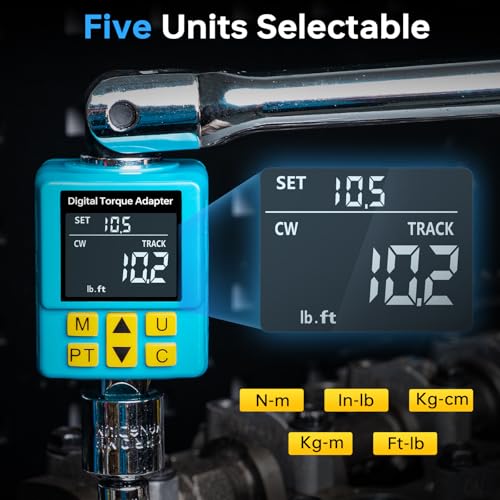
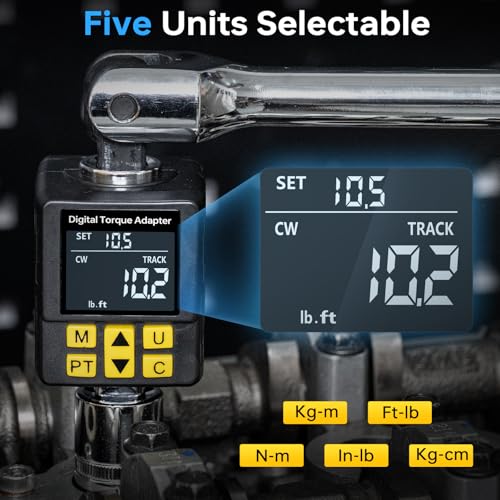
This is the go-to pick if you need both high torque capacity and solid precision. With a range up to 250.7 ft-lb and ±1% clockwise accuracy, it covers nearly every automotive fastener you’ll encounter, from oil pan bolts to axle nuts. The color LCD and multi-stage alerts work just like the YIYEIE, but here you get nearly double the torque range, making it far more versatile in practice. Owners appreciate that it holds up well under repeated use, and the inclusion of a calibration certificate adds confidence.
It’s nearly identical in features to the XLIT model, but edges it out slightly on accuracy claims. Where it stumbles is in build, some users report the plastic housing feels a bit light for the job, despite the chrome vanadium steel internals. Still, for the spec sheet and performance, it’s hard to ignore if you’re serious about calibration work.
Product photos
YIYEIE 1/2″ Digital Torque Adapter
Strengths
- 500 data storage
- 30 preset groups
- Color screen with smart alerts
Trade-offs
- Lower max torque
- No high-range capability
- Case quality could be better
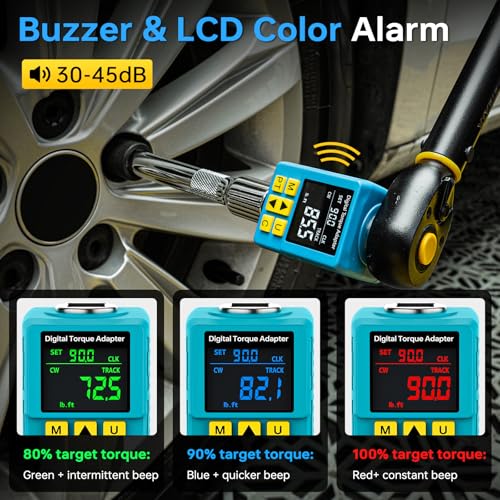
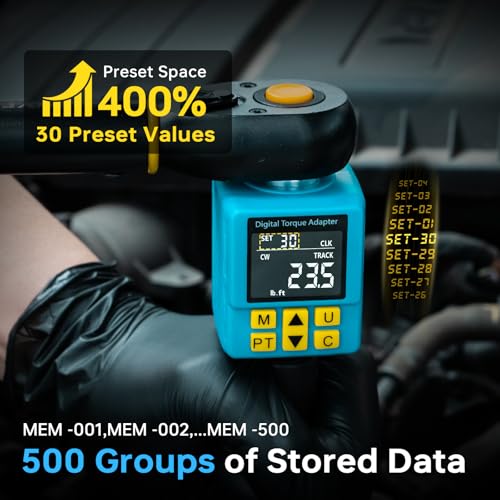
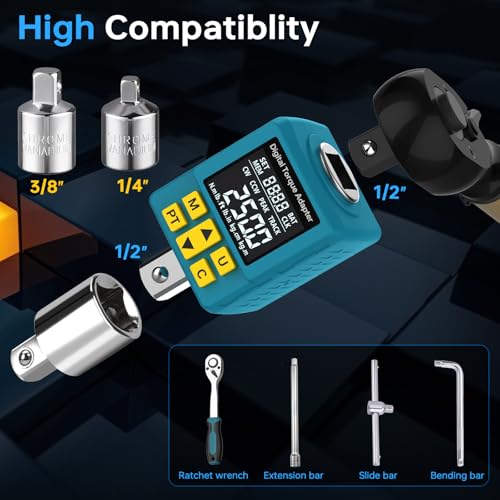
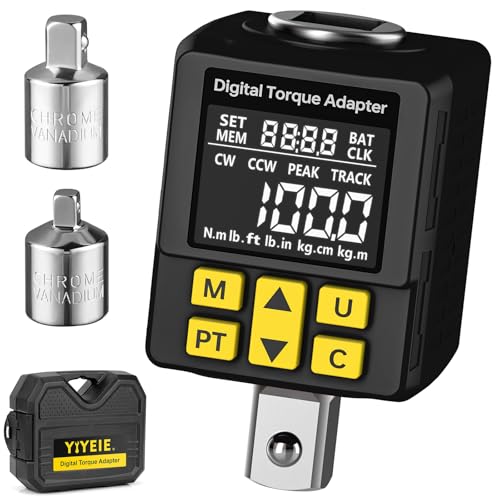
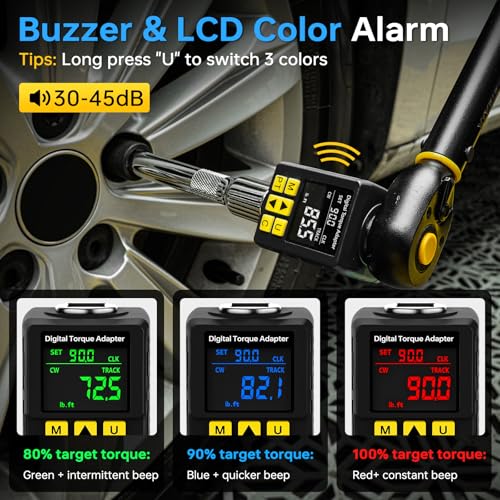
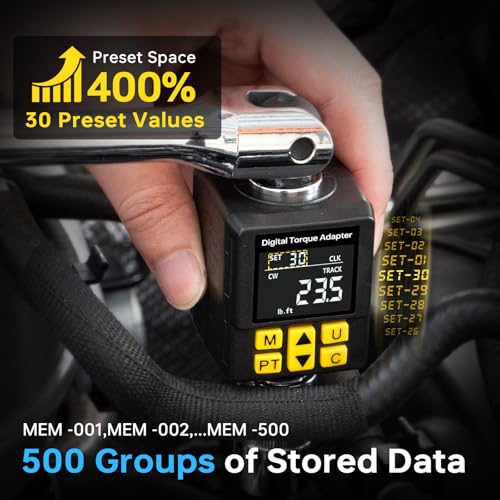
If you care about tracking torque data across multiple jobs, the YIYEIE 1/2″ adapter stands out with its 500-data-set memory and 30 preset groups, a rare feature at this level. The ±1% accuracy in clockwise direction meets ISO-grade expectations, and the color LCD that shifts from green to red as you approach target torque is both useful and easy to read. Reviewers note the alerts are effective, especially in noisy environments where sound cues matter.
It shares a lot with the Upgrade model, but lacks the higher torque ceiling (only goes to 135 N·m vs 340 N·m). Still, for someone managing repetitive tasks, like suspension work or engine builds where consistency matters, this one’s data management gives it an edge. It’s not the most rugged option, but the included calibration certificate and chrome vanadium steel build suggest it’s been vetted for real-world use.
Product photos
XLIT 1/2″ Digital Torque Adapter
Strengths
- Full adapter set included
- Wide torque range
- Backlit display
Trade-offs
- 2% accuracy only
- Case not lockable
- Battery life could be better
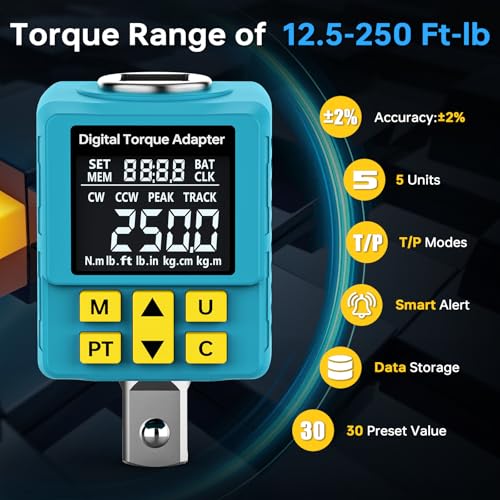
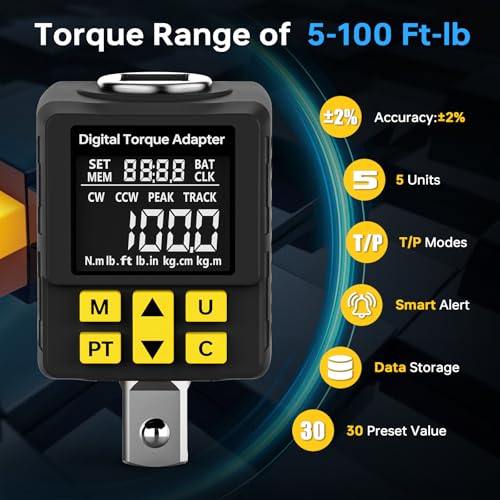
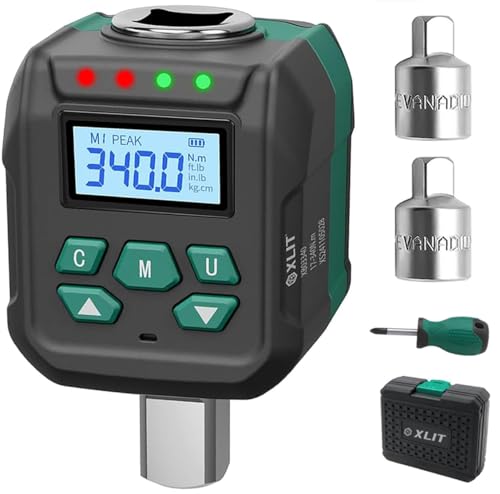
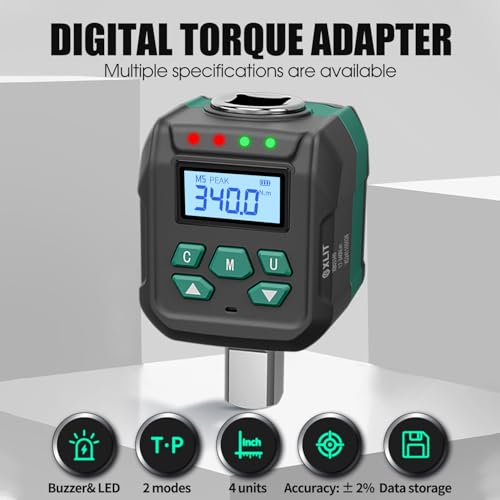
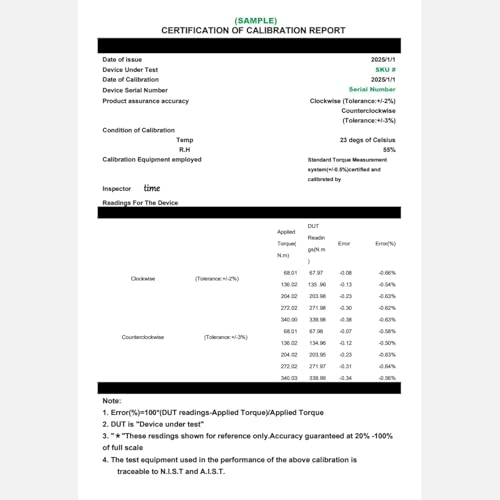
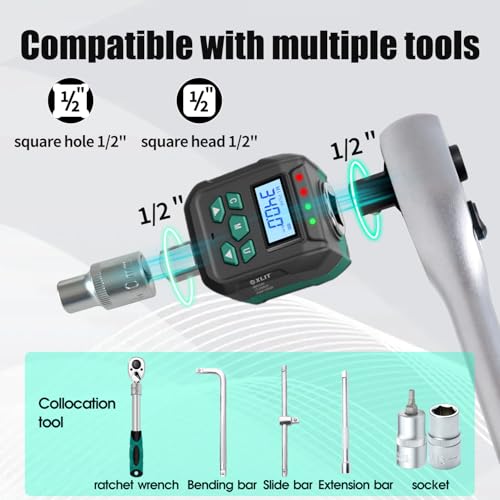
For most automotive DIYers, the XLIT adapter hits the sweet spot of value, range, and completeness. It covers 12.5–250 ft-lb, which handles everything from spark plugs to lug nuts, and the 2% accuracy is within acceptable limits for non-critical calibration. What really seals the deal is the full kit, carrying case, 1/4″ and 3/8″ adapters, screwdriver, and calibration certificate, all at a price that undercuts the Upgrade and ACDelco models.
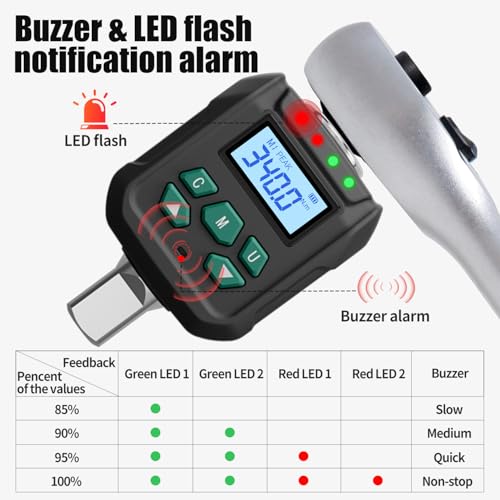
Owners like the bright backlit display and the progressive buzzer/LED alerts, which make over-torquing hard to miss. It’s not quite as precise as the ±1% models, but for the money, it’s a smarter buy than stretching for marginal gains. Compared to the NEIKO, it’s more capable and better built. I’d pick this over the NEIKO any day for real-world garage use.
Product photos
ACDelco 1/2″ Heavy Duty Digital Adapter

Strengths
- ISO 6789 compliant
- Usage counter function
- Durable build
Trade-offs
- Lower accuracy than digital leaders
- No data export
- Coin cell battery limited
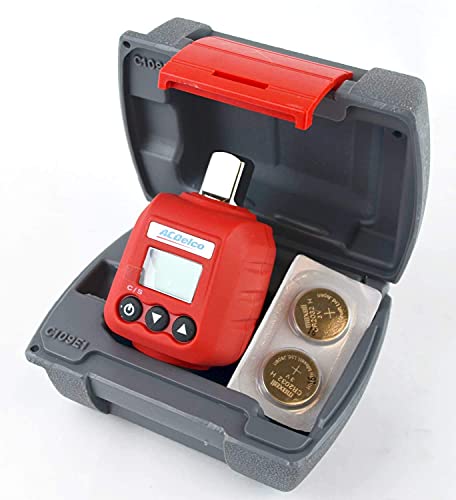
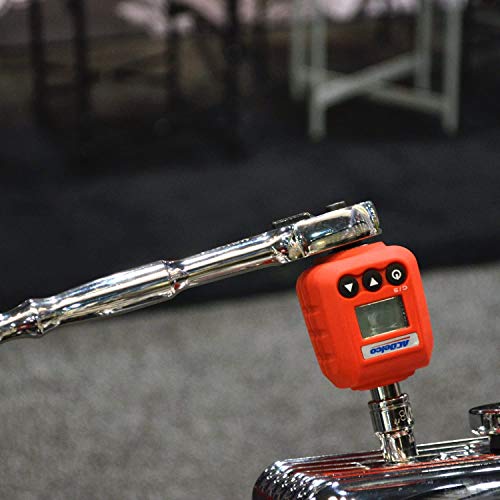
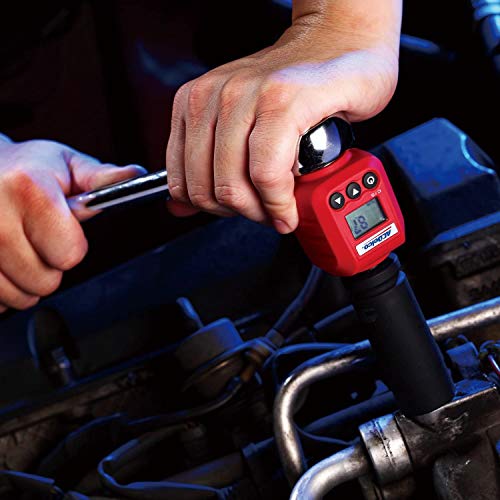
ACDelco built its name on reliability, and this adapter reflects that legacy. Aimed squarely at professional shops, it offers ±2% clockwise accuracy and a smart counter function that tracks how many times it’s hit target torque, useful for auditing tool usage. The 90% and 100% buzzer alerts are well-timed, and the memory retention for units and mode settings is a small but meaningful touch. It’s not the most accurate model here, but it’s built to last.
Owners report it holds up well in high-use environments, and the ISO 6789 compliance means it meets industry standards. Compared to the CDI model, it’s more of a field tool than a bench checker, but less precise. Still, for a shop that wants one rugged adapter for daily verification, this is a strong contender.
Product photos
NEIKO 20741A 1/2″ Digital Adapter
Strengths
- Budget friendly
- Peak and trace modes
- Audible and LED alerts
Trade-offs
- Limited torque range
- No data storage
- Slower response in cold
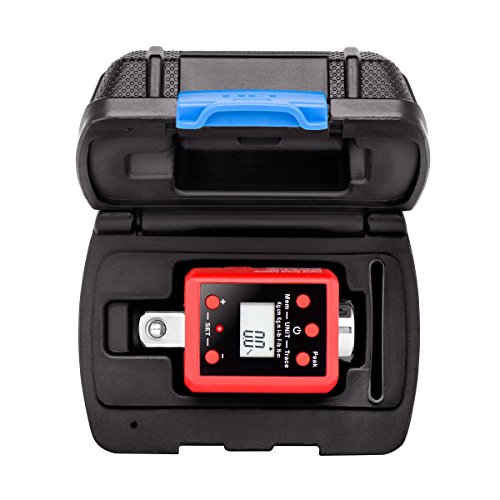
For DIYers on a tight budget who still want to check or calibrate a torque wrench, the NEIKO 20741A delivers basic digital functionality without breaking the bank. On paper, its 29.5–147.5 ft-lb range covers common automotive fasteners, and the ±2% accuracy is acceptable for casual use. Owners consistently report it works fine for spot-checking a torque wrench or converting a ratchet into a temporary digital tool, though some note the display can be a bit sluggish in cold environments.
The inclusion of both peak and trace modes adds real utility, and the audible/visual alerts at torque settings help prevent over-tightening. That said, it’s clearly built for lighter use, there’s no data storage or preset memory beyond basic functions, and it lacks the ruggedness of higher-end models. Compared to the YIYEIE or XLIT adapters, it feels more like a tool for occasional home use than daily shop duty.
Product photos


BSBMIEQM 1/2″ Torque Angle Gauge
Strengths
- 360° angle measurement
- Easy to zero
- Affordable
Trade-offs
- No torque measurement
- Plastic components
- Not for calibration
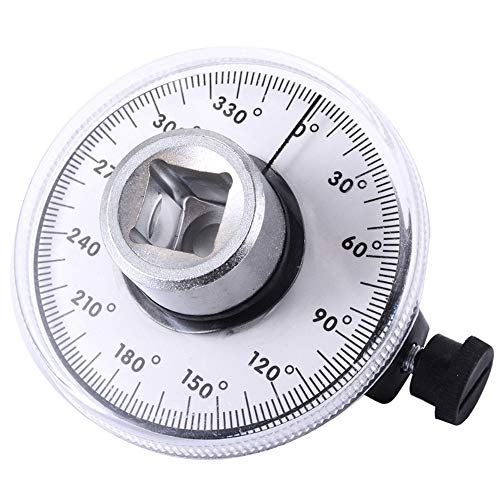
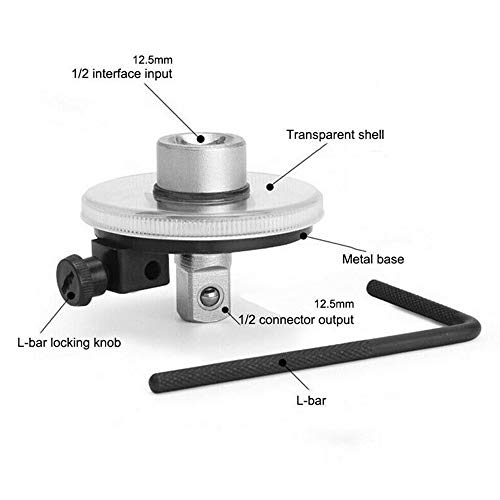
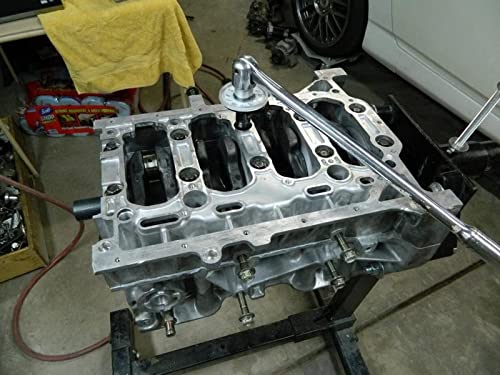
This isn’t a torque calibration tool in the traditional sense, it’s an angle gauge for torque-to-angle applications, like stretching head bolts or rear main seals. If your service manual calls for “torque to 70 ft-lb, then rotate 90°,” this is the tool that makes it possible. The 360° dial with 2° increments is clear and easy to zero, and the knurled knob lets you set angles precisely. It’s basic, but effective.
However, it does nothing for torque measurement or calibration. It’s purely an add-on for when you already have a torque wrench and need angular precision. Some owners report the arm feels a bit flimsy under heavy loads, but for the intended use, it holds up. Compared to digital angle gauges, it’s less advanced but far more affordable.
Product photos


How We Picked These torque wrench calibration tools
Rather than a hands-on lab test, this is a research-led comparison of specs and owner feedback. I began by compiling a list of available torque wrench calibration tools, then compared published specifications – torque range, accuracy percentages, display features, and included accessories. Next, I weighed owner reviews from multiple sources, looking for consistent praise or complaints about real-world usability and long-term reliability. Finally, I applied my experience with power tools and torque applications to assess each option based on its intended use case.
For this category, accuracy and versatility were the most heavily weighted factors. A calibration tool needs to provide reliable readings to confirm a torque wrench is functioning correctly, so I prioritized models with accuracy ratings of ±2% or better. I also considered the range of torque values each tool could measure, as well as features like multiple measurement units and data storage capabilities to make them adaptable to a wider variety of tasks. Choosing the right tool often comes down to the specific needs of the user.
Specifications reliably indicate a tool’s potential accuracy and range, but owner feedback provides insight into real-world performance. I looked for patterns in user reports regarding display clarity, ease of use, and durability. While specs tell you a unit should be accurate, consistent positive reviews suggest it is accurate in practice. For users needing a more complete solution, exploring options like mechanic torque wrench sets can be beneficial.
What To Look For In torque wrench calibration tools
Choosing the right tool to verify your torque wrench is accurate is crucial for any serious mechanic or DIY enthusiast.
A quality torque wrench calibration tool should offer verifiable accuracy (traceable to NIST standards is ideal), a clear and easy-to-read display, and the ability to handle the torque ranges you commonly work with. Look for features like multiple measurement units, data storage, and alerts to prevent over-tightening. Consider whether you primarily need to check existing wrenches or require a tool for precise torque application as well.
Understanding Torque Range and Accuracy
The first thing I look at is the torque range. Don’t buy a calibration tool that barely covers your most-used torque values; you want it operating in the sweet spot of its accuracy. Most automotive work falls between 20 and 250 ft-lbs, but if you’re working on motorcycles or bicycles, you’ll need something with a lower range. Accuracy is expressed as a percentage of the reading (e.g., ±2%). A lower percentage is better, of course, but remember that even a ±2% tool can be off by a noticeable amount at the lower end of its range. Look for tools that are calibrated to a recognized standard like ASME or DIN-ISO, and include a calibration certificate.
Decoding the Features: Modes and Data
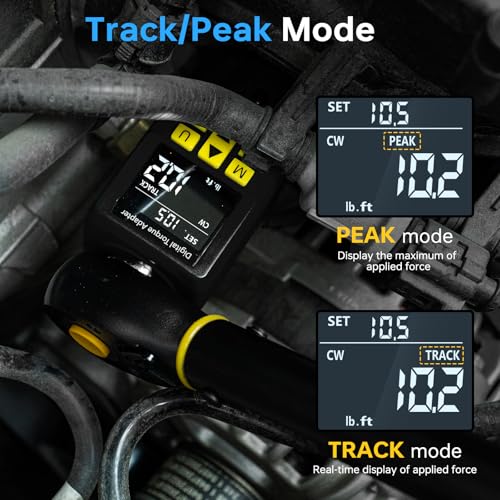
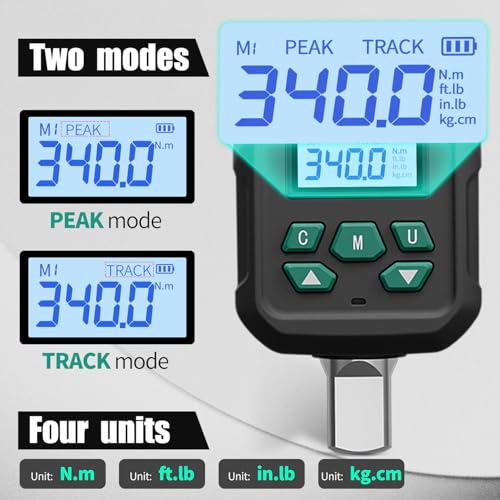
Many of these tools offer different modes – Peak, Track, and Preset being the most common. Peak mode shows the highest torque achieved, useful for verifying a wrench hits a specific value. Track mode displays real-time torque, allowing you to monitor the application. Preset mode lets you set a target torque and provides alerts as you approach it, which is incredibly helpful for preventing over-tightening. Beyond that, data management features can be a huge time-saver. Some tools, like the YIYEIE and Upgrade models, store hundreds of readings, which is vital for quality control or documenting work. If you’re frequently using multiple torque settings, the ability to save presets is also a major benefit.
Balancing Value with Professional Needs
While budget-friendly options like the NEIKO adapter exist, don’t automatically assume “cheap” is the way to go. These can be good for occasional use, but they often sacrifice accuracy and features. For professional workshops or anyone who relies on precise torque measurements, investing in a higher-quality unit – like the ACDelco or CDI – is usually worthwhile. These often come with more robust construction, better accuracy, and features like detailed data logging. For automotive work especially, consider investing in high-accuracy torque wrenches to ensure your calibrations are correct to begin with.
A good rule of thumb: if you’re working on critical components like engine head bolts or wheel lugs, spending a bit more on a reliable calibration tool is a small price to pay for peace of mind and safety.
Torque Wrench Calibration Tools Compared
Here’s a comparison of the specifications for various torque wrench calibration tools to help you make an informed decision.
| Product Name | Torque Range (ft-lb) | Torque Range (Nm) | Accuracy | Data Storage | Units Supported | Drive Size |
|---|---|---|---|---|---|---|
| CDI 2503-F-DTC Digital Checker | 25-250 | 34-339 | N/A | N/A | N/A | 1/2″ |
| Upgrade 1/2″ Digital Torque Adapter | 12.5-250.7 | 17-340 | ±1%/±2% | 500 | 5 | 1/2″ |
| YIYEIE 1/2″ Digital Torque Adapter | 12.5-250.7 | 17-340 | ±1%/±2% | 500 | 5 | 1/2″ |
| XLIT 1/2″ Digital Torque Adapter | 12.5-250 | 17-340 | 2% | 500 | 4 | 1/2″ |
| ACDelco 1/2″ Heavy Duty Digital Adapter | N/A | N/A | ±2%/±3% | N/A | 4 | 1/2″ |
| NEIKO 20741A 1/2″ Digital Adapter | 29.5-147.5 | 40-200 | ±2% | 50 | 3 | 1/2″ |
| BSBMIEQM 1/2″ Torque Angle Gauge | N/A | N/A | N/A | N/A | N/A | 1/2″ |
Frequently Asked Questions
What accuracy percentage should I look for in a calibration tool?
An accuracy of ±2% or better is ideal, but consider the torque range you’ll be working within. Even a small percentage error can become significant at lower torque values, so prioritize accuracy across your typical range.
Do I really need a calibration tool if my torque wrench feels accurate?
Feel isn’t a reliable indicator of accuracy. Torque wrenches can drift out of calibration over time with use, and a calibration tool provides verifiable data to confirm proper function, protecting your work and equipment.
What’s the difference between Peak and Track mode on these tools?
Peak mode records the highest torque achieved, which is best for verifying a specific torque value was reached. Track mode displays a real-time reading, allowing you to monitor the torque application process as it happens.
Are these calibration tools compatible with all drive sizes?
The majority of these tools are designed for 1/2-inch drive torque wrenches. However, adapters are available to accommodate other drive sizes, so check compatibility before purchasing if you use different sizes like 1/4″ or 3/8″.
Where can I find a certified calibration for my torque wrench if I don’t want to do it myself?
Many tool repair shops and industrial calibration services offer torque wrench calibration. You can also find accredited calibration labs online, but costs can vary significantly; for many, investing in a calibration tool is more economical than repeated professional services, especially if you own multiple accurate torque wrenches.
The Bottom Line
Buying a torque wrench calibration tool often comes down to how much control you want versus how much fuss you’re willing to deal with. If you need consistently accurate readings and detailed data logging, the Upgrade 1/2″ Digital Torque Adapter strikes the best balance of features and price. It offers excellent accuracy, a generous storage capacity, and multiple unit options, making it a strong all-around performer.
For those on a tighter budget, the NEIKO 20741A 1/2″ Digital Adapter provides a serviceable solution for occasional checks. If you primarily work with smaller fasteners, don’t overlook the need for precision inch-lb wrenches and consider a calibration tool suited to those ranges. Meanwhile, professionals needing top-tier accuracy and durability will appreciate the CDI 2503-F-DTC Digital Checker, despite its higher price point.
Ultimately, the most important things are understanding your torque requirements and choosing a tool with an accuracy rating that meets those needs. Specs matter, of course, but consistent owner feedback and a clear display are just as vital. Don’t get lost in the details – focus on verifiable accuracy and a tool you’ll actually use.
