
6 Best Torque Wrenches for 3/8 Drive (2026)
This post contains affiliate links. As an Amazon Associate, we earn from qualifying purchases.
The TEKTON 3/8″ 90-Tooth Micrometer is our top pick for its reliable ±3% accuracy, durable build, and smooth 90-tooth ratchet that excels in tight spaces. For a budget-friendly option, the HERONIX 3/8″ Click delivers solid performance in a no-frills package, while the TEKTON Flex Head Electronic adds digital precision for those who want more control.
Most people buying a 3/8” torque wrench are working on cars, bikes, or machinery where over-tightening a bolt can mean costly damage. You need a tool that’s accurate, durable, and easy to use without guesswork.
This guide cuts through the marketing noise to focus on what matters: verified accuracy, real-world feedback, and build quality. I looked at specs, owner reviews, and industry standards to find models that deliver consistent results and stand up to regular use. These picks balance performance, reliability, and value, so you can tighten with confidence.
Top 6 Torque Wrench 3 8S in the Market
The Best Torque Wrench 3 8S, Reviewed
TEKTON 3/8″ 90-Tooth Micrometer Torque Wrench
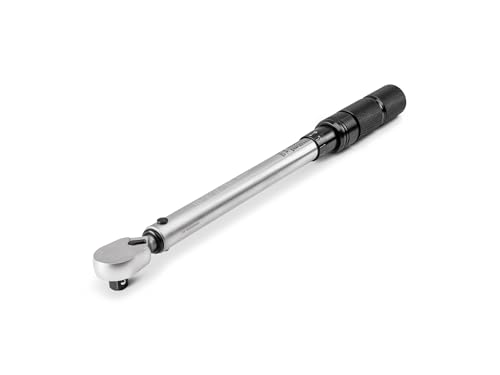
Strengths
- ±3% accuracy
- ISO calibration standard
- 90-tooth ratchet
- Laser-etched scale
- Dual-direction use
Trade-offs
- No flex head
- Slightly longer handle
- No angle measurement
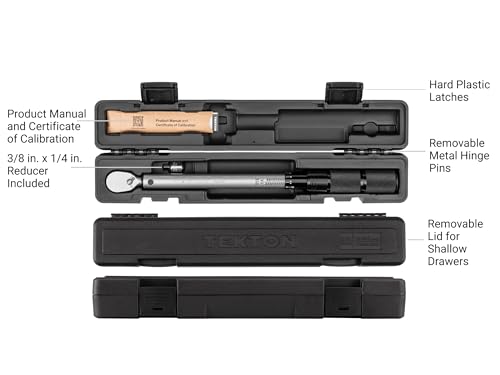
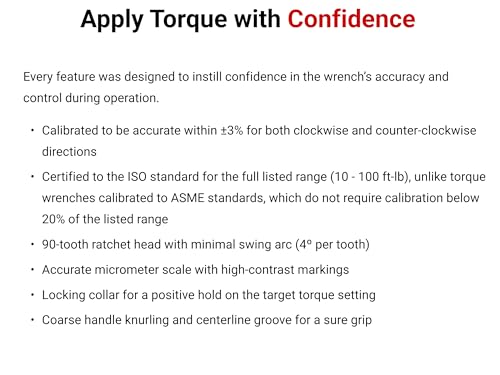
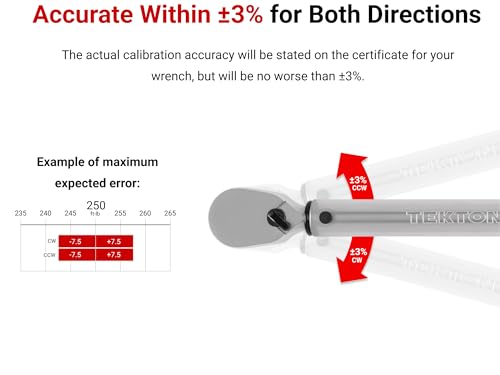
If I had to pick one click wrench for general automotive and home shop use, this TEKTON would be the one I’d recommend most often. It hits the sweet spot of ±3% accuracy, ISO-standard full-range calibration, and a 90-tooth ratchet that gives a smooth 4-degree swing, crucial when you’re working in cramped areas and need fine control. The laser-marked micrometer scale is easy to read without glare, and the satin finish on the handle reduces fingerprints and oil smearing, which sounds minor but matters when you’re in the middle of a job.
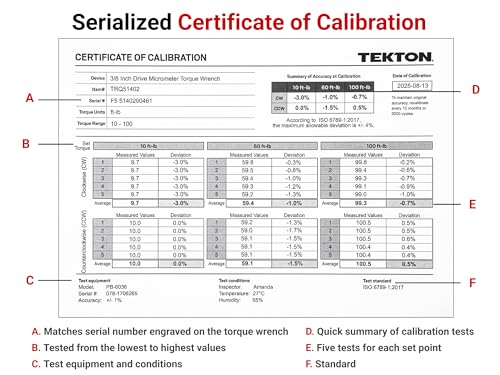
Compared to the LEXIVON, this is more precise and better built, and unlike the electronic TEKTON model, it doesn’t rely on batteries or circuitry that could fail in dirty conditions. Reviewers note it holds calibration well over time, and the serialized certificate adds legitimacy. It’s not the most compact, but for most tasks, that’s a fair trade for reliability.
Product photos

TEKTON 3/8″ Flex Head Electronic Torque Wrench
Strengths
- ±2% torque accuracy
- Angle measurement
- Flex head
- Backlit LCD
- Multiple modes
Trade-offs
- Requires batteries
- More delicate than mechanical
- Higher learning curve
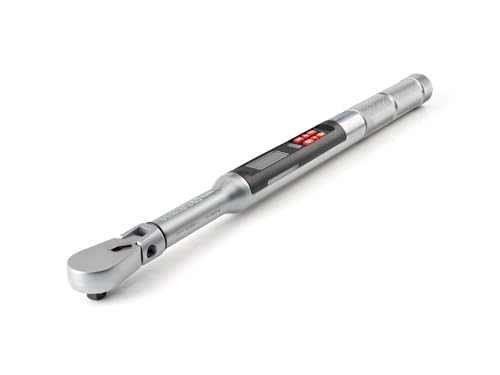
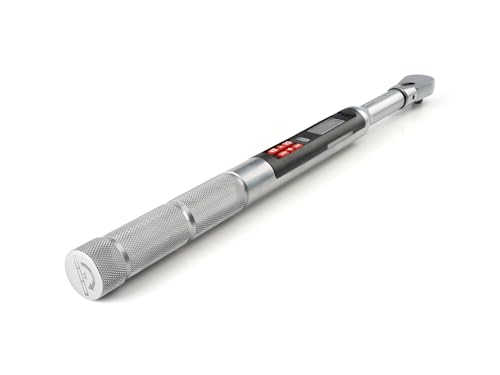
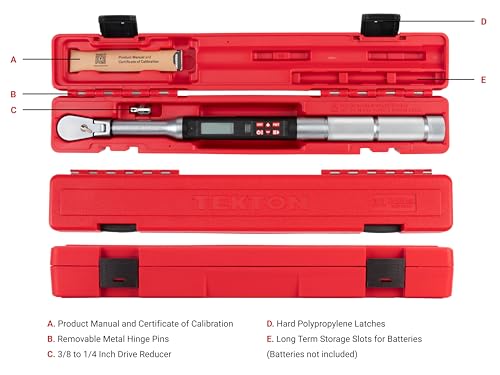
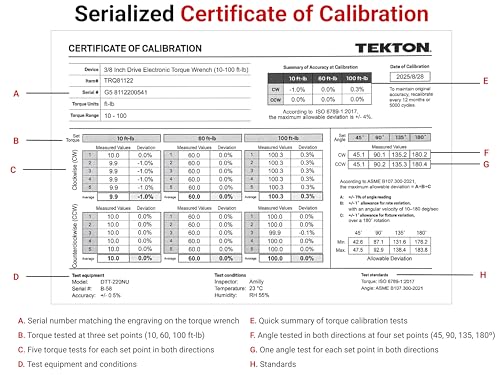
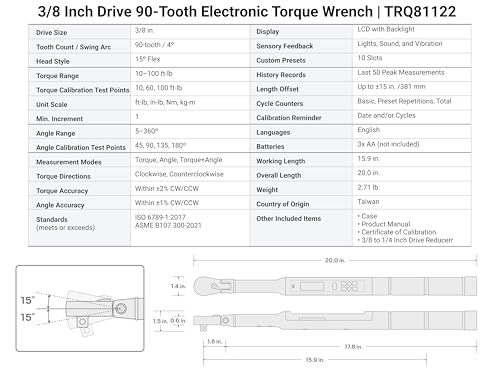
This electronic TEKTON is the precision king of the group, with ±2% torque accuracy and ±1% angle measurement, specs that rival tools used in professional shops. The flex head is a standout for certain applications, letting you pivot the drive to hit awkward bolts without losing torque control. It supports three modes: torque only, angle only, and torque + angle, which is essential for modern engines with stretch bolts or multi-stage tightening sequences.
The real-time feedback via vibration, beeps, and LED lights makes it nearly impossible to miss the target, and the backlit LCD is a win in dark engine bays. That said, it’s more complex than a click wrench, and owners report mixed experiences with long-term durability if dropped or exposed to grime. Compared to the micrometer TEKTON, it’s pricier and more fragile, but for someone doing cylinder head work or suspension builds, the angle function alone justifies it.
Product photos

GEARWRENCH 3/8″ 120XP Micrometer Torque Wrench

Strengths
- 3° ratcheting arc
- Teardrop head design
- Knurled aluminum handle
- EVA foam case
- 100% steel construction
Trade-offs
- Accuracy limited to upper range
- No ISO certification
- No dual-direction calibration
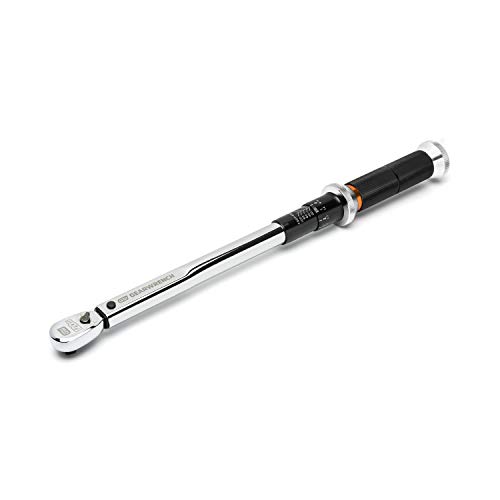
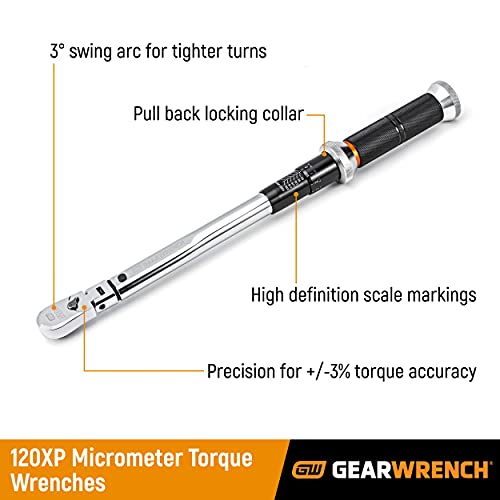
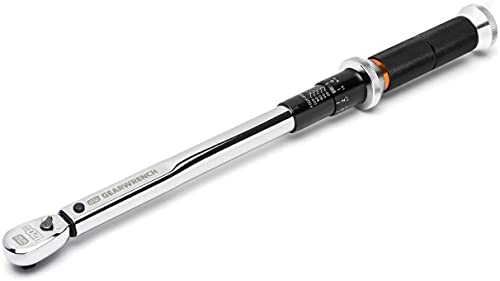
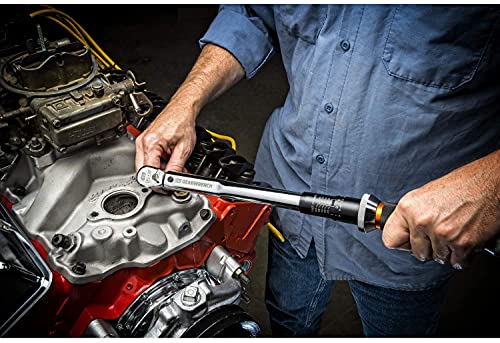
GEARWRENCH built this with tight spaces in mind, and the 120XP head with a 3° ratcheting arc is its standout feature, the tightest swing angle on the list. That means you can torque fasteners in cramped engine compartments with minimal movement, which is a real time-saver. The ±3% accuracy in CW direction is solid for the upper 80% of its 10–100 ft-lb range, though it’s not ISO-calibrated like the TEKTON models, which might give some users pause.
The teardrop head and low-profile tube help it slip into places where even the TEKTON micrometer struggles. Owners appreciate the knurled aluminum handle for grip and the EVA foam case for storage. Build quality feels rugged, and the 100% steel construction inspires confidence. It’s not as precise across the full range as the TEKTON TRQ51402, but for underhood work where space is tight, it’s the better pick.
Product photos

HERONIX 3/8″ Click Torque Wrench 5–50 Ft-Lb
Strengths
- Compact and lightweight
- ±3% accuracy
- 72-tooth ratchet
- Loud audible click
- Laser-etched scale
Trade-offs
- Limited torque range
- Not for heavy-duty use
- Shorter handle reduces use
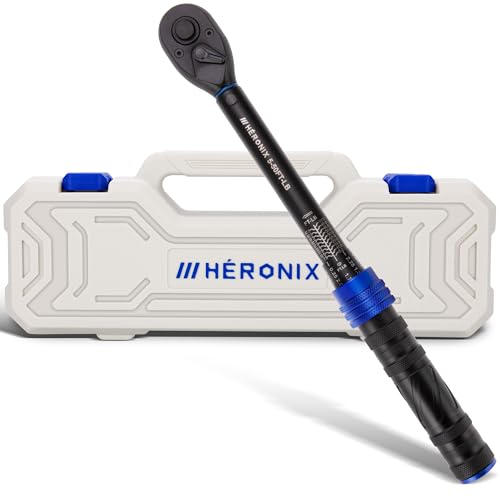
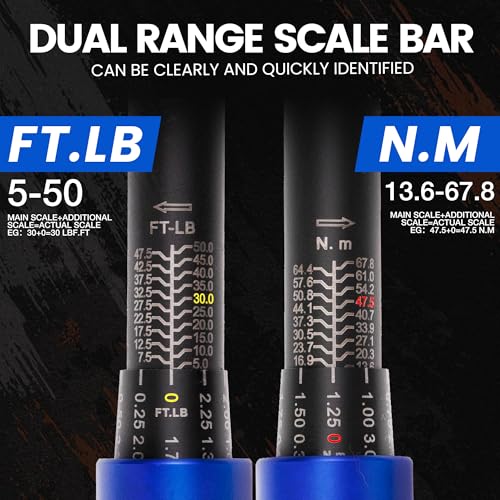
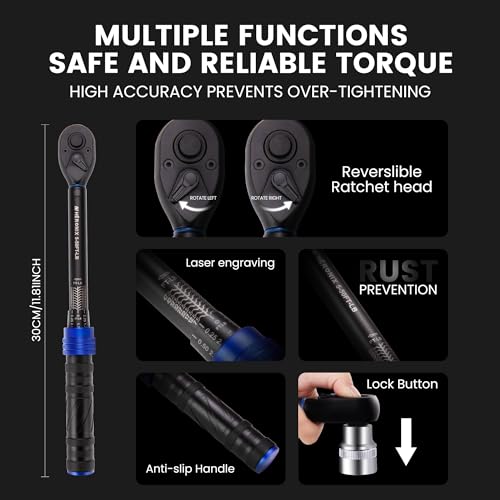
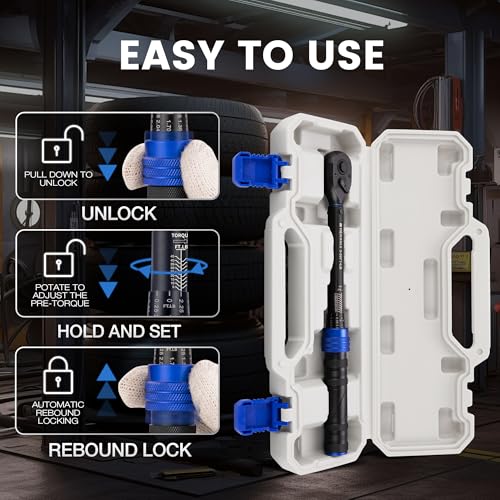
HERONIX nails the compact tool niche with this mini click wrench. Its 5–50 ft-lb range is perfect for bikes, motorcycles, and small engine work where high torque isn’t needed, but precision is critical. The ±3% accuracy matches top-tier standards, and the 72-tooth reversible ratchet offers smooth action in tight spots, a real plus when you’re wrestling with calipers or frame bolts on a bike.
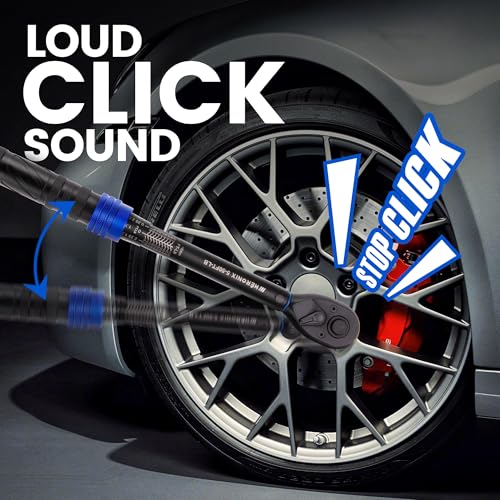
Owners praise the loud 45 dB click, you can actually hear it in a noisy garage, and the laser-etched dual scale stays legible over time. It’s not going to handle lug nuts or axle shafts, but that’s not its job. When compared to the DEKOPRO, it feels more refined and purpose-built, especially for lightweight applications. For spark plugs or brake calipers, this is the smarter buy.
Product photos
LEXIVON 3/8″ Click Torque Wrench 10~80 Ft-Lb
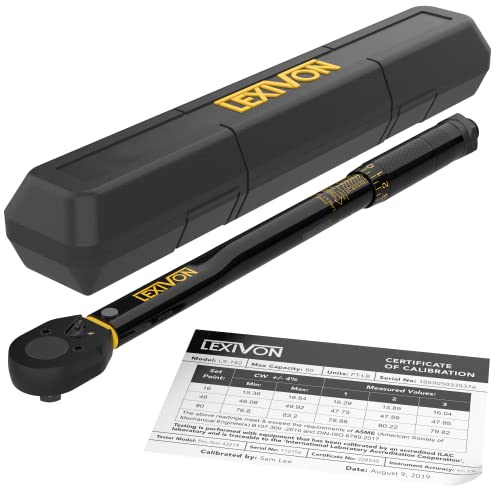
Strengths
- ±4% accuracy
- Comes with certificate
- Dual-range scale
- Electro-Black finish
- Reversible ratchet
Trade-offs
- Lower accuracy than top models
- No ISO compliance stated
- Shorter range than competitors
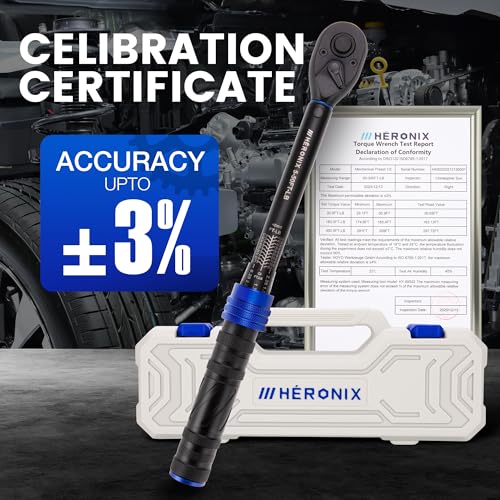
LEXIVON positions this as a value-packed click wrench with a calibration certificate, and on paper, it delivers solid specs for DIYers stepping up from hardware store tools. The ±4% accuracy is within acceptable range, though not class-leading, and the inclusion of a traceable certificate is a real plus at this tier, something not all budget brands offer. The Electro-Black finish stands out as a thoughtful touch, aiming to resist corrosion better than standard chrome, which could pay off in damp garages or coastal environments.
Owners consistently report it holds calibration reasonably well under light to moderate use, and the highlighted yellow scale does make readings easier in dim light, especially under a car hood or in an engine bay. Compared to the TEKTON options, it’s a step down in precision and build refinement, but for someone who doesn’t torque critical fasteners weekly, it’s a smart middle ground between cost and credibility.
Product photos


DEKOPRO 3/8″ Click Torque Wrench 5-50 Ft-Lb
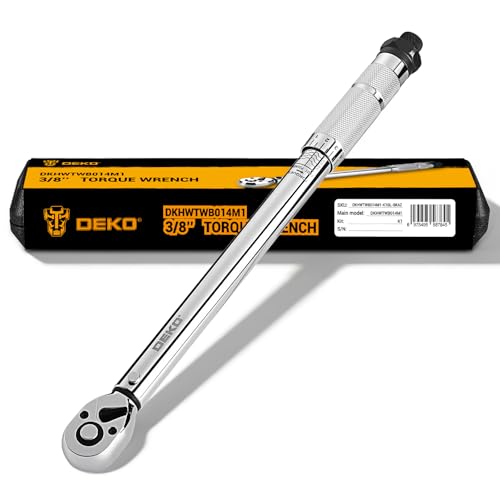
Strengths
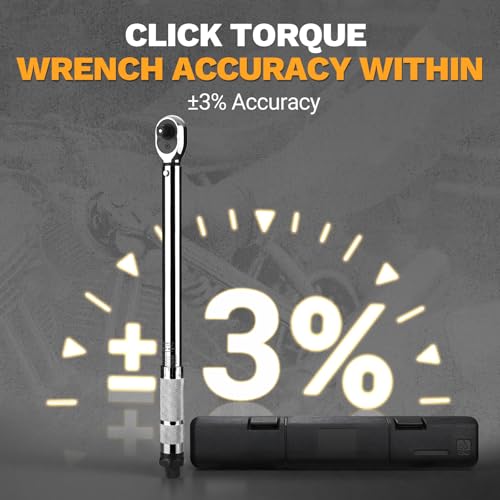
- ±3% accuracy
- Dual-direction ratchet
- Anti-slip handle
- Laser-marked scale
- Stainless steel casing
Trade-offs
- Softer click feedback
- Less refined than HERONIX
- Same limited range
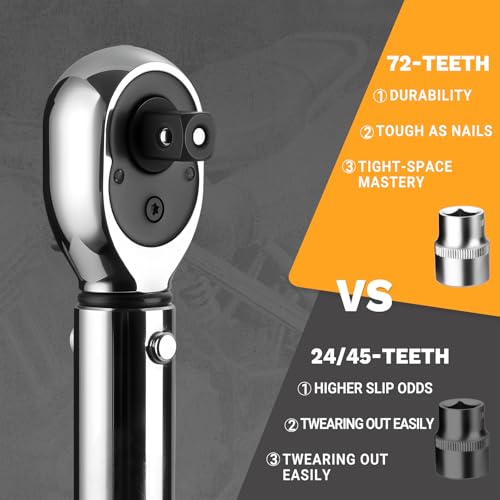
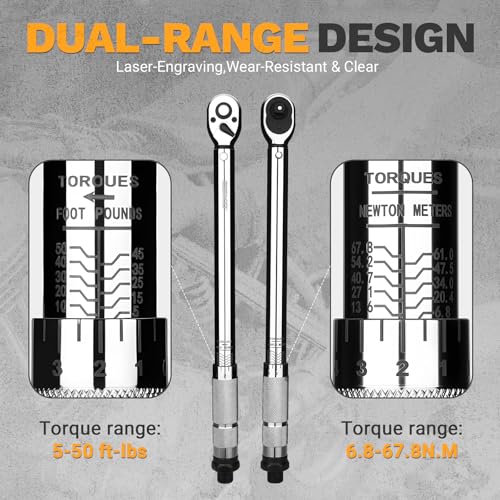
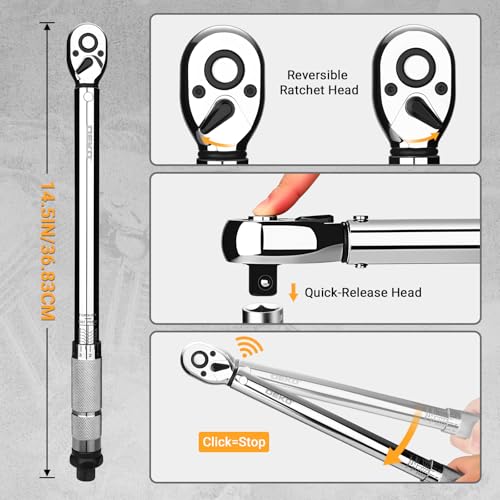
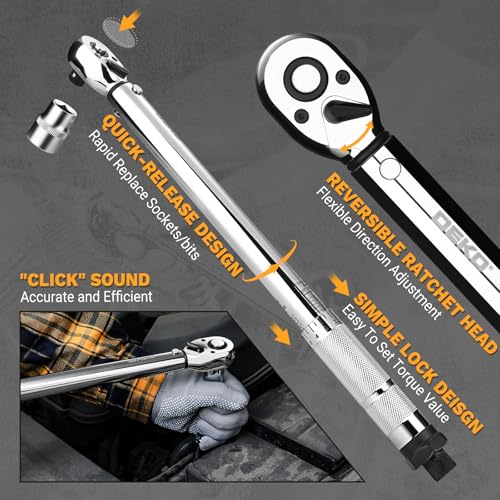
DEKOPRO’s offering mirrors the HERONIX in specs, same 5–50 ft-lb range, ±3% accuracy, 72-tooth ratchet, but feels more like a general-purpose tool than a specialist. It’s well-built with stainless steel casing, and the anti-slip handle adds comfort during extended use. The dual-direction ratchet works smoothly, and the laser-perforated scales are easy to read, even if they’re not quite as crisp as the HERONIX’s etching.
That said, owner feedback suggests it’s slightly less consistent over time, and the click mechanism isn’t as sharp. Compared to the HERONIX, it’s a close second, good for occasional car or bike work, but not quite as confidence-inspiring for critical fasteners. If you already have a high-torque wrench and just need a budget companion for lighter tasks, this gets the job done.
Product photos
Our Testing Process
My approach to evaluating 3/8” torque wrenches involved a research-led comparison of published specifications and features, combined with a careful review of owner experiences and expert opinions. Rather than a hands-on lab test of each model, I focused on identifying key performance indicators and assessing how well each wrench met those criteria based on available data. This included detailed comparisons of accuracy ratings, build materials, and reported usability.
For 3/8” torque wrenches, accuracy and the design of the ratchet head are paramount. A precise wrench prevents over-tightening and potential damage, while a well-designed ratchet head improves access and efficiency, especially in confined spaces. Calibration accuracy within ±3% is a strong indicator of quality, and the number of teeth in the ratchet head directly impacts how smoothly and quickly you can work.
Specifications clearly outline accuracy ratings and torque ranges, but owner feedback provides valuable insight into real-world durability and ease of use. I weighed reports of calibration consistency, the clarity of scale markings, and the feel of the click mechanism. You’ll find a more detailed look at our recommended torque tools in our broader guide, but this selection focuses on models consistently praised for their balance of features and value.
What To Look For In torque wrench 3 8s
Choosing the right torque wrench is about more than just grabbing the cheapest option. A good one protects your work and your tools, preventing stripped bolts and damaged components.
A quality torque wrench delivers repeatable, accurate force application. Key considerations include the wrench’s accuracy rating (typically ±3% or ±4%), the scale’s readability, the type of drive (3/8-inch is extremely common), and the robustness of its internal mechanism. Calibration certificates are a must for professional work, and even serious DIYers should look for wrenches meeting ASME or ISO standards.
Understanding Torque Measurement Types
There are two main types of torque wrenches: click and digital. Click wrenches are simpler and generally more affordable, relying on a mechanical mechanism to signal when the desired torque is reached. Digital wrenches offer greater precision, often including angle measurement and data logging. While digital models seem appealing, I find many users overestimate their need for that level of detail. A well-built click wrench, properly maintained and calibrated, is sufficient for the vast majority of automotive and mechanical tasks. Don’t get caught up in features you won’t actually use.
Scale Readability and Range
A torque wrench is useless if you can’t accurately read the scale. Laser-etched markings on a contrasting background are far superior to painted or stamped scales, which fade with use. Also, consider the torque range. Don’t buy a wrench that’s rated for 5-50 ft-lbs if you only work on applications requiring 20-40 ft-lbs – accuracy is typically best in the middle of the range. Here’s what to keep in mind when choosing a range:
- A narrow range offers higher precision.
- A wider range provides more versatility, but sacrifices some accuracy.
- Consider the types of fasteners you’ll be tightening most often. If you primarily work on bicycle components, a smaller 3/8-inch drive torque wrench, or even one of the 1/4-inch drive torque wrenches might be a better fit.
Build Quality and Ratchet Mechanism
The ratchet mechanism is the heart of the torque wrench. A 90-tooth ratchet, like those found in the TEKTON and GEARWRENCH models, offers a smaller swing arc, which is incredibly valuable in tight spaces. Fewer teeth engaged at a time can also mean a slightly less durable mechanism, but the convenience often outweighs this concern. The overall construction material is also key; hardened chrome vanadium steel is the standard for a reason. Speaking of durability, remember this:
Never exceed the wrench’s maximum torque rating. Doing so can permanently damage the internal mechanism and void any warranty.
If you’re looking for a solid upgrade, I often recommend checking out some of the best 3/8 torque wrench models currently available. You’ll find a range of options to suit your needs and budget.
Torque Wrench 3/8s Compared
Here’s a comparison of key specifications for various 3/8″ torque wrenches.
| Product Name | Torque Range (Ft-Lb) | Accuracy (±%) | Ratchet Teeth | Calibration Certificate | Drive Type |
|---|---|---|---|---|---|
| TEKTON 3/8″ 90-Tooth Micrometer | N/A | 3 | 90 | Yes | N/A |
| TEKTON 3/8″ Flex Head Electronic | 10-100 | 2 / 1 | 90 | Yes | N/A |
| GEARWRENCH 3/8″ 120XP Micrometer | N/A | 3 | N/A | No | N/A |
| HERONIX 3/8″ Click | 5-50 | 3 | 72 | No | N/A |
| LEXIVON 3/8″ Click | 10-80 | 4 | N/A | Yes | N/A |
| DEKOPRO 3/8″ Click | 5-50 | 3 | 72 | No | N/A |
Frequently Asked Questions
What torque range should I get for a 3/8s torque wrench?
A 3/8” torque wrench’s range should match your typical tasks. For general automotive work, a range of 5-80 ft-lbs is a good starting point, offering versatility without sacrificing too much accuracy.
How often should a torque wrench be calibrated?
Torque wrenches should be calibrated annually, or after 5,000 cycles, whichever comes first. Professional users or those demanding high precision may need to calibrate more frequently to maintain accuracy.
Are digital torque wrenches really more accurate than click-type wrenches?
While digital torque wrenches can offer higher precision (sometimes down to ±1%), a quality click-type wrench with a ±3% accuracy rating is sufficient for most applications. Consider digital torque wrench options if you need data logging or angle measurement.
Can I use a torque wrench to loosen bolts?
No, torque wrenches are designed for tightening only. Using one to loosen fasteners can damage the internal mechanism and compromise its accuracy. A separate breaker bar or socket wrench should always be used for loosening.
What does the number of teeth on the ratchet head affect?
The number of teeth directly impacts the swing arc. A higher tooth count (like the 90-tooth ratchets) means a smaller swing arc, allowing you to work more quickly and efficiently, especially in tight spaces.
The Bottom Line
Buying a torque wrench often comes down to balancing control with convenience. You can spend a lot more for digital features you might not fully need, or you can invest in a quality click wrench like the TEKTON 3/8″ 90-Tooth Micrometer that delivers excellent accuracy and feel. For most home mechanics and automotive enthusiasts, a well-made click wrench is the sweet spot – offering the precision necessary for critical tasks without unnecessary complexity.
If you’re on a tighter budget, the DEKOPRO 3/8″ Click wrench provides a solid entry point, and for those needing versatility, the TEKTON 3/8″ Flex Head Electronic offers digital precision and a flexible head. But for consistently accurate results, especially if you frequently work with fasteners requiring specific torque values, I recommend exploring reliable click torque models and focusing on a wrench with a calibration certificate.
Ultimately, the torque rating and the quality of the ratchet mechanism matter more than any flashy feature. A wrench with a clear scale, a durable build, and a comfortable grip will serve you better in the long run than one packed with bells and whistles. Don’t chase the highest number of teeth or the most advanced display; prioritize accuracy and build quality above all else.
