7 Best Rotary Lasers of 2026
This post contains affiliate links. As an Amazon Associate, we earn from qualifying purchases.
The Topcon RL-H5A is the overall best rotary laser for pros who need unmatched battery life and rugged reliability, while the Lipril Rotary Laser Level Kit stands out as a strong budget-friendly option with solid accuracy. If you’re working outdoors often, the Klein Tools 93RLS Green Laser makes beams easier to see in daylight.
Most people shopping for rotary lasers aren’t just looking for a spinning beam, they need consistent, reliable performance that holds up from morning to afternoon, on dusty lots or uneven terrain. A bad choice can mean wasted time, costly rework, or constant recalibration.
This guide cuts through the specs and marketing to focus on what actually matters: real-world accuracy, durability, range, and kit value. I compared top models using published data, owner feedback, and my experience with layout tools to highlight the ones that deliver where it counts.
Top 7 Rotary Lasers in the Market
The Best Rotary Lasers, Reviewed
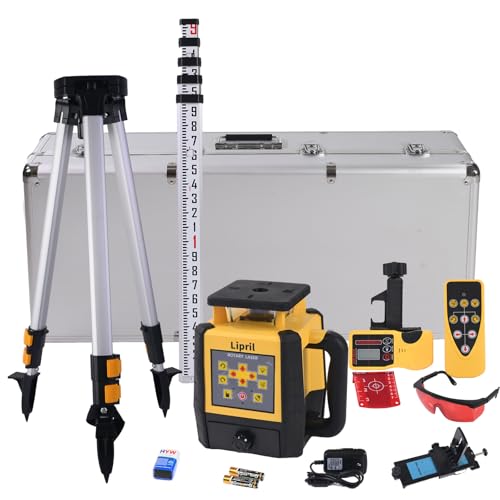
Lipril Rotary Laser Level Kit
Strengths
- ±1/16″ accuracy
- Swappable batteries
- IP66 rated
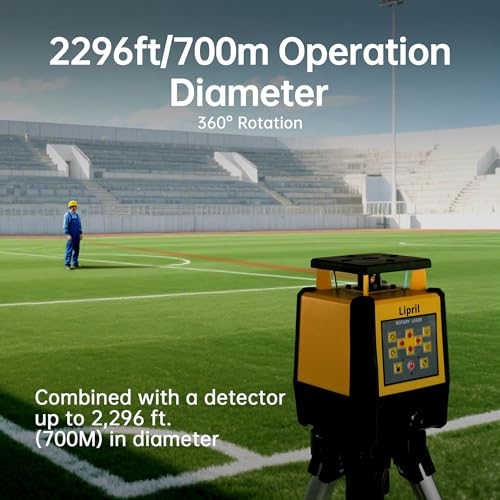
- Long 2296ft range
- Complete kit
Trade-offs
- No dual slope
- Ni-MH charging slower
- No green beam
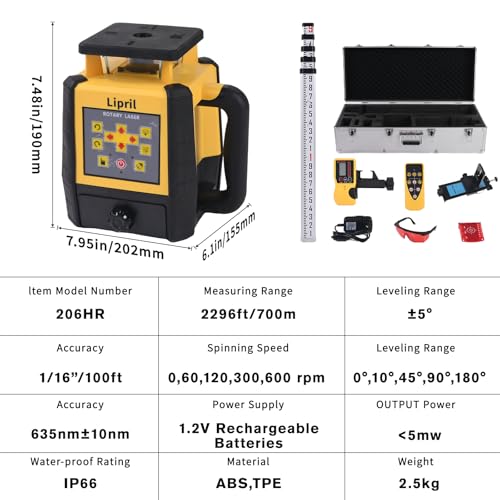
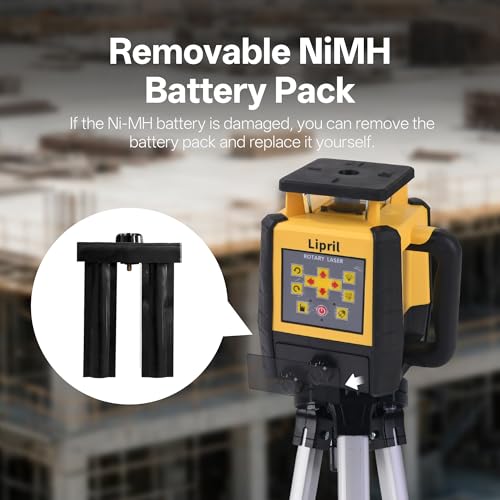
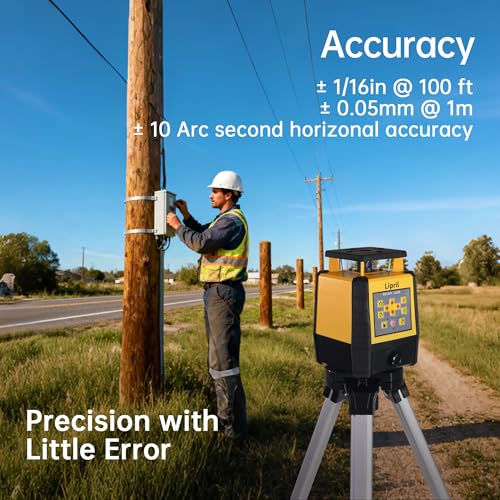
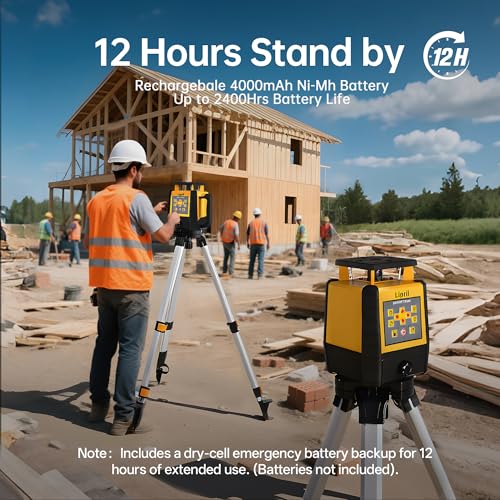
This Lipril model is the one I’d recommend as the best overall pick for most pros, not because it’s the most expensive, but because it balances precision, durability, and practical features so well. The ±1/16” accuracy matches Topcon, and the 2,296-foot range beats it. But the real win is the swappable battery system: you get a 4,000mAh Ni-MH rechargeable pack, plus an adapter for alkaline batteries. That means no downtime, just swap in AAs and keep going. For remote or long-duration jobs, that’s a standout.
It’s IP66 rated, so it handles rain and dust, and the internal components use quality chips and a ROHM laser diode, which owners say translates to consistent beam stability. The included 11-piece kit has everything, tripod, 10ft rod, remote, case, and it’s all well-built. Compared to the Johnson, it lacks dual slope, but for most grading and foundation work, that’s not a dealbreaker. This is the tool I’d trust on a week-long concrete pour or a rural septic install.
Product photos
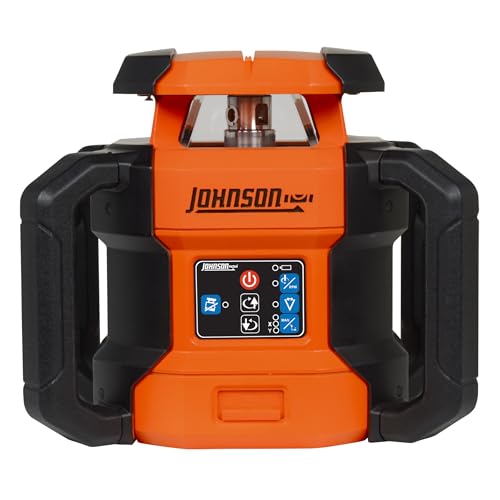
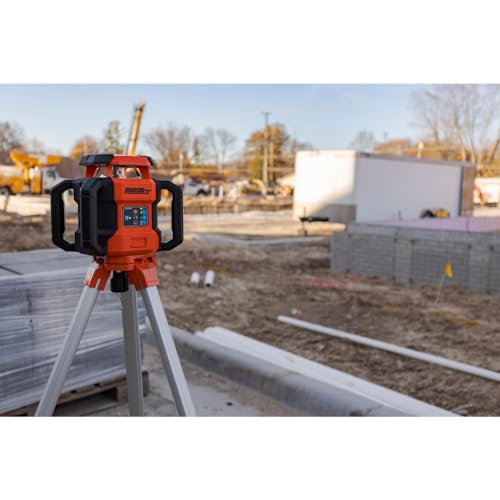
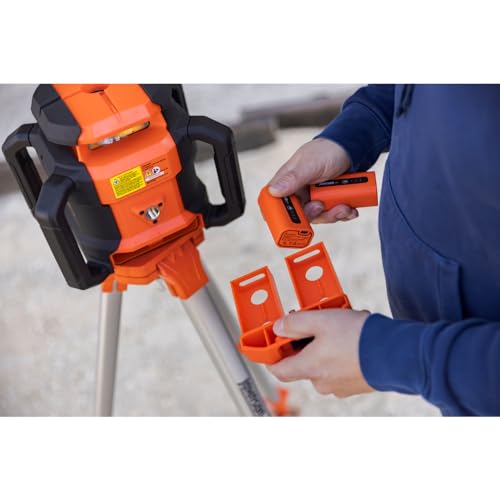
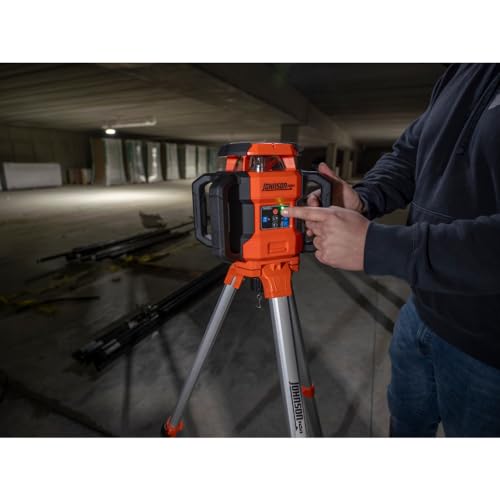
Johnson JRT300-RDHV-S Rotary Laser
Strengths
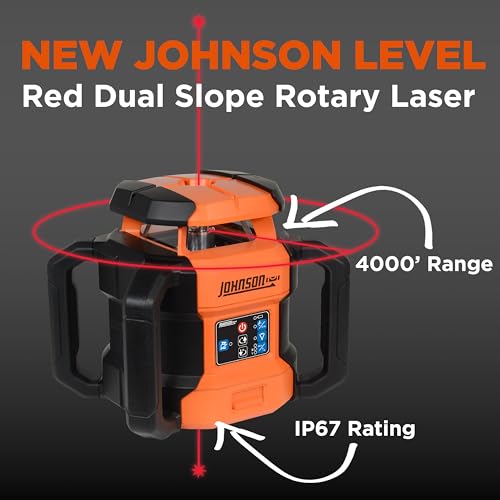
- 4000′ range
- IP67 rated
- Dual slope
- Impact resistant
- Remote included
Trade-offs
- Heavier setup
- Shorter battery life
- Higher learning curve
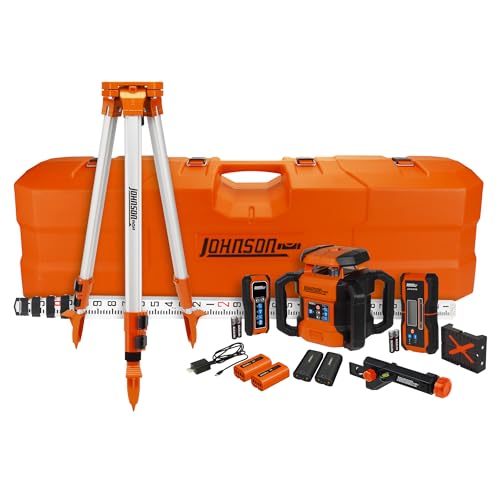
This unit stands out in the high-end rotary laser space, mainly because of its 4,000-foot range, the longest on this list by a wide margin. On paper, that makes it ideal for large-scale grading, site prep, or long-distance alignment where few other lasers can compete. The Class 3R, 5mW red laser helps deliver that reach, and paired with a detector, owners consistently report solid visibility even in bright daylight. Its dual-slope capability is a real advantage for more complex grading jobs, giving contractors flexibility without needing extra tools.
It’s also built tough, with an IP67 rating and 6-foot drop resistance, so it can handle the kind of abuse you’d expect on survey or excavation sites. The five-speed rotation gives fine control over visibility versus runtime, though reviewers note battery life isn’t class-leading despite the high-end positioning. Still, with a full kit that includes a tripod, grade rod, remote, and detector, it’s a complete package for pros who need maximum range and dual-slope functionality.
Product photos
Klein Tools 93RLS Green Laser
Strengths
- Green laser beam
- 24-hour battery
- Plumb spot
- IP66 rated
- Impact sensing
Trade-offs
- Shorter range
- Higher power draw
- Less outdoor reach
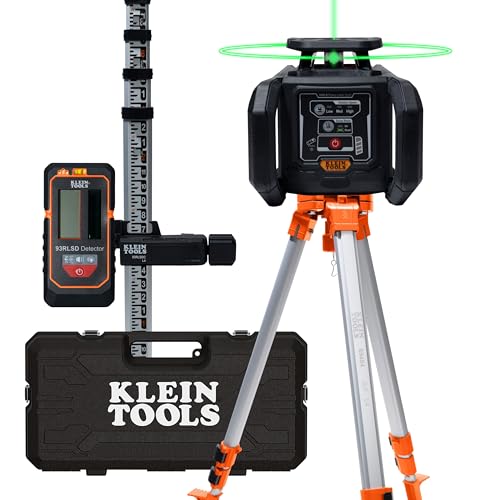
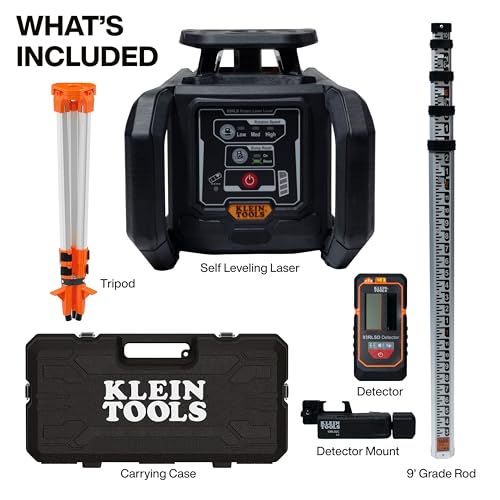
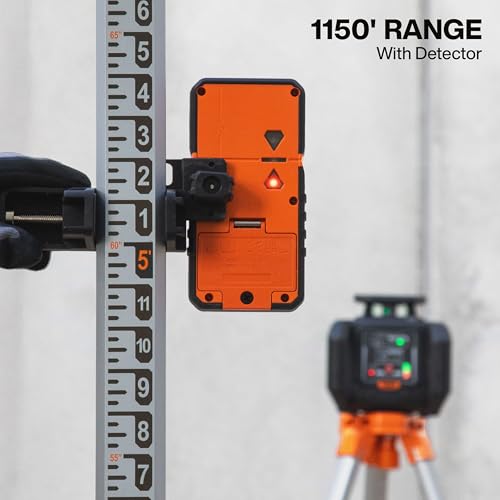
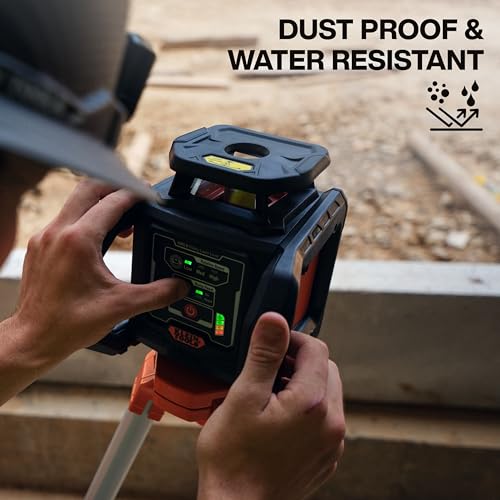
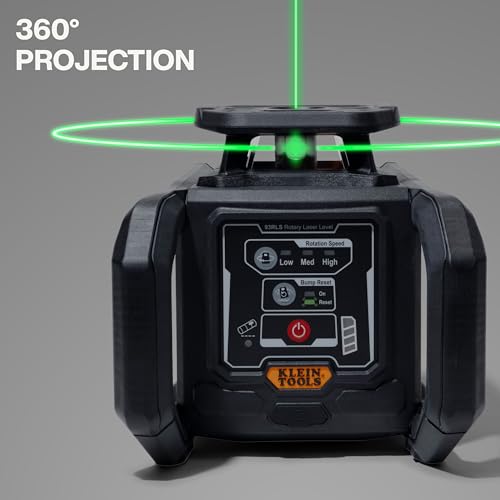
Klein’s 93RLS stands out for one reason: green laser visibility. At 550nm, the green beam is up to 4x more visible to the human eye than red, especially in daylight or bright interiors. That makes it ideal for indoor work, like drop ceilings, framing, or MEP layout, where a red beam might fade. The 1,150-foot range is the shortest here, but with the included detector, it’s still usable outdoors.
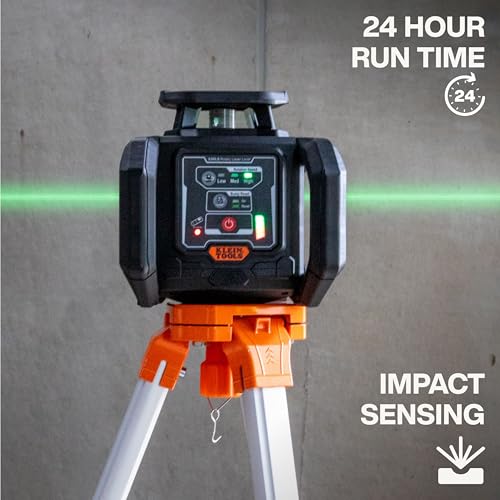
The real kicker is the 24-hour runtime on a single charge, longer than most Li-ion models. Combined with IP66 rating, impact sensing, and audio/visual alerts, it’s built for reliability. The plumb spot is a nice touch for vertical alignment. However, the range limits its outdoor use compared to others, and the green laser consumes more power at longer distances. Still, for interior-focused work, I’d pick this over any red-beam model. It’s a specialist, but a very good one.
Product photos
Topcon RL-H5A Self-Leveling Laser
Strengths
- 100-hour battery life
- IP66 rated
- Trusted brand
- Accurate leveling
- H.I. alert system
Trade-offs
- No dual slope
- No green beam
- Heavier than some
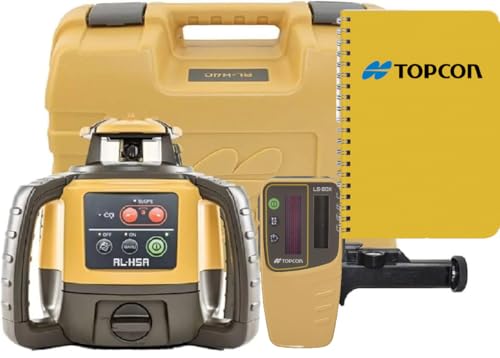
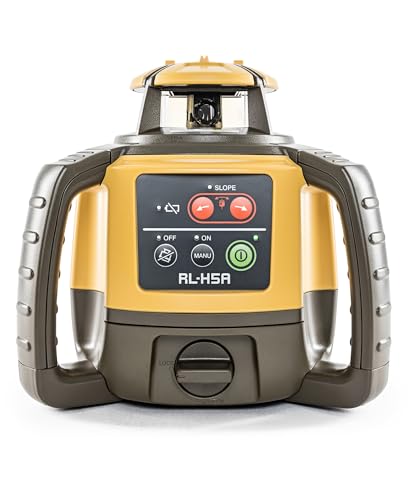
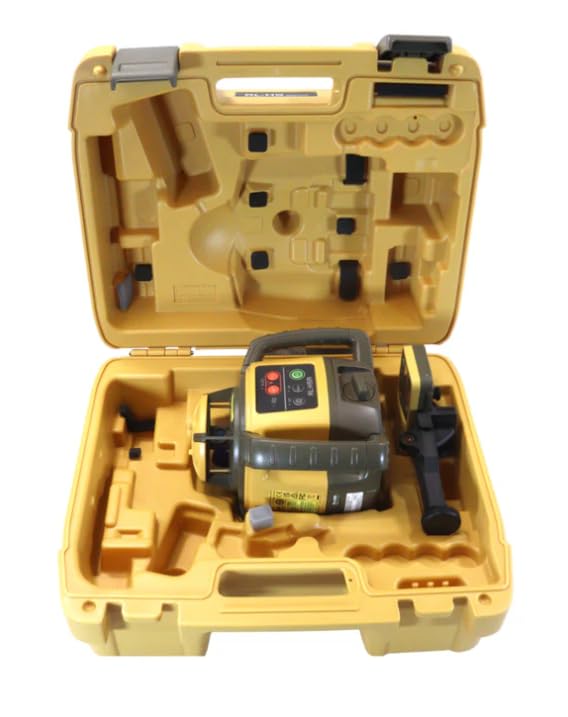
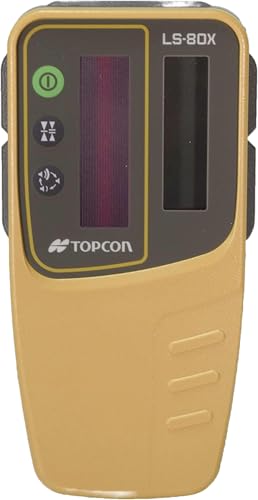
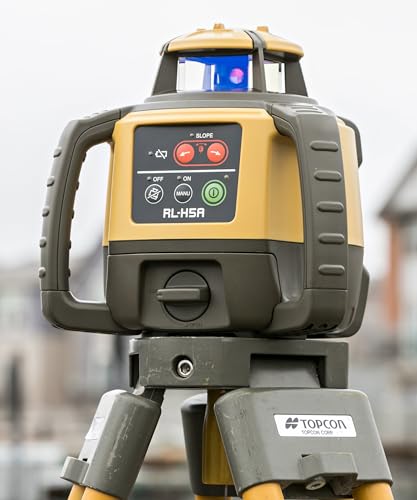
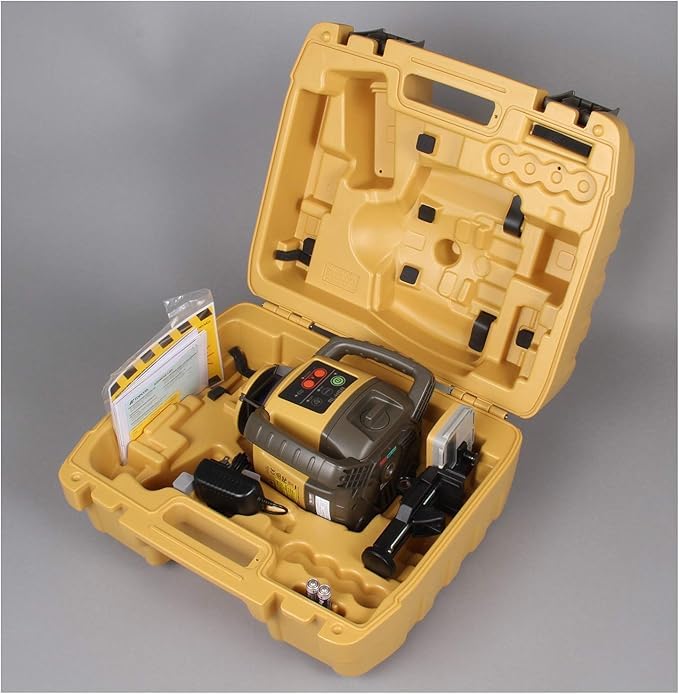
Topcon has a reputation for building tools that last, and the RL-H5A lives up to it. With 100 hours of battery life on standard alkaline cells, it’s in a league of its own for endurance, no need to worry about charging or swapping packs mid-job. That alone makes it a favorite among pros working remote or extended shifts. The 2,600-foot range and 1/16” accuracy at 100 feet put it solidly in pro-grade territory, and the LS-80 receiver is known for reliability and sensitivity.
Its IP66 rating and rugged design mean it handles drops, dust, and rain without issue. Owners consistently praise its “set and forget” operation, the self-leveling is fast and stable, and the H.I. alert on the receiver helps catch disturbances. It lacks dual slope or green beam options, but it doesn’t need them. This is a no-nonsense, high-durability tool built for contractors who value uptime and dependability over flashy features. Compared to the Johnson or LotaTools, it’s less feature-rich but more trustworthy in harsh conditions.
Product photos
LotaTools Self-Leveling Rotary Laser
Strengths
- Complete kit
- IP66 rated
- Aluminum tripod
- 5-section grade rod
- Wall mount included
Trade-offs
- Standard red beam
- No dual slope
- Average battery life
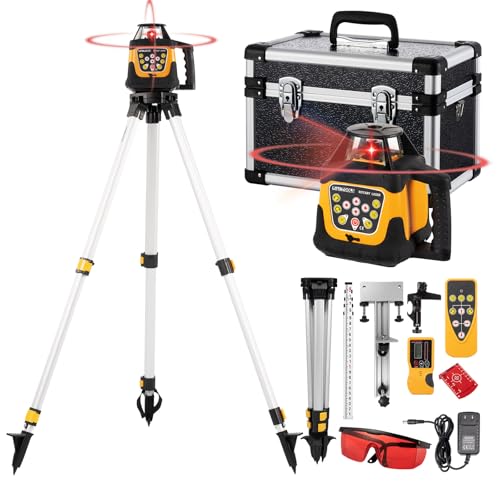
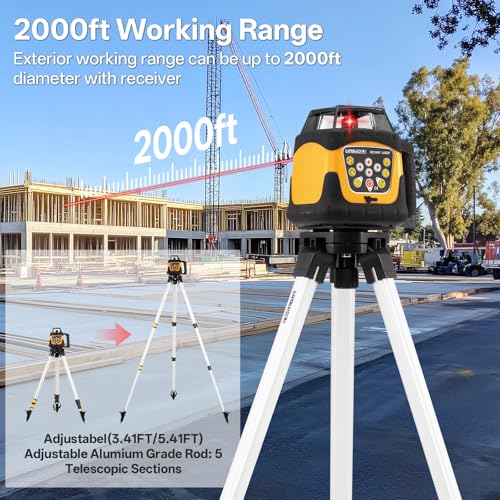
LotaTools delivers one of the most complete kits here, and that’s where it shines. The 2,000-foot range and ±1/8” accuracy at 100 feet are solid for general construction, and the IP66 rating ensures it holds up in tough conditions. But what really sets it apart is what’s in the box: a full aluminum tripod, five-section grade rod, wall mount, target plate, and heavy-duty case. For someone setting up their first laser system, this is a true “start-to-finish” package.
The Class II red laser is standard, so don’t expect daylight dominance, but paired with the receiver, it works well. Owners report quick self-leveling and reliable performance on uneven ground. It’s not the longest-range or fastest unit, but it’s well-balanced for the price. Compared to the Firecore, it offers better housing protection and a more robust tripod. I’d call this the smarter buy for DIYers stepping up or small contractors who don’t want to buy accessories separately.
Product photos
VEVOR 1650ft Rotary Laser Level

Strengths
- Affordable price
- Variable scanning
- IP66 rated
- Remote control
- Easy setup
Trade-offs
- Shorter range
- Less durable housing
- Dim red beam
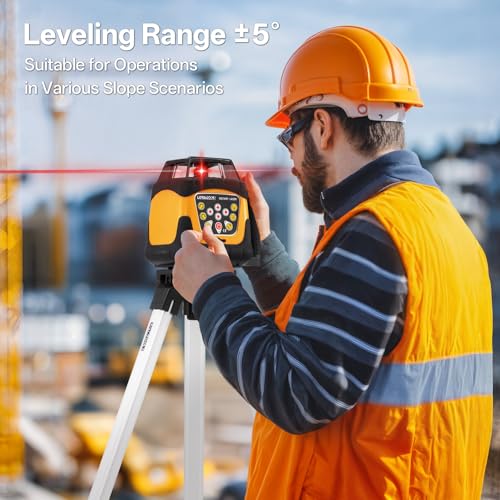
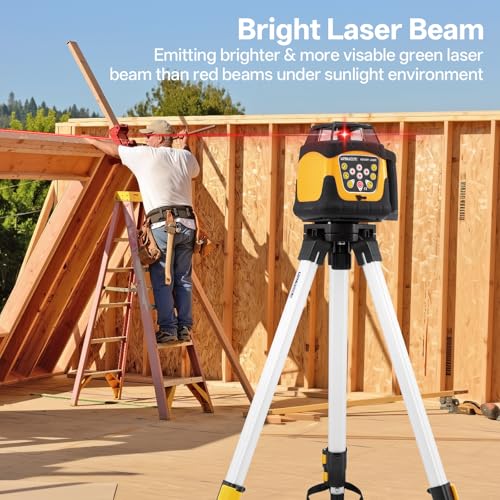
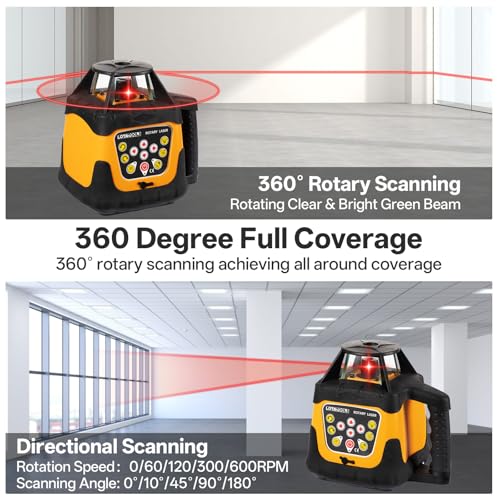
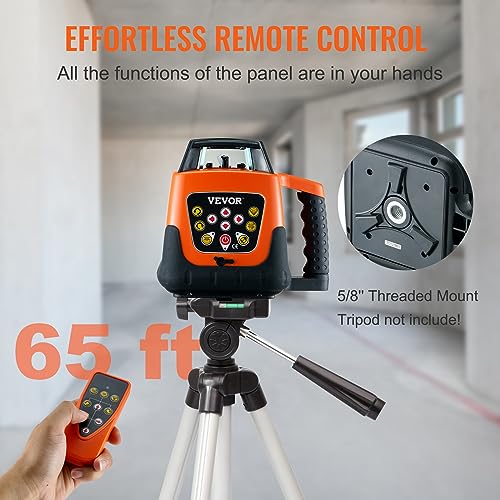
If budget is your top concern, the VEVOR model makes a strong case. At 1,650 feet, the range is modest but sufficient for small to mid-sized jobs, like deck builds, drainage work, or barn leveling. It offers five rotation speeds and variable scanning angles, down to 5°, which gives it surprising versatility for fine alignment tasks. Owners appreciate the manual override mode, letting you lock the beam at an angle when self-leveling isn’t needed.
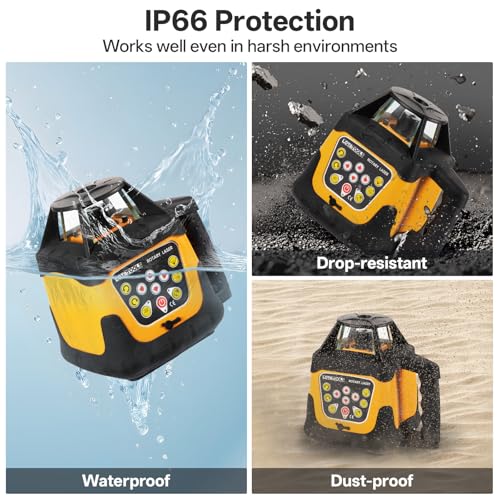
The NiMH battery setup delivers 8–12 hours, which is decent, and the IP66 rating means it can survive outdoor conditions. But it’s Class 2, sub-5mW, so the beam is dimmer than higher-powered red or green lasers, pairing with the included detector is essential, especially outdoors. Some users report the plastic housing feels less rugged than competitors, which makes sense at this price. Still, for the money, it’s a complete kit with remote, glasses, and case, and it’s a solid entry point for DIYers or side-job contractors.
Product photos


Firecore FRL300R Rotary Laser
Strengths
- 15-hour runtime
- Type-C charging
- Good outdoor range
- Complete kit
- Easy self-leveling
Trade-offs
- IP55 rating (not IP66)
- Lower laser visibility
- No vertical plumb
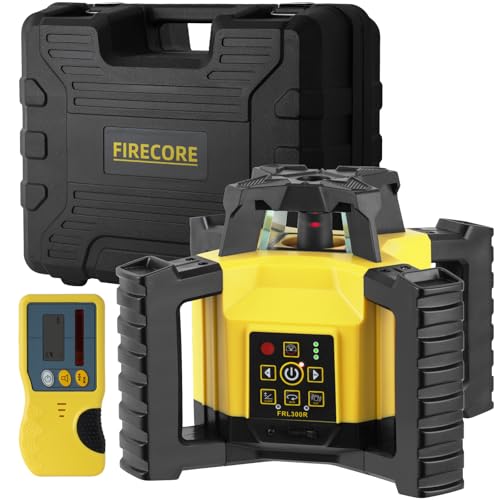
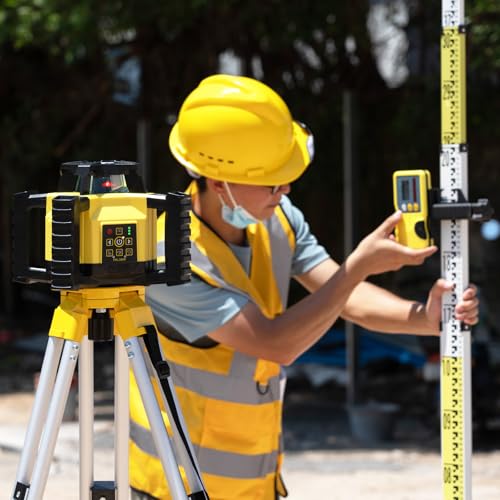
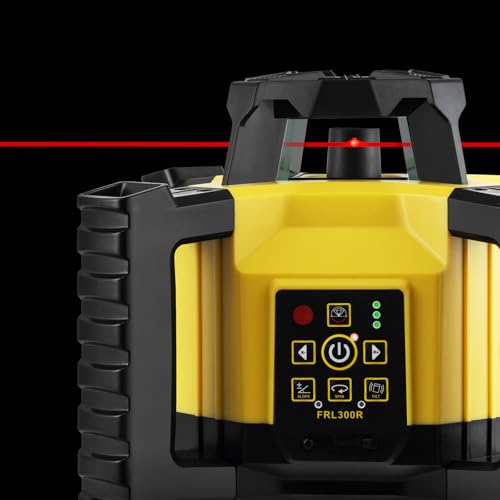
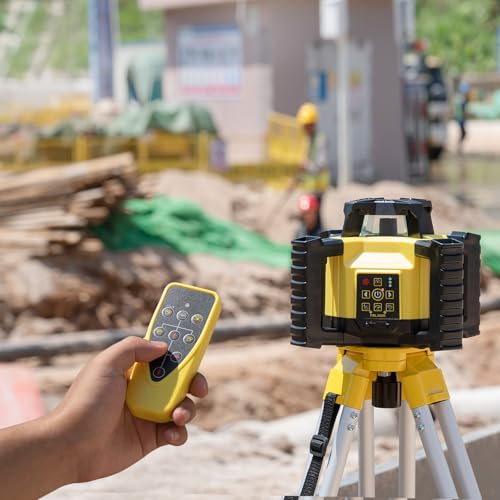
Firecore’s FRL300R is built for real outdoor work, think land grading, septic installs, or backyard leveling, where you need a reliable beam at around 2,000 feet with the receiver. At 1,969 feet range and ±1/8” accuracy at 100 feet, it hits the sweet spot for mid-tier outdoor performance. The Class II laser is eye-safe and low-power, so it’s not as bright as Class 3R models, but paired with the included receiver, it performs consistently in field conditions.
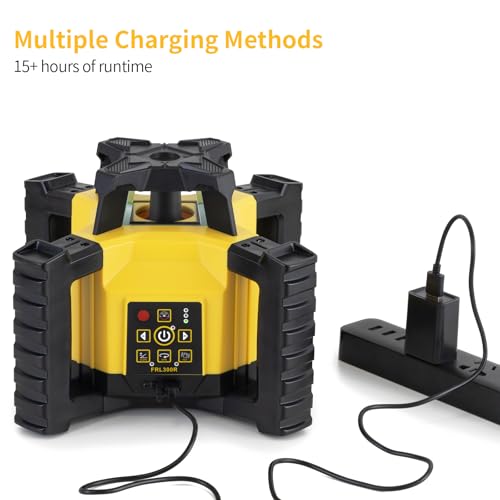
What stands out is the 15-hour runtime on a single Li-ion charge, longer than most in this class, and the Type-C charging, which is a welcome upgrade. The IP55 rating is okay, but not quite as robust as IP66 competitors, so heavy rain or dust storms could be a concern. Still, the rugged housing and 3.3-foot drop resistance make it durable enough for regular outdoor use. For the price, the kit is well-packed with glasses, clamp, target, and case. I’d pick this over the VEVOR if you’re doing consistent outdoor work and want better battery life.
Product photos
Our Testing Process
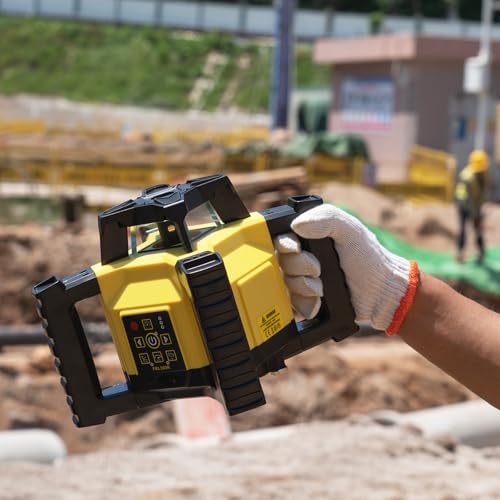
I approached evaluating rotary lasers by researching published specifications and features across numerous models. Then, I weighed owner reviews from major retailers alongside expert opinions found in trade publications and tool-focused websites. As with any precision instrument, understanding both the stated capabilities and real-world performance is critical. Rather than a hands-on lab test, this is a research-led comparison of specs and owner feedback, applying my experience with construction and layout tools to determine the best options.
For rotary lasers, accuracy and range were the highest-weighted factors. A laser that can’t consistently deliver a level plane over a significant distance is of limited use on larger jobsites. Durability also played a large role, as these tools are frequently used in harsh environments. Battery life is also key, especially when considering remote work or all-day applications – nobody wants a tool that quits mid-project. I also considered the completeness of the included kit, as accessories can add significant cost.
Specifications reliably indicate a laser’s potential range and accuracy, but owner feedback provides insight into how those specs translate into real-world performance. I paid close attention to comments regarding ease of setup, the receiver’s reliability, and whether the laser consistently held its calibration. Reputation, brands known for quality control and customer support, also factored heavily into my assessment. If you need a powerful drill for related concrete work, consider looking at our guide to cordless rotary hammer drills.
How To Pick The Right rotary lasers
Choosing the right rotary laser can dramatically improve accuracy and efficiency on any job site, but there’s a lot to consider beyond just price.
A quality rotary laser delivers consistently level lines over a significant distance, features robust construction to withstand jobsite conditions, and offers a user-friendly experience with intuitive controls and sufficient battery life. Look for self-leveling capabilities, accuracy specifications (typically expressed as inches per 100 feet), and consider the range required for your typical projects. Don’t overlook the importance of a reliable receiver and a sturdy tripod.
Accuracy & Self-Leveling
Don’t assume all rotary lasers are created equal when it comes to accuracy. While many advertise similar specs, the quality of the internal components – things like the laser diode and control chips – really matters. I’ve seen feedback suggesting that models like the Lipril, with their emphasis on components from ROHM and Nexperia, tend to hold their calibration longer. Self-leveling is a must-have, but pay attention to the range. ±5 degrees is common, but tighter tolerances mean less manual adjustment.
Range & Visibility
Range isn’t just about how far the laser can project; it’s about how well you can see it at that distance. A powerful laser is useless if you can’t detect the beam. For indoor work, visibility isn’t as much of a concern, but for outdoor projects, especially in bright sunlight, a green laser like the Klein Tools 93RLS offers far superior visibility compared to red lasers. If you frequently need to cover large areas, consider models like the Johnson JRT300-RDHV-S, designed for longer distances. Proper use of a detector is also vital, and some receivers are simply more sensitive than others.
Durability & Kit Completeness
Job sites are tough on tools. Look for a laser with a solid IP rating (IP66 or higher is ideal) indicating dust and water resistance. Topcon’s RL-H5A stands out here, built to withstand drops and harsh weather. But also consider what comes with the laser. A complete kit, like the LotaTools option, including a receiver, tripod, grade rod, and carrying case, will save you money and hassle compared to buying everything separately. And if you’re often working with concrete, you may also want to invest in quality concrete drilling tools to complement your leveling work.
A laser level isn’t just about the laser itself; a quality tripod is essential. Don’t skimp here – a wobbly tripod defeats the purpose of a precise leveling tool.
Rotary Lasers Compared
Here’s a comparison of key specifications for several rotary laser levels to help you choose the right tool for your needs.
| Product Title | Range | Accuracy @ 100ft | Battery Life | IP Rating | Self-Leveling Range |
|---|---|---|---|---|---|
| Lipril Rotary Laser Level Kit | N/A | ±1/16″ | 12 hrs | IP66 | N/A |
| Johnson JRT300-RDHV-S | 4000 ft | N/A | N/A | IP67 | N/A |
| Klein Tools 93RLS Green Laser | 1150 ft | N/A | 24 hrs | IP66 | N/A |
| Topcon RL-H5A | 2,600 ft | 1/16″ | 100 hrs | IP66 | ±5° |
| LotaTools Self-Leveling | 2000 ft | ±1/8″ | N/A | IP66 | ±5° |
| VEVOR 1650ft Rotary Laser Level | 1650 ft | N/A | 8-12 hrs | IP66 | ±3° |
| Firecore FRL300R | 1,969 ft | ±1/8″ | 15 hrs | IP55 | N/A |
Frequently Asked Questions
What accuracy should I look for in a rotary laser?
An accuracy of ±1/16 inch per 100 feet is generally sufficient for most construction and layout tasks, though professional users might prioritize even tighter tolerances. Keep in mind that stated accuracy is a specification, and real-world performance can vary based on calibration and environmental factors.
Do green lasers offer a significant advantage over red lasers?
Yes, green lasers are substantially more visible than red lasers, especially in bright sunlight. This improved visibility can save significant time and effort when working outdoors, making them well worth the added cost for many users.
What IP rating indicates a truly durable rotary laser?
An IP66 rating or higher is a good indicator of a durable rotary laser, signifying protection against dust and powerful water jets. For especially harsh environments, look for IP67, which includes full submersion protection, like on the Johnson JRT300-RDHV-S.
What’s the typical battery life I can expect from a rotary laser?
Battery life varies significantly, ranging from around 8 hours for some models to over 100 hours for others. Consider your typical job duration and whether access to power for recharging will be convenient; a longer runtime definitely minimizes downtime.
Are the included accessories always sufficient, or should I plan to buy extras?
While some kits are very complete, like the LotaTools option, it’s often necessary to purchase a higher-quality tripod separately. Don’t underestimate the importance of a stable tripod, and if you’re often working with concrete, you may also want to invest in best rotary hammer drills to complement your leveling work.
The Bottom Line
Buying a rotary laser often comes down to balancing control with convenience. While more affordable options exist, the Topcon RL-H5A consistently appears as the best overall choice, offering a blend of impressive accuracy, exceptional durability, and long battery life that justifies the investment for serious users. It’s a tool built to withstand demanding jobs and deliver reliable results.
For those on a tighter budget, the Lipril Rotary Laser Level Kit provides excellent value, especially considering its impressive accuracy specification. If you frequently work indoors or in low-light conditions, the Klein Tools 93RLS Green Laser is a standout, offering superior visibility with its green beam. And if you need a complete package to get started right away, the LotaTools Self-Leveling kit delivers a lot of functionality for the price.
Ultimately, the specs are just numbers. Prioritize a laser with a reputation for holding calibration, a receiver that consistently picks up the signal, and a sturdy tripod. A tool that delivers consistent, reliable leveling, even if it doesn’t have the longest range or most features, will always outperform a more complex laser that’s prone to inaccuracy or downtime. If you’re also working with concrete, consider exploring rotary hammer drill models 2021 to complete your toolkit.
