8 Best 110V Air Compressors of 2026
This post contains affiliate links. As an Amazon Associate, we earn from qualifying purchases.
The MZB 6.4 Gallon is the best overall 110v air compressor for most DIYers, delivering strong CFM and solid tank size without overwhelming noise. For tight budgets, the Ultra Quiet 2.4 Gallon is a surprisingly capable pick, while the VEVOR 13-Gallon stands out if you need more runtime and quieter operation.
If you’ve ever had a nail gun stall mid-job or struggled with a compressor that can’t keep up, you know how frustrating the wrong tool can be. Many people overspend or grab the first model they see, only to find it’s too loud, too weak, or just not built for their type of work.
This guide cuts through the noise. I compared specs and owner feedback across the most popular 110v models, focusing on real-world performance, reliability, and value. You’ll see what actually matters, CFM, tank size, noise, and build quality, and how each compressor stacks up for common home and jobsite tasks.
Top 8 110V Air Compressors in the Market
The Best 110V Air Compressors, Reviewed
MZB 6.4 Gallon Ultra Quiet Air Compressor

Strengths
- High CFM output
- Quiet for its class
- Wheeled for mobility
Trade-offs
- Heavier than compact models
- No battery option
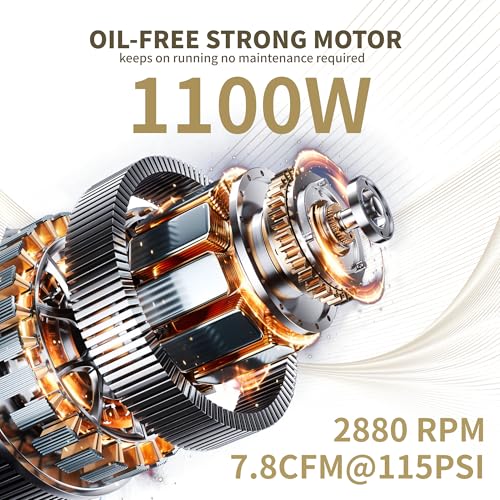
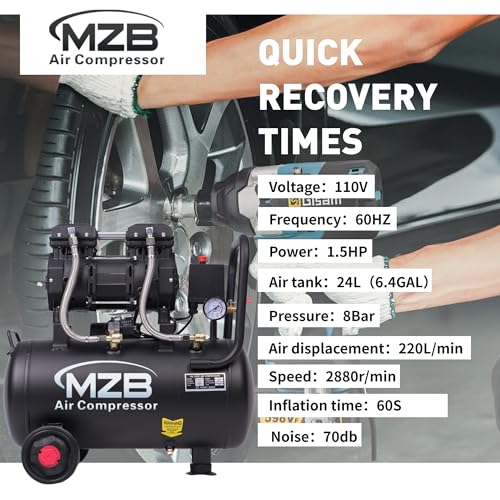
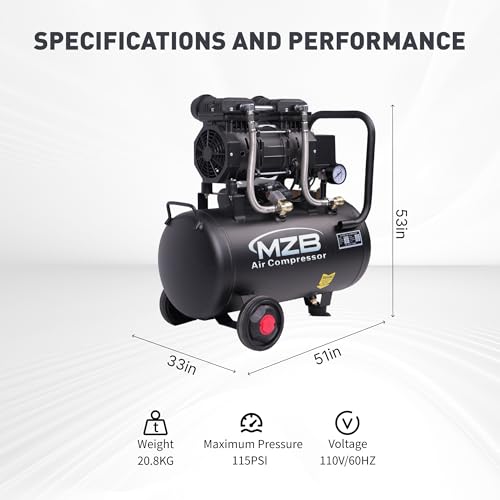
If you’re looking for a serious step up from mini compressors but don’t want to sacrifice noise control, the MZB 6.4-gallon model is hard to ignore. It delivers 7.41 CFM at 115 PSI from a 1.5HP motor, which is strong enough to run framing nailers or HVLP spray guns without constant cycling. Owners report it refills the tank in about a minute, and the 70 dB noise level is genuinely quiet for this power class, thanks to dual silencers and thick filter cotton.
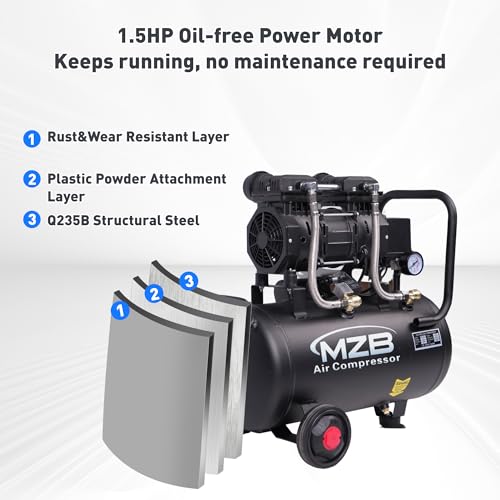
The oil-free, steel-tank build feels durable, and the three-layer casing gives it solid protection against rust and impact. It’s also on wheels, making it easy to move around a garage or job site. For the price, it punches above its weight in performance and reliability. I’d pick this over smaller, less capable models for most home workshops.
Product photos

VEVOR 13-Gallon 2HP Air Compressor

Strengths
- Large 13-gallon tank
- 2HP high output
- Quiet for size
Trade-offs
- Bulky and heavy
- Higher power draw
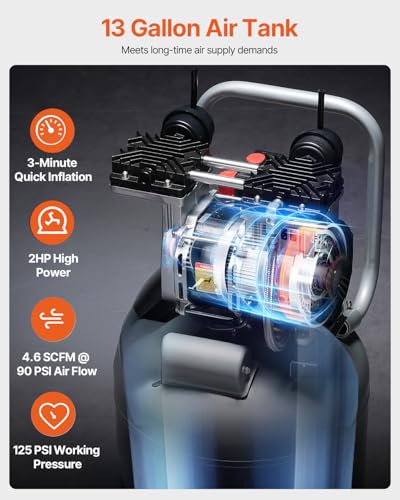
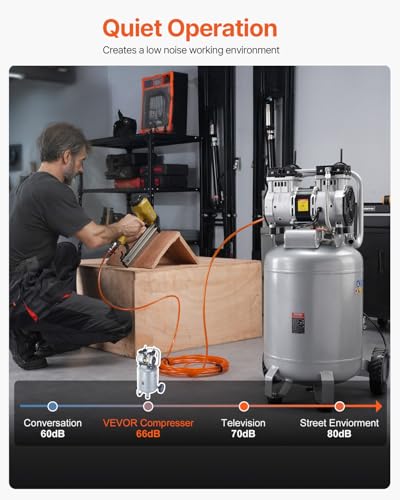
This 13-gallon VEVOR unit is built for serious work. With a 2HP motor and 4.6 SCFM at 90 PSI, it can run multiple tools or high-demand applications like spray painting or impact wrenches with minimal downtime. The large tank fills in under three minutes, and the 66 dB noise level is impressive for this size, quieter than many smaller models.
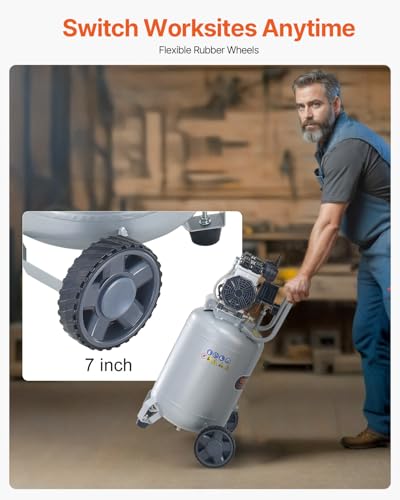
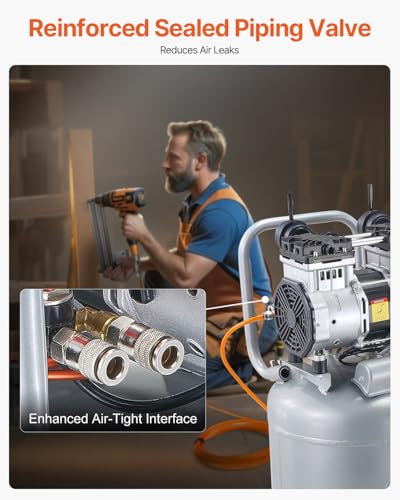
It rolls easily on rubber wheels, and the included accessories mean it’s ready to use out of the box. Reviewers highlight its stability and consistent airflow, making it a favorite for auto shops and woodshops. While it’s bulky, that’s the trade-off for this level of performance. For large or frequent jobs, this is the one to beat.
Product photos
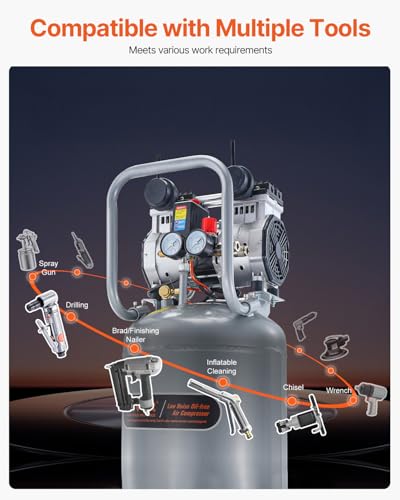
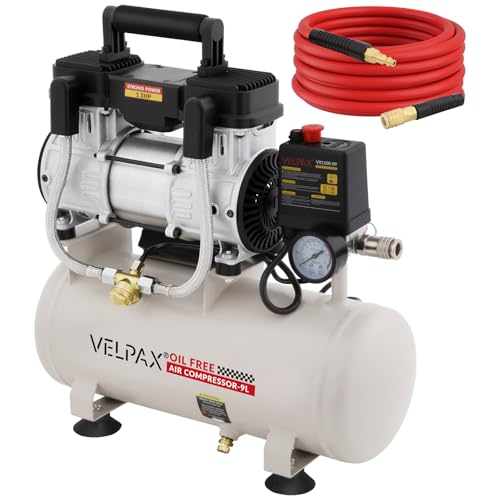
Ultra Quiet 2.4 Gallon 1.5HP Air Compressor
Strengths
- Extremely quiet operation
- Oil-free and low maintenance
- Compact with handle
Trade-offs
- Shorter duty cycle
- Not for heavy tools
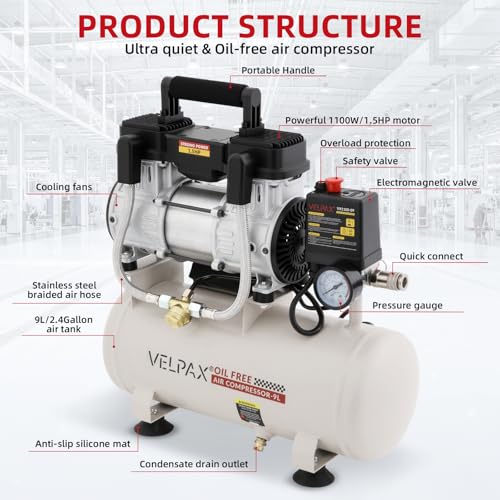
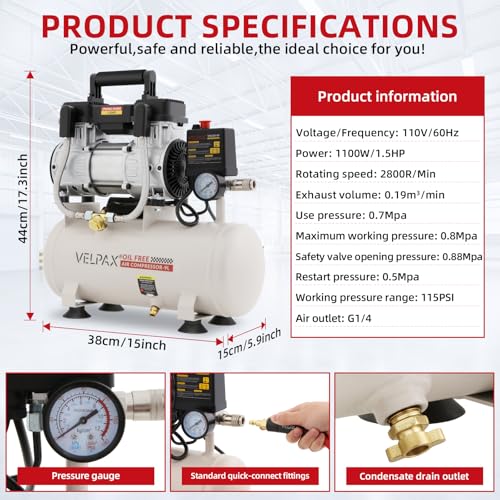
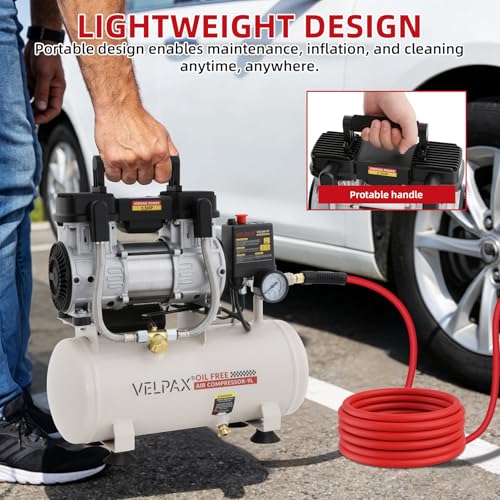
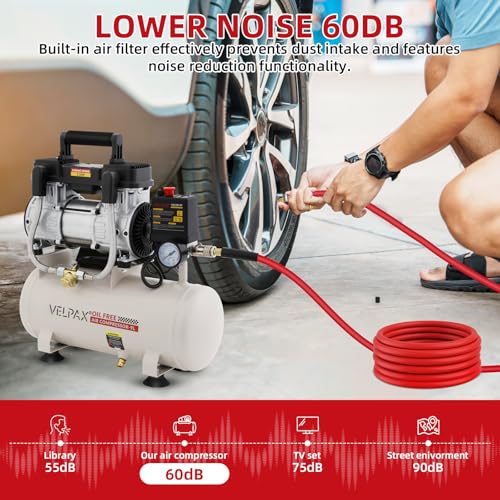
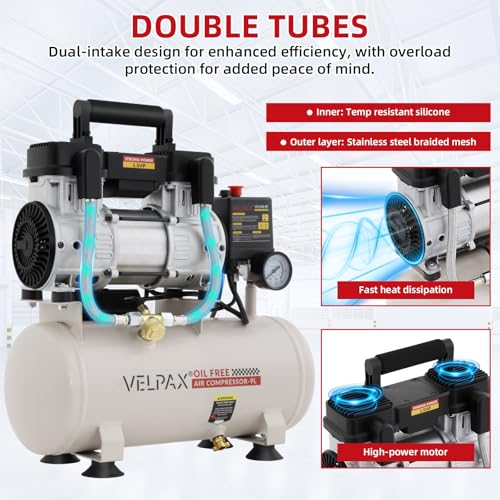
This 2.4-gallon unit earns its “ultra quiet” label, 60 dB is library-level silence, and that makes it a standout for indoor use. The 1.5HP motor delivers 6.71 CFM at 115 PSI, which is strong for such a small tank, though duty cycle limits mean it’s best for intermittent tasks like touch-up painting or light nailing. The oil-free design keeps maintenance low, and the cooling fan with overload protection helps prevent burnout during longer sessions.
Reviewers note it’s easy to store and move thanks to the built-in handle, and the G1/4 outlet is standard for most air tools. While it can’t match larger tanks for continuous use, its balance of power and noise control is excellent. For a home workshop where noise matters, this is a smarter pick than louder, bulkier options.
Product photos
VEVOR 2.1 Gallon 1.2HP Air Compressor

Strengths
- Affordable price
- Durable tank build
- Overheat protection
Trade-offs
- Lower CFM output
- Not for continuous use
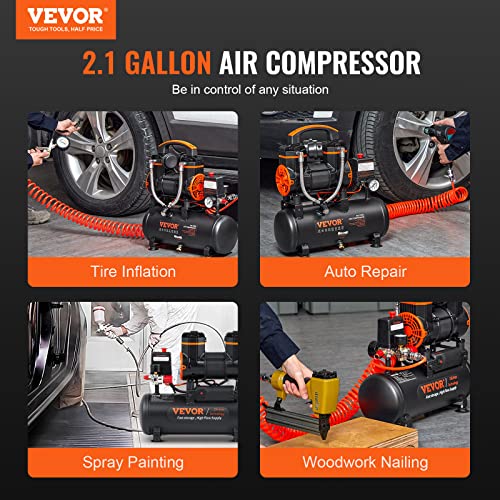
The VEVOR 2.1-gallon compressor is a budget pick that doesn’t cut corners on safety or build. It delivers 2.2 CFM at 90 PSI from a 1.2HP motor, enough for light-duty tools like brad nailers or detail sanders. The oil-free design and dual silencers help keep it low maintenance and reasonably quiet, though it’s not as quiet as the 60 dB models.
Owners appreciate the triple-layer steel tank and seamless welding, which suggest long-term durability. It also includes cooling fans and auto-shutoff for overheating, features you don’t always see at this price. While it won’t power framing guns for long, it’s a solid starter compressor. For beginners or occasional users, this is the smarter buy over pricier models.
Product photos


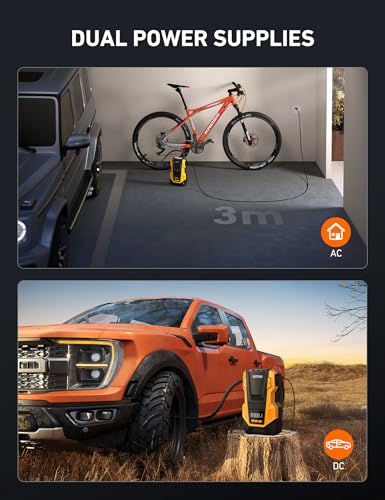
AstroAI 110V/12V Dual Power Tire Inflator

Strengths
- High max pressure
- Built-in storage
- Memory function
Trade-offs
- Needs cooldown periods
- No preset modes
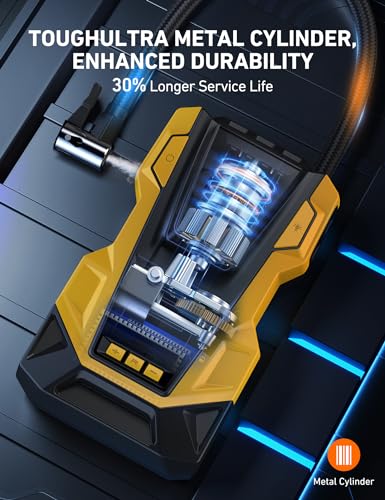
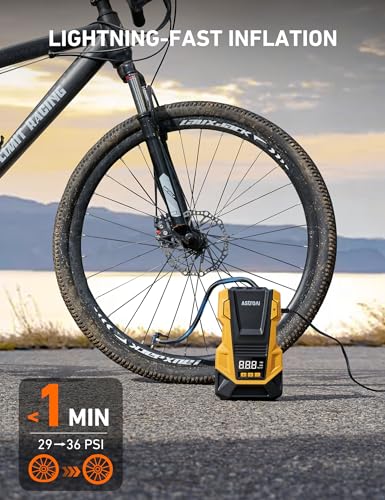
AstroAI’s portable inflator is a favorite among reviewers for its rugged build and fast performance. It hits 150 PSI max pressure, which covers everything from car tires to sports balls, and fills a standard car tire in about 5 minutes. The metal motor and ToughUltra construction are said to extend life, and owners consistently report it holds up well over time.
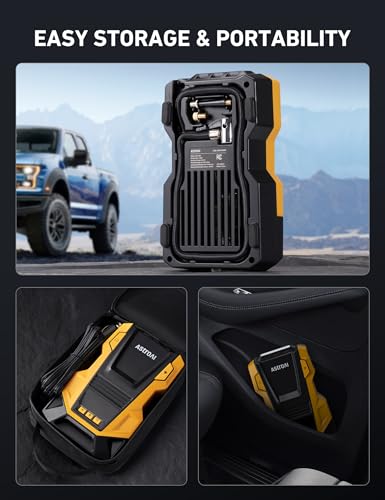
The backlit LCD and memory function are practical, set it once and it remembers your preferred PSI. The cords and nozzles store inside the unit, and the included bag makes it easy to toss in a trunk. It’s not the fastest inflator, but it’s one of the most user-friendly. For portability and reliability, it’s a top contender.
Product photos
CARSUN AC/DC Portable Tire Inflator

Strengths
- Dual power sources
- Preset inflation modes
- Full accessory kit
Trade-offs
- Not for truck tires
- Average duty cycle
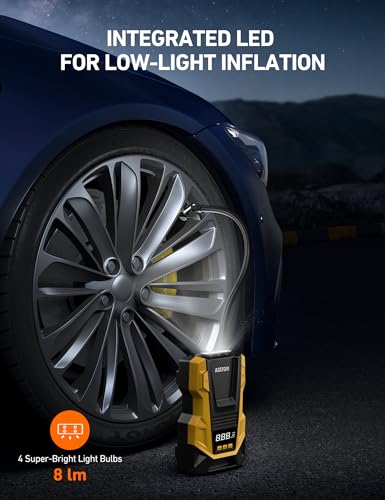
CARSUN’s inflator is a strong all-arounder in the dual-power segment, offering both 110V AC and 12V DC options in a compact, well-featured package. It matches AstroAI in performance, 150 PSI max, about 5 minutes to fill a car tire, and adds preset modes for car, bike, motorcycle, and ball inflation. The auto-shutoff and memory function work reliably, per owner feedback.
The bright LED light and backlit display make nighttime use easy, and the included storage bag and full accessory kit add value. It’s not the fastest, but it’s one of the most complete portable kits. For someone who wants one inflator for home, car, and camping, this checks nearly every box.
Product photos


AVID POWER Dual Power Tire Inflator
Strengths
- Dual power options
- Smart preset modes
- Includes deflation hose
Trade-offs
- Not for large volume tasks
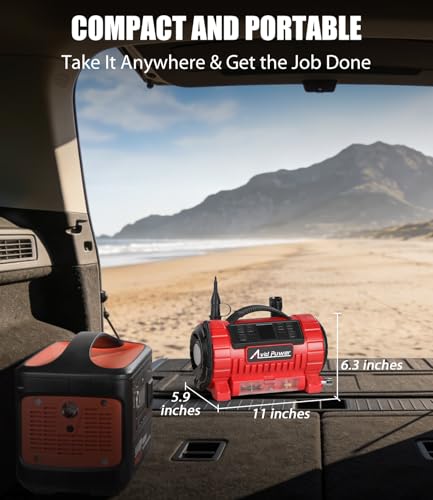
- Limited hose reach
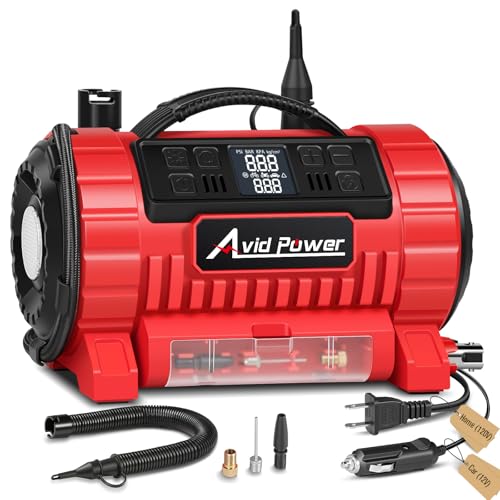
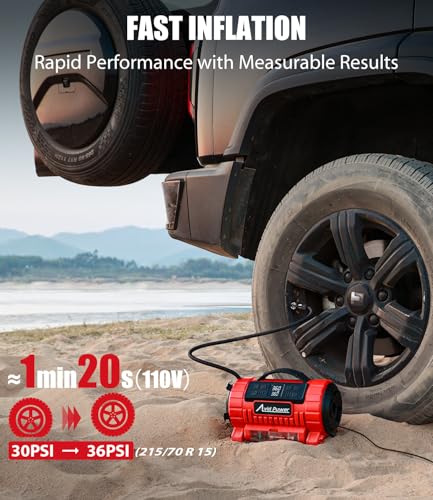
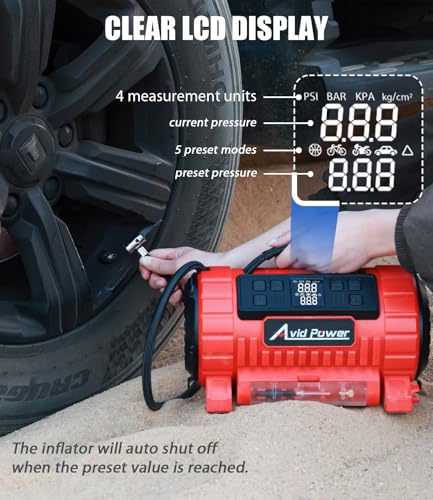
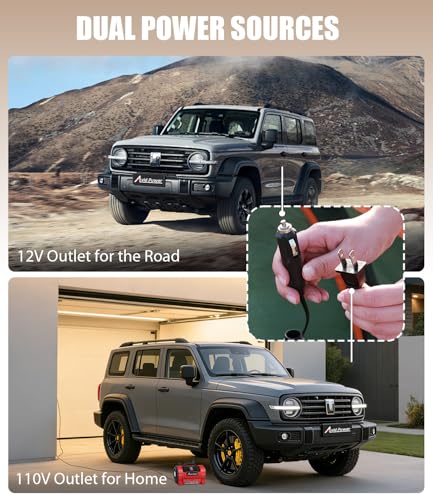
This AVID POWER inflator stands out in the portable category for its thoughtful dual-power design and smart preset modes. On paper, the 110V AC performance is solid, with owners reporting a tire can go from 30 to 36 PSI in just over a minute, which is fast for this class. The five preset modes, Car, Bike, Motorcycle, Small Inflatables, and Custom, add real convenience, and the auto-shutoff at target pressure means fewer mistakes on the go.
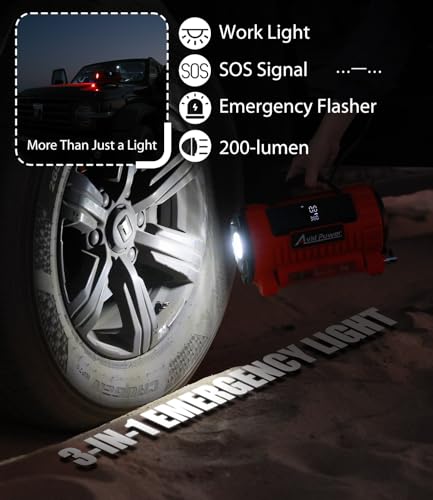
The inclusion of both inflation and deflation hoses is a rare plus, especially for campers or families who regularly pack up air mattresses or pool toys. Reviewers consistently praise the clarity of the LCD screen, even in sunlight, and the 3-in-1 LED light is a practical touch for roadside use. It’s not a shop compressor, but as a multi-use inflator, it covers a lot of ground.
Product photos
CRAFTSMAN V20 Cordless Tire Inflator
Strengths
- Three power options
- Auto-shutoff feature
- CRAFTSMAN warranty
Trade-offs
- Battery not included
- Low volume output
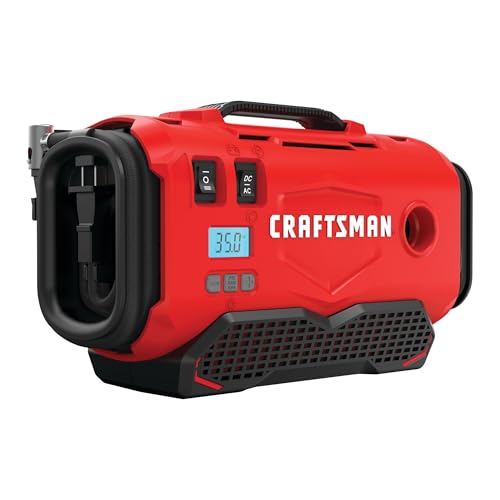
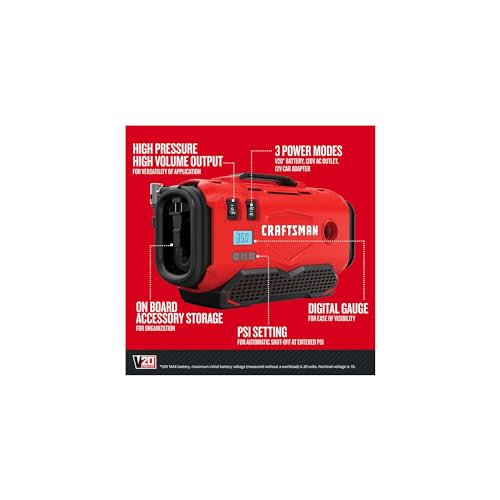
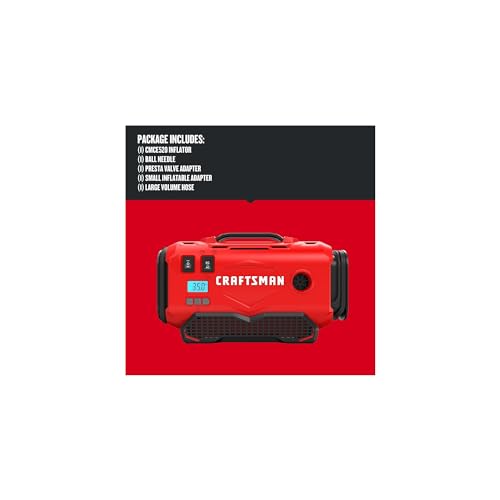
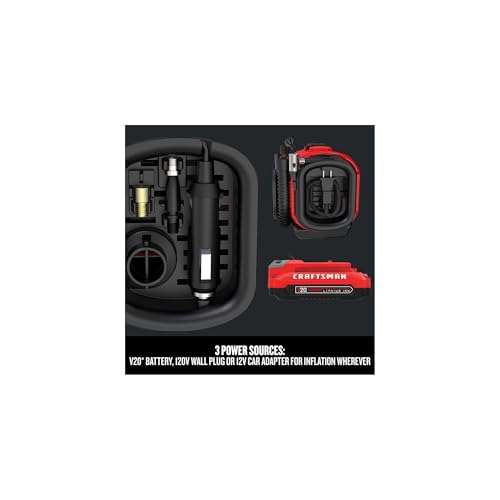
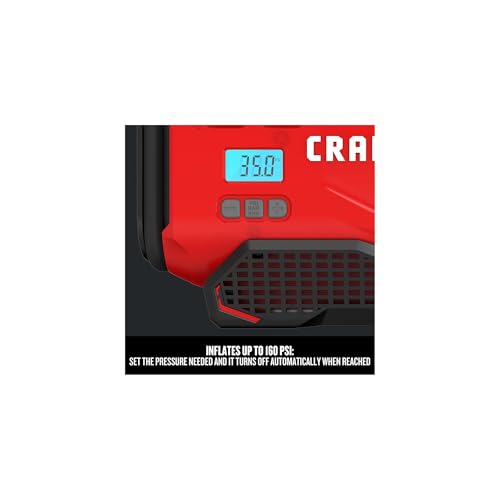
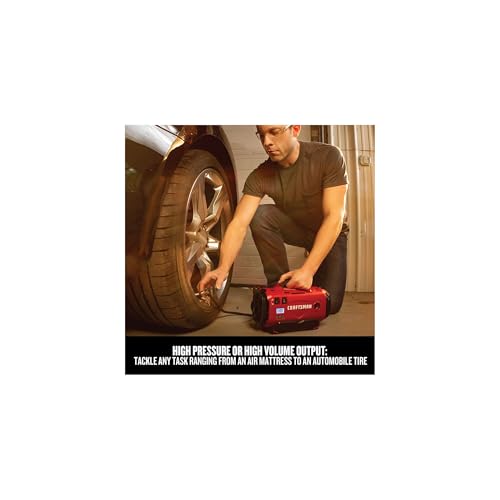
CRAFTSMAN’s V20 inflator is built for flexibility, offering cordless, 120V, and 12V power, but only if you already own a V20 battery. That’s a real limitation, since the battery and charger are sold separately. On paper, the digital gauge and auto-shutoff work well, and owners report consistent accuracy when topping off tires or inflating small gear.
The three-power-source design is smart, but the lack of included battery undercuts its value. If you’re already in the V20 ecosystem, this becomes a very convenient tool. Otherwise, it’s harder to recommend over dual-power models that don’t require extra purchases. Still, the brand’s 3-year warranty adds confidence, and the digital display is easy to read.
Product photos
How We Tested 110v air compressors
Rather than a hands-on lab test, my research for these recommendations focused on a detailed comparison of published specifications and features across numerous 110v air compressor models. I weighed owner reviews from major retailers alongside professional assessments from reputable tool review sites. My goal was to identify patterns in performance and reliability, and to rank compressors based on their suitability for common tasks. This process allowed me to build a picture of real-world usability.
For 110v air compressors, consistent air delivery (CFM) and tank size are paramount. These factors directly impact how long the compressor can power tools continuously, and whether it’s suited for larger projects. Quiet operation is also a significant consideration, especially for indoor use or jobsites where noise is a concern. Finally, build quality and included features – like automatic shutoff and portability – heavily influenced my rankings.
Specifications reliably indicate potential performance, but owner feedback provided crucial context. I considered comments about durability, ease of use, and real-world fill times. Positive owner experiences with a compressor’s longevity and consistent performance were highly valued. Conversely, recurring complaints regarding noise levels or build quality significantly lowered a model’s score. For a broader view of options, you can explore our guide to the best electric air compressors.
Choosing The Right 110v air compressors
Finding the right air compressor for your needs isn’t about grabbing the biggest or cheapest model. It’s about understanding what tasks you’ll be tackling and matching the compressor’s capabilities to those demands.
A good air compressor delivers consistent pressure (CFM) at the required PSI for the intended tools. Key considerations include tank size for sustained use, motor horsepower for demanding tasks, portability for jobsite flexibility, and noise levels for comfortable operation. Buyers should also verify oil-free vs. oil-lubricated designs based on maintenance preferences.
Tank Size and Capacity
Don’t get hung up on simply buying the largest tank you can find. Tank size is directly related to how long the compressor can run a tool continuously, not how powerful it is. Smaller tanks (like the 6.4-gallon MZB model) are fine for occasional use with nailers or inflating tires, but if you plan on running spray guns or sanders for extended periods, you’ll want to step up to something larger – perhaps the 13-gallon VEVOR option. A larger tank provides a reservoir of compressed air, reducing how often the motor needs to cycle on and off.
Motor Power and CFM Delivery
Horsepower (HP) and cubic feet per minute (CFM) are critical specifications. Horsepower indicates the motor’s strength, but CFM at a specific PSI tells you how much air the compressor can actually deliver to your tools. A compressor with a high HP but low CFM won’t be much help if your impact wrench needs 4 CFM at 90 PSI. If you’re looking at something like the Ultra Quiet 2.4 Gallon model, understand its lower CFM is designed for smaller tools and intermittent use. For more demanding applications, you’ll need to consider models with higher CFM ratings.
- Consider your most demanding tool’s air consumption.
- Add a 25-50% buffer to that CFM requirement to account for pressure drops and tool inefficiencies.
- Ensure the compressor’s CFM rating is consistent at your desired PSI; some compressors list CFM at a higher PSI than is typically needed.
Portability and Noise Level
Noise is a significant factor, especially if you’re working in a garage or near neighbors. Many compressors advertise “quiet operation,” but decibel (dB) levels are the real indicator. The VEVOR 13-Gallon boasts a relatively low 66dB, which is considerably quieter than many other models. If you need something even quieter, investigate the ultra-quiet 110v compressors available. Beyond noise, portability matters. If you need to move the compressor around a jobsite, consider a model with wheels and a handle, like the VEVOR 13-Gallon. But if you’re primarily inflating tires or running small tools, a compact unit like the AstroAI or CARSUN inflators might be all you need. These dual-power inflators are also great for those wanting to explore expert-recommended air compressors.
A compressor that cycles on and off frequently will wear out faster and may not provide consistent pressure. Prioritize a unit that can keep up with your tool’s demands without excessive cycling.
110v Air Compressors Compared
This table provides a side-by-side comparison of key specifications for a variety of 110v air compressors.
| Product Name | Tank Size (Gallons) | HP | Max PSI | CFM @ 90 PSI | Noise Level (dB) | Power Source |
|---|---|---|---|---|---|---|
| MZB 6.4 Gallon | 6.4 | 1.5 | 115 | 7.41 | 70 | 110V |
| VEVOR 13-Gallon | 13 | 2 | N/A | N/A | 66 | 110V |
| Ultra Quiet 2.4 Gallon | 2.4 | 1.5 | 115 | N/A | 60 | 110V |
| VEVOR 2.1 Gallon | 2.1 | 1.2 | N/A | 2.2 | N/A | 110V |
| AstroAI 110V/12V Dual Power | N/A | N/A | 150 | N/A | N/A | 110V/12V |
| CARSUN AC/DC Portable | N/A | N/A | 150 | N/A | N/A | 110V/12V |
| AVID POWER Dual Power | N/A | N/A | N/A | N/A | N/A | 110V/12V |
| CRAFTSMAN V20 Cordless | N/A | N/A | N/A | N/A | N/A | Battery/110V/12V |
Frequently Asked Questions
What size tank do I really need?
Tank size depends on the tools you’ll use; a smaller 6-gallon tank is adequate for nailers and inflation, but continuous use tools like spray guns require a larger tank, like the 13-gallon VEVOR, to prevent the motor from constantly cycling.
Are oil-free compressors okay for frequent use?
Oil-free compressors are convenient due to lower maintenance, but generally have a shorter lifespan than oil-lubricated models. For consistent, demanding tasks, an oil-lubricated compressor is the better long-term choice.
How much CFM do I need for an impact wrench?
Most 3/8-inch impact wrenches require around 4 CFM at 90 PSI for continuous operation. Always check your tool’s specifications and add a 25-50% buffer when selecting a compressor to avoid performance issues.
Can I run a 220V air compressor on a standard 110V outlet with an adapter?
No, attempting to run a 220V compressor on a 110V circuit is unsafe and will likely damage the compressor. The voltage mismatch can cause a fire hazard or burn out the motor.
Where can I find more information on smaller compressor options?
If you’re looking for a more compact solution, you can explore our guide to the efficient mini air compressors to find options suitable for lighter tasks and limited spaces.
The Bottom Line
Choosing an air compressor always comes down to balancing capability with convenience. You can spend more for a larger tank and higher CFM, giving you more runtime and power for demanding tasks, or you can opt for a smaller, more portable unit that’s ideal for lighter jobs. For the best overall combination of performance and value, I believe the VEVOR 13-Gallon strikes the right chord – it offers a good balance of tank size, power, and a relatively quiet operation, making it suitable for a wide range of projects.
If you’re on a tighter budget or primarily need a compressor for inflating tires and running small nailers, the MZB 6.4 Gallon is a solid choice. For those prioritizing portability and versatility, especially if you need to run tools both at a jobsite and from a vehicle, the AstroAI 110V/12V Dual Power model and other similar dual-power inflators represent a smart investment. And for anyone seeking the best portable electric compressors, those dual-power options are hard to beat.
Ultimately, the specs matter, but they’re secondary to understanding how you’ll use the compressor. Focus on matching the CFM and PSI requirements of your tools, and don’t overspend on features you won’t need. A well-chosen compressor, properly maintained, will provide years of reliable service, and that’s far more valuable than any headline-grabbing specification.
