9 Best Rotary Spreaders of 2026
This post contains affiliate links. As an Amazon Associate, we earn from qualifying purchases.
The Scotts Turf Builder EdgeGuard DLX is our top pick for most homeowners, offering reliable performance and clean edges, while the Chapin 8400C stands out as the best budget option for larger lawns. If you need maximum durability and heavy-duty capacity, the VEVOR 100LBS Walk-Behind Spreader is the most versatile choice for serious yard work.
Most people don’t realize how much a poor spreader can waste product and damage their lawn with uneven application. It’s frustrating to spend time and money on fertilizer or seed only to see streaks, burn spots, or gaps.
This guide cuts through the noise by focusing on real-world performance, durability, and value. I compared specs and owner feedback across the most popular models, zeroing in on spread consistency, build quality, and ease of use to find the ones that actually deliver results.
Top 9 Rotary Spreaders in the Market
The Best Rotary Spreaders, Reviewed
Chapin 8400C 100-Pound Spreader
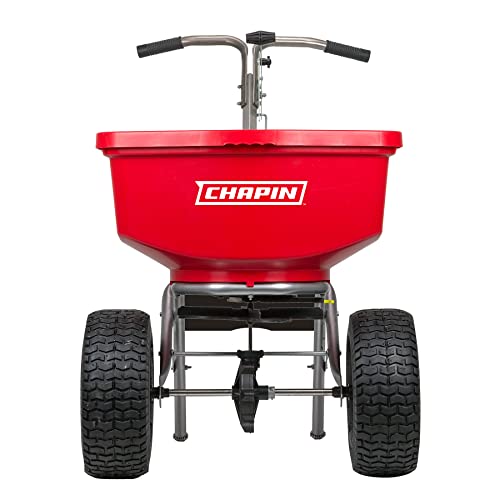
Strengths
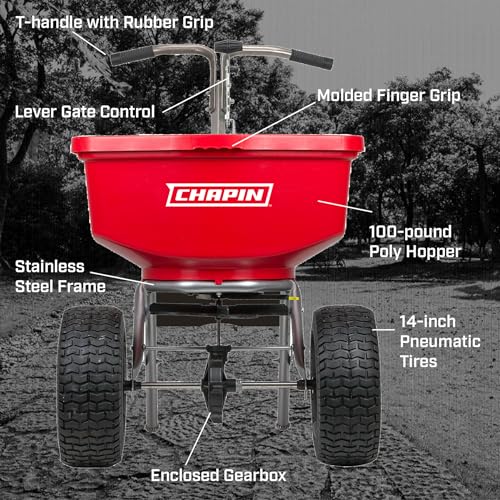
- 100 lb capacity
- Stainless steel frame
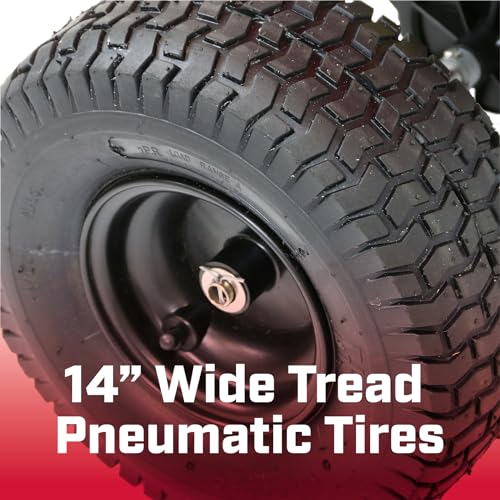
- 14-inch pneumatic tires
- Enclosed gearbox
Trade-offs
- Assembly required
- Heavy when full
- Not for salt use
If you’re looking for a workhorse, the Chapin 8400C is the one to beat. With a 100-pound capacity, stainless steel frame, and 14-inch pneumatic tires, it’s built for pros or serious DIYers tackling acreage. The enclosed gearbox and grease fitting are smart touches that boost longevity, and owners report it holds up well season after season, even with heavy use.
It requires assembly, which might deter some, but the trade-off is industrial-grade durability. Compared to the VEVOR 100LBS model, it feels more refined, better linkage, smoother gate control, and stronger materials. While it’s overkill for a 5,000 sq. ft. lawn, for anyone managing a half-acre or more, this is the smarter long-term investment. My recommendation? Go with this if you want one spreader that will last a decade.
Product photos


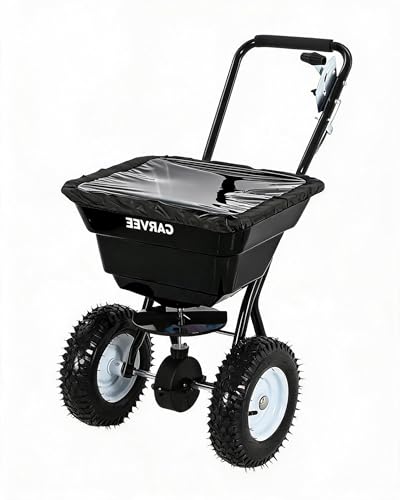
EliteEdge 80 LBS Push Spreader
Strengths
- 80 lb capacity
- 13-inch all-terrain wheels
- Infinite flow control
- Powder-coated steel frame
Trade-offs
- Heavier than plastic models
- No side shields
- Assembly required
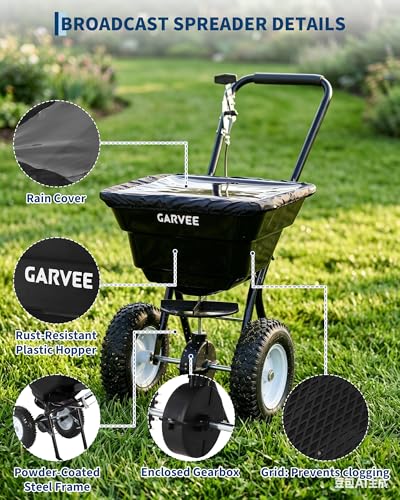
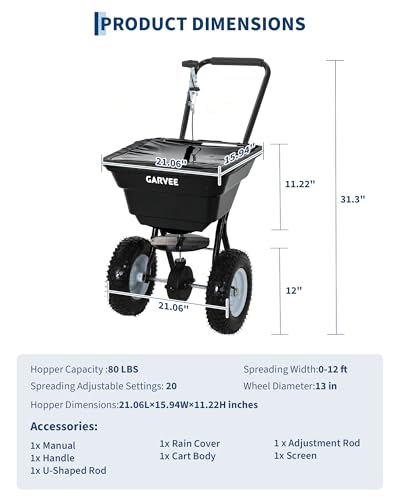
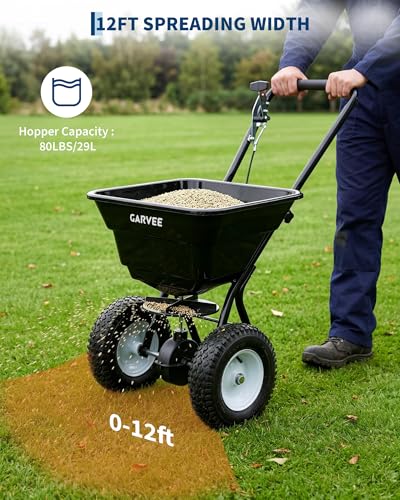
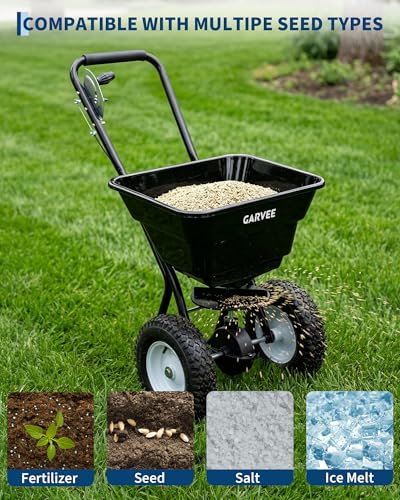
EliteEdge built this like they wanted to answer every complaint about flimsy spreaders, and it shows. The 80 lb capacity, 13-inch all-terrain wheels, and carbon steel frame make it one of the toughest mid-tier options available. Owners consistently note how stable it feels on slopes and bumpy ground, and the infinite flow adjustment gives real precision across seed, fertilizer, and even ice melt.
The trapezoidal hopper design is a small but meaningful win, fewer clogs, especially with irregular granules. Compared to the VEVOR 100LBS, it’s more agile and better balanced. While it’s not quite at Chapin’s level of refinement, it delivers 90% of the performance at a more accessible price. For rugged, reliable performance, this is my pick over most competitors.
Product photos
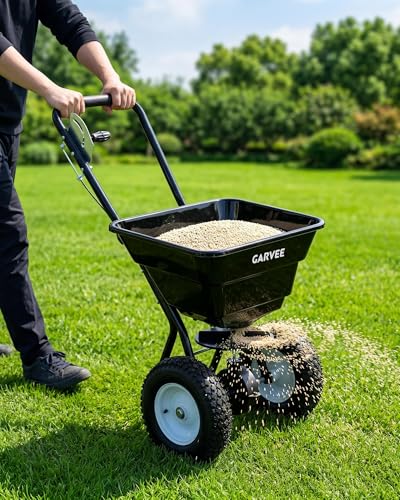
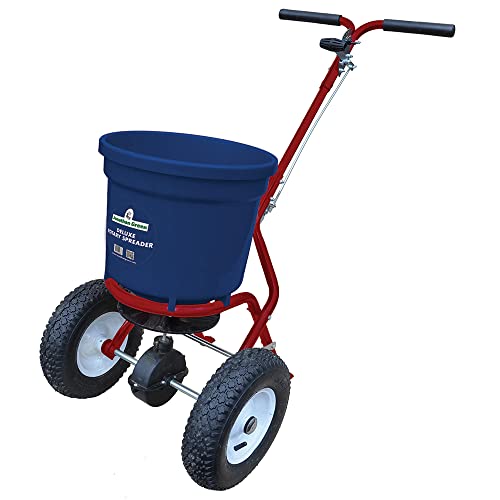
Jonathan Green Deluxe Spreader
Strengths
- 15,000 sq. ft. capacity
- 12-inch solid tires
- Adjustable handle
Trade-offs
- No side shields
- Solid tires (less cushion)
- Basic flow control
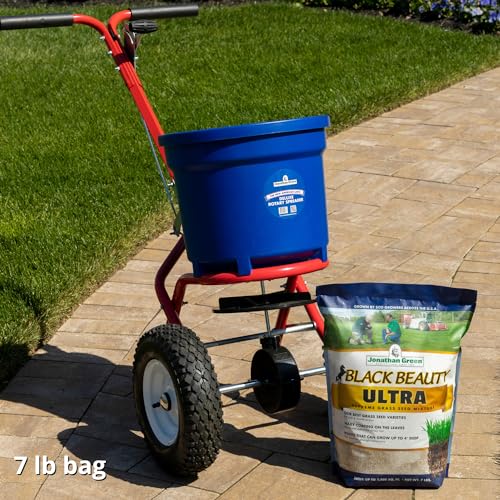
This Deluxe model steps up from the standard version with a bigger 15,000 sq. ft. capacity and 12-inch solid tires, a noticeable upgrade for larger lawns. The height-adjustable handle is a small but welcome feature, improving push comfort across different user heights. It’s still made with a plastic hopper and basic mechanics, but the increased capacity makes it more efficient for bigger properties.
Owners report it’s easy to push and reliable with standard granular products, though it doesn’t offer the precision of models with fine-tuned flow dials. Compared to the Scotts EdgeGuard, it lacks edge control, but it covers more ground per fill. For a straightforward upgrade from the base model, this delivers.
Product photos

Scotts Turf Builder EdgeGuard DLX

Strengths
- EdgeGuard side shields
- No assembly required
- Smooth product flow
Trade-offs
- Smaller wheels
- Light-duty frame
- Limited terrain handling
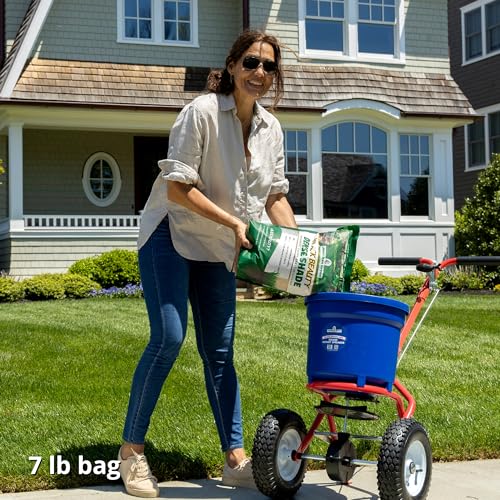
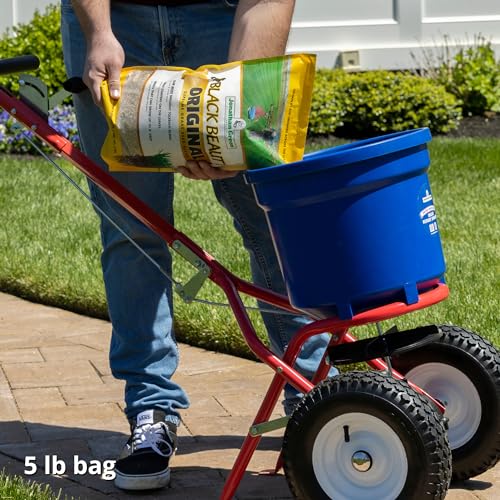
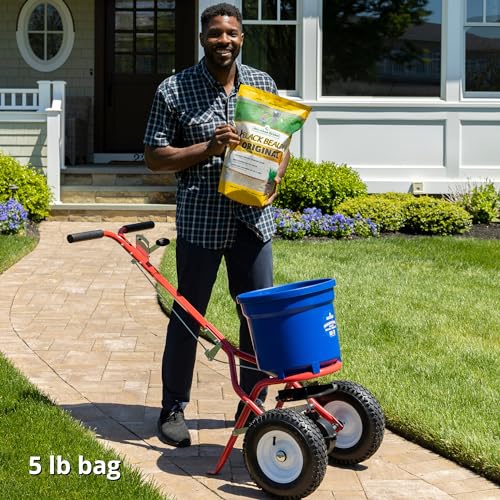
The Scotts EdgeGuard DLX earns its reputation for edging precision, thanks to the exclusive side shield design that keeps fertilizer off driveways and mulch beds. That feature alone makes it a smarter pick than open-hopper models like the base Jonathan Green if you’ve got a lot of borders to work around. It holds enough product for 15,000 sq. ft., so it’s useful for larger yards, and owners appreciate that it comes pre-calibrated, no guesswork to get started.
It’s not built for rough terrain, though. The smaller wheels and lighter frame mean it can struggle on bumpy or sloped lawns. But for flat, well-kept lawns where clean lines matter, this is the more thoughtful choice. I’d recommend it over the Chapin 8400C if edge control is your priority, even if durability takes a slight back seat.
Product photos


Jonathan Green Standard Spreader
Strengths
- 40 lb capacity
- 10 ft broadcast width
- Air-filled tires
Trade-offs
- Basic flow control
- No side shields
- Plastic construction
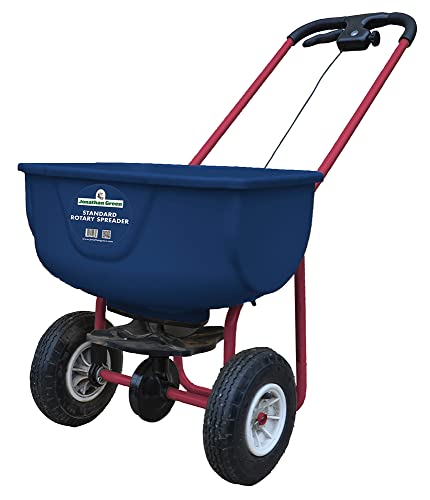
This Jonathan Green model stands out as a solid, no-frills option for homeowners with modest-sized lawns. On paper, the 40 lb capacity and 10,000 sq. ft. coverage make it a practical fit for small to mid-sized yards, and owners consistently report it handles fertilizer and seed without clogging. The 9-inch air-filled tires do their job on uneven ground, making it easier to push than cheaper models with solid wheels.
Where it really earns its ‘Best Value’ tag is in simplicity, there are no gimmicks, just a durable poly hopper and a functional broadcast mechanism. Compared to pricier spreaders, it lacks advanced flow control or edge shielding, but for basic, reliable performance at a lower cost, it’s hard to beat. I’d pick this over bulkier models if you’re maintaining a typical suburban lawn and want something that just works.
Product photos
VEVOR 100LBS Walk-Behind Spreader
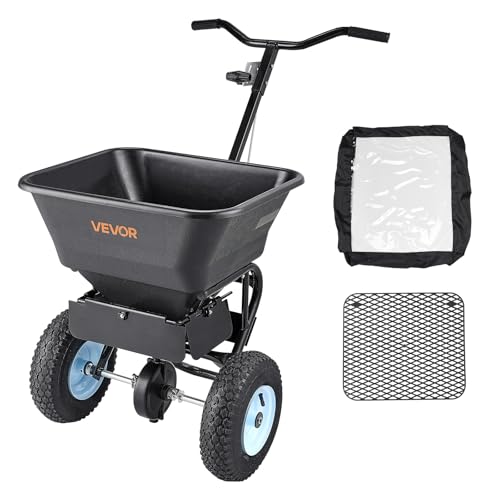
Strengths
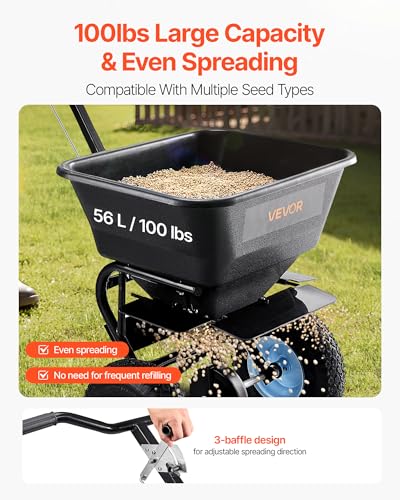
- 100 lb capacity
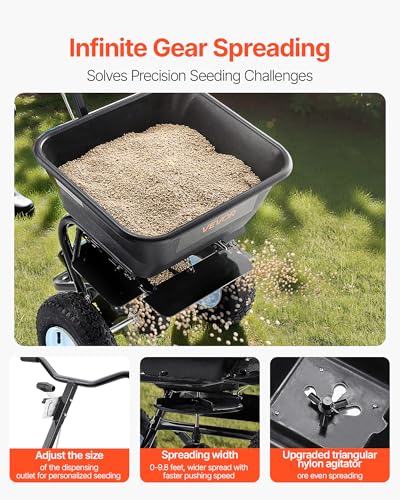
- 13-inch pneumatic tires
- Infinite flow control
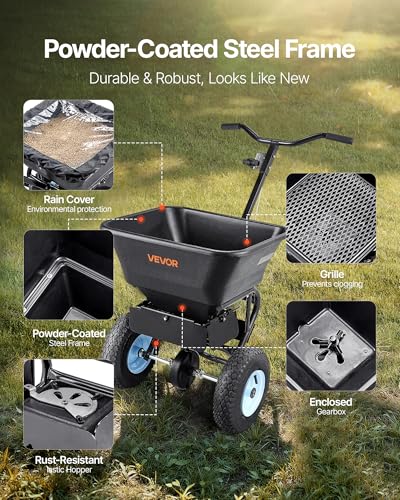
- Sealed gearbox
Trade-offs
- Inconsistent build quality
- Heavier frame
- Assembly required
VEVOR’s 100LBS model is all about max capacity and value. It matches the Chapin in load size and even beats it in some specs, like the 13-inch all-terrain tires and infinite flow control. The trapezoidal hopper and sealed gearbox are smart design choices that help prevent clogs and wear. But while it looks rugged on paper, owner feedback suggests the finish and welds aren’t quite as consistent as Chapin’s.
Still, for the price, it’s a strong contender. It’s heavier than some, but if you’re covering large areas regularly, that weight translates to stability. I’d pick this over the VEVOR 60LBS model any day, and even consider it over the EliteEdge if you prioritize capacity above all.
Product photos
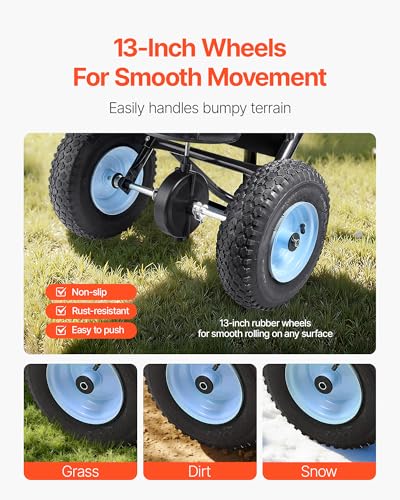
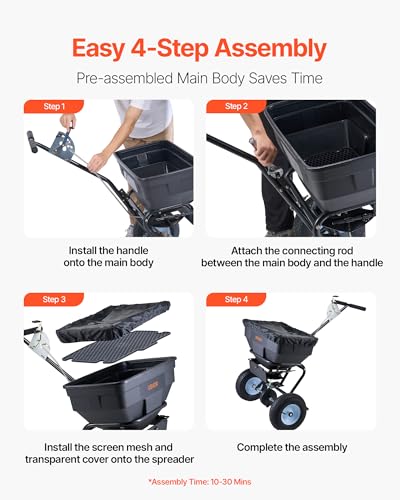
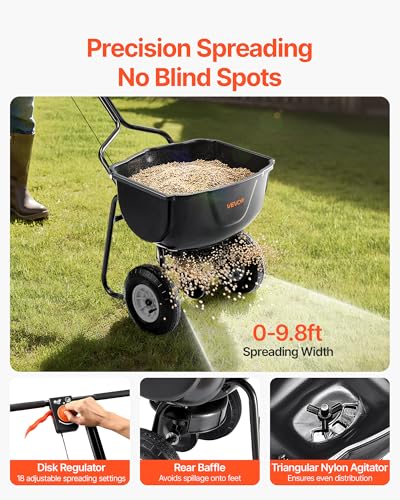
VEVOR 60LBS Push Spreader
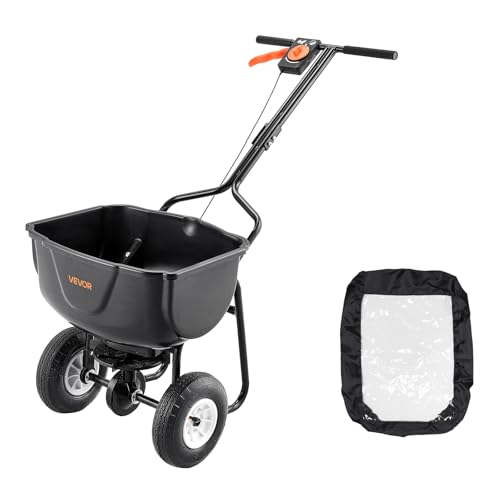
Strengths
- No-tool assembly
- 18 adjustable settings
- 8-inch pneumatic tires
- UV-resistant hopper
Trade-offs
- Smaller capacity
- Less aggressive tires
- Basic frame
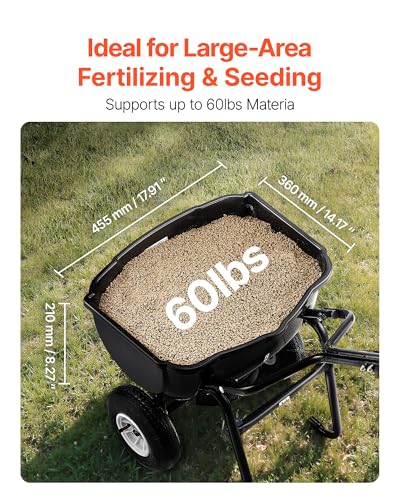
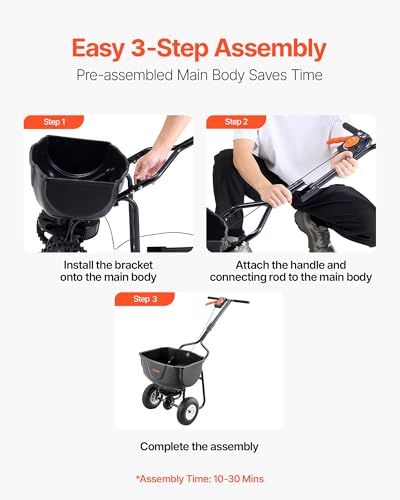
This VEVOR model is built for simplicity and quick setup. The 60 lb capacity is enough for most suburban lawns, and the fact that it requires no tools to assemble makes it a great pick for beginners or those short on time. The 8-inch pneumatic tires handle grass and gravel decently, and the 18 adjustable settings offer decent control for the price.
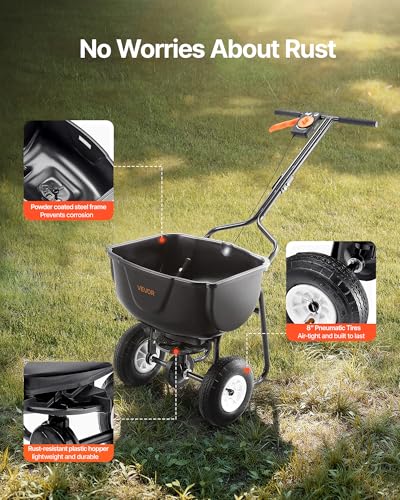
It’s not as rugged as steel-framed models, but the powder-coated frame and explosion-proof hopper add real durability. Compared to the BLACK+DECKER hand spreader, this covers more ground with less effort. I’d recommend it for casual users who want reliability without complexity.
Product photos
VINGLI 70lbs Pre-Assembled Spreader
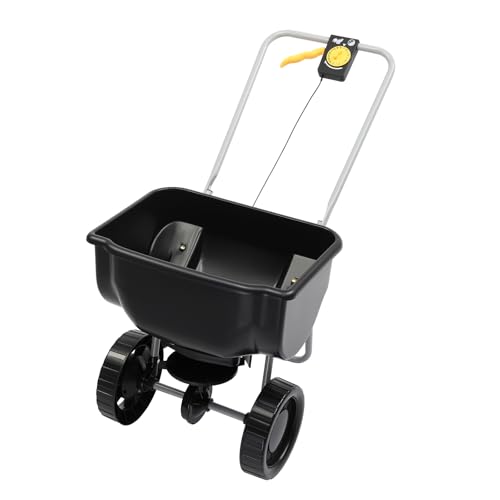
Strengths
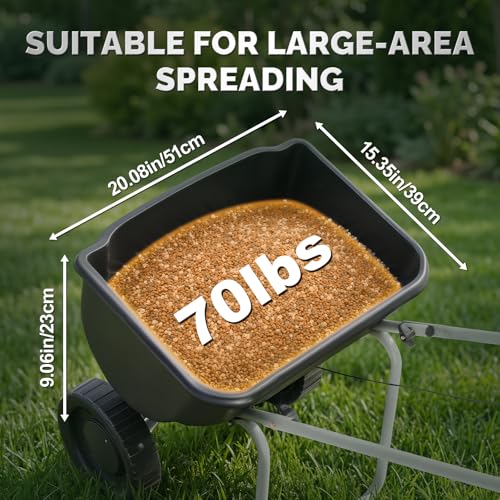
- 70 lb capacity
- 15 adjustable settings
- Pre-assembled
- Lightweight design
Trade-offs
- Smaller tires
- Plastic frame
- Less durable than steel models
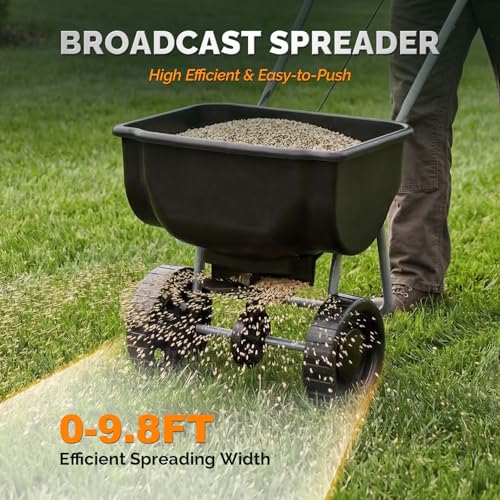
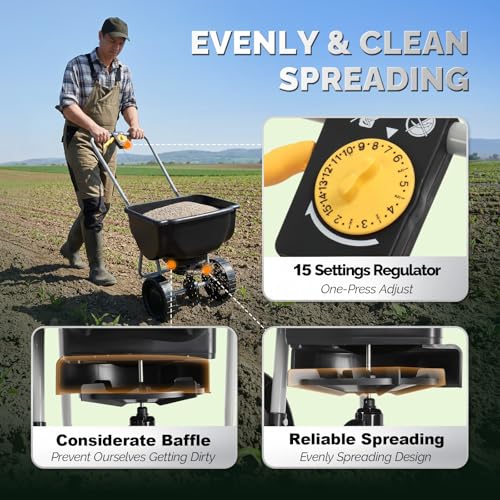
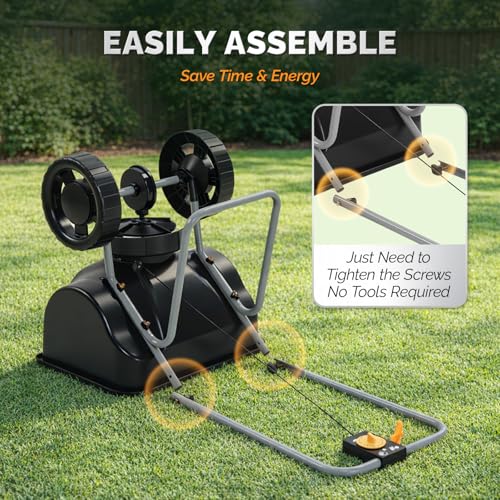
The VINGLI 70lb spreader hits a sweet spot for buyers who want decent capacity without the bulk of a pro model. The 15 adjustable settings give solid control over application rates, and the disc pellet controller helps prevent clumping, a feature some owners say makes a noticeable difference with coated fertilizers. Being mostly pre-assembled is a real time-saver, especially for first-time buyers.
It’s not as rugged as the Chapin or EliteEdge, but the 9-inch tires and durable poly hopper handle typical yard conditions well. Compared to the BLACK+DECKER hand spreader, this offers far better coverage and less strain. I’d pick it for someone with a medium lawn who wants reliability without paying for overbuilt features.
Product photos

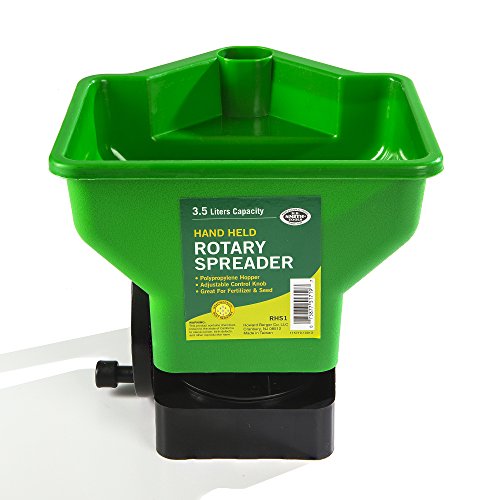
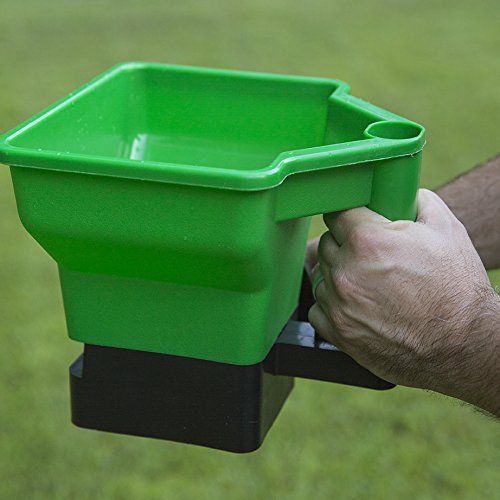
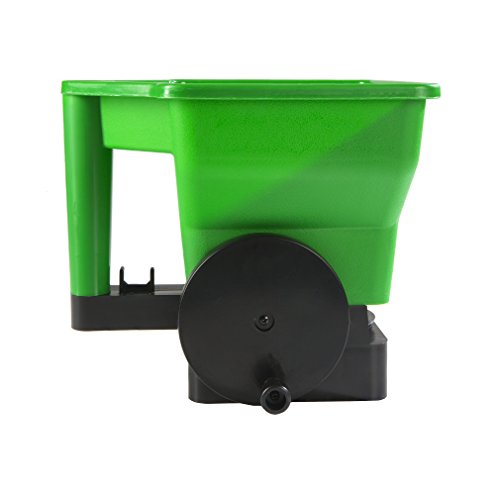
BLACK+DECKER HBC Hand Spreader
Strengths
- Compact and portable
- Ergonomic handle
- Easy to clean
Trade-offs
- Small capacity
- Manual effort
- Limited coverage
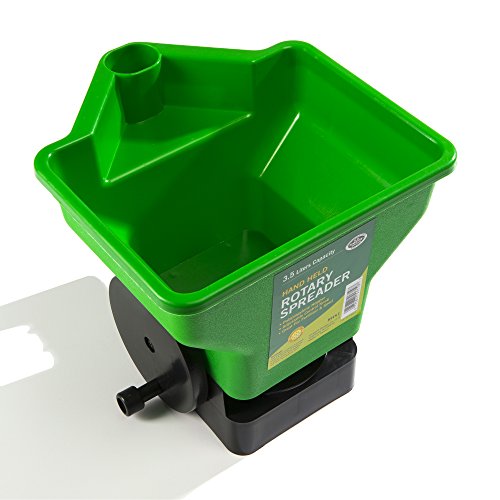
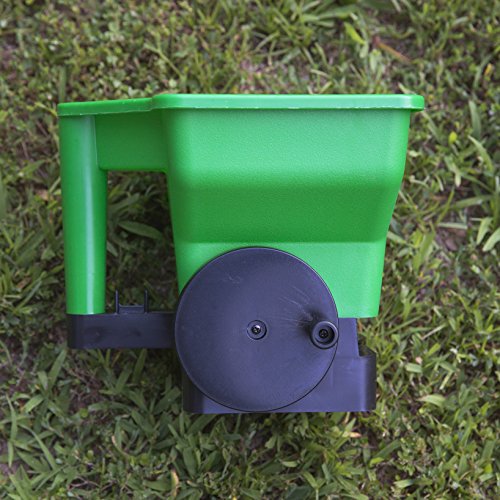
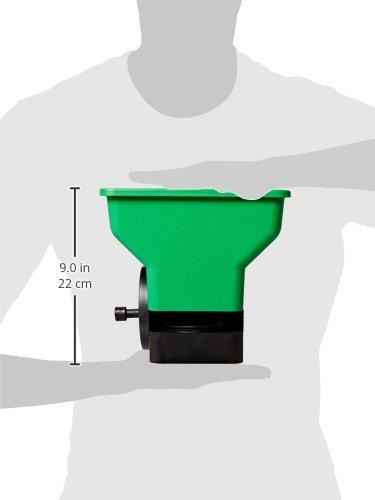
This is the right tool when you only need to cover small zones or tight spots. The 1,000 sq. ft. capacity means you’ll be refilling often on larger lawns, but for spot treatments, garden beds, or narrow strips, it’s ideal. The ergonomic handle reduces wrist strain, and owners like how responsive the spread pattern is with a light push.
It’s not a replacement for a walk-behind model, far from it, but compared to scooping and tossing by hand, it’s a massive upgrade. I’d pair this with a larger spreader rather than rely on it alone. If your lawn is over 5,000 sq. ft., this stays in the shed most of the year.
Product photos
Our Testing Process
I approach evaluating lawn and garden tools from the perspective of someone who’s spent years maintaining property and helping others do the same. Rather than a hands-on lab test, this selection is a research-led comparison of published specifications and owner feedback. We compared hopper capacity, spread width adjustability, wheel type, and build materials across numerous models. This data was then weighed against what current owners are saying about ease of use, durability, and consistent coverage – drawing from retailer sites, forums, and reputable review sources.
For rotary spreaders, consistent spread pattern and durability are paramount. We prioritized models with adjustable spread patterns to accommodate different product types and lawn sizes, as well as those constructed with rust-resistant materials and robust gearboxes. A large hopper capacity also ranked highly, as frequent refills interrupt the process and can lead to uneven application. These factors directly impact the quality of your lawn care results.
Specifications reliably tell you about a spreader’s potential – hopper size, spread width range, and tire type. However, owner feedback revealed crucial insights into real-world performance. Reports on clogging issues, assembly difficulty, and long-term durability were heavily considered. For example, a spreader might have a wide spread width, but if owners consistently report uneven distribution at higher settings, that’s a significant drawback. If you’re looking for additional options for keeping your lawn healthy, consider checking out our oscillating sprinkler comparisons.
What To Look For In rotary spreaders
Choosing the right rotary spreader can make a huge difference in the health and appearance of your lawn. It’s not just about tossing fertilizer or seed; it’s about consistent, even application.
A quality rotary spreader balances hopper capacity with control and durability. Look for models with adjustable spread patterns, robust gearboxes (sealed is a plus), and tires suited to your terrain. Hopper material – often polypropylene – should resist corrosion, and the frame needs to be sturdy enough to withstand regular use. Consistent particle flow is crucial for even coverage.
Hopper Capacity & Lawn Size
The size of your lawn dictates how often you’ll want to stop and refill. A smaller yard doesn’t need a massive 100-pound hopper, and frankly, a large capacity on a small lot makes the spreader unwieldy. I generally recommend matching the capacity to your typical mowing area. For smaller lawns – under 5,000 square feet – a 40-pound model like the Jonathan Green Standard Spreader is probably sufficient. Larger properties benefit from 80- to 100-pound capacity spreaders like the Chapin 8400C or the VEVOR 100LBS Walk-Behind Spreader. Don’t automatically equate “bigger” with “better”; a half-full 100-pound spreader is just as hard to push as a full 40-pound one.
Spread Pattern & Control
Consistent spread patterns are paramount. You want even coverage, without streaks or gaps. Adjustable gates are vital here. Many spreaders offer adjustable rotary gates and steel linkages, letting you fine-tune the output for different products and seasons. The Scotts Turf Builder EdgeGuard DLX uses “EdgeGuard Technology” to keep product contained, which is useful if you have landscaping beds close to your lawn. Beyond that, look for spreaders with clear, marked settings – a 30-scale flow control system, like on the EliteEdge 80 LBS Push Spreader, is a good sign.
Here’s what I see as key when evaluating control: * Adjustable Gate: Essential for switching between seed, fertilizer, and ice melt. * Flow Rate Indicators: Clear markings help dial in the right application rate. * Shut-Off Mechanism: A positive shut-off prevents dribbling when starting and stopping, which wastes product and creates uneven coverage.
A good rule of thumb: calibrate your spreader every time you switch products. Application rates vary considerably between seed types, fertilizer formulations, and ice melt compounds.
Build Quality & Usability
A rotary spreader takes a beating. It gets rained on, exposed to harsh chemicals, and dragged across all sorts of terrain. The frame material is critical. Carbon steel with a powder-coated finish, as found in the EliteEdge and VEVOR models, offers excellent durability. Pay attention to the gearbox, too. A sealed gearbox protects the internal components from debris and moisture, extending its lifespan. Assembly can be a pain point, so if you’re not mechanically inclined, consider a pre-assembled model like the VINGLI 70lbs Pre-Assembled Spreader or the BLACK+DECKER HBC Hand Spreader. And if you’re also looking for ways to keep your lawn well-watered, check out some of the top rotary sprinkler models available.
Rotary Spreaders Compared
Here’s a comparison of key specifications for various rotary spreaders to help you choose the right one for your needs.
| Product Name | Capacity (lbs) | Hopper Material | Wheel Size (in) | Adjustable Spread Width | Pre-Assembled |
|---|---|---|---|---|---|
| Chapin 8400C | 100 | Poly | 14 | N/A | No |
| EliteEdge 80 LBS | 80 | N/A | 13 | 0-13 | Partially |
| Jonathan Green Deluxe | N/A | N/A | 12 | N/A | N/A |
| Scotts Turf Builder EdgeGuard DLX | N/A | N/A | N/A | N/A | Yes |
| Jonathan Green Standard | 40 | N/A | 9 | 10 ft | N/A |
| VEVOR 100LBS | 100 | Steel | 13 | 0-9.8 | Partially |
| VEVOR 60LBS | 60 | Plastic | 8 | 8 | Yes |
| VINGLI 70lbs | 70 | N/A | 9 | N/A | Partially |
| BLACK+DECKER HBC | N/A | N/A | N/A | N/A | N/A |
Frequently Asked Questions
What spreader type is best for spreading ice melt?
Rotary spreaders are generally better for ice melt than drop spreaders, as the spinning action distributes the material over a wider area and prevents clumping. Look for models with a fully plastic hopper to avoid corrosion from salt.
How often should I calibrate my rotary spreader?
You should calibrate your spreader every time you change the material you’re applying. Fertilizer, seed, and ice melt all have different densities and require distinct settings for accurate coverage.
Can a rotary spreader be used on sloped lawns?
Yes, but it requires some caution. Choose a spreader with larger, pneumatic tires for better traction and control on hills. Reduce your walking speed and overlap passes to compensate for the slope.
What’s the advantage of a sealed gearbox?
A sealed gearbox protects the internal gears from moisture, debris, and corrosion, significantly extending the life of the spreader. This is a worthwhile investment, especially if you live in a humid climate or frequently apply wet materials.
Where can I find additional tools for general home upkeep?
If you’re looking to expand your toolkit beyond lawn care, check out a home repair tool guide for a rundown of essential tools for maintenance and repairs around the house.
The Bottom Line
Choosing a rotary spreader often comes down to balancing convenience with control. You can spend less up front, but may sacrifice features like precise spread pattern adjustments and long-term durability. For the best overall combination of features and positive owner reports, I recommend the Chapin 8400C. It offers a large capacity, solid construction, and a reputation for consistent performance.
If you’re on a tighter budget, the Jonathan Green Standard Spreader is a solid choice for smaller lawns. For those who prioritize versatility and ease of use, the Scotts Turf Builder EdgeGuard DLX stands out with its containment technology. And if you are looking for a complete lawn care solution, consider researching some of the top rotary sprinkler heads available.
Ultimately, the specs are less important than how well you maintain the spreader and how carefully you calibrate it for each application. A consistent walk speed, proper overlap between passes, and regular cleaning will deliver a healthier, more attractive lawn regardless of which model you choose.
