8 Best Multi Process Welders of 2026
This post contains affiliate links. As an Amazon Associate, we earn from qualifying purchases.
The Miller Multimatic 215 PRO stands out as the best overall multi process welder for its reliable performance and clean arc across MIG, TIG, and Stick, while the ARCCAPTAIN MIG205MP 9-IN-1 offers strong versatility at a more accessible price, especially if you need plasma cutting and aluminum capability.
Most buyers struggle to balance real-world performance with feature overload, too many options, not enough clarity on what actually matters in the field. I’ve researched the top models, comparing specs and owner feedback to identify which machines deliver where it counts. This guide breaks down what to prioritize, amperage, duty cycle, process quality, and how to match a welder to your projects without overspending on bells and whistles you won’t use.
Top 8 Multi Process Welders in the Market
The Best Multi Process Welders, Reviewed
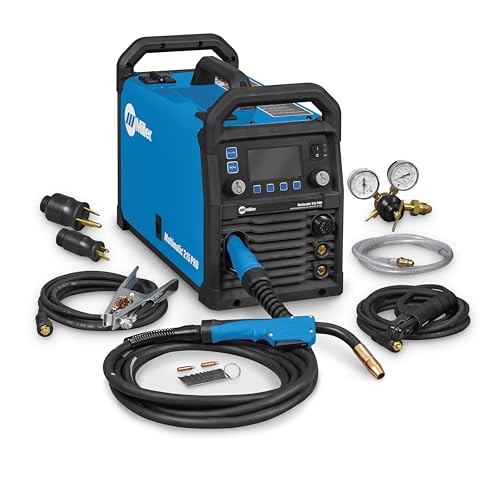
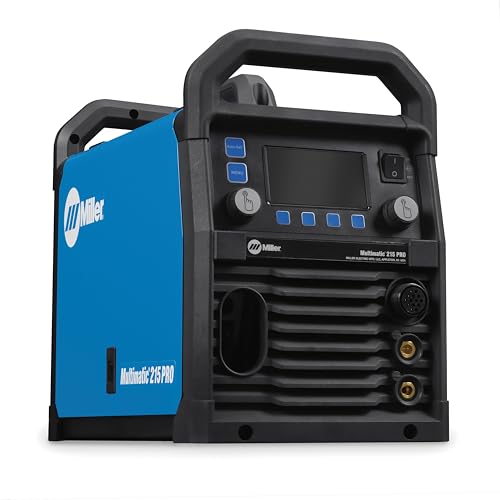
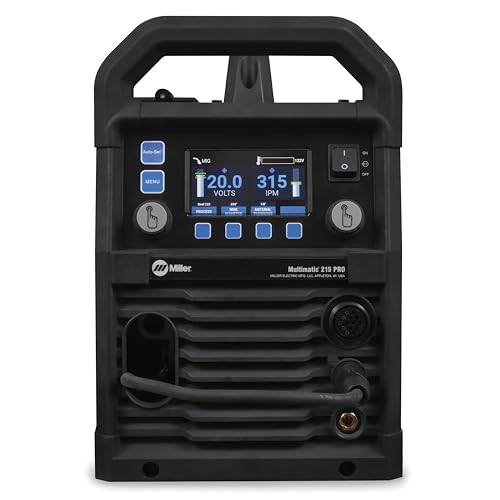
Miller Multimatic 215 PRO
Strengths
- Pulsed MIG and TIG
- BeadVision monitoring
- Auto-Set ease
- Program memory
- Fan-On-Demand
Trade-offs
- Higher price
- Limited amperage vs FEMEROL
- Spool gun sold separately
The Miller Multimatic 215 PRO is the benchmark I keep coming back to when comparing multiprocess welders. It’s not the cheapest or the most amperage-heavy, but its combination of pulsed MIG, pulsed TIG, and BeadVision monitoring sets a high bar. The Auto-Set feature takes the guesswork out of setup, and the program memory lets you save custom profiles, ideal if you switch between jobs often.
Owners consistently report smooth arc starts, minimal spatter, and excellent control on thin materials, especially with the Fan-On-Demand system keeping things cool without constant noise. The Quick Select drive roll handles multiple wire sizes without swapping, a small but meaningful detail. While it costs more than the Lincoln or ARCCAPTAIN, the refinement justifies it. This is the smarter buy if you weld aluminum or stainless regularly.
Product photos
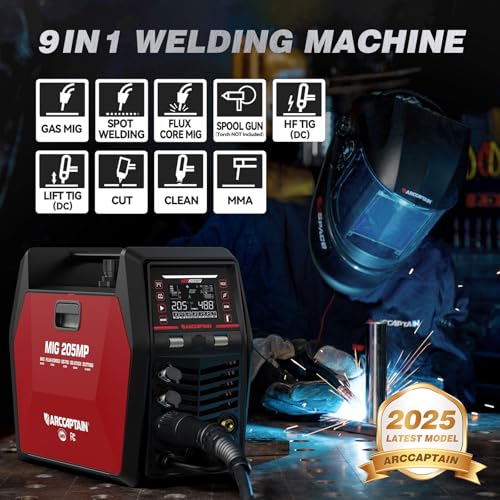
ARCCAPTAIN MIG205MP 9-IN-1

Strengths
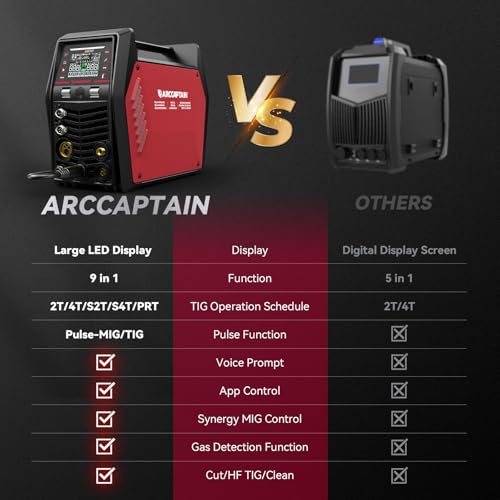
- 9 welding modes
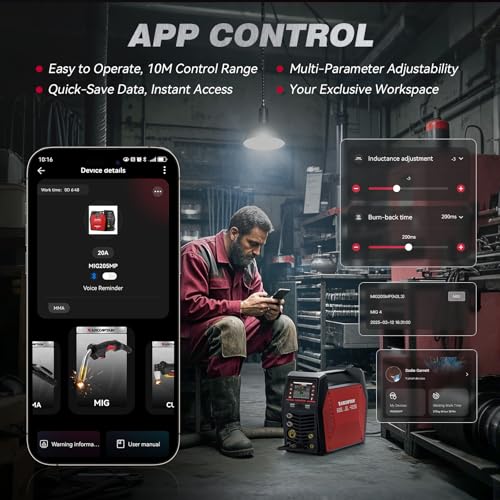
- App connectivity
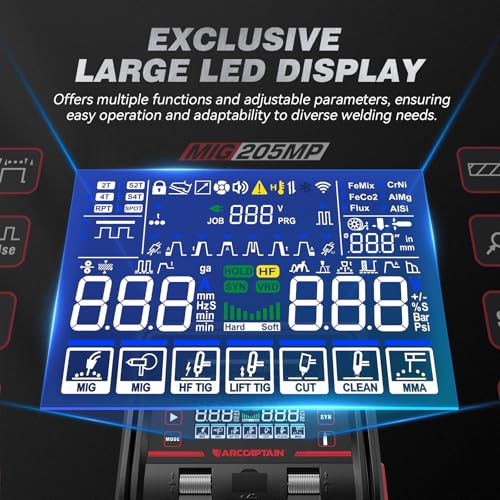
- Large LED display
- Dual voltage
- Pulsed MIG support
Trade-offs
- Shared torch port
- App connectivity spotty
- Steeper learning curve
This ARCCAPTAIN model pushes the envelope on features, packing in nine welding modes and app connectivity that feels more like a smart home device than a welder. On paper, the iControl app is a standout, owners praise its preset memory and real-time monitoring, though some note the Bluetooth range is hit-or-miss beyond 10 feet. The dual-voltage setup and broad amperage range (30–205A) make it flexible for both garage work and heavier field repairs.
Where it shines is versatility: the ability to switch between pulsed MIG, HF TIG, and plasma cutting in one unit is rare at this price tier. Reviewers consistently report clean aluminum welds when using a spool gun, and the large LED display is a real win for visibility. But all that tech comes with a learning curve, beginners might feel overwhelmed, and the shared TIG/MMA torch socket feels like a cost-cutting move.
Product photos

YESWELDER MCT-520 6-IN-1
Strengths
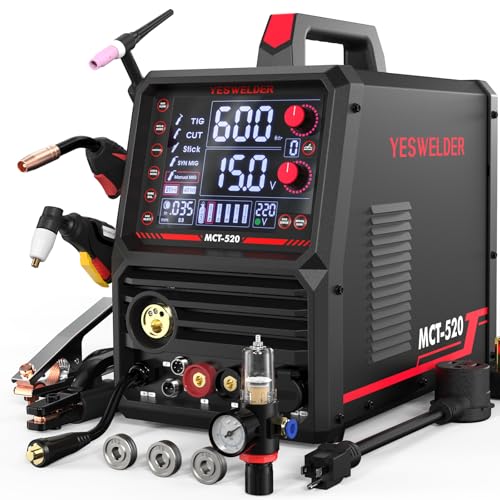
- 6-in-1 versatility
- Large glove-friendly display
- Plasma cutter included
- Strong user support
- 2-year USA warranty
Trade-offs
- Foot pedal not included
- Spool gun sold separately
- No pulsed MIG
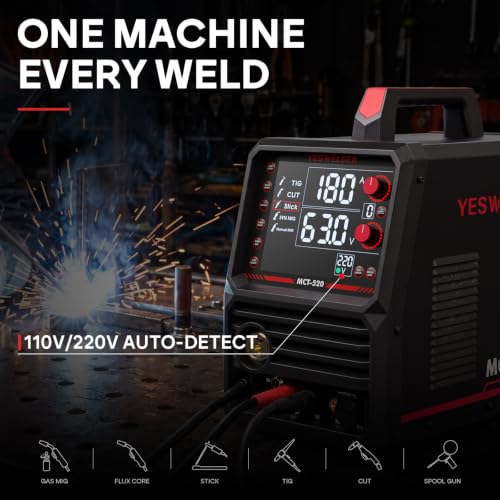
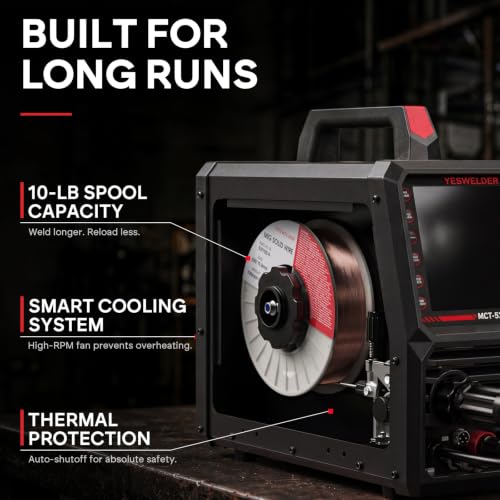
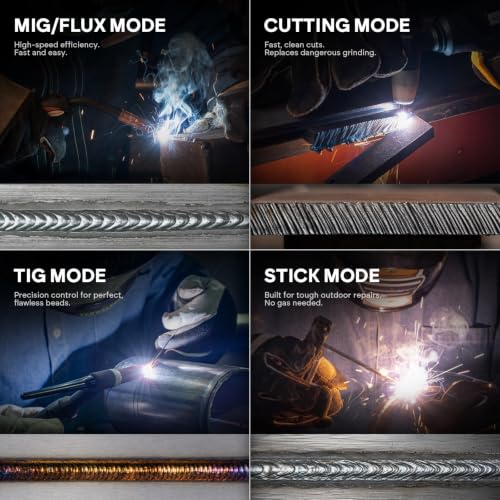
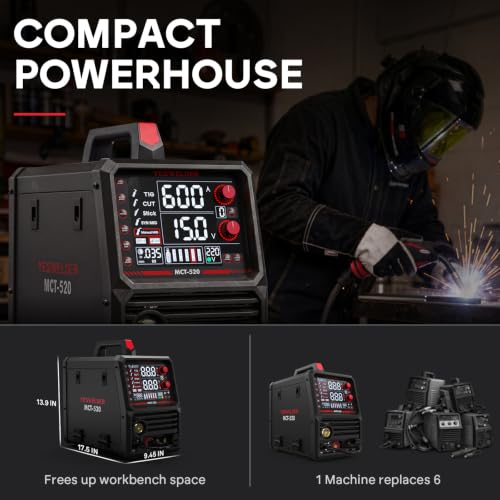
The YESWELDER MCT-520 is the definition of bang for the buck. For a single machine price, you get MIG, flux-core, stick, HF TIG, plasma cutting, and spool gun compatibility, all in a rugged, glove-friendly design. The 7-inch LED display is a standout, easy to read and adjust even with bulky gloves, and the physical dials are a welcome rejection of touchscreens that fail in dusty shops.
Owners love the 5-minute setup claim, and the step-by-step videos actually help. The plasma cutter delivers a clean 5/16-inch cut, and the TIG mode responds well to foot pedal control (sold separately). It doesn’t have Miller’s polish or Lincoln’s legacy, but for the price, it’s one of the most complete packages available. My recommendation? This is the smarter buy over the FEMEROL combo if you want reliability and real-world usability.
Product photos

FEMEROL 6-in-1 Plasma Combo

Strengths
- Integrated plasma cutter
- HF TIG start
- Thorough kit
- Dual voltage
- Good cut capacity
Trade-offs
- Wire feed inconsistency
- Average MIG performance
- TIG pedal not included
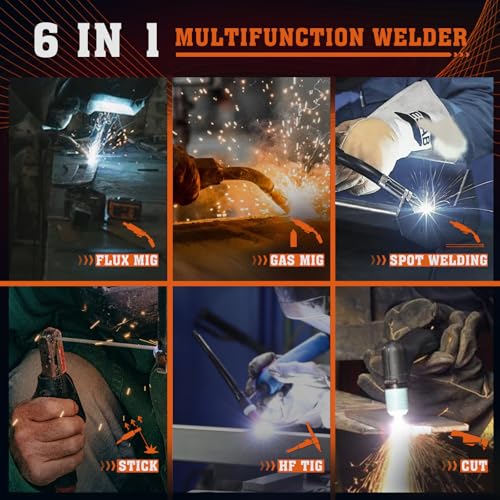
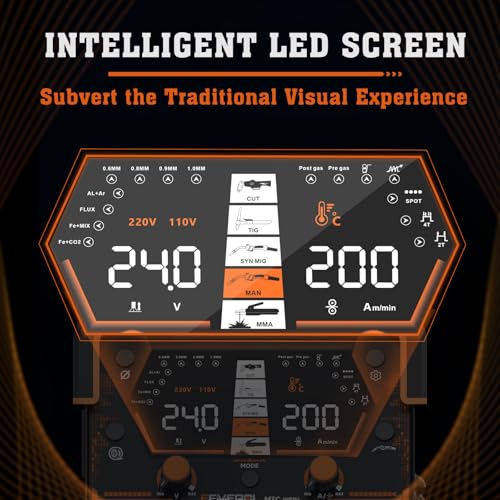
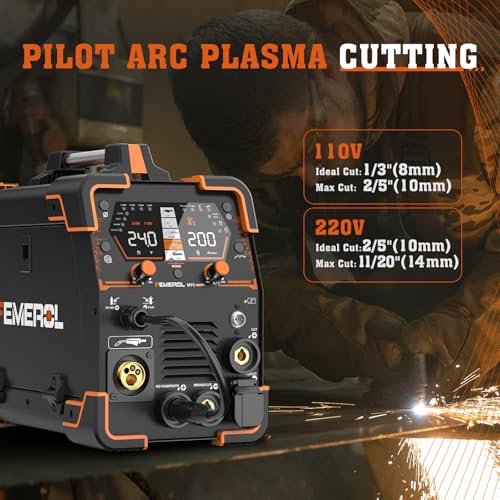
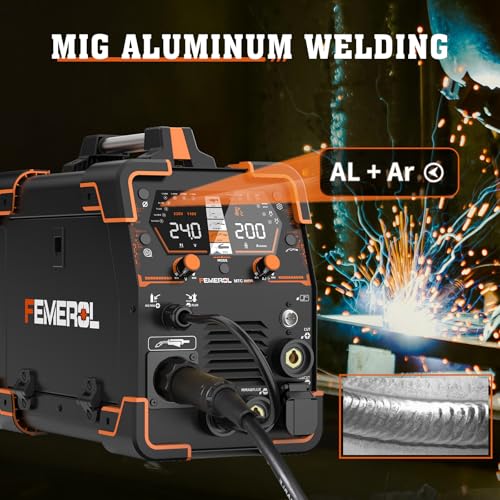
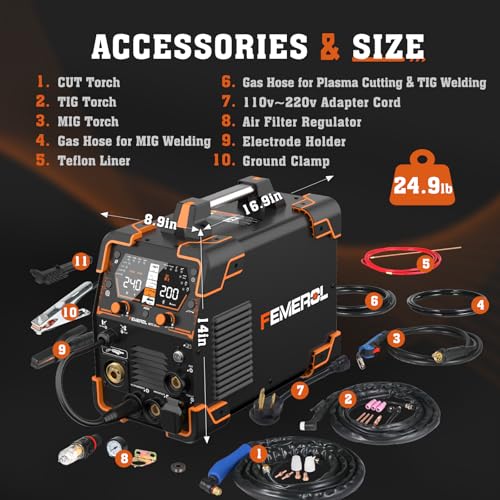
The FEMEROL combo unit makes a strong case for welders who cut as much as they weld. With a 200A welder and 50A plasma cutter in one box, it’s a space- and cost-saving solution for shops that handle both tasks. The HF TIG start is a real upgrade over lift TIG, owners note fewer tungsten touches and cleaner arc starts, which matters on stainless or thin steel. The 10mm clean cut is reliable, and using compressed air keeps consumables affordable.
It’s not the smoothest MIG performer under heavy load, and some users report the wire drive needs frequent tweaking. But the included package, torch, regulator, hoses, even a hammer, adds real value. Against the YESWELDER MCT-520, it’s less refined on the weld side but holds its own on cutting.
Product photos
Lincoln Electric POWER MIG 215
Strengths
- Excellent build quality
- Reliable wire feed
- TIG ready out of box
- Dual voltage
- Trusted brand
Trade-offs
- Fewer advanced features
- No app or digital presets
- Basic display
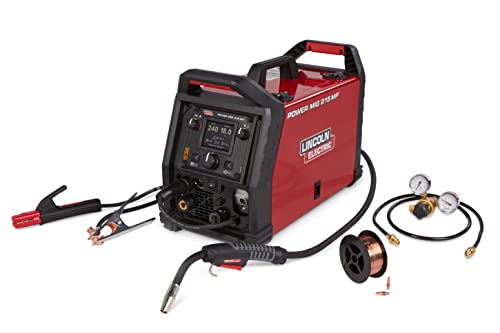
Lincoln Electric has long been the gold standard for reliability, and the POWER MIG 215 MPi continues that legacy. It doesn’t have flashy apps or touchscreens, but what it does offer is rock-solid build quality and consistent performance across MIG, flux-core, stick, and DC TIG. The ergonomic case and multiple lift points make it shop-friendly, and the built-in TIG solenoid means you can plug in a torch and go, no extra mods needed.
Owners consistently praise its wire drive system, which feeds smoothly even with flux-core wire, a common pain point on budget units. It’s not the most feature-packed, but for welders who value durability and simplicity, this is a workhorse. I’d pick it over the ARCCAPTAIN or FEMEROL for long-term use, especially in tough environments.
Product photos


FEMEROL 250A Multi Process
Strengths
- 250A output
- Synergic MIG control
- Aluminum capable
- Dual voltage
- Solid build
Trade-offs
- No pulse TIG
- Cooling concerns
- Accessories sold separately
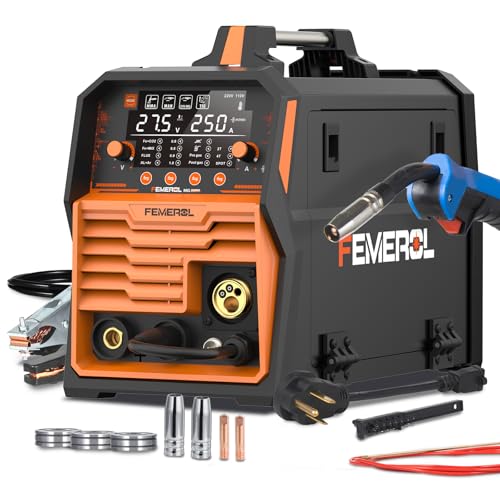
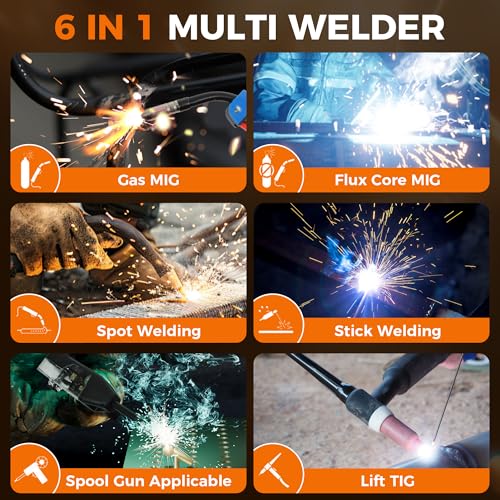
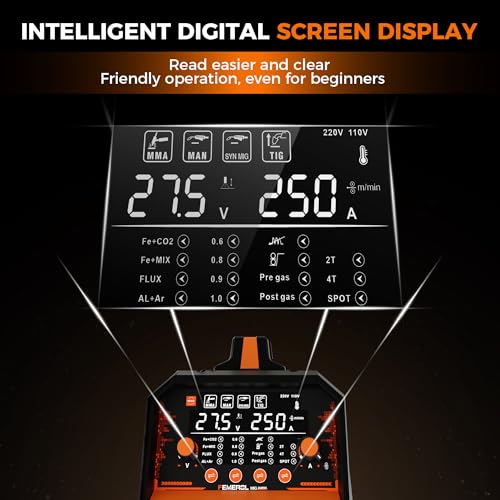
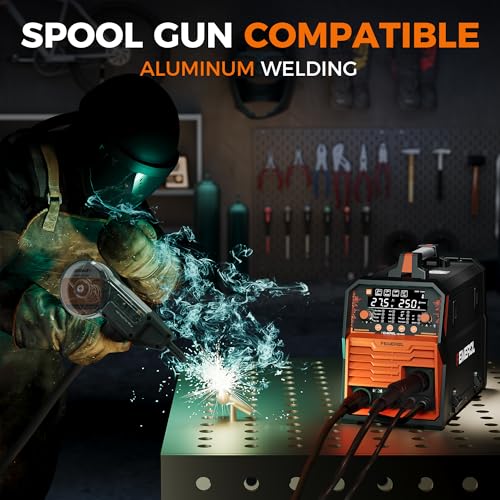
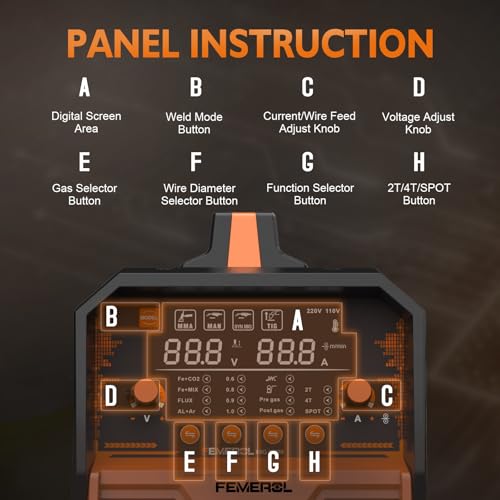
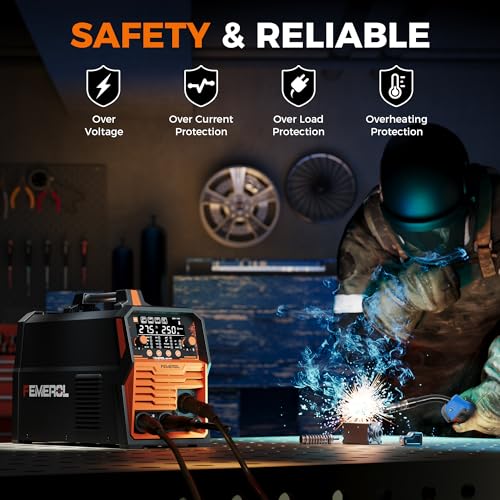
If raw power is what you’re after, this FEMEROL unit delivers. With a 250A output, it’s capable of welding mild steel up to 14mm, solid for heavy fabrication or farm repairs. The synergic control is a big plus for beginners, automatically matching wire feed speed and voltage, and owners report it’s surprisingly easy to pick up even without prior experience. It handles aluminum via spool gun or teflon liner, which adds flexibility, though the gun and spool kit aren’t included.
That said, while the specs look strong, some reviewers note the cooling system struggles during extended use, and the lack of advanced TIG features like pulse control limits its precision on thin materials. Compared to the Miller or Lincoln models, it’s less refined but offers more amperage for the cost.
Product photos
ARCCAPTAIN 6-IN-1 MIG Welder
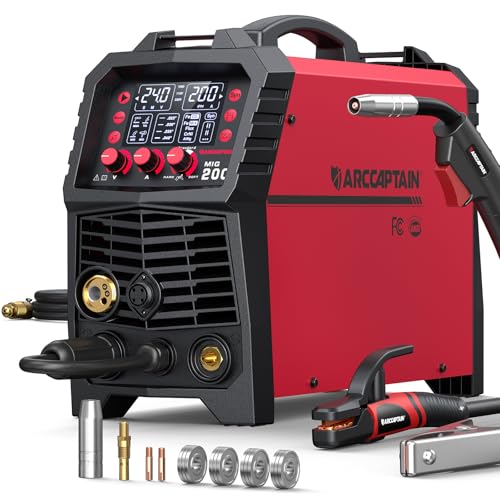
Strengths
- Aluminum optimized
- Spool gun ready
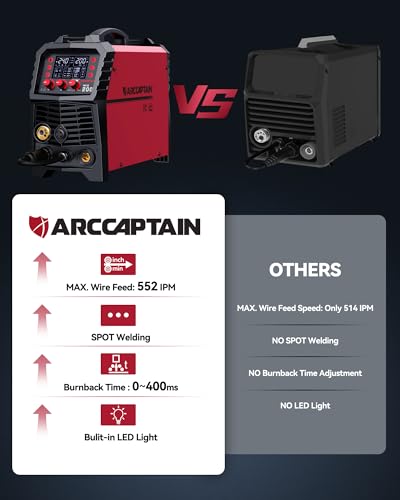
- Burn-back adjustment
- 10 preset memories
- Clear LED display
Trade-offs
- Lift TIG only
- No pulse MIG
- Rollers sold separately
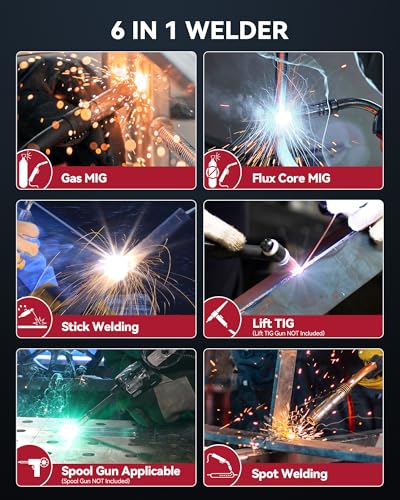
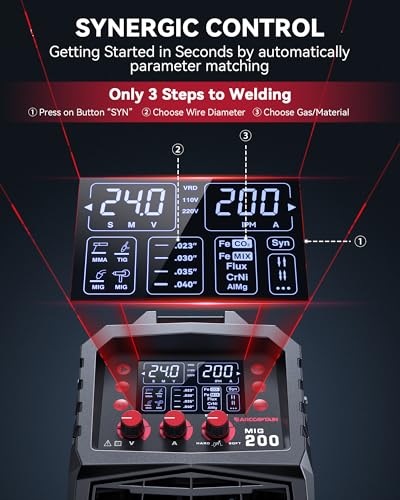
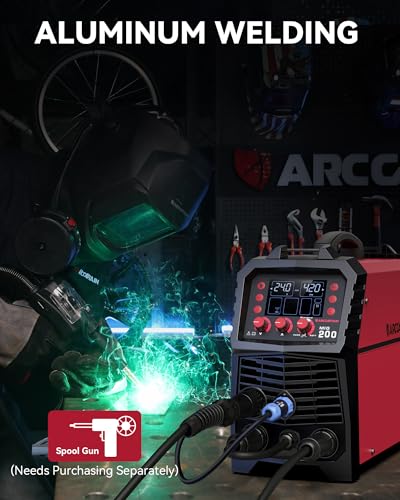
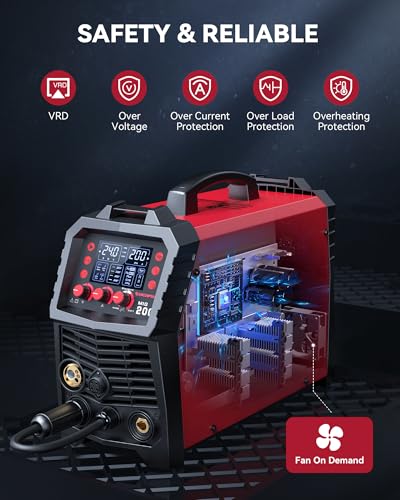
This ARCCAPTAIN model stands out specifically for aluminum welding, and that’s where it earns its keep. With spool gun compatibility and pre-flow/post-flow controls, it gives you the fine-tuning needed for clean, spatter-free aluminum joints. The 200A output is sufficient for most home and repair work, and owners report strong performance on both thin and medium-gauge aluminum when paired with the right gun.
The large LED display is easy to read through a helmet, and the 10 preset memories are a practical touch for repeat jobs. While it lacks the HF TIG start of pricier models, the lift TIG mode works reliably. Compared to the YESWELDER budget option, this one offers better control and durability, especially for aluminum-focused users.
Product photos
YESWELDER 135A 3-in-1
Strengths
- Ultra lightweight
- Flux core ready
- Beginner friendly
- Bonus wire included
- Low cost
Trade-offs
- Low amperage
- TIG torch not included
- Limited thickness capacity
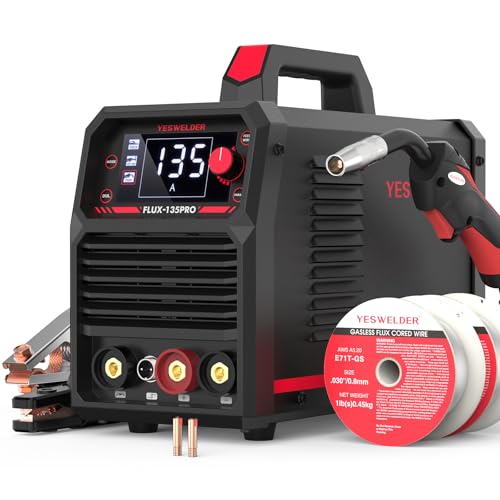
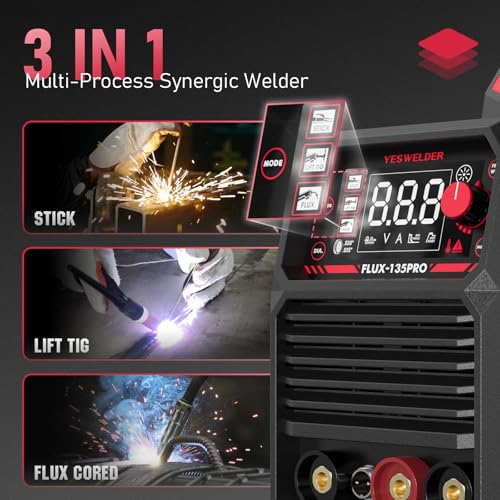
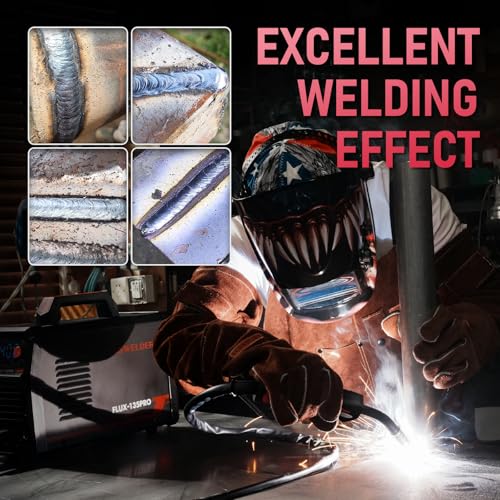
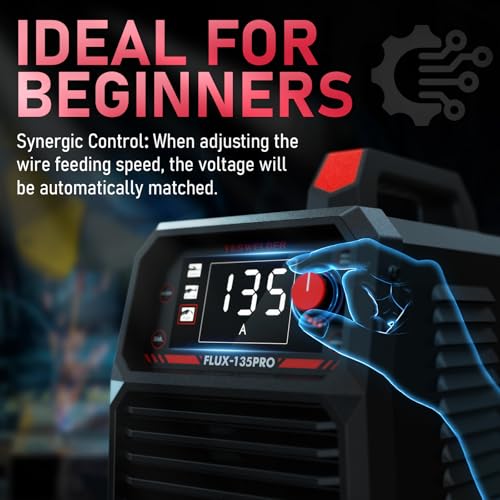
If you’re just getting started or need a lightweight backup welder, the YESWELDER 135A is hard to beat. At just 11.4 lbs, it’s ultra-portable, and the included flux core wire means you can start welding right away, no gas tank needed. The synergic control adjusts voltage automatically with wire speed, which beginners appreciate, and the digital display gives real-time feedback without clutter.
It’s limited to 3/32-inch steel, so don’t expect heavy-duty work, but for light repairs, fencing, or small builds, it performs reliably. Compared to the larger FEMEROL or Miller units, it’s underpowered, but that’s the trade-off for the price. The lift TIG mode works, but you’ll need to buy the torch separately, which isn’t always clear upfront.
Product photos


How We Tested multi process welders
Rather than a hands-on lab test, my research focused on a detailed comparison of published specifications and features across a range of multi process welders. I weighed owner reviews from multiple sources – including major retailers and welding forums – alongside expert opinions from established tool review sites. This data was then analyzed against my experience with power tools and welding processes to determine relative strengths and weaknesses.
For this category, I prioritized versatility and duty cycle. A multiprocess welder should genuinely handle several techniques well, not just list them as capabilities. Duty cycle is also crucial; a higher percentage means more continuous welding before needing to cool down, directly impacting productivity. Build quality and included accessories were also weighted heavily, as they impact long-term value.
Specifications clearly indicate maximum amperage, input voltage, and material thickness capacity. However, owner feedback proved essential for judging real-world usability, arc stability, and the accuracy of advertised features. Reputation and brand reliability also factored in, as these often correlate with the quality of customer support and parts availability. You’ll find more information on top multi-process welders here.
How To Choose The multi process welders
Choosing the right multi process welder can feel overwhelming, but focusing on your typical projects and skill level will narrow down the options considerably.
A good multi process welder balances versatility with usability. Key considerations include amperage output for material thickness, the number of processes supported (MIG, TIG, Stick, etc.), duty cycle for sustained use, and features like pulse control and synergic settings to simplify operation. Look for models with robust build quality and good user reviews regarding reliability and ease of maintenance.
Amperage and Material Thickness
Don’t overspend on a machine with more amperage than you actually need. While a higher amperage welder can handle thicker materials, it doesn’t automatically mean better weld quality for thinner stock. For most DIY projects and auto body repair, 120-150 amps is sufficient. If you plan on working with thicker steel (1/4 inch or more) regularly, or anticipate tackling heavy-duty farm or construction work, you’ll want to step up to at least 200 amps. Remember to check the manufacturer’s specifications for recommended material thicknesses for each process. It’s also worth considering whether you’ll be welding aluminum; this often requires a machine with more sophisticated features and, frequently, AC TIG capability.
Process Versatility & Control
Multi process welders aim to do it all, but the quality of each process varies. Some machines excel at MIG welding but offer a basic Stick mode, while others prioritize TIG functionality. Think about how you’ll be using each process. Do you need pulse control for cleaner TIG welds on stainless steel? Is a synergic mode, where the machine automatically adjusts settings, important for you, especially if you’re a beginner? I often recommend considering how easily you can switch between processes. Some models require significant setup changes, while others offer nearly instant transition. If you anticipate a lot of aluminum work, explore AC TIG multi-process welders to ensure compatibility.
- A basic 3-in-1 (MIG, Stick, TIG) is fine for simple repairs.
- A 5-in-1 or 6-in-1 adds cutting capability (plasma cutter), increasing versatility.
- Advanced features like pulse settings and spot welding offer greater control and specialized applications, but also increase complexity and cost. This is a good investment if you want to expand your skills.
A welder that simplifies setup and operation is often the one you’ll actually use. Don’t get caught up in features you won’t need.
Value and Usability Features
Price is always a factor, and there are excellent options available at various price points. If you’re on a tight budget, look at cheap multi-process welders. However, don’t automatically sacrifice quality for cost. Consider features like digital displays, intuitive controls, and built-in safety features. A machine with a robust build and good customer support will save you headaches in the long run. Don’t underestimate the value of clear, easy-to-understand documentation and readily available online resources. Finally, think about portability. A lighter-weight machine with a carrying handle is a plus if you plan on moving it around frequently.
Multi Process Welders Compared
Here’s a comparison of key specifications for several multi process welders to help you choose the right one.
| Product Title | Processes | Input Voltage (V) | Max Output Current (A) | Duty Cycle (%) | Aluminum Welding |
|---|---|---|---|---|---|
| Miller Multimatic 215 PRO | MIG/TIG/Stick | 120/240 | 215 | N/A | No |
| ARCCAPTAIN MIG205MP 9-IN-1 | MIG/TIG/Cut/Stick | 120/240 | 205 | 60 | Yes (Spool Gun) |
| YESWELDER MCT-520 6-IN-1 | MIG/TIG/Cut/Stick | 120/240 | 200 | N/A | Yes (Spool Gun) |
| FEMEROL 6-in-1 Plasma Combo | MIG/TIG/Cut/Stick | 110/220 | N/A | 60 | No |
| Lincoln Electric POWER MIG 215 | MIG/TIG/Stick | 120/230 | N/A | N/A | No |
| FEMEROL 250A Multi Process | MIG/TIG/Stick | 110/220 | 250 | N/A | Yes |
| ARCCAPTAIN 6-IN-1 MIG Welder | MIG/TIG/Stick | 110/220 | N/A | N/A | Yes (Spool Gun) |
| YESWELDER 135A 3-in-1 | MIG/Stick/TIG | 120 | 135 | N/A | No |
Frequently Asked Questions
What duty cycle should I look for in a multi process welder?
A 60% duty cycle is generally sufficient for hobbyists and light-duty tasks, but if you plan on welding for extended periods, aim for a machine with at least a 70% or higher duty cycle. Higher duty cycles prevent overheating and allow for more continuous welding.
Are multi process welders suitable for automotive work?
Yes, many multi process welders are well-suited for auto body repair and restoration. Look for models with pulse control for cleaner welds on thin sheet metal and consider a spool gun attachment for easier aluminum welding, which is common in some vehicles.
Can I use a multi process welder to cut metal?
Some multi process welders include a plasma cutting function, making them versatile for fabrication projects. These 5-in-1 or 6-in-1 machines can handle both welding and cutting, but remember that the cutting performance might not match a dedicated plasma cutter.
What’s the difference between AC and DC TIG welding, and why does it matter?
DC TIG welding is best for steel, stainless steel, and other ferrous metals, while AC TIG is necessary for aluminum. If you plan to weld aluminum, ensure the machine specifically supports AC TIG functionality. You’ll find affordable multi-process welders that can offer both.
How much do I really need to spend for a quality multi process welder?
You can find capable multi process welders starting around $500, but expect to pay $800 to $1500 for a machine with more features, a higher duty cycle, and better build quality. Investing a bit more upfront often results in a more reliable and long-lasting machine.
The Bottom Line
Ultimately, choosing a multi process welder comes down to balancing control with convenience. You can spend a lot of time chasing the perfect settings and features, or you can get a machine that delivers solid performance across the board. For most users, I believe the Miller Multimatic 215 PRO strikes that balance exceptionally well – it’s a dependable machine that minimizes frustration and maximizes results.
If you’re working with a tighter budget, the YESWELDER 135A 3-in-1 offers a surprising amount of capability for the price. For those needing maximum versatility, especially if you’re interested in welders with plasma cutting, the ARCCAPTAIN MIG205MP 9-IN-1 is a compelling option, though it will require a steeper learning curve. And if you anticipate frequent aluminum work, remember to consider a machine compatible with a spool gun.
More than any specific amperage rating or feature list, the most important thing is to understand the fundamentals of welding. A machine won’t make you a skilled welder; practice, patience, and a solid grasp of welding techniques will. Focus on mastering the basics, and the right machine will simply be a tool to help you achieve your goals.
