
3 Best Air Compressors for Truck Tires 2026
This post contains affiliate links. As an Amazon Associate, we earn from qualifying purchases.
The VIAIR 88P Portable Compressor Kit is the best overall choice for truck tires, delivering strong airflow and reliable 12V performance, while the ETENWOLF VORTEX S6 stands out as the top cordless option for its 100% duty cycle and large battery, and the ALL-TOP Dual Cylinder is ideal for garage use with its high CFM output on AC power.
Keeping your truck’s tires properly inflated shouldn’t mean wrestling with a weak or underpowered compressor. Too many units fail when faced with large tire volumes, leaving you stranded or wasting time waiting for slow fills.
After reviewing specs, owner feedback, and real-world use cases, I focused on models that deliver consistent airflow, durable builds, and the cooling capacity needed for truck-sized tires. This guide breaks down what actually matters, so you can pick a compressor that works when you need it most.
Top 3 Air Compressor For Truck Tires in the Market
The Best Air Compressor For Truck Tires, Reviewed
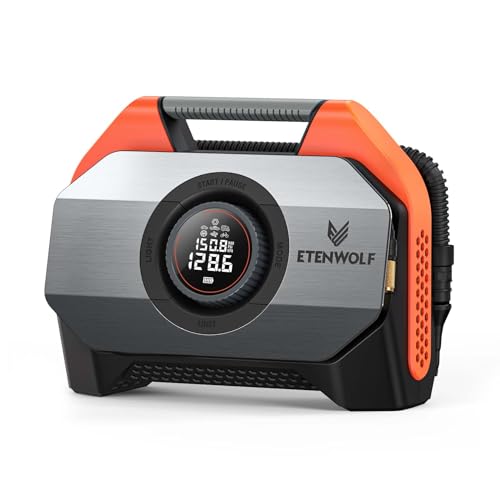
ETENWOLF VORTEX S6 Cordless Air Compressor
Strengths
- Dual-cylinder cooling
- 100% duty cycle
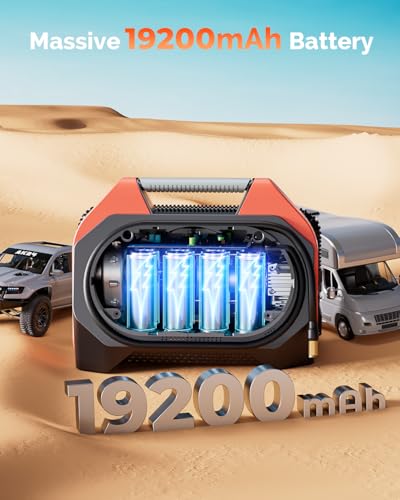
- 19200 mAh battery
- Auto-stop precision
- USB-C power bank
Trade-offs
- Heavy for portable use
- Bulky design
- Premium price
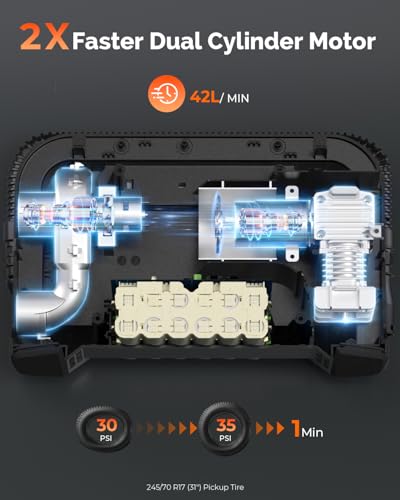
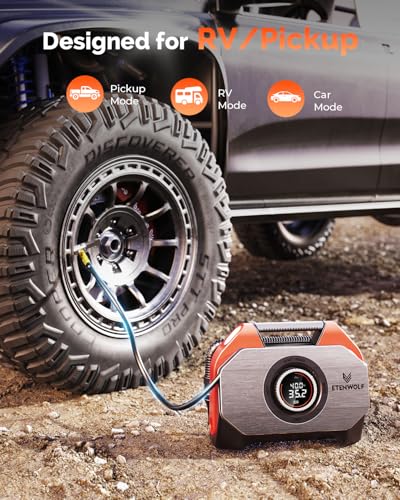
If you’re looking for a portable air compressor that can keep up with heavy-duty trucks and frequent tire top-offs without being chained to your vehicle’s battery, the ETENWOLF VORTEX S6 stands out. Its dual-cylinder design and 100% duty cycle mean it won’t overheat during back-to-back inflation sessions, something most cordless models can’t claim. On paper, the 1.5 CFM output and 19200 mAh battery are impressive, and owners consistently report filling large truck tires quickly, with many noting it handled four F-150 tires from flat to 35 PSI without issue.
The auto-stop feature with preset memory is a real time-saver, especially if you’re checking tire pressure regularly. It’s not just a tire inflator either, its USB-C port doubles as a power bank, and the 1000-lumen LED is bright enough to light up a campsite. While it’s bulky for a cordless unit, that’s the trade-off for the performance. Compared to the VIAIR 88P, this one wins on convenience and sustained output, though it’s heavier and pricier.
Product photos

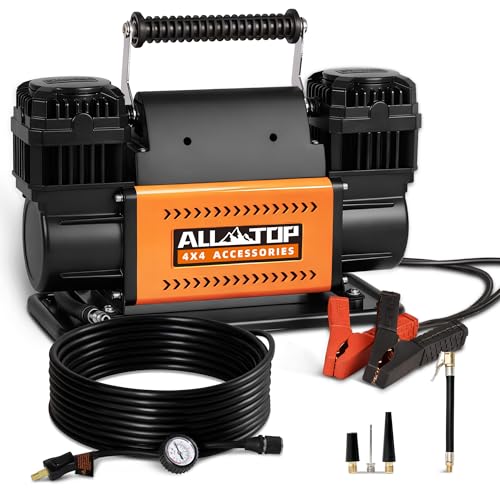
ALL-TOP Dual Cylinder Air Compressor
Strengths
- High CFM for large tires
- Dual aluminum cylinders
- 26 ft air hose
- 150 PSI max pressure
- Thermal overload protection
Trade-offs
- Very heavy
- No auto shut-off
- Basic design
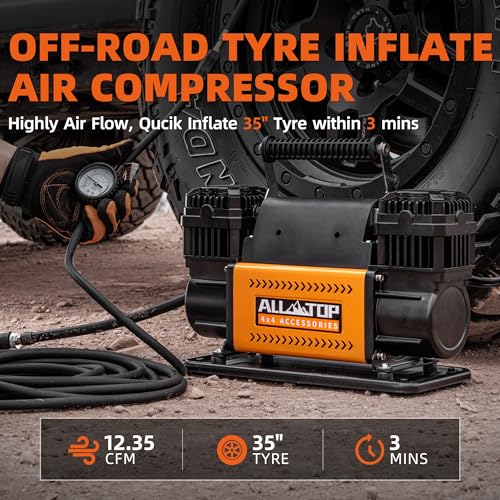
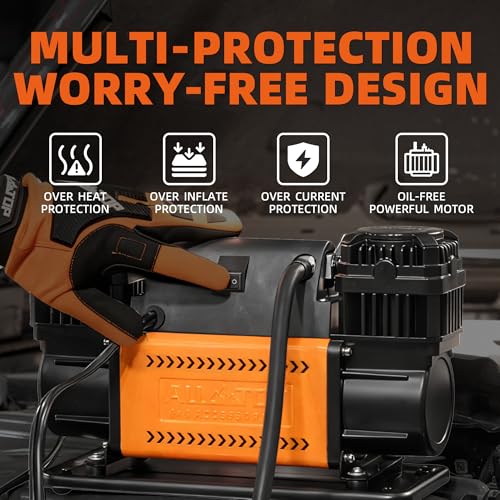
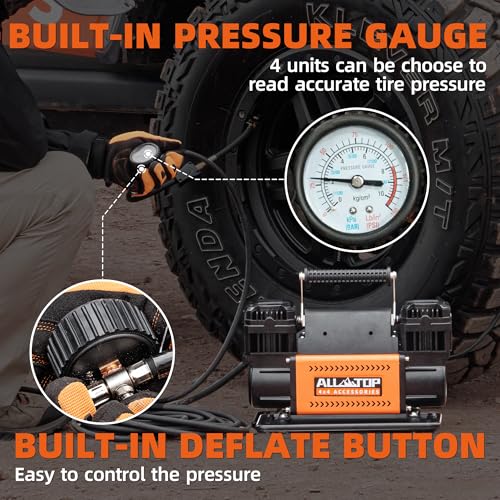
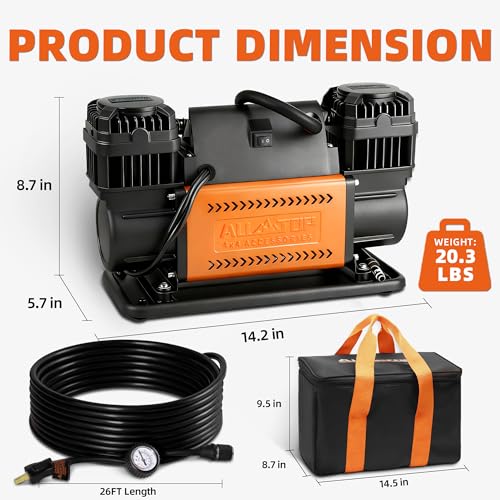
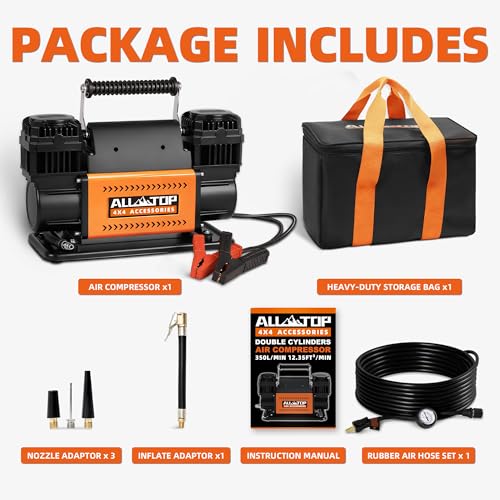
This is a brute of a unit, big, heavy, and built for users who prioritize raw power over portability. With a max output of 12.35 ft³/min (about 4.3 CFM) and 150 PSI max pressure, it’s spec’d for large truck and RV tires, making it a serious upgrade over typical 12V inflators. The dual aluminum cylinders and hollow metal shell help with heat dissipation, and the auto-thermal cutoff adds peace of mind during long runs. Owners using it on 4x4s and heavy trailers say it outperforms smaller units when inflating dualies or large off-road tires.
But it’s not subtle, the 24-pound weight and 26-foot hose make it more of a garage or job-site companion than something you toss in a backpack. It lacks the smart features of the ETENWOLF (no auto-stop, no battery), and the design feels utilitarian at best. Still, if you’re running oversized tires and need a compressor that won’t quit, this one delivers. It’s more powerful than the VIAIR 88P, but less mobile.
Product photos
VIAIR 88P Portable Compressor Kit

Strengths
- Rugged, field-tested build
- 16 ft air hose
- Reliable 12V performance
- Compact carry case
- Solid brass chuck
Trade-offs
- Requires vehicle battery
- 25-minute duty cycle
- No onboard battery
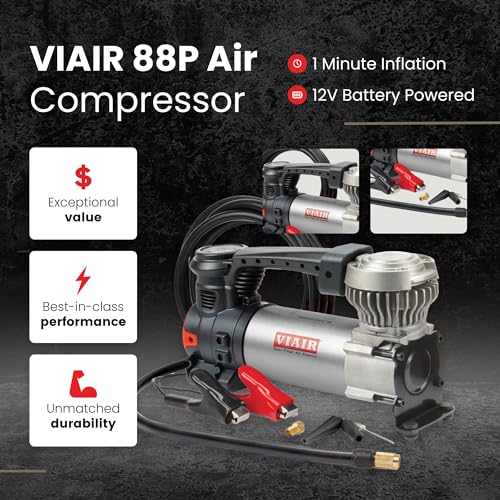
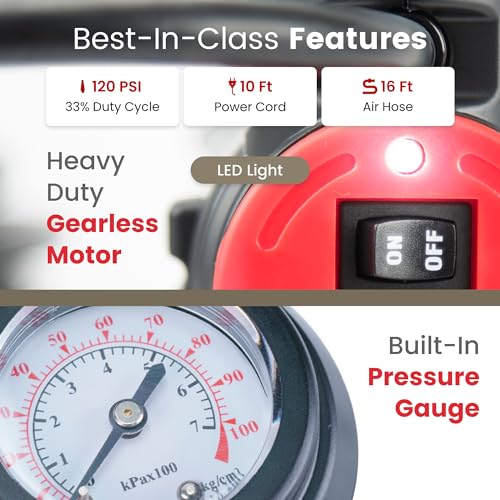
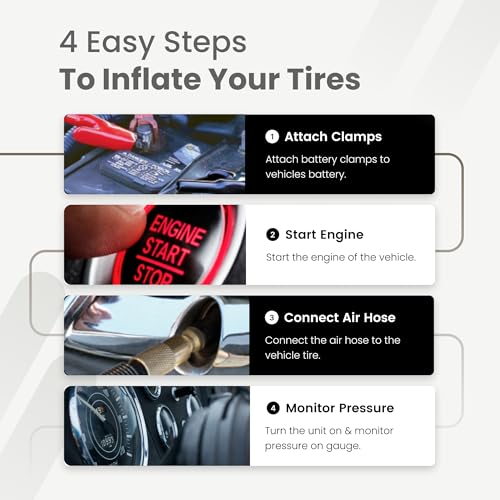
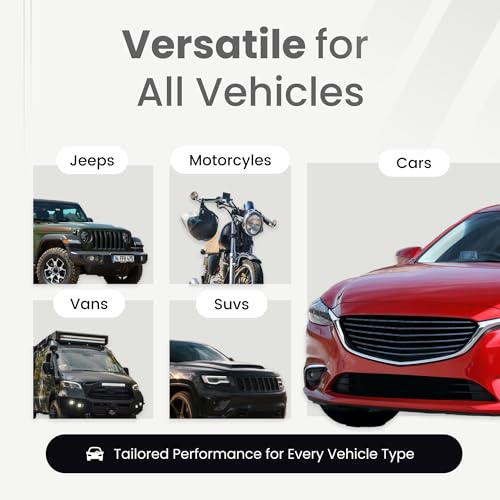
The VIAIR 88P feels like the kind of tool you toss in your Jeep and forget about, until you need it, and then it just works. It’s not flashy, but it’s built like a tank with a gearless motor and a rugged case, and reviewers often call it ‘the most reliable 12V compressor I’ve owned’. It runs off your vehicle’s battery with alligator clamps, which is a pro in off-road situations where portability and power matter more than cordless freedom. The 16-foot hose is a standout, long enough to reach all four tires without repositioning.
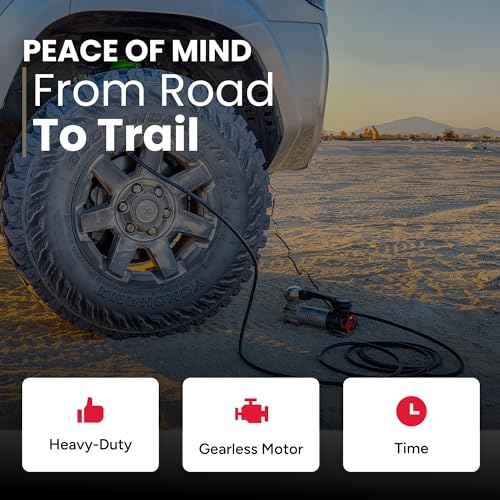
It’s slower than the ETENWOLF S6 on paper (1.47 CFM vs 1.5 CFM), but real-world feedback suggests it’s plenty fast for 33-inch tires, hitting 30 PSI from 20 in under a minute. Where it really shines is durability, VIAIR has a reputation for lasting years in harsh conditions, and this model backs that up. It’s not a replacement for a shop compressor, but for trail use or emergency top-offs, it’s hard to beat. I’d pick this over the ALL-TOP model for its proven track record and compact size.
Product photos
Our Testing Process
Rather than a hands-on lab test, my research for this guide focused on a detailed comparison of published specifications and features across numerous models. I weighed owner reviews from multiple sources – looking for consistent praise and complaints – alongside assessments from reputable automotive and tool review sites. My experience maintaining workshops and helping with vehicle repairs informed how I prioritized those specs and feedback.
For air compressors aimed at truck tires, consistent airflow (CFM) and maximum PSI are critical. A compressor needs to deliver sufficient volume to inflate large tires efficiently, and enough pressure to reach highway-recommended levels. Durability also factored heavily; truck tires often require inflation in demanding conditions, so build quality and cooling systems are important. You’ll find a lot of overlap in our recommendations with those in a thorough tire compressor guide.
Specifications reliably reveal a compressor’s potential output – CFM at 0 PSI is a key indicator of speed. However, owner feedback proved vital for gauging real-world performance and long-term reliability. I paid close attention to reports of overheating, duty cycle limitations, and gauge accuracy, factors not always apparent from spec sheets. Reputation and brand history played a role, too; established manufacturers often deliver more consistent quality and support.
How To Choose The air compressor for truck tires
Choosing the right air compressor for your truck tires can feel overwhelming, but focusing on a few key specs will make the process much easier.
A quality air compressor for truck tires prioritizes high airflow (CFM) at sufficient PSI to quickly inflate large-volume tires. Look for durable construction – particularly the pump and cylinders – and features like auto-stop to prevent overinflation. Battery-powered models need substantial amp-hour ratings for multiple tire inflations, and all compressors benefit from integrated cooling systems for continuous use.
Duty Cycle & Cooling
Many compressors advertise peak PSI, but that number means little if the unit overheats after inflating just one tire. A compressor’s duty cycle – the percentage of time it can run continuously – is critical, especially if you frequently air down for off-roading or have multiple tires to fill. Look for models with 100% duty cycle ratings, meaning they can run continuously without needing to cool down. These typically feature robust dual-cylinder designs, like the ALL-TOP Dual Cylinder Air Compressor, coupled with dedicated cooling systems. Don’t skimp here; a cheap compressor that can’t handle the task is just a waste of money.
Power Source & Portability
Deciding between a corded or cordless model is a fundamental choice. Corded compressors offer consistent power and are generally more powerful for the price, but require proximity to a 12V outlet (or an extension cord if using a household AC-to-DC adapter). Cordless models, like the ETENWOLF VORTEX S6 Cordless Air Compressor, provide ultimate freedom and are ideal for remote locations. However, battery capacity is a major consideration. Here’s what I look for in cordless options: * A large battery (15Ah or greater) for multiple inflations. * Fast charging capabilities (USB-C PD is a plus). * The ability to function while charging, avoiding downtime.
A good rule of thumb: for serious off-roaders, a dedicated 12V compressor with a high CFM rating and a robust construction is preferable to relying on a multi-tool compressor for emergency situations.
Flow Rate (CFM) and Tire Size
The CFM (cubic feet per minute) rating dictates how quickly a compressor can inflate a tire. Larger tires require significantly more CFM. For standard truck tires (around 31-33 inches), a compressor delivering at least 1.0 CFM @ 0 PSI is a good starting point. If you run larger tires (35 inches or bigger) or frequently air down for off-roading, you’ll want to prioritize models with 1.5 CFM or higher, like the VIAIR 88P Portable Compressor Kit. Underestimating CFM leads to long inflation times and potential motor overheating. I’ve seen too many folks purchase a unit that simply can’t keep up with their tire size, resulting in frustration and a return trip to the store for truck tire inflator models.
Air Compressor for Truck Tires Compared
Here’s a comparison of specifications for air compressors designed for truck tires, to help you evaluate your options.
| Product Title | Max PSI | Airflow (CFM @ 0 PSI) | Power Source | Duty Cycle | Battery Capacity |
|---|---|---|---|---|---|
| ETENWOLF VORTEX S6 | 160 | 1.5 | Cordless | 100% | 19200 mAh |
| ALL-TOP Dual Cylinder | 150 | 12.35 | 120V | N/A | N/A |
| VIAIR 88P | 120 | 1.47 | 12V | 25 min | N/A |
Frequently Asked Questions
What PSI should I use to inflate my truck tires?
Typically, 35 PSI is a good starting point for most truck tires, but you should always check the sticker on your driver’s side doorjamb or your owner’s manual for the manufacturer’s recommended pressure. Using the correct PSI maximizes fuel efficiency and tire life.
How long do cordless air compressors take to charge?
Charging times vary greatly, but expect between 3-6 hours for a full charge with a standard wall outlet. Many newer models now support fast charging via USB-C Power Delivery (PD), reducing charge times to as little as 2 hours.
Can I use a standard air compressor for car tires on my truck?
While you can use a car tire compressor on a truck, it will take significantly longer to inflate the larger volume of truck tires. For consistently efficient inflation, especially with larger tires, a compressor specifically designed for truck tires – or a powerful inflators for large tires – is a better investment.
What does CFM @ 0 PSI actually mean?
CFM at 0 PSI measures the compressor’s airflow when the pressure is at its lowest. This is the most useful CFM specification because it indicates how quickly the compressor can initially fill a tire, which is when it works the hardest.
Are more expensive air compressors always better?
Not necessarily. While a higher price often indicates better build quality and features, it’s crucial to focus on specifications like CFM and PSI that align with your needs. A well-reviewed, moderately priced model with sufficient airflow can often outperform a more expensive unit that lacks the necessary power for your truck’s tires.
The Bottom Line
Choosing an air compressor for truck tires often comes down to balancing convenience with capability. While cordless options offer freedom, the ETENWOLF VORTEX S6 stands out for its powerful inflation and substantial battery, making it a strong all-around performer for most truck owners. It delivers a good blend of power and portability, which is key for many drivers.
If you need raw power for large tires or frequent use, the ALL-TOP Dual Cylinder Air Compressor is an excellent choice, and for those prioritizing a dedicated 12V solution, particularly for off-roading, the VIAIR 88P Portable Compressor Kit delivers consistent performance. For owners seeking portable air compressors for SUV and truck tires, these represent the best choices in their respective categories.
Ultimately, the specs matter, but don’t get lost in the numbers. Prioritize a compressor with sufficient CFM for your tire size, a durable build for long-term reliability, and a power source that fits your needs. A compressor is only as good as its ability to deliver consistent airflow and pressure, so focusing on those fundamentals will serve you better than chasing the highest PSI rating alone.
