How to Start a Chainsaw Safely for All Types (Gas, Electric)
This post contains affiliate links. As an Amazon Associate, we earn from qualifying purchases.
To start a chainsaw, you must match three things: the correct startup sequence for your saw’s power source (gas, battery, or corded electric), a full set of personal protective equipment (PPE), and a stable, clear work area. The chain brake must be engaged before every start, and the saw must be pinned to the ground—never started while held in the air.
Most people get this wrong by rushing the prep. They skip the gear, fumble with the controls, and yank the starter cord while the saw wobbles on its side. That’s how kickback happens before the chain even moves.
This guide walks through the exact steps for gas, electric, and battery chainsaws. It covers the safety non-negotiables, what to do when the engine won’t fire, and the maintenance checks that prevent most starting problems before you pull the cord.
Key Takeaways
- Never start a chainsaw without the chain brake engaged. This is the primary safety feature that prevents the chain from spinning at startup.
- Always start a gas chainsaw on the ground, stabilized with your foot through the rear handle. Drop-starting (holding it in the air) is a guaranteed way to lose control.
- Use fresh, properly mixed fuel. Stale gas or an incorrect oil ratio is the leading cause of hard starting in gas models after storage.
- Your PPE is not optional. Kevlar chainsaw chaps can stop a moving chain in milliseconds, and ANSI Z87.1-rated goggles protect your eyes from flying wood chips and oil.
- If a gas saw floods, turn off the ignition, set the choke to the run position, open the throttle fully, and pull the starter cord 10-15 times to clear the cylinder. Then restart normally.
Essential Safety Gear and Workspace Setup
You cannot start the saw until the area and your person are ready. This isn’t a formality. A chainsaw is one of the most dangerous tools in the shop, and the moment of startup is when you’re most vulnerable to a slip.
Your Personal Protective Equipment (PPE) kit is your first layer of defense. A hard hat protects from falling branches. Hearing protection is mandatory—a gas chainsaw operates at 100-110 decibels, enough to cause permanent hearing damage in minutes.
Cut-resistant gloves improve grip and protect your hands. Steel-toe boots guard your feet from dropping the saw or a rolling log. Long, snug-fitting pants prevent loose fabric from catching in the mechanism.
The most critical piece is Kevlar chainsaw chaps or pants. The outer layer tears easily on contact, pulling hundreds of Kevlar fibers into the chain’s drive links. This jams the sprocket and stops the chain in fractions of a second.
I learned this the hard way trimming a fallen oak. The saw kicked back off a hidden nail and glanced my thigh. The chaps shredded, but my leg had only a scratch. Without them, it would have been a trip to the emergency room.
Before you start: The two deadliest mistakes at startup are ignoring the chain brake and starting the saw in an unstable position. A disengaged brake lets the chain spin at idle, which can grab loose clothing or cause a fall. Starting a gas saw while holding it, rather than pinning it to the ground, removes your leverage if it kicks or the engine surges.
Clear your work area in a 15-foot radius. Move rocks, branches, tripping hazards, and garden hoses. Ensure no bystanders, especially children or pets, are within this zone. Your escape path should be clear behind you. Check overhead for dead branches or power lines.
What’s the Difference Between Starting Gas, Electric, and Battery Chainsaws?
The core safety steps are identical, but the mechanics differ. A gas chainsaw is a small, finicky engine that needs a precise fuel-air mix. An electric chainsaw (corded or battery) is essentially a powerful motor with an on/off switch.
Gas models require the most steps and are the most common source of user error. You’re managing a choke, a primer, a throttle lock, and a pull cord. Electric models are simpler: connect power, engage the brake, and pull the trigger. Battery models add the step of ensuring the battery is charged and properly seated.
The consequence of confusing them is a no-start or a flooded engine. Trying to start a gas saw with the choke in the wrong position for its temperature will either flood it or starve it. Trying to start an electric saw without depressing the safety interlock will do nothing.
| Power Source | Primary Starting Step | Most Common User Error | Typical Time to Start |
|---|---|---|---|
| Gasoline (2-cycle) | Pull-start cord with choke sequence | Incorrect choke setting (cold vs. warm) | 3-5 pulls when cold |
| Battery Electric | Insert battery, press trigger | Dead or unseated battery | Instant |
| Corded Electric | Plug in cord, press trigger | Not engaging chain brake first | Instant |
The right tool for the job matters. For a 30-minute cleanup of small branches, a battery saw eliminates the fuel hassle. For felling a 24-inch oak, you need the sustained power of a gas prosumer model like the Husqvarna 450. Their startup procedures reflect that design intent.
How Do You Start a Gas-Powered Chainsaw?
This is the procedure that frustrates most new users. Follow it in order, without skipping.
Starting a cold gas-powered chainsaw requires a specific control sequence: engage the chain brake, set the master control lever to the choke position, press the fuel primer bulb 5-7 times, press the decompression valve (if equipped), and pull the starter cord with a smooth, fast motion until the engine fires. After the first ‘pop,’ move the control lever to the half-throttle position and pull again to start.
Step 1: Pre-Start Inspection. Check the chain tension. It should be snug against the bar but still pull freely by hand. Inspect the bar for damage and ensure the oiler port is clear. Check the air filter—a clogged filter starves the engine. Verify the chain brake moves freely and snaps forward to engage. This is also the time for chainsaw maintenance tips, like ensuring the chain is sharp. A dull chain makes the engine labor and is more likely to kick back.
Step 2: Fuel and Stabilization. Use fuel mixed within the last 30 days. For most modern saws, that’s a 50:1 ratio (2.6 oz of 2-cycle oil per gallon of 89+ octane gas). I keep a dedicated mixing bottle with ratio markings to avoid mistakes. Place the saw on flat ground. Insert your right foot through the rear handle, pinning the saw firmly. Keep the bar tip pointing away from you and clear of any object.
Step 3: The Cold-Start Sequence.
- Engage the chain brake by pushing the guard forward until it clicks.
- Activate the master control switch or lever to the “On” or “Run” position.
- Set the choke lever to the full “Choke” position (usually a symbol of a closed valve).
- Press the decompression valve button, if your saw has one. This reduces cylinder pressure for easier pulling.
- Press the primer bulb firmly until you see fuel fill the clear line (usually 5-7 presses).
- With your left hand on the front handle, pull the starter cord smoothly and briskly. Don’t yank it to its full length; use a 12-18 inch pull. Repeat until the engine briefly “pops” or runs for a second.
- Immediately move the choke lever to the half-throttle or “Fast Idle” position.
- Pull the starter cord again. The engine should start and run at a high idle.
Step 4: Warm-Up and Final Check. Let the engine run for 30-60 seconds. Disengage the chain brake by pulling the guard back toward you. Hold the saw over a light surface (a piece of cardboard or a leaf). You should see a fine spray of oil being flung from the chain. No oil means the lubrication system is blocked—shut down and fix it before cutting.
What happens if you skip a step? If you forget the chain brake, the chain will spin at idle speed. If you leave the choke on after the engine pops, it will flood. If you don’t pin the saw with your foot, the engine torque can twist it out of your hands on the first pull.
Starting Electric and Battery-Powered Chainsaws
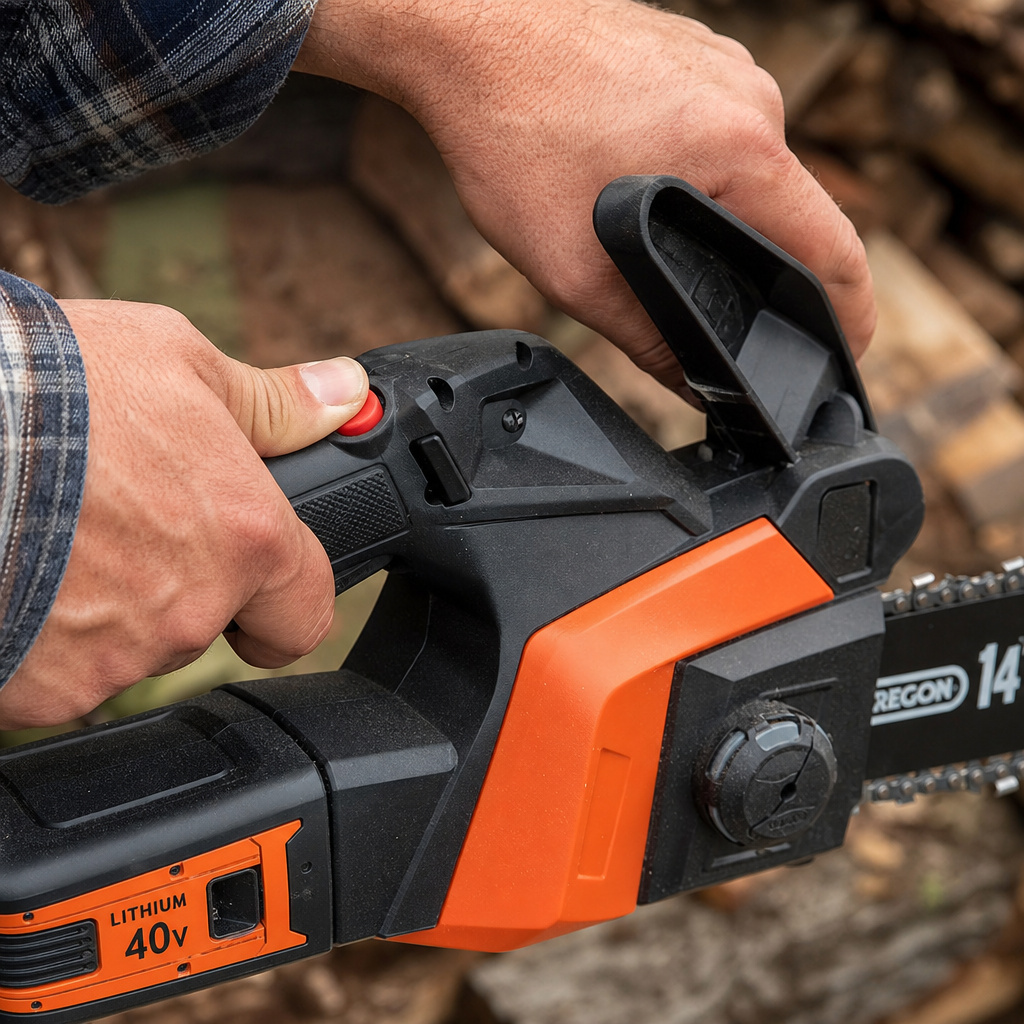
The process is simpler, but the fundamental safety rule remains: chain brake first. The lack of a pull cord makes people complacent.
For corded electric models, first plug the cord into a Ground Fault Circuit Interrupter (GFCI) outlet. For battery models, insert a fully charged battery until it clicks and locks.
Engage the chain brake by pushing the front hand guard forward. You will now need to perform a two-action start: depress the safety lockout lever or button (usually with your left thumb), then squeeze the main trigger. The motor will spin, but the chain will remain stationary until you deliberately disengage the chain brake.
The main advantage here is consistency. There’s no choke, no flood risk, no stale fuel. The main risk is forgetting that the chain brake is a mechanical lock.
I’ve seen users force the trigger, thinking the saw is broken, when they simply never released the brake. Also, always check that the cord is behind you and not in your cut line. Cutting through your own power cord is a spectacular and dangerous failure.
Troubleshooting: Why Won’t My Chainsaw Start?
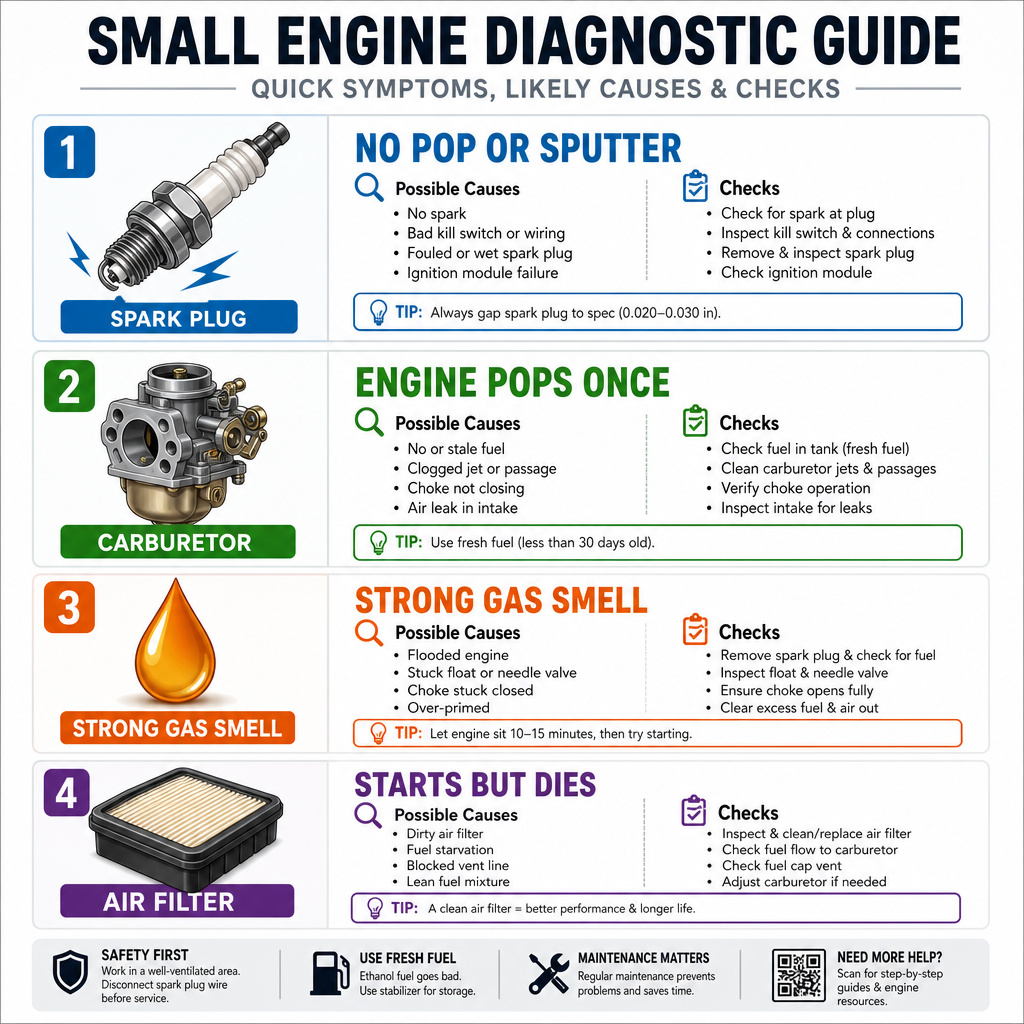
If you’ve followed the sequence and the saw won’t start, work through this diagnostic list. The most common culprit is fuel-related.
The engine doesn’t pop or sputter.
- Cause: No spark or no fuel delivery.
- Check: Ignition switch, spark plug connection, and fuel flow. Is the fuel line cracked? Is the spark plug fouled? A plug fouled by old, oily gas is a classic issue after winter storage.
The engine pops once but doesn’t run.
- Cause: Usually a clogged carburetor jet or incorrect choke sequence.
- Check: Did you move the choke to half-throttle after the first pop? If yes, the carburetor may need cleaning, especially if the saw has old fuel in it.
The engine is flooded (smells strongly of gas).
- Cause: Too much fuel in the combustion chamber, often from over-priming or leaving the choke on.
- Fix: Turn the ignition off. Set the choke to the “Run” position (no choke). Hold the throttle trigger fully open. Pull the starter cord 10-15 times. This draws air through the cylinder to clear the excess fuel. Then attempt a normal start without using the primer.
The engine starts but dies when the chain brake is released.
- Cause: A badly misadjusted idle speed screw or a dirty air filter.
- Check: Let the saw warm up fully. With the chain brake engaged, try adjusting the idle screw (marked ‘LA’ or ‘I’ on the carburetor) a quarter-turn clockwise. If that doesn’t help, clean or replace the air filter.
| Symptom | Most Likely Cause | Immediate Action | Severity |
|---|---|---|---|
| No response to pulling cord | Ignition off, brake not engaged, dead battery | Check master switch, ensure chain brake is engaged, verify battery charge | Low |
| Engine pops once, then nothing | Clogged carburetor, stale fuel | Move choke to half-throttle, attempt start 2-3 more times | Medium |
| Strong gas smell, won’t start | Flooded engine | Follow flood-clearance procedure (throttle open, pull cord repeatedly) | Medium |
| Starts but dies at idle | Dirty air filter, low idle speed | Clean air filter, adjust idle screw slightly clockwise | Low |
For persistent issues, especially fuel system problems, consult your power saw basics guide for foundational operation principles. If the saw has been stored with fuel over the winter, you will likely need to drain the tank and carburetor, replace the fuel filter, and install a new spark plug.
Pre-Season and Storage Startup Checklist
A chainsaw that’s been sitting for months needs more than just fresh gas. Follow this list before your first serious cut of the season.
- Drain Old Fuel: Completely empty the fuel tank and the carburetor bowl. Stale fuel forms varnish that clogs tiny jets.
- Replace Fuel Filter: The in-tank filter degrades over time. A clogged filter causes fuel starvation.
- Inspect and Clean the Air Filter: Tap it out or wash it (if foam). A dirty filter chokes the engine.
- Check Spark Plug: Remove it. The electrode should be light tan, not black and sooty. Replace if fouled.
- Inspect Chain and Bar: Look for damaged, cracked, or overly worn drive links. Dress the bar rails with a flat file if they are burred.
- Verify Oil Pump Flow: Start the saw (after all checks) and hold it over cardboard. You must see an oil line.
- Tighten All External Fasteners: Vibration loosens nuts and bolts. Check handlebar mounts, clutch cover, and bar nuts.
Neglecting storage prep is why most “winter kill” happens. The fuel goes bad, the filter gums up, and the user blames the tool. I made this mistake with an Echo CS-310 I left in the shed over a wet winter. The spring startup took an hour of carb cleaning. Now I run the tank dry and add fuel stabilizer for any planned storage over 30 days.
Frequently Asked Questions
Do you start a chainsaw with the brake on or off?
Always start with the chain brake engaged. This is the primary safety lock that prevents the chain from rotating. The brake must be clicked fully forward into the locked position before you pull the starter cord or press the trigger.
How many pulls should it take to start a chainsaw?
properly tuned gas chainsaw should start within 3-5 pulls when cold, and 1-2 pulls when warm. If it takes 10+ pulls, there is likely an issue with fuel, spark, or air. Stop and diagnose; repeated pulling without starting often floods the engine.
Why does my chainsaw start but then stop?
This is usually caused by a clogged fuel filter, a dirty carburetor, or an incorrect idle speed setting. The engine gets enough fuel to start from the primer but then starves. Clean the fuel system and check the idle adjustment screw. A dirty air filter can also cause this.
Can I use regular gas in my chainsaw?
No. You must use fresh, unleaded gasoline with a minimum 89 octane rating, mixed with the correct amount of high-quality 2-cycle engine oil. Never use ethanol-blended fuel (E15 or E85) if you can avoid it, as ethanol attracts moisture and degrades fuel lines. Always mix fuel for the exact ratio specified in your manual (e.g., 50:1).
The Bottom Line
Starting a chainsaw safely is a deliberate, mechanical ritual. It demands respect for the tool, the environment, and your own body. Gear up completely, every single time. Pin the gas saw to the earth. Engage that chain brake. Follow the cold-start sequence without rushing.
The difference between a routine job and an accident is often a single skipped step. That step is almost always a safety one—the forgotten brake, the missing chaps, the unstable stance. Master the startup procedure so it becomes muscle memory. That way, your focus is free for the complex task of cutting, not on wondering if you primed the bulb enough times. The saw is a powerful ally, but only if you’re in control from the very first pull.
{
“@context”: “https://schema.org”,
“@type”: “HowTo”,
“name”: “How to Start a Chainsaw Safely: Gas, Electric, and Battery Models”,
“totalTime”: “PT10M”,
“tool”: [
{
“@type”: “HowToTool”,
“name”: “Gas-powered chainsaw (e.g., STIHL MS 170, Husqvarna 450)”
},
{
“@type”: “HowToTool”,
“name”: “Battery-powered or corded electric chainsaw”
},
{
“@type”: “HowToTool”,
“name”: “Flat file or chainsaw sharpening kit”
},
{
“@type”: “HowToTool”,
“name”: “Fuel mixing bottle with ratio markings”
}
],
“supply”: [
{
“@type”: “HowToSupply”,
“name”: “Fresh 2-cycle engine oil and 89+ octane gasoline”
},
{
“@type”: “HowToSupply”,
“name”: “Bar and chain lubricating oil”
},
{
“@type”: “HowToSupply”,
“name”: “Personal Protective Equipment (PPE) kit”
}
],
“step”: [
{
“@type”: “HowToStep”,
“name”: “Gear up and clear the area”,
“text”: “Put on all Personal Protective Equipment (PPE): hard hat, safety glasses, hearing protection, cut-resistant gloves, long pants, steel-toe boots, and Kevlar chainsaw chaps. Clear a 15-foot radius of people, pets, and tripping hazards.”
},
{
“@type”: “HowToStep”,
“name”: “Inspect the chainsaw”,
“text”: “Check chain tension (should be snug but pull freely), bar lubrication, and air filter. Ensure the chain brake is engaged. For gas models, verify you have fresh, properly mixed fuel (typically a 50:1 ratio).”
},
{
“@type”: “HowToStep”,
“name”: “Stabilize the saw on the ground”,
“text”: “Place the chainsaw on flat, level ground. For gas saws, place your right foot through the rear handle to pin it down. Keep the bar tip clear of any dirt, rocks, or debris.”
},
{
“@type”: “HowToStep”,
“name”: “Start the engine (Gas Model)”,
“text”: “Activate the master control switch. Press the decompression valve if equipped. Set the choke to the cold-start position. Press the primer bulb 5-7 times. Pull the starter cord with a smooth, fast motion until the engine ‘pops.’ Disengage the choke to half-throttle, then pull again to start.”
},
{
“@type”: “HowToStep”,
“name”: “Start the engine (Electric/Battery Model)”,
“text”: “Insert a charged battery or connect the power cord. Engage the chain brake. Depress the safety lockout trigger with your left thumb, then squeeze the main trigger with your right hand. The chain will not spin until you release the chain brake.”
},
{
“@type”: “HowToStep”,
“name”: “Warm up and final check”,
“text”: “Allow a gas engine to idle for 30-60 seconds. Check that oil is visibly being flung from the chain onto a light surface (like a piece of cardboard). Disengage the chain brake only when you are in position and ready to make your first cut.”
}
]
}
{
“@context”: “https://schema.org”,
“@type”: “FAQPage”,
“mainEntity”: [
{
“@type”: “Question”,
“name”: “Do you start a chainsaw with the brake on or off?”,
“acceptedAnswer”: {
“@type”: “Answer”,
“text”: “Always start with the chain brake engaged. This is the primary safety lock that prevents the chain from rotating. The brake must be clicked fully forward into the locked position before you pull the starter cord or press the trigger.”
}
},
{
“@type”: “Question”,
“name”: “How many pulls should it take to start a chainsaw?”,
“acceptedAnswer”: {
“@type”: “Answer”,
“text”: “properly tuned gas chainsaw should start within 3-5 pulls when cold, and 1-2 pulls when warm. If it takes 10+ pulls, there is likely an issue with fuel, spark, or air. Stop and diagnose; repeated pulling without starting often floods the engine.”
}
},
{
“@type”: “Question”,
“name”: “Why does my chainsaw start but then stop?”,
“acceptedAnswer”: {
“@type”: “Answer”,
“text”: “This is usually caused by a clogged fuel filter, a dirty carburetor, or an incorrect idle speed setting. The engine gets enough fuel to start from the primer but then starves. Clean the fuel system and check the idle adjustment screw. A dirty air filter can also cause this.”
}
},
{
“@type”: “Question”,
“name”: “Can I use regular gas in my chainsaw?”,
“acceptedAnswer”: {
“@type”: “Answer”,
“text”: “No. You must use fresh, unleaded gasoline with a minimum 89 octane rating, mixed with the correct amount of high-quality 2-cycle engine oil. Never use ethanol-blended fuel (E15 or E85) if you can avoid it, as ethanol attracts moisture and degrades fuel lines. Always mix fuel for the exact ratio specified in your manual (e.g., 50:1).”
}
}
]
}
