
What is a Radial Arm Saw Used For? (The Complete Truth)
This post contains affiliate links. As an Amazon Associate, we earn from qualifying purchases.
A radial arm saw is a stationary woodworking tool where a circular saw blade is mounted on a motorized carriage that slides along a horizontal arm suspended over a work table. This design lets the blade move across a stationary workpiece, making it uniquely capable of precise crosscuts, dadoes, rabbets, and compound angle cuts in one machine. Its versatility stems from the arm’s ability to pivot, the blade’s ability to tilt, and the carriage’s ability to travel.
Most people think of it as a giant, dangerous crosscut saw. That’s not wrong, but it misses the point. The real mistake is trying to use it like a table saw for every rip cut, or ignoring the specific safety rules its design demands. You can get hurt fast if you treat it like any other saw.
This guide walks through exactly what a radial arm saw does, where it shines, where it can bite you, and why a tool invented a century ago still has a die-hard following in modern shops. We’ll cover the cuts, the comparisons, and the non-negotiable safety steps.
Key Takeaways
- The radial arm saw’s superpower is the stationary workpiece. You can crosscut a 12-foot board alone because you’re not wrestling the board, just pulling the saw.
- Its most dangerous and most common operation is the crosscut, which is a “climb cut.” The blade rotation tries to pull the carriage forward into the workpiece, requiring constant control.
- For ripping lumber, you must rotate the blade 90 degrees, lock it, and use anti-kickback pawls and a featherboard. It’s a table saw operation performed on a less optimal tool.
- New models are rare and expensive. Most shop owners find value in refurbishing vintage DeWalt or Craftsman units from the 1970s and 80s, which were built like tanks.
- While it can do many jobs, it’s often slower to set up for compound angles than a miter saw and less efficient for ripping than a table saw. Its best role is as a dedicated crosscut and dado station.
What is a Radial Arm Saw? The Core Design
Look at a radial arm saw and you see the arm first. It’s a horizontal beam, anchored to a vertical column at the rear of the machine. The motor and blade assembly rides on this arm via a carriage.
You pull this carriage by hand along the arm’s track to make a cut. The entire arm can pivot left and right for miter angles, and the motor can tilt for bevel cuts. The workpiece sits flat on the table and is held against a fence at the back.
The defining mechanical principle is the moving cutter over a fixed workpiece. This inverts the operation of a table saw, where the workpiece moves past a fixed blade. This inversion is why the radial arm saw excels at crosscutting long, heavy, or wide stock that would be cumbersome to maneuver on a table saw.
The concept isn’t new. Raymond DeWalt patented the modern radial arm saw in 1922. His original DeWalt “Wonder-Worker” was a revolution for production shops, allowing one machine to handle multiple cutting operations. For decades, it was the undisputed king of the crosscut. Walk into any professional cabinet shop or millwork house from the 1950s through the 1980s, and you’d see a line of them, often with dedicated operators.
The feel of using one is distinct. There’s the weight of the carriage as you pull it, the specific whine of the motor traveling on the track, and the need to consciously return the saw to the rear after every cut. It demands a different rhythm than other stationary saws.
What Cuts Can a Radial Arm Saw Make?
Its versatility is legendary. With the correct setup and accessories, a single radial arm saw can replace several other tools. Here’s the breakdown of its core capabilities.
Crosscuts (The Primary Job)
This is the radial arm saw’s home turf. You set the arm at 0 degrees (perpendicular to the fence), lock it, and pull the blade straight through the wood. The cut is exceptionally clean and accurate when the saw is well-tuned. The advantage is handling capacity. You can crosscut a sheet of plywood in the middle with ease, or trim the end of a long heavy timber without needing outfeed support.
The critical detail everyone misses is the climb-cut. On a crosscut, the blade is oriented so its teeth at the front of the cut are moving downward. This pinches the workpiece against the table, which is good.
But because you are pulling the blade into the workpiece, the rotational force of the blade wants to help you, pulling the carriage forward. If you lose control, the saw can self-feed violently. That’s why you never just “let go” mid-cut. You maintain a firm, controlling pull and a deliberate return.
Dadoes and Rabbets
With a dado blade stack (a set of chipper blades between two outer blades), the radial arm saw becomes a potent groove-cutting machine. You lock the carriage in place over the table, then feed the workpiece past the spinning dado stack to plow out a channel. It’s perfect for shelf dados in cabinet sides or tenon cheeks. You need a saw with enough arbor length and horsepower; a 10-inch saw typically handles a 1-inch wide dado, but check your model’s specs.
Miter, Bevel, and Compound Cuts
- Miter Cuts: Pivot the entire arm left or right to your desired angle (e.g., 45 degrees). The blade travel arc is now angled relative to the fence.
- Bevel Cuts: Tilt the motor and blade assembly to the desired angle. The blade now cuts on a slant.
- Compound Cuts: Combine a miter and a bevel. This is where setup time increases. You’re adjusting both the arm angle and the blade tilt, then making test cuts to dial it in. A modern compound miter saw does this faster and easier, but the radial arm saw can do it.
Ripping (The Advanced, Caution-Required Operation)
To rip (cut along the grain), you must reconfigure the saw. You rotate the motor 90 degrees so the blade is parallel to the fence, lock it securely, and often lower the blade guard assembly. The workpiece is then fed into the blade, similar to a table saw.
Before you start any ripping operation: Install and adjust the anti-kickback pawls. These are spring-loaded teeth that ride on the workpiece but dig in if the wood tries to kick back. Also, use a featherboard clamped to the table to hold the stock firmly against the fence. Ripping on a radial arm saw exposes you to a wider open blade and a less rigid cutting platform than a table saw. It requires your full attention.
I learned this the hard way ripping a long 2×4 on an old Craftsman. I didn’t tighten the motor pivot lock enough after rotating it. Halfway through the cut, the motor torqued, the blade bound, and the board shot back like a missile, putting a dent in the garage door behind me. The lock had a quarter-turn of play I’d ignored. Now I check it twice and push the lock with my hip for extra leverage.
Radial Arm Saw vs. Table Saw vs. Miter Saw: Which Should You Use?
This is the real question for anyone setting up a shop. Each tool has a strength. The table saw is the undisputed champion of the rip cut.
The miter saw is the quick-change artist for trim and repeated angle cuts. The radial arm saw is the versatile specialist for crosscuts and joinery. Trying to make one tool do everything leads to frustration and risk.
| Tool | Best For | Biggest Weakness | Workspace Footprint |
|---|---|---|---|
| Radial Arm Saw | Precision crosscuts, dadoes/rabbets, handling wide/long stock | Slower setup for angles, less safe/optimal for ripping | Long rear clearance needed for arm travel. |
| Table Saw | Ripping, sheet goods, repeatable cuts with a fence | Crosscutting wide/long boards safely | Large, needs infeed/outfeed space. |
| Compound Miter Saw | Fast miters, bevels, compound cuts, trim work | Limited crosscut width (~12″), cannot rip | Compact, fits on a bench. |
The radial arm saw occupies a unique middle ground. If you only have space for one stationary saw and your work is 80% cutting boards to length and making dadoes for shelves, it’s a compelling choice. Its ability to act as a circular saw for plywood on a grand scale is a huge benefit for cabinetry.
But if you’re doing framing or breaking down sheets of plywood, a table saw and a circular saw operation for rough cuts is a better combo. And for installing baseboard or crown molding, a good compound miter saw is untouchable for speed.
Critical Safety Practices You Cannot Skip
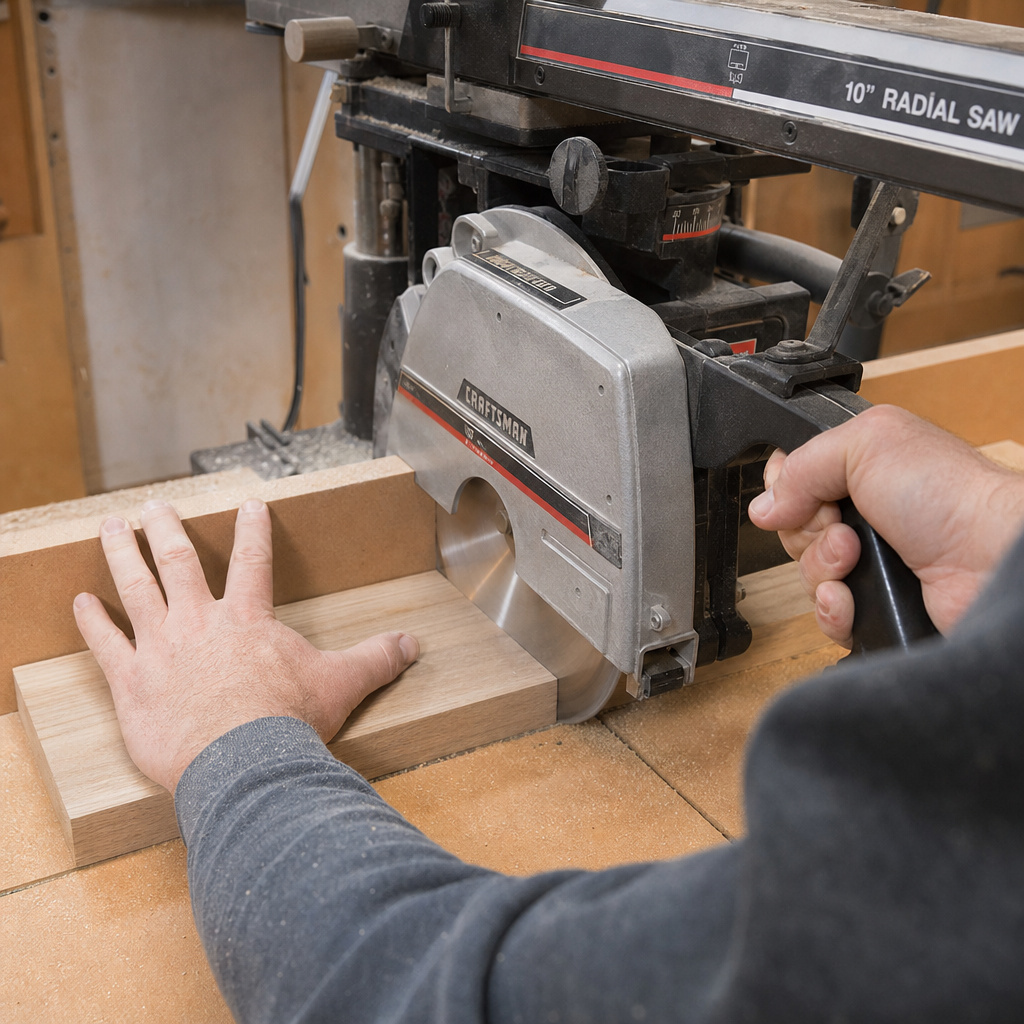
The radial arm saw has earned a reputation, and not without reason. Its design presents inherent hazards that must be managed with strict discipline. This isn’t about being scared; it’s about being smart.
- Maintain a Sharp, Appropriate Blade. Use a blade with a low or negative hook angle (around -5 degrees) for crosscutting. This reduces the aggressive self-feeding “climb” tendency. A dull blade requires more force to pull, increasing the chance of loss of control.
- Always Use a Zero-Clearance Fence. The stock fence has a wide gap for the blade to pass through. Replace it with a wooden fence face that you cut into with the saw. This supports the workpiece fibers at the cut line, preventing tear-out and, more importantly, keeping small offcuts from falling into the gap and being launched back at you.
- Control the Carriage with Two Hands. For a crosscut, your left hand holds the workpiece against the fence, away from the blade path. Your right hand pulls the carriage. After the cut, your right hand immediately returns the carriage fully to the rear position. Never reach near the blade path while the carriage is forward.
- Never Use the Saw for Freehand Cutting. The workpiece must always be held firmly against the fence. The radial arm saw is not a bandsaw or jigsaw. Any attempt to “steer” a workpiece during a cut will bind the blade.
- Implement a Strict One-Person Rule. No one else should be near the table while the saw is running. Do not allow someone to help support a long piece on the outfeed side. They can’t see the blade and the risk is too high.
If you smell burning wood during a crosscut, you’re feeding too slowly or the blade is dirty. The friction heat can glaze the cut and create a fire risk over time. Stop, let the blade cool, clean the pitch off with a dedicated cleaner, and increase your pull speed slightly on the next cut.
Is a Radial Arm Saw Right for Your Shop?
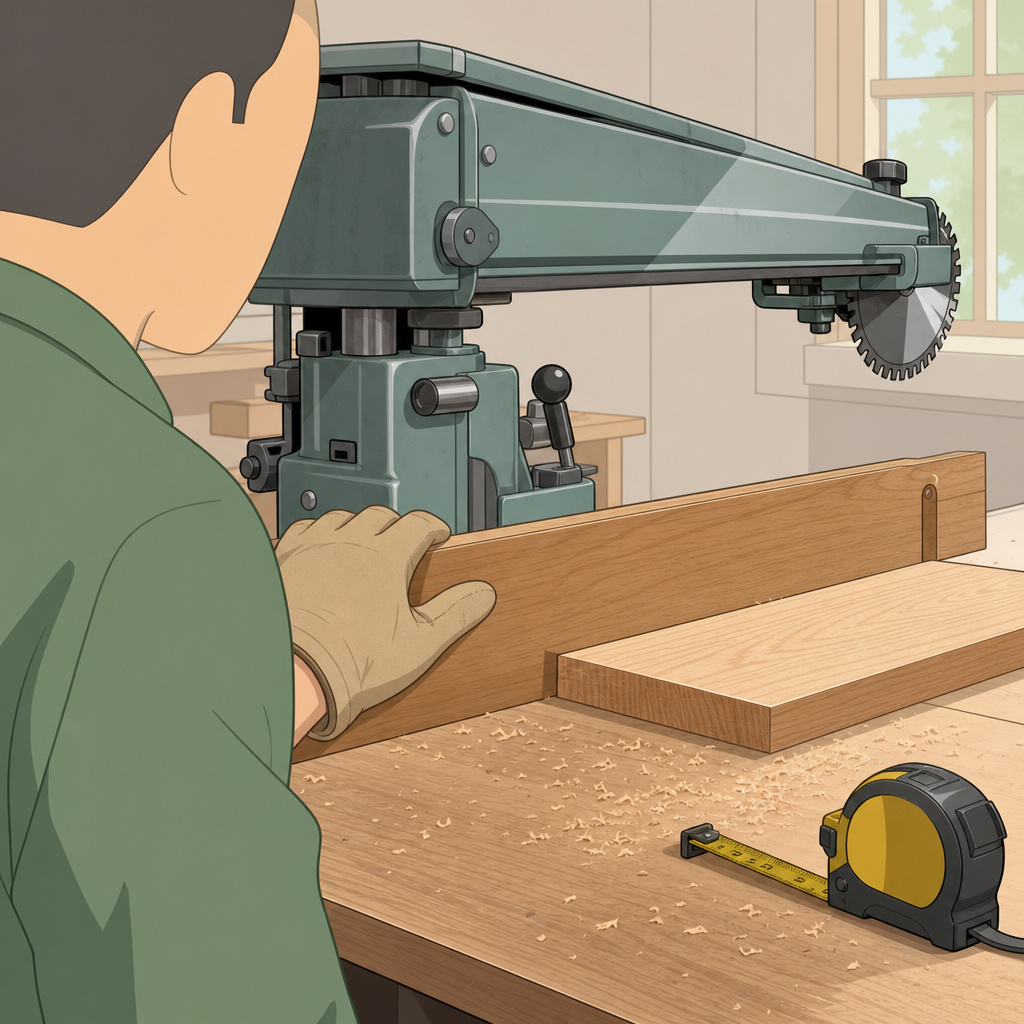
This isn’t a simple yes or no. It’s a tool that rewards a specific workflow and punishes carelessness. Let’s break down the decision factors.
The Case For Getting One
- You have space for a dedicated station. It needs a permanent home against a wall with room for the arm to travel its full distance behind the table.
- Your projects involve lots of crosscutting solid wood. Think furniture making, timber framing, or cutting down long stock.
- You need to cut wide dados or rabbets and don’t have a router table or a table saw with a dado stack.
- You enjoy restoring vintage iron. The market is full of high-quality old DeWalt, Craftsman, and Delta models that, once tuned, will outlast any new homeowner-grade tool.
The Case Against Getting One
- Your shop is small or you need portability. This is a heavy, stationary anchor.
- Your primary work is breaking down sheet goods. A table saw with a panel sled or a track saw is far more efficient and safer.
- You are uncomfortable with strict safety protocols. If you’re the type to remove guards “just for this one cut,” this is not your tool.
- You need fast, repeated compound angle cuts. A compound miter saw will save you hours of setup time.
Consider the source. I have a 1970s DeWalt in my garage. It’s my go-to for squaring up rough lumber and cutting dados for bookcases.
But when I need to rip a stack of 1x4s, I wheel out my jobsite table saw. And for trim, the miter saw is on a rolling stand. The radial arm saw complements them; it doesn’t replace them.
Maintaining and Tuning Your Radial Arm Saw
A wobbly, out-of-alignment radial arm saw is a dangerous machine. The good news is that the cast-iron construction of most models means they can be brought back to spec with some patience. Regular maintenance is non-negotiable.
| Maintenance Task | Frequency | Consequence of Neglect |
|---|---|---|
| Clean tracks and carriage bearings | After 8 hours of use | Grit causes binding, leading to jerky pulls and loss of control. |
| Check arm and blade alignment | Monthly, or if cuts aren’t square | Bevels and miters won’t match, joinery fails. |
| Lubricate pivot points | Every 3 months | Stiff movement makes precise angle setting difficult. |
| Inspect power cord and switch | Annually | Fraying or a sticky switch creates an electrical hazard. |
| Tighten all bolts and locks | Before each use | A loose motor pivot or arm lock can shift during a cut, causing binding or kickback. |
The most common tuning issue is the blade not being parallel to the fence throughout its travel. This causes the blade to rub and burn the wood on one side of the cut. The fix is usually adjusting the yoke that holds the carriage to the arm, using the manufacturer’s shims or set screws. It’s a fussy job, but it’s the difference between a precision tool and a frustrating hazard.
For a deep dive on keeping any spinning blade tool in top shape, the principles of circular saw maintenance apply here too: clean, sharp, and aligned.
Frequently Asked Questions
Are radial arm saws obsolete?
Not at all. While they’re less common in home centers than they were 40 years ago, they are still manufactured for industrial applications and have a fervent following among woodworkers. Their specific capabilities for crosscutting and dadoing haven’t been perfectly replicated by any other single tool.
Why are radial arm saws considered so dangerous?
The primary risk is the climb-cutting action during crosscuts, which can self-feed if not controlled. Additionally, the large exposed blade and the need to reconfigure the tool for different operations (like ripping) introduce opportunities for error if safety procedures aren’t followed meticulously.
Can you use a radial arm saw to cut metal?
It’s not recommended. The typical blade speed and motor design are for wood. Cutting metal requires a much slower blade speed (SFPM) to avoid overheating and damaging the blade. A dedicated metal-cutting bandsaw or a circular saw for concrete with the correct abrasive blade is the right tool for that job.
What should I look for in a used radial arm saw?
Check for: minimal play in the carriage when you try to wiggle it, an arm that moves smoothly without binding, a motor that starts without excessive noise or smoke, and the presence of all safety guards and anti-kickback parts. Cast-iron construction is a sign of quality. Missing parts for old models can be hard to find.
How much space do I need behind the saw?
You need at least the length of the arm plus a few inches. For a common 24-inch arm model, plan for about 30 inches of clear wall space behind the saw for the carriage to fully retract. This is critical for safety and function.
The Bottom Line
The radial arm saw is a tool of specific genius. It solves the problem of cutting large, heavy wood with precision by moving the cutter instead of the material. For that core task—crosscutting and joinery like dadoes—it remains arguably the best tool ever designed. Its decline in popularity has more to do with the rise of safer, faster, single-purpose tools and shifting DIY trends than a flaw in its function.
But it demands respect. You must learn its quirks, particularly the climb-cut, and adhere to its safety rules without exception.
If you have the space, need the capability, and are willing to put in the time to set it up and maintain it correctly, a radial arm saw can be the most versatile and satisfying stationary saw in your shop. If your work is more about speed, portability, or breaking down sheet goods, your money and time are better spent on a quality table saw and miter saw combo. Choose the tool that fits the work, not the legend.
{
“@context”: “https://schema.org”,
“@type”: “HowTo”,
“name”: “How to Safely Use a Radial Arm Saw for Crosscuts and Dadoes”,
“totalTime”: “PT30M”,
“tool”: [
{
“@type”: “HowToTool”,
“name”: “Radial arm saw with 10-inch blade”
},
{
“@type”: “HowToTool”,
“name”: “Anti-kickback pawls and feather board”
},
{
“@type”: “HowToTool”,
“name”: “Safety goggles, hearing protection, and dust mask”
}
],
“step”: [
{
“@type”: “HowToStep”,
“name”: “Check alignment and install blade”,
“text”: “Verify the blade is parallel to the fence and square to the table. Install a sharp, negative-hook-angle blade for cross-cutting or a dedicated dado stack for grooves.”
},
{
“@type”: “HowToStep”,
“name”: “Set up zero-clearance fence”,
“text”: “Replace the standard fence with a sacrificial wooden fence you cut into, creating a zero-clearance slot that prevents tear-out and supports small workpieces.”
},
{
“@type”: “HowToStep”,
“name”: “Perform a crosscut with controlled pull”,
“text”: “Hold the workpiece firmly against the fence with your left hand. Use your right hand to pull the saw carriage smoothly toward you, controlling the climb-cutting action.”
},
{
“@type”: “HowToStep”,
“name”: “Return the carriage fully after each cut”,
“text”: “After the cut, push the saw carriage all the way back to its starting position behind the fence before releasing the workpiece or reaching near the table.”
}
]
}
{
“@context”: “https://schema.org”,
“@type”: “FAQPage”,
“mainEntity”: [
{
“@type”: “Question”,
“name”: “Are radial arm saws obsolete?”,
“acceptedAnswer”: {
“@type”: “Answer”,
“text”: “Not at all. While they’re less common in home centers than they were 40 years ago, they are still manufactured for industrial applications and have a fervent following among woodworkers. Their specific capabilities for crosscutting and dadoing haven’t been perfectly replicated by any other single tool.”
}
},
{
“@type”: “Question”,
“name”: “Why are radial arm saws considered so dangerous?”,
“acceptedAnswer”: {
“@type”: “Answer”,
“text”: “The primary risk is the climb-cutting action during crosscuts, which can self-feed if not controlled. Additionally, the large exposed blade and the need to reconfigure the tool for different operations (like ripping) introduce opportunities for error if safety procedures aren’t followed meticulously.”
}
},
{
“@type”: “Question”,
“name”: “Can you use a radial arm saw to cut metal?”,
“acceptedAnswer”: {
“@type”: “Answer”,
“text”: “It’s not recommended. The typical blade speed and motor design are for wood. Cutting metal requires a much slower blade speed (SFPM) to avoid overheating and damaging the blade. A dedicated metal-cutting bandsaw or a circular saw for concrete with the correct abrasive blade is the right tool for that job.”
}
},
{
“@type”: “Question”,
“name”: “What should I look for in a used radial arm saw?”,
“acceptedAnswer”: {
“@type”: “Answer”,
“text”: “Check for: minimal play in the carriage when you try to wiggle it, an arm that moves smoothly without binding, a motor that starts without excessive noise or smoke, and the presence of all safety guards and anti-kickback parts. Cast-iron construction is a sign of quality. Missing parts for old models can be hard to find.”
}
},
{
“@type”: “Question”,
“name”: “How much space do I need behind the saw?”,
“acceptedAnswer”: {
“@type”: “Answer”,
“text”: “You need at least the length of the arm plus a few inches. For a common 24-inch arm model, plan for about 30 inches of clear wall space behind the saw for the carriage to fully retract. This is critical for safety and function.”
}
}
]
}
