What is a Trimmer Line? Guide to Sizes, Shapes & Materials
This post contains affiliate links. As an Amazon Associate, we earn from qualifying purchases.
A trimmer line is a length of durable nylon monofilament, often reinforced with additives like carbon fiber, that spins at high speed from the head of a string trimmer to cut grass and weeds. It’s defined by two non-negotiable specs: its diameter (like 0.080” or 0.095”) and its cross-sectional shape (round, square, twisted). Matching these to your trimmer’s power and your yard’s vegetation is the entire game.
Most people grab the cheapest spool at the hardware store, assuming all line is the same. That mistake costs you time, money, and patience. A line that’s too thin for your machine will snap every five minutes. A line that’s too thick will bog down the motor, strain the drive shaft, and leave you with a half-cut lawn and a hot, unhappy tool.
This guide breaks down the anatomy of trimmer line. We’ll cover why diameter matters more than you think, how shape changes the cut, what those “titanium” labels actually mean, and how to pick the right one without burning out your trimmer or your wallet.
Key Takeaways
- The diameter printed on your trimmer’s head or manual is a limit, not a suggestion. Exceed it by even 0.010” on a residential tool and you risk stalling the motor.
- Square and star-shaped lines cut more aggressively but wear down 30-40% faster than round line when hitting hard surfaces like fence posts or gravel.
- Soaking nylon line in water for a day before use isn’t a myth; it lets the polymer chains absorb moisture, reducing brittleness and breakage on the first few passes.
- “Universal” spools are a compromise. For consistent performance, match the line’s flexibility and core construction to your trimmer’s feed mechanism (bump, auto-feed, or fixed head).
- Store line in a sealed container away from sunlight. UV radiation degrades nylon over a single season, turning a tough line into a brittle one that shatters on impact.
What is a Trimmer Line, Actually?
A trimmer line is a consumable cutting tool. Think of it as a rapidly spinning, disposable blade made of engineered polymer. Its job is to transfer the rotational energy from your trimmer’s motor into kinetic energy at the tip, slicing through plant material via impact.
Trimmer line is typically a nylon copolymer monofilament, chosen for its balance of tensile strength, flexibility, and abrasion resistance. Manufacturers modify the base polymer with additives like aluminum oxide, carbon fiber, or titanium dioxide to increase impact strength, reduce friction-induced melting, and improve UV stability. The line’s performance is a direct function of its molecular density and the homogeneity of these additive mixtures.
The wrong line doesn’t just perform poorly. It forces the tool to work outside its designed parameters. That has consequences with real timelines.
I ran a mid-grade 0.095” “commercial” line on a homeowner-grade 18V cordless trimmer for a season. The tool struggled, the battery drained twice as fast, and by autumn, the plastic head housing had developed a hairline crack near the output shaft. The motor was trying to swing a heavier load than it was rated for, creating harmonic vibrations the housing wasn’t built to handle.
I replaced the head, switched back to 0.080” line, and the problem vanished. The tool wasn’t weak. I was feeding it the wrong fuel.
Trimmer Line Diameter: The Single Most Important Number
Diameter is measured in inches or millimeters, and it’s the first thing you check. This number isn’t about preference. It’s about physics. A thicker line has more mass. Spinning that mass requires more torque. Your trimmer’s motor only produces so much torque.
Exceed its capacity and the RPMs drop. The line doesn’t reach cutting speed. It whips against the grass instead of slicing it, tearing and bruising the lawn.
The motor overheats. The battery or engine labors. It’s a cascade failure that starts with a number on a spool.
Here’s how to match diameter to the job, with the “why” included.
| Diameter (inches) | Best For | Machine Power Required | What Happens If You Go Too Big |
|---|---|---|---|
| 0.065” – 0.080” | Fine grass, soft weeds, precise edging. | Light-duty (18-24V cordless, low-cc gas) | Motor bogs, line doesn’t extend, battery drains in minutes. Overheats plastic gear housings. |
| 0.095” | Standard residential lawns, mixed grass and weeds, occasional woody stems. | Medium-duty (40V+ cordless, 25-30cc gas) | Noticeable RPM drop in thick growth. Increases wear on clutch and drive shaft bearings over time. |
| 0.105” – 0.130” | Dense weeds, overgrown areas, light brush, saplings. | Heavy-duty (commercial 30cc+ gas, high-torque electric) | Can stall weaker motors. Risks cracking trimmer head shields on bump-feed systems from increased centrifugal force. |
| 0.155” – 0.170” | Heavy brush, tough vines, commercial clearing. | Professional-grade brush cutters only. | Will destroy the gearbox on a residential string trimmer within 1-2 hours of use. |
The rule is simple. Find the maximum diameter rating stamped on your trimmer’s head or in the manual. That’s your ceiling.
For everyday use, choose a line one step below that ceiling. If your trimmer takes up to 0.095”, keep 0.080” loaded for routine grass and save the 0.095” for the weedy perimeter. This keeps the tool in its happy zone, where it spins fast and cuts clean.
Trimmer Line Shapes Explained
Once diameter is locked in, shape determines how the line attacks the vegetation. Shape is about cutting efficiency and finish. The choice here is less about machine safety and more about the job’s demands and your tolerance for line wear.
Round Line: The Workhorse
Round line is the default. It’s durable, relatively quiet, and feeds smoothly in almost any head. Because it has no edges, it wears down evenly and tends to tear through grass rather than slice it. That’s fine for most maintenance trimming. Its strength is impact resistance, it can take a hit from a rock or sidewalk and just lose a little length, not shatter.
Use round line for general yard work, especially if your property has hidden obstacles. It’s the most forgiving shape.
Square, Hex, and Pentagon Line: The Aggressive Cutters
These shapes have sharp corners. Those corners act like tiny blades, slicing through grass stems for a cleaner cut. They’re fantastic for thick, fibrous weeds where round line might just bend them over. The trade-off is those corners wear down quickly when abraded against hard surfaces. A square line hitting a concrete driveway edge will lose its edge in seconds, rounding off and then performing like a slightly thicker round line.
I keep a spool of 0.095” square line for the spring cleanup when the fence line is full of tough, dry weeds. It powers through them where round line would stall. But I switch back to round once those areas are cleared, because the square line disappears twice as fast when I inevitably clip the fence posts.
Twisted or Spiral Line: The Quiet Specialists
Twisted line, like Maxpower Twisted or Shakespeare Ugly Twist, has a helical shape. This design reduces aerodynamic drag and vibration, which cuts down on the high-pitched whine. It’s noticeably quieter. Cutting performance is similar to round line, but the twist can help it grab and chop through light, fluffy growth like overgrown ornamental grasses a bit better.
Its real benefit is user comfort on long jobs. If noise bothers you, it’s worth the small premium.
Star and Serrated Lines: The Niche Players
Multi-point star line (5 or 6 points) offers multiple cutting edges for a very clean cut in coarse grass. Serrated line has notches like a saw blade, designed for brutal work on thick stems and undergrowth. These are specialty shapes for specific, tough conditions. They demand a powerful, commercial-grade machine. On a homeowner trimmer, they’ll wear down almost immediately or cause feed problems.
| Line Shape | Cutting Action | Best Use Case | Durability vs. Round | Noise Level |
|---|---|---|---|---|
| Round | Tearing/Impact | General purpose, rocky areas, routine maintenance | Baseline (Most Durable) | Standard whine |
| Square/Hex | Slicing | Dense weeds, overgrowth, clean edge trimming | Wears 30-40% faster | Slightly higher pitch |
| Twisted/Spiral | Tearing with better grab | Long trimming sessions, noise-sensitive areas | Slightly less durable | Noticeably quieter |
| Star | Multi-edge slicing | Coarse grasses (e.g., crabgrass, tall fescue) | Wears 50% faster | Standard whine |
| Serrated | Sawing/Chopping | Heavy brush, vines (with brush cutter only) | Wears very fast | Aggressive roar |
Materials and Construction: What “Titanium” Really Means
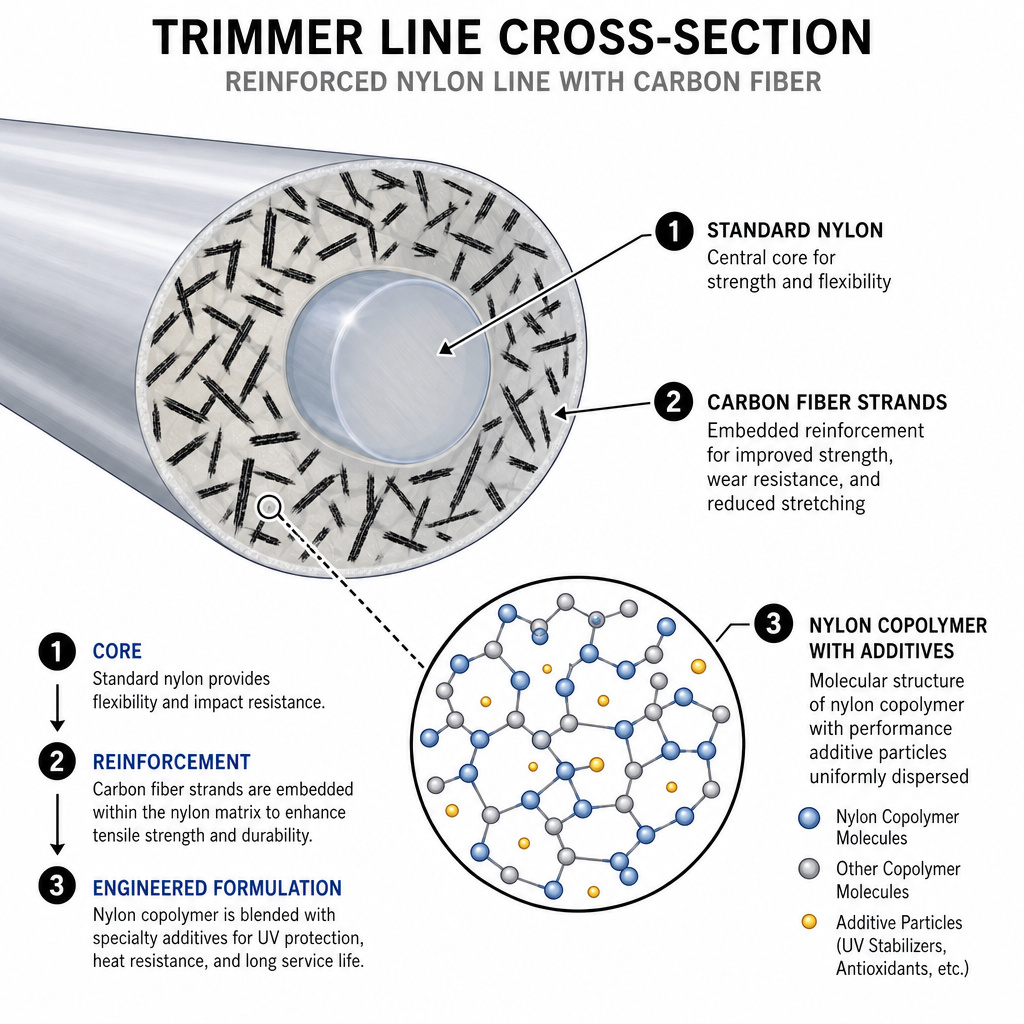
Almost all trimmer line is a nylon copolymer. The differences come from additives blended into the nylon melt before it’s extruded. These aren’t marketing gimmicks. They change the material properties on a molecular level.
- Standard Nylon: Good all-around balance of strength and flexibility. It’s what you get in most economy spools.
- Carbon Fiber Reinforced: Micro-strands of carbon fiber are embedded in the nylon. This increases tensile strength (resistance to snapping under tension) and improves abrasion resistance. The line fights wear from sand and dirt better. Echo Black Diamond is a prime example.
- Titanium Coated or Infused: This usually refers to titanium dioxide (TiO2) powder mixed into the polymer. TiO2 is a potent UV stabilizer. It significantly slows the degradation caused by sunlight, which is the primary reason line goes brittle in storage. It also hardens the surface slightly. STIHL’s X-Line uses this approach.
- Aluminum Oxide Added: Aluminum oxide is an extremely hard ceramic. Adding it creates a line that holds its sharp edge longer, crucial for square and star shapes. It’s the reason Oregon Magnum Gatorline chews through tough material.
The mechanism is straightforward. These additives fill the microscopic spaces between the long nylon polymer chains. When the line impacts a stem, the energy is dispersed through this reinforced matrix instead of focusing on a single weak point in the pure nylon. That’s why a “titanium” line might seem to last longer, it’s not stronger in a single massive impact, but it resists the cumulative micro-fractures that lead to failure.
How to Choose the Right Trimmer Line for Your Yard
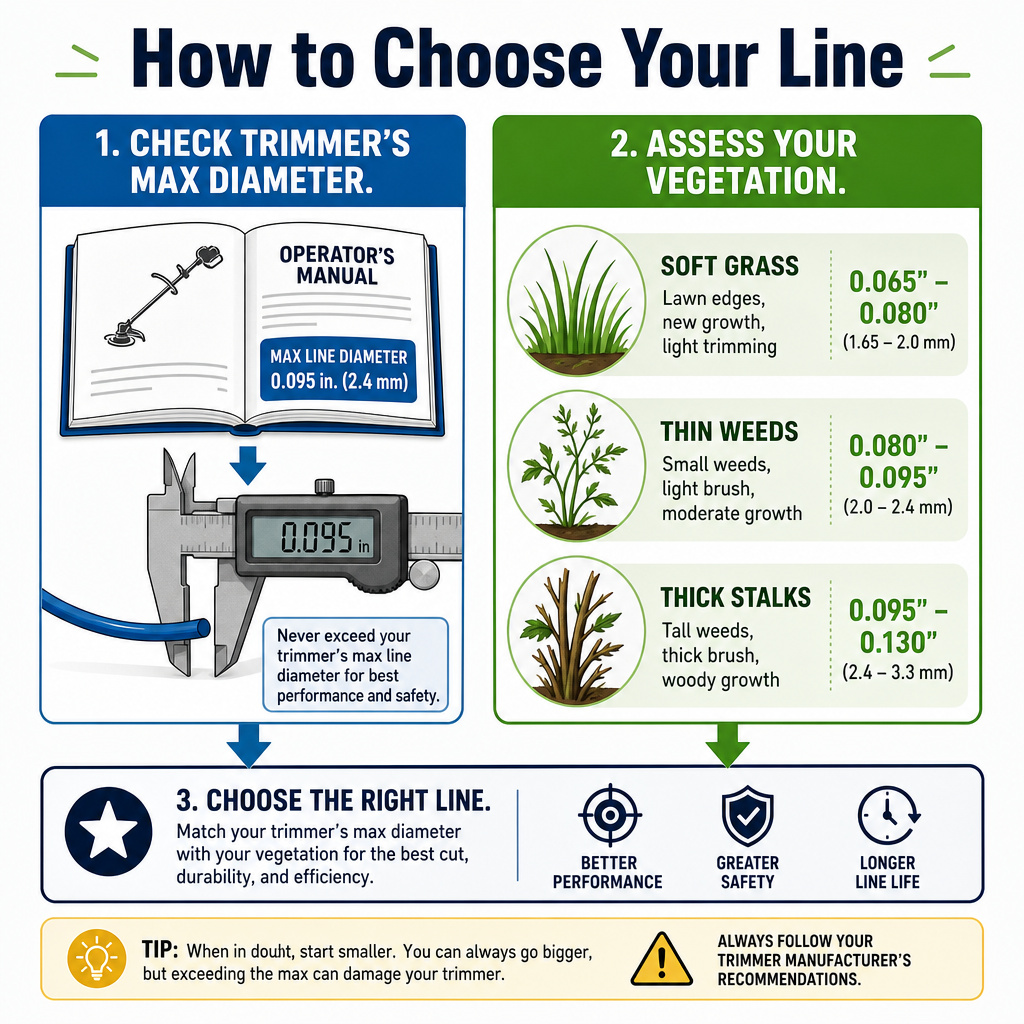
Stop browsing the aisle randomly. Follow this decision sequence. It takes 60 seconds and saves an hour of frustration.
- Check Your Trimmer’s Max Diameter. Look at the head. Look in the manual. This is your law. Write it down.
- Assess Your Vegetation. Is it 90% lawn grass? Go round, one size below your max. Is it a mixed border with thick weeds? Go square or twisted at your max diameter.
- Consider Your Machine’s Age. Older trimmers, or ones with worn clutches, perform better with a slightly smaller, round line. It reduces load.
- Pick a Material Grade. For seasonal homeowners, standard nylon is fine. If you trim weekly or have abrasive soil (sandy, rocky), step up to a carbon fiber or titanium-reinforced line. The cost per hour of runtime is often lower.
- Buy a Spool, Not Pre-Cuts. Spools are vastly more economical. Pre-cut segments are for specific fixed-line heads only.
Before you start any trimmer line replacement: Disconnect the spark plug wire on gas models or remove the battery on electric trimmers. The head can spin unexpectedly if the trigger is bumped, and the line cutter on the guard is sharp enough to take off a fingertip. Wear safety glasses, a snapped line end travels at over 200 mph.
The actual process of restringing a string trimmer is straightforward once you have the right line. The challenge most face is improper winding string trimmer line, which leads to tangles and feed failures. Wind it tight, even, and in the direction of the arrow on the spool.
Pro Tips, Storage, and Common Mistakes
This is where experience talks. The manual doesn’t cover this.
- The Soaking Trick is Real. For round nylon line, soaking in water for 12-24 hours before use lets the polymer absorb moisture. Hydrated nylon is more flexible and less prone to brittle fracture on the first impact. Don’t do this with co-polymer or reinforced lines, it has minimal effect.
- Length Matters. After loading, only about 6-8 inches of total line should be extended from the head. Longer than that reduces cutting speed, increases vibration, and risks breaking. For the exact correct line length, a good rule is the line shouldn’t extend past the edge of your trimmer’s guard.
- Store Line in the Dark. UV light breaks down nylon. Keep your spool in the original bag inside a toolbox or on a shaded shelf. A brittle line will sound different, a higher-pitched ping instead of a thwack when it hits something.
- Don’t Mix and Match. Don’t put two different diameters or shapes on the same spool. They’ll wear at different rates and cause an unbalanced, vibrating head.
- Know When to Replace the Whole Head. If you’re constantly fighting line feed issues even with proper technique, the problem is likely a worn bump head or a cracked spool. Replacing the entire head assembly (like with an Echo Speed-Feed) is cheaper than your time spent cussing at it.
A final note on brand loyalty. OEM line from your trimmer’s manufacturer is often good, but it’s not magic. Third-party lines like Echo Black Diamond or Oregon Magnum frequently outperform it for less money.
The community isn’t wrong. My Ego trimmer runs exclusively on Maxpower Twisted now. The OEM line was brittle and expensive. The switch was a no-brainer.
Frequently Asked Questions
What’s the difference between trimmer line and weed eater string?
They are the same thing. “Weed eater” is a brand name (from Weed Eater) that became generic, like Kleenex. “Trimmer line” or “string trimmer line” are the correct generic terms for the cutting filament.
Can I use a thicker line than my trimmer recommends to make it more powerful?
No. This is the most common destructive mistake. A thicker line requires more torque to spin. Your trimmer’s motor can’t produce more torque than its design allows. Using too thick a line will overheat the motor, strain the drive shaft, and drastically shorten the tool’s life. It makes the tool weaker, not stronger.
How often should I replace my trimmer line?
Replace it when it’s gone. There’s no time-based schedule. A good reinforced line on a typical suburban yard might last 2-3 months of weekly use. You’ll know it’s time when you’re bumping the head constantly to feed new line, or the cutting performance drops noticeably. Always have a spare spool.
Why does my new trimmer line keep breaking immediately?
Three likely culprits. First, you’re using too thin a line for the vegetation (e.g., 0.065” in thick weeds). Second, the line is old and has been UV-degraded in storage, it snaps from brittleness. Third, you’re hitting hard objects like rocks, pavement, or metal fencing. Switch to a larger diameter, buy fresh line, and be more mindful of the cutting path.
Is there an eco-friendly trimmer line?
Yes, oxo-biodegradable lines exist. They are designed to break down more quickly in landfill conditions than standard nylon. However, they are often less durable and more expensive. For most users, the more sustainable practice is to use a durable line that lasts longer, generating less frequent waste.
What size line should I buy if I lost my manual?
First, check the trimmer head itself, the maximum diameter is often molded into the plastic. If not, look up your trimmer’s model number online. As a safe default for unknown residential electric trimmers, 0.080” round line is a good start. For unknown gas trimmers, try 0.095”. You can find specific guides, like for the Ryobi 18V line size, on our site.
The Bottom Line
Trimmer line is a precision consumable, not a commodity. The right line, matched in diameter, shape, and material to your machine and your mess, transforms the job from a fight to a clean-up. Ignore the specs and you’ll fight your tool all season. Follow them and it just works.
Start with the diameter stamped on your trimmer. Pick a shape for your dominant task. Invest in a reinforced material if you trim often.
Learn the simple steps for using a string trimmer effectively and for storing a weed trimmer properly in the off-season. Keep a fresh spool in your shed. The difference in cut quality, tool longevity, and your own satisfaction is immediate and tangible. It’s the cheapest upgrade your trimmer will ever get.
