What Is a Masonry Drill Bit? ANSI Tolerance for Anchor Strength
This post contains affiliate links. As an Amazon Associate, we earn from qualifying purchases.
A masonry drill bit is a cutting tool with a carbide-tipped head, designed to bore holes into hard, brittle materials like concrete, brick, and block. Its defining feature is the tungsten carbide tip brazed to a steel body, which withstands the abrasion and impact of masonry. The bits come in specific shank types (SDS+, round, A-taper) to match different drills, and specialized versions exist for exact anchor-setting or cutting through embedded steel.
That carbide tip is the only part that touches the material. The steel body behind it exists to channel dust out of the hole. Get that relationship wrong, pushing the steel flutes into the work instead of letting the tip cut, and you burn out bits in minutes.
What follows is a breakdown of the three things that actually matter: the tip geometry that does the work, the shank that transfers power from your drill, and the diameter tolerance that decides whether your anchor holds or pulls out. By the end, you’ll be able to look at any masonry bit and know its job in ten seconds.
Key Takeaways
- A standard masonry bit and an anchor-setting bit are not the same. Using a general-purpose bit for a wedge or sleeve anchor can oversize the hole by a few thousandths of an inch, cutting anchor pull-out strength by 20% or more.
- The shank dictates the drill. SDS+ bits only work in SDS+ rotary hammers for efficient hammering; round shank bits work in any standard drill chuck but are less efficient for heavy concrete.
- Some masonry bits must run in rotary-only mode. Using hammer action on a tile bit or a rebar-cutting bit will shatter the carbide or destroy the drill.
- Diameter and length are printed on the bit. Match the diameter exactly to your anchor size, and choose an overall length (OAL) that provides at least an inch more depth than your anchor’s required embedment.
- For holes deeper than 16 inches, pre-drill the first 6 inches with a shorter bit of the same diameter. This keeps the long bit from wandering and snapping under its own flex.
What a Masonry Drill Bit Actually Is (And What It Isn’t)
A masonry drill bit isn’t just a twist bit with a hard tip. It’s a system. The tungsten carbide tip, often a single, chisel-shaped piece brazed on, crushes and powders the masonry. The flutes behind it are there for one job: to pull that dust out of the hole so the tip can keep cutting. If the flutes clog, the tip spins against powder, overheats, and loses its hardness. That’s when you smell the burnt-metal scent and see the tip glow dull red.
The ISO 5468:2017 standard dimensions document specifies sizes for rotary and rotary impact masonry drill bits with hardmetal tips, covering diameters from 4 mm to 25 mm. It explicitly excludes hammer drill bits, drawing a clear line between impact-rated tools and basic rotary ones.
The steel body varies by job. A general-purpose bit for drilling a hole to pass a cable has looser tolerances. A bit for setting a 1/2-inch wedge anchor, like the Relton REL207, is machined to ANSI B212.15 tolerance. That’s a spec for hole diameter precision. Miss it by a few thousandths of an inch, and the anchor won’t expand fully against the concrete. The holding power drops off a cliff.
The Three Parts That Matter: Tip, Shank, and Tolerance
You can ignore the marketing about “industrial grade” or “professional.” Look at the tip, read the shank, and check the diameter stamp.
The Carbide Tip: It’s a Wear Item, Not a Lifetime Tool
The tip is tungsten carbide, a sintered powder metal that’s brutally hard but brittle. It doesn’t get dull the way a steel knife does; it microfractures and wears down. You’ll see the chisel edge round over. Once it loses its sharp corner, it starts rubbing instead of cutting. Heat accelerates this. That’s why you pull the bit out every 10-15 seconds to clear the flutes, you’re letting the tip cool.
There are two common tip shapes. A four-cutter head (like on many Bosch bits) is for fast, general drilling in brick and block. A Groo-V tip, like on the Relton RELGRT, has a single, wider carbide piece with a deep groove. It’s more aggressive and stays sharper longer in hard concrete, but it’s also more prone to grabbing if you’re not careful.
Shank Types: SDS+, Round, A-Taper, and Spline
The shank is how the bit connects to the drill, and getting it wrong means the bit either won’t fit or will destroy your tool.
| Shank Type | Fits In | Best For | The Catch |
|---|---|---|---|
| SDS+ | SDS+ rotary hammer chuck | All hammer drilling in concrete | Won’t fit a standard drill chuck without an adapter |
| Round Shank | Any keyed or keyless drill chuck | Light hammer drilling, rotary-only work | Less efficient hammer action; chuck wears faster |
| A-Taper | Older Hilti, Bosch rotary hammers | Vintage rotary hammers | Requires a specific, often obsolete, drill |
| Spline | Large SDS-Max rotary hammers | Big-diameter, deep concrete coring | High-torque commercial work only |
An SDS+ shank has grooves that lock into a specialized chuck. It can slide back and forth a few millimeters, which lets the hammer’s impact energy travel directly into the bit instead of through the chuck bearings. This is why an SDS+ rotary hammer feels like it’s doing the work for you. A round shank bit gets gripped by the chuck jaws. All the hammer impact goes through those jaws, which heats them up and wears them out faster on a heavy job.
Where this goes sideways: Putting an SDS+ bit into a standard drill chuck with an adapter. The adapter defeats the sliding action, so you get all the vibration with none of the efficiency. You’ll burn out a standard drill’s hammer mechanism in an afternoon.
Why Diameter Tolerance Isn’t Optional for Anchors
For a lag shield or a plastic anchor, a hole that’s 1/64-inch oversize is annoying. For a mechanical expansion anchor like a wedge or sleeve anchor, it’s a structural failure waiting to happen.
The anchor expands against the walls of the hole. If the hole is too big, the expansion sleeve can’t make full contact. The load transfers through a smaller area, and the concrete around it crumbles under much lower force. The masonry drill bit selection guide from Relton’s distributor notes that an oversized pilot hole can reduce pull-out strength by 20% or more. That’s the difference between a deck railing that stays put and one that leans after a season.
Bits like the Relton REL207 are manufactured to ANSI B212.15 tolerance for this reason. Their diameter is held to a precise spec. A general-purpose Bosch BM2008 bit will get the hole done, but its diameter might vary just enough to compromise the anchor. Don’t substitute.
SDS+ vs Round Shank: The Power Transfer Difference
This is the single biggest point of confusion. People buy an SDS+ bit because they see the pros using them, then try to force it into their standard drill. It doesn’t work because the physics are different.
An SDS+ system is a direct hammer. The bit floats in the chuck, so the piston inside the rotary hammer slams directly into the bit’s shank. The energy goes straight into the tip. A round shank in a standard hammer drill is an indirect hammer. The drill’s mechanism hammers the entire chuck, and the chuck jaws transmit that impact to the bit. It’s less efficient, noisier, and harder on the tool.
Use an SDS+ bit in an SDS+ rotary hammer for any concrete work thicker than a patio block. Use a round shank bit in a standard hammer drill for brick, block, or the occasional concrete screw. Trying to drill a 1/2-inch hole 4 inches deep into a foundation with a round shank bit in a standard drill will take ten minutes and smell like an electrical fire. The right tool for the right drill bit selection is not a suggestion.
When You Must Turn the Hammer Off
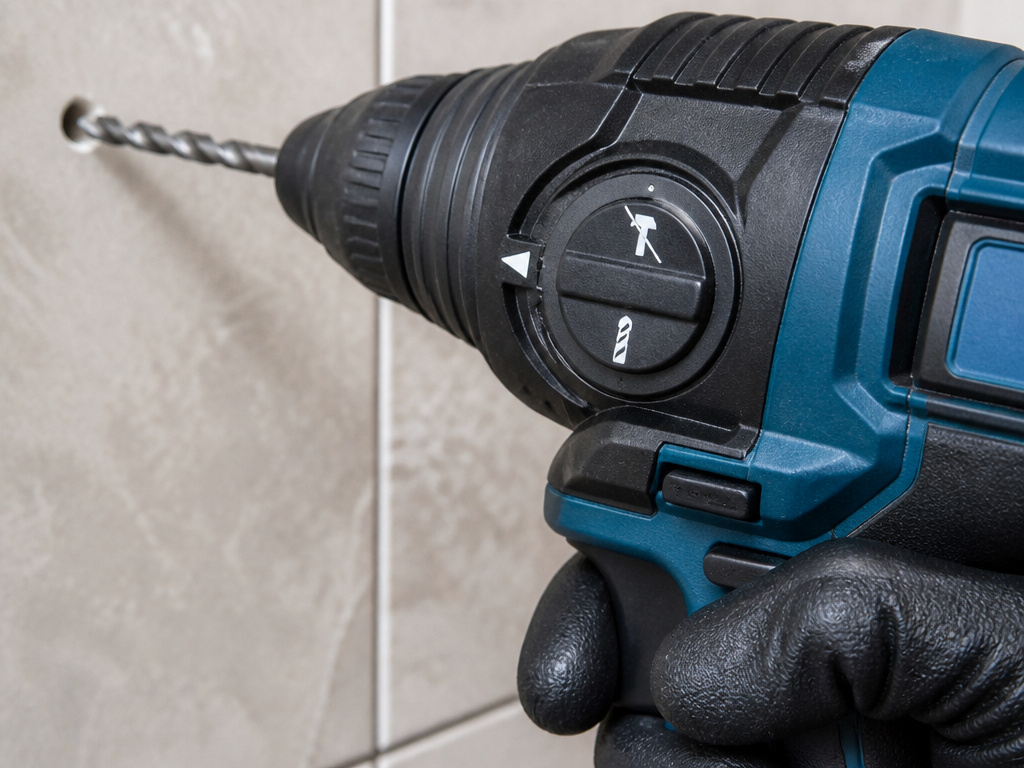
Hammer action is for brittle materials. It pulverizes concrete and brick. It also shatters carbide when it hits something ductile, like steel, or something brittle-but-smooth, like tile.
For embedded rebar, you use a Relton Rebar Eater (RELRB or RELSRB). Its carbide tip is shaped to shear through steel, not crush it. The manufacturer’s guide states it must run in rotary-only mode, no hammer action. The hammer function will chip the carbide cutters immediately. If you hit rebar, stop, switch the drill to rotary-only, and chew through it. Then switch back to hammer mode to finish the concrete.
For tile or glazed brick, you use a bit like the Relton Tip-Top (RELTT), also designed for higher RPM rotary-only drilling. The hammer’s vibration will crack the glaze or the tile itself long before the bit makes it through. The difference between masonry and wood drill bits is dramatic, but the difference between a hammer bit and a vibration-sensitive bit is a broken workpiece.
Picking the Right Bit: A Decision Table
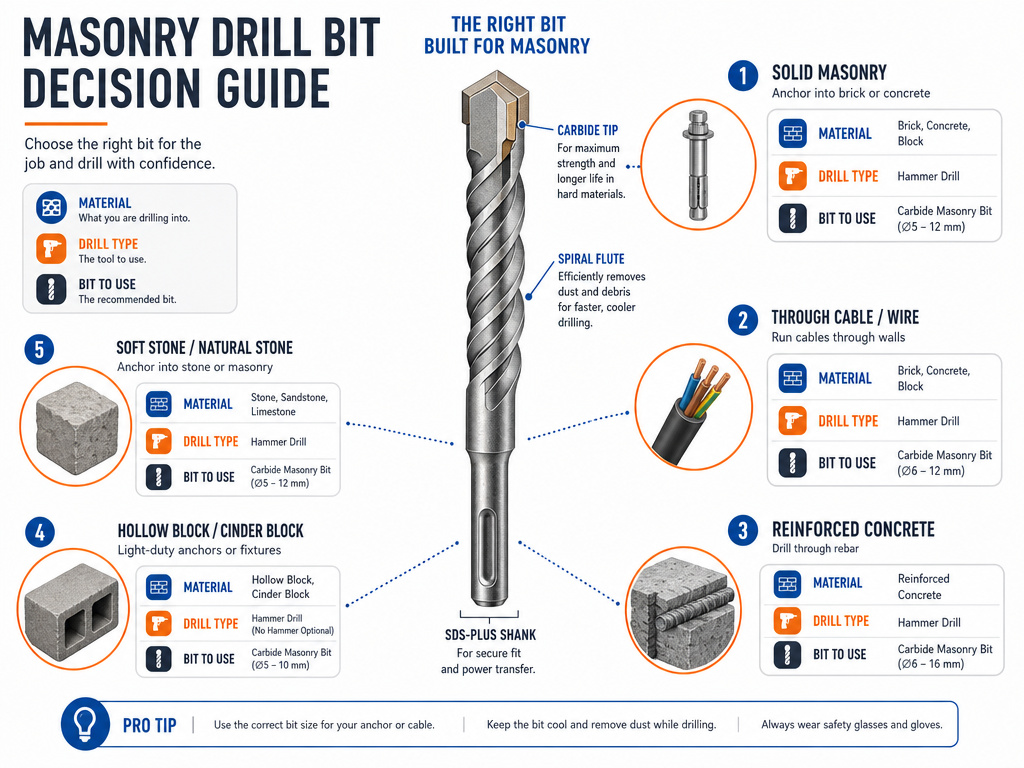
Stop looking at the package color. Match the bit to your material, your drill, and your end goal.
| You Need To… | Material | Drill Type | Bit To Use | Critical Setting |
|---|---|---|---|---|
| Install a wedge anchor | Solid concrete | SDS+ Rotary Hammer | Relton REL207 (ANSI tolerance) | Hammer + Rotation |
| Drill a hole for a cable | Brick or block | Standard Hammer Drill | Bosch BM2000 series (round shank) | Hammer + Rotation |
| Cut through rebar inside concrete | Concrete with rebar | Any Drill (chuck must fit bit) | Relton Rebar Eater (RELRB/RELSRB) | Rotary-Only |
| Drill through ceramic tile | Tile over substrate | Standard Drill | Relton Tip-Top (RELTT) or diamond grit bit | Rotary-Only |
| General-purpose holes | Cinder block | Standard Drill | Relton Groo-V Tip (RELGRT) | Hammer + Rotation |
The Bosch Fast Spiral Rotary Masonry Drill Bit series (like the BM2008) is the default for round-shank work. The Relton REL207 is the default for anchor-setting in an SDS+ hammer. For everything else, you’re choosing a specialty tool.
The Two Drilling Mistakes That Break Bits
First, pushing too hard. The carbide tip needs to cut, not grind. Let the tool’s weight and the hammer action do the work. If you lean on the drill, you flex the bit, bind it in the hole, and snap the shank right at the chuck. You’ll feel the drill bog down before it breaks. Ease up.
Second, not clearing the flutes. Concrete dust is abrasive. When the flutes pack full, that dust acts like a grinding paste between the bit’s steel body and the hole wall. The friction generates tremendous heat, which travels straight to the carbide tip and softens it. The bit is now toast. Pull out every 10-15 seconds, even on a deep hole, to blow the dust out.
Common mistake: Drilling a deep hole with a long bit in one go. A 400mm (16-inch) bit has a lot of flex. If you don’t start it straight, it will walk as you go deeper, bending and eventually snapping. The fix is to pre-drill a pilot hole at least 150mm (6 inches) deep with a shorter, stiffer bit of the same diameter. Then follow with the long bit.
Lubrication is for metal, not masonry. Never use oil or cutting fluid on a masonry bit. It turns the concrete dust into a slurry that clogs the flutes instantly. For deep holes in very hard concrete, a trickle of water can help keep dust down and cool the tip, but it’s messy. Dry and slow with frequent clearing is the cleaner method.
Frequently Asked Questions
Can I use a masonry bit in a regular drill?
Yes, but only in a hammer drill setting on the drill. A standard “drill-only” mode provides no impact, so the bit will just spin and polish the concrete surface. You must have the hammer function engaged. Even then, a standard drill’s hammer action is weak compared to an SDS+ rotary hammer, so limit it to brick, block, or shallow holes in soft concrete.
What’s the difference between a masonry bit and a concrete bit?
In common terms, they’re often used interchangeably. Technically, a “concrete drill bit” usually refers to an SDS-plus style bit designed for high-impact rotary hammers and the hardest aggregates. A “masonry drill bit” can be a broader category that includes bits for brick and block. For anchor-setting in structural concrete, you want a bit like the Relton REL207, which is sold as a concrete bit.
How do I know if my masonry bit is dull?
Look at the carbide tip. A sharp bit has distinct, crisp edges. A dull bit has rounded, smoothed-over edges. You’ll also hear the pitch of the drill change, it will whine higher as it spins without cutting, and you’ll see fine powder instead of coarse chips coming out of the hole. Progress will slow to a crawl.
Why does my masonry bit keep overheating?
The flutes are clogged. When concrete dust packs in, it creates friction against the hole wall. That friction generates heat, which travels up the steel body to the carbide tip. Carbide starts to lose hardness around 1000°F. Pull the bit out every few seconds, especially in deep holes, and blow or brush the flutes clean. Let the bit cool down before continuing.
Can a masonry bit drill through metal?
No. The carbide tip is brittle and designed to crush abrasive material. Forcing it against steel will shatter the carbide edges. The flutes are also not designed to evacuate long, stringy metal chips. You’ll ruin the bit and likely damage the material. Use a high-speed steel (HSS) or carbide drill bit made for metal.
Before You Go
A masonry drill bit is defined by its carbide tip, but chosen by its shank and its tolerance. Match the shank to your drill: SDS+ for rotary hammers, round shank for standard drills. Match the tolerance to your task: ANSI-spec for anchors, general-purpose for everything else. And remember, the hammer switch isn’t always on, turn it off for rebar and tile.
For the vast majority of DIY anchor-setting jobs, a Relton REL207 in the correct diameter is the only bit that guarantees the hole size the anchor engineer specified. For everything else, a Bosch BM2000 series round shank bit will handle brick, block, and the occasional concrete screw. Keep the flutes clean, let the tool do the work, and the bit will last through the project.
