What is a Rotary Hammer Drill Used For | The 3 Primary Jobs
This post contains affiliate links. As an Amazon Associate, we earn from qualifying purchases.
A rotary hammer drill is used for drilling large-diameter holes in concrete, masonry, and stone, as well as for chiseling, demolition, and surface finishing work. Its core function is delivering high-impact energy via a pneumatic hammering mechanism, which a standard hammer drill cannot match.
That pneumatic mechanism is the whole difference. It turns a drilling tool into a small-scale demolition machine. A standard hammer drill uses a mechanical clutch that slaps two metal cams together. It’s loud, it vibrates your arm off, and it bogs down in anything thicker than a cinder block.
A rotary hammer uses an air piston. The motor drives a crank that moves a piston inside a sealed cylinder, compressing air that then slams a striker into the drill bit’s tail. That air cushion absorbs recoil, transfers more energy forward, and lets the tool work for hours without shaking itself apart. You feel the difference on the first trigger pull, it’s a deep, rhythmic thud, not a frantic rattle.
What follows: the three jobs a rotary hammer actually does, the specs that matter from the OEM manuals, and the one mistake that turns a $500 tool into a paperweight within a month.
Key Takeaways
- Its primary job is drilling holes over 1/2 inch in diameter in concrete and masonry. A standard hammer drill stalls around 3/8 inch.
- The pneumatic hammering mechanism delivers 3-5 times more impact energy than a hammer drill, making it the only choice for reinforced concrete or all-day use.
- Most models include a “hammer-only” or chiseling mode, allowing you to remove tile, break up small slabs, or chase channels in walls without rotation.
- Using the wrong chuck system (SDS-plus vs. SDS max) for the bit size burns out the tool’s drive train. Match the chuck to the hole diameter.
- These are professional-grade tools. Repairs and carbon brush replacement must be performed by authorized service centers to maintain safety certifications, per Makita and Hilti manuals.
The 3 Primary Uses of a Rotary Hammer Drill
Forget the marketing blurbs. A rotary hammer has three concrete functions, and each one ties directly to a physical limit printed in the tool’s manual. If your task doesn’t fit one of these slots, you’re using the wrong tool.
Rotary hammer drills are designed for drilling in concrete and masonry, as well as for light chiseling work on masonry and surface finishing on concrete. Working on materials hazardous to health, such as asbestos, is not permissible. . Hilti TE 7-C Rotary Hammer Operations Manual
1. Drilling Large Holes in Concrete & Masonry
This is the core task. The question is: how large? The Makita HR2800 manual lists a concrete capacity of 28 mm (about 1-1/8 inch) for a tungsten-carbide tipped bit. For a core bit, it’s 80 mm (over 3 inches). A standard hammer drill’s manual might list a 13 mm (1/2 inch) capacity for concrete. That gap is the rotary hammer’s entire reason for existing.
The force required increases exponentially with diameter. A 1-inch hole doesn’t need twice the power of a 1/2-inch hole; it needs closer to four times the power. The rotary hammer’s pneumatic system delivers that sustained force where a hammer drill’s mechanical system would overheat and slip. This is why foundation work, installing anchor bolts, and running conduit through slab require a rotary hammer.
2. Chiseling & Demolition Work
Flip the selector switch to “hammer only” or the chisel icon, and the tool stops rotating. The piston still fires, driving a flat chisel, point chisel, or spade bit straight back and forth. This is for controlled demolition.
- Removing ceramic tile from a concrete subfloor.
- Breaking up a small section of sidewalk or a concrete step.
- Chasing channels in a masonry wall to run electrical conduit.
- Scarifying a concrete surface to improve adhesive bonding.
Where this goes sideways: Using a rotary hammer for heavy demolition like breaking full foundations. These are not demolition hammers. The Hilti TE 7-C manual explicitly limits use to “light chiseling work.” Overloading it cracks the tool’s housing at the hammer mechanism seal within 20-30 hours of abuse.
3. Drilling in Steel, Wood, and Other Materials (Secondary Function)
Turn the selector to “drill only” or “rotation without hammering,” and it acts like a heavy-duty drill. The Makita HR2800 manual lists a 13 mm capacity for steel and a 32 mm capacity for wood. You wouldn’t buy a rotary hammer for this, but it’s a capable backup. The key is using the correct keyless drill chuck adapter for standard round-shank bits, as the SDS chuck won’t hold them.
| Primary Use Case | Typical Bit/Bond Diameter | Tool Setting | Risk if Misused |
|---|---|---|---|
| Concrete Drilling | 1/2″ to 3″+ (Core Bit) | Hammer Drilling + Rotation | Bit jams, motor stalls, drive train wear |
| Masonry Chiseling | N/A (Flat Chisel, Point) | Hammer Only (No Rotation) | Housing crack, seal failure from sideload |
| Steel/Wood Drilling | Up to 1/2″ (Steel), 1-1/4″ (Wood) | Rotation Only (No Hammer) | Chuck adapter loosens, bit slips and strips |
How It Works: The Pneumatic Hammer (Not Just a Loud Drill)
The internal mechanism is what you’re paying for. Understanding it explains why a rotary hammer outperforms a hammer drill and why it requires specific maintenance.
A hammer drill uses a mechanical impact system. Two ribbed metal discs (cams) ride against each other. As the drill rotates, the ribs catch and release, causing the chuck to pulse forward and back a millimeter or two. It’s direct metal-on-metal contact. This creates intense high-frequency vibration, less actual forward force, and significant wear on the components.
A rotary hammer uses a pneumatic hammering mechanism. Here’s the sequence: 1. The motor turns a crank or wobble plate. 2. This drives a piston inside a sealed cylinder. 3. The moving piston compresses air in front of it. 4. The compressed air acts as a spring, accelerating a separate “striker” piston forward. 5. The striker slams into the tail of the drill bit, transferring energy. 6. The bit recoils, the air decompresses, and the cycle repeats.
The air cushion is the genius. It absorbs the recoil energy that would otherwise travel back into the tool and your arms. It also allows the striker to build more momentum before impact, delivering a heavier, slower blow with more force. This is the deep thud versus the high-pitched rattle.
That’s why they work for hours. That’s why they drill bigger holes. All other features, the SDS chuck, the anti-vibration grip, the brushless motor, are built to support this pneumatic system.
Rotary Hammer vs. Hammer Drill vs. Impact Driver
This is the most common point of confusion. People use the terms interchangeably, but the tools are built for different layers of the same problem.
| Tool | Primary Mechanism | Best For | Ineffective For |
|---|---|---|---|
| Rotary Hammer | Pneumatic piston (air-driven striker) | Large holes (>1/2″) in concrete, masonry, stone; light chiseling | Driving screws, fine woodworking, small holes in metal |
| Hammer Drill | Mechanical cams (metal-on-metal impact) | Small to medium holes (<1/2″) in brick, block, poured concrete | Large concrete holes, demolition, all-day masonry work |
| Impact Driver | Rotational hammer & anvil | Driving long screws & lag bolts into wood; high-torque fastening | Drilling holes (no chuck), masonry of any kind |
The rotary hammer vs hammer drill decision comes down to hole size and material hardness. For a few 1/4-inch anchors in a brick wall, a hammer drill is fine. For a dozen 3/4-inch holes in a foundation footer, you need a rotary hammer. The impact driver doesn’t belong in this conversation, it’s for turning fasteners, not drilling.
The mechanism difference also dictates the chuck system. Hammer drills use a standard keyed or keyless chuck. Rotary hammers use an SDS system (Slotted Drive System) for a reason.
The SDS Chuck System: Why Your Bits Lock In
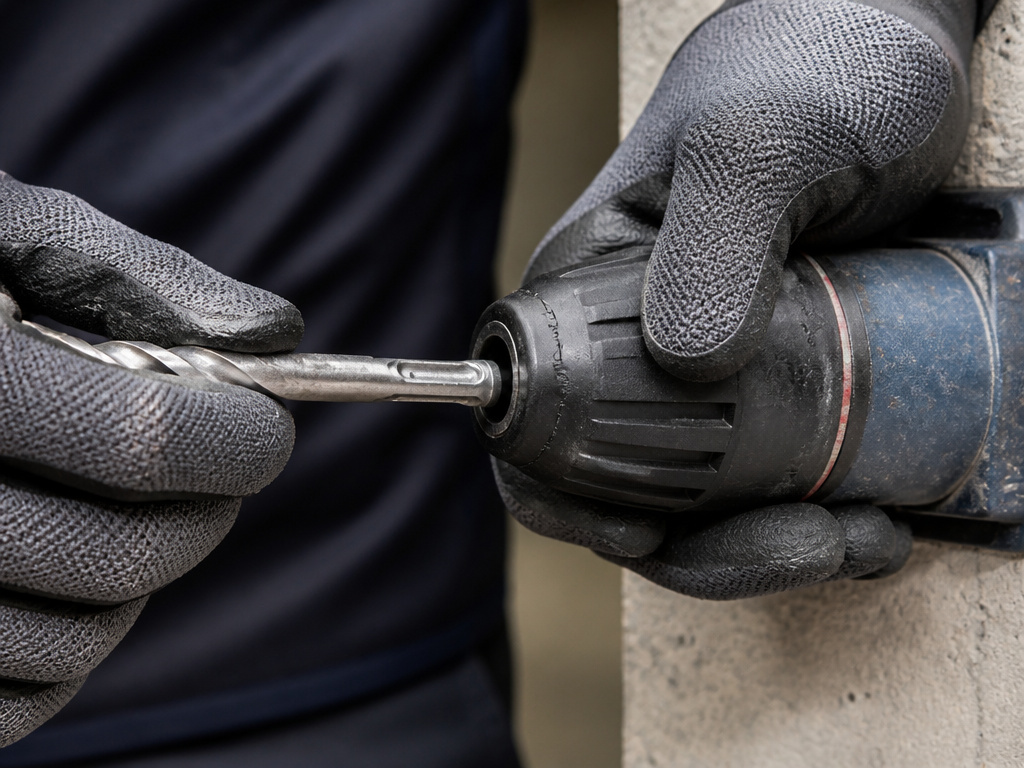
You cannot use standard drill bits in a rotary hammer without an adapter. The tool requires an SDS shank, which is a specific design that allows for both rotational drive and a back-and-forth hammering motion.
- SDS-plus: The most common system for light to mid-duty tools. The shank has grooves that lock into the chuck, allowing about 10 mm of back-and-forth “float.” This float is critical, it lets the bit move independently from the chuck’s rotation, which is how the striker transfers energy. SDS-plus is for bits up to about 1-1/4 inch in diameter.
- SDS max: For heavy-duty rotary hammers and demolition hammers. The shank is larger, with a different groove pattern, and can handle the immense force of bits over 1-1/2 inches. The Bosch GBH 8-45 D is an SDS max tool. You cannot put an SDS-plus bit in an SDS max chuck, or vice versa.
The SDS connection is why the bit change is tool-free. You pull the chuck sleeve back, insert the bit until it clicks, and release. To remove, pull the sleeve back and the bit slides out. This secure, quick-change system is non-negotiable for the forces involved.
What the Manuals Say: Intended Use & Safety Rules
OEM manuals are not suggestions. They are legal documents that define the tool’s intended use and the conditions under which its safety certifications are valid. Ignoring them voids warranties and turns a safe tool into a hazard.
The Makita HR2800 manual states the tool is “double-insulated in accordance with European Standard” and that “repairs, carbon brush inspection, and replacement must be performed by Makita Authorized Service Centers.” Using non-genuine parts or a non-authorized repair shop breaks that safety certification chain.
The Hilti TE 2-A18 cordless manual is even more specific: “The power tool may be used only in a dry environment. Do not use the power tool where there is a risk of fire or explosion. Working on materials hazardous to the health (e.g. Asbestos) is not permissible.”
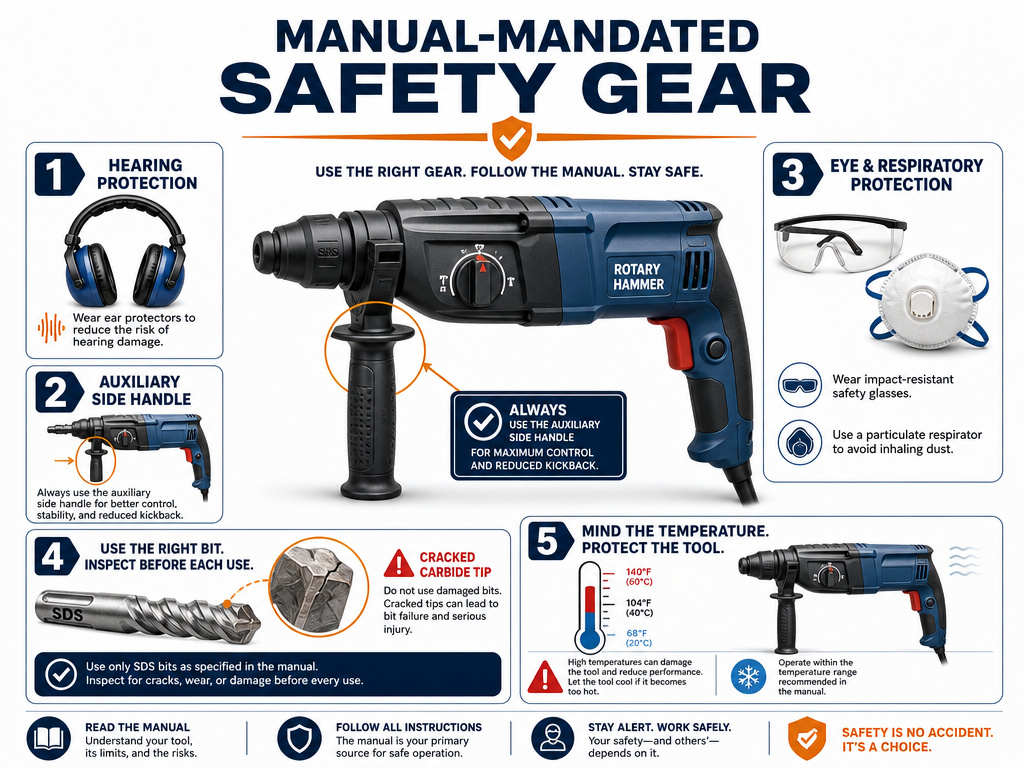
Here’s the safety gear every manual mandates. Skipping any one is how accidents happen.
- Wear ear protectors. The noise from a rotary hammer exceeds 100 dB. Hearing damage is permanent and cumulative.
- Use the auxiliary side handle. Always. It gives you leverage to control the torque and prevents the tool from spinning if the bit binds.
- Wear safety glasses and a dust mask. Concrete dust contains silica, which causes silicosis. A regular dust mask isn’t enough; you need a respirator rated for particulates.
- Inspect the bit and chuck before each use. A cracked carbide tip or a worn SDS shank can shatter under load.
- Let the tool warm up in cold weather. The Hilti TE 7-C manual notes: “The hammering mechanism works only when the power tool has reached a minimum operating temperature.” Run it under no load for a minute first.
Choosing the Right Rotary Hammer Drill
You don’t need the biggest one. You need the one that matches your most frequent task. Buying an SDS max hammer to hang shelves is like using a sledgehammer to drive a finish nail.
For most homeowners and serious DIYers tackling foundation bolts, deck footings, or masonry repairs, an SDS-plus rotary hammer in the 1-2 Joule impact energy range is the sweet spot. The Makita HR2800 series or a Bosch GBH 2-28 are industry standards. They handle bits up to 1-1/4 inch, have a chiseling function, and aren’t too heavy.
For professional contractors drilling hundreds of holes for rebar or using large core bits, you step up to SDS max tools like the Bosch GBH 8-45 D or Hilti TE 30 series. These are heavier, more expensive, and deliver the force needed for production work.
Cordless models, like those in our guide to the best cordless rotary hammer drills, offer fantastic mobility but trade some power and runtime. They’re perfect for overhead work, remote sites, or smaller jobs where dragging a hose-like extension cord is a nuisance.
The part nobody mentions: The service indicator. Some pro models, like the Bosch GBH 8-45 D, have a light that flickers about 8 hours before the carbon brushes are worn out. If you ignore it, the tool shuts off to prevent motor damage. That’s a scheduled stop, not a breakdown. Cheaper tools just die mid-hole.
Frequently Asked Questions
Can you use a rotary hammer as a regular drill?
Yes, but only if it has a “drill only” or “rotation without hammering” mode. You must also use a keyless drill chuck adapter to hold standard round-shank bits. It’s a heavy, overpowered option for drilling wood or metal, but it works in a pinch.
What is the difference between SDS-plus and SDS max?
SDS-plus is for light to mid-duty tools and bits up to about 1-1/4 inch in diameter. SDS max is for heavy-duty tools and larger bits, typically over 1-1/2 inches. The shanks are physically incompatible. Using an undersized chuck for a large bit destroys the tool’s drive train.
Is a rotary hammer better than a hammer drill for concrete?
For holes larger than 1/2 inch in diameter, yes, unequivocally. The rotary hammer’s pneumatic system delivers more impact energy with less vibration, allowing it to power through reinforced concrete without stalling. A hammer drill will struggle, overheat, and take exponentially longer.
Can you chisel with a rotary hammer?
Yes, most models include a “hammer only” or chiseling mode. This disengages the rotation, allowing you to use flat chisels, points, or spades for demolition, tile removal, or chasing. It is designed for light to medium chiseling, not breaking large slabs.
Do you need a special bit for a rotary hammer?
Yes. You need bits with an SDS-plus or SDS max shank, depending on your tool. These bits have a specially designed tail that fits into the chuck and allows for the back-and-forth hammering motion. Standard drill bits will not work.
Are rotary hammers dangerous?
They are powerful tools and can be dangerous if used improperly. The primary risks are kickback if the bit binds, flying debris, silica dust inhalation, and hearing damage. Following the manual’s safety instructions, using the side handle, wearing PPE, and inspecting equipment, mitigates these risks.
The Bottom Line
A rotary hammer drill is for making big holes in hard stuff and for breaking hard stuff up. Its pneumatic hammering mechanism is the key, delivering force that a hammer drill can’t touch. Match the chuck system (SDS-plus for most, SDS max for pros) to your hole size, respect the safety rules in the manual, and it will be the most reliable tool in your concrete and masonry arsenal. For everything else, there’s a drill.
